Book of the month – September 2025

During our teaching careers, hubby and I had to learn numerous acronyms describing ND (neurodivergent) children: ADHD (Attention-Deficit/Hyperactivity Disorder), OCD (Obsessive-Compulsive Disorder), ASD (Autism Spectrum Disorder), ODD (Oppositional Defiant Disorder) and so on, but the book that I’m reviewing this month is an extreme example of what hubby calls PPS (Poor Parenting Syndrome)!

Wavewalker: A Memoir of Breaking Free

Suzanne Heywood

At seven years old, Suzanne Heywood set sail from England with her parents and younger brother on what was supposed to be a three-year trip around the world retracing one of Captain Cook’s voyages. What followed was a decade of isolation on a 70-foot sailboat crossing some of the world’s most dangerous oceans and surviving horrendous storms, shipwrecks, and reefs. What sounded like the romantic adventure of a lifetime became a child’s worst nightmare “trapped inside someone else’s dream”.

Deprived of safety, friendship, and education, Suzanne longed to return to the stability of England and the opportunity to attend school, but her parents saw this only as selfishness on her part and refused to entertain the idea. Determined to educate herself, she worked diligently on correspondence courses dropping lessons into the mail whenever and wherever the family went ashore. Ultimately her desire for independence and self-determination became so intolerable to her parents, particularly her mother, that at age 16, they dropped her off at an isolated cabin on the north island of New Zealand, leaving her responsible for her younger brother while they continued their travels around the South Pacific!   

It would be hard to read this book without becoming increasingly angry at the parents who, according to the epilogue, told their daughter later that she had a “privileged” upbringing! It is, however, a story of resilience and determination. At 17, finally escaping the constraints of her bizarre childhood, Suzanne was accepted into college at Oxford where she went on to earn her PhD.

While Suzanne’s childhood was one of neglect rather than physical abuse, there are strong parallels between her story and Tara Westover’s powerful memoir, Educated

International Women’s Day – Break The Bias

Tomorrow is International Women’s Day. It saddens me that we should even need to set aside a day to focus on women’s rights, to remind the world that women deserve equality. The reality, however, is that we need to do much more than simply dedicating one day a year to drawing attention to the plight of women worldwide. This needs to be addressed 365 days of the year!

The theme of International Women’s Day 2022 is #BreakTheBias. We are urged to:

Imagine a gender equal world.

A world free of bias, stereotypes, and discrimination.

A world that is diverse, equitable, and inclusive.

A world where difference is valued and celebrated.

In reality, we need to do more than just imagine that world. We need to be aware that gender bias, discrimination and stereotyping exist and actively call them out each and every time we see them. Whether deliberate or unconscious, gender bias makes it difficult for women to move ahead. Even in the developed countries of the world, disparity continues to exist in the workplace, in education, and in health care.

Globally, most women are employed in lower-wage occupations and lower paid industries than men. They are underrepresented in corporations in general and the percentage of women decreases with each step up the corporate ladder. In 2016, only 3 of the 100 highest paid CEOs in Canada were women.

A 2015 UN Human Rights report raised concerns about “the persisting inequalities between women and men” in Canada including the “high level of pay gap.” Five years later, in 2020, Statistics Canada reported that on an average, full-time working women earned 76.8 cents for every dollar made by men. The gap is even wider for women who are Indigenous, members of other visible minorities, newcomers, or living with a disability. The situation is similar in other first world nations. In the UK, for example, women earn an average of 18% less than men.

Gender bias in education is much more subtle in the western world than in countries like Pakistan where over 50% of girls receive no formal education and South Sudan where that number is closer to 75%. Here in Canada, in spite of the fact that 56% of post secondary students are female, women continue to be underrepresented in STEM majors (science, technology, engineering, and mathematics). In spite of the fact that, on average, they don’t outperform girls in high school math or physics, there continues to be a perception that boys are naturally more adept in these areas. This is the kind of stereotype that we need to call out!

Bias also affects the quality of health care that women receive. Too often, doctors view men with chronic pain as “brave” or “stoic” while women are seen as “emotional” or even “hysterical”. Her pain is much more likely to be treated as the symptom of a mental health condition, rather than a physical one.

Important biological differences between the sexes can influence how diseases, drugs, and other therapies affect people, but medical research has often been limited to male participants. They are considered better test subjects because they don’t have menstrual cycles and can’t become pregnant! This lack of inclusivity has led to gaps in knowledge that are detrimental to women’s health.

Lastly, traditional attitudes by which women are regarded as subordinate to men continue to perpetuate widespread abuse. Gender-based violence happens in all communities, cultures, and faith groups, and at every age and every income level, but some women are at higher risk than others. More than 40% of all Canadian women have experienced some form of intimate partner violence, but this number rises to 60% for Indigenous women. Every 6 days a woman in Canada is killed by her intimate partner. The homicide rate for women who identify as Indigenous is more than 5 times higher than that of all other women. Immigrant women are more vulnerable to domestic abuse often due to economic dependence, language barrier, and a lack of knowledge about community resources. In addition, when incidents of abuse within visible minority groups are reported, they are often taken less seriously by the criminal law system and the perpetrators routinely receive less harsh punishments. Younger women and women with disabilities are at much higher risk of experiencing violence. According to a 2019 report from Statistics Canada, 30% of all women over the age of 15 report the they have been assaulted sexually compared to 8% of men. The actual number is, of course, much higher as many incidents are never reported. 69% of all those who experience incidents of cybercrime are women.

On International Women’s Day and always, we need men and women to advocate for equality for all. Together, we can break the bias!

IMG_3619

Around the world, people are crossing their arms in the International Women’s Day #BreakTheBias pose to show solidarity. Why not join the movement? Post your photo on social media using #IWD2022 and #BreakTheBias to encourage other people to commit to working toward a more inclusive world for all.

Images: internationalwomensday.com

Desperate to go to school

I recognize that even in the most developed nations, schools aren’t perfect. After all, they are a reflection of the society that they’re a part of and are heavily influenced by the political ideologies and trends of the day, but imagine having to sneak your child into school to give them a chance at an education of any sort.

Started in 1983 by George and Jean DeTellis, New Missions has established 35 churches and schools in Haiti and the Dominican Republic that provide approximately 10 000 children with education, a wholesome meal each day, and medical care. Tim DeTellis, George and Jean’s son, grew up on the mission field in Haiti and now serves as president of New Missions. Yesterday Tim posted a video update on his Facebook page that touched my heart and today I want to share his plea with you.

In the video (which I was unfortunately unable to post here) Tim speaks of the fact that parents were going out and finding school uniforms and putting them on their children so that they could slip into class to receive the benefit of education as well as the gift of food and medical care. “Why? Because these children and their families are that desperate,” says Tim. When these unregistered children came to the attention of the school personnel, rather than turning them away, they welcomed them. “Now we’ve registered them and in the last six months, to our astonishment, we have increased our enrolment by 1000 children!” he goes on to say.

We all know that education is not free. Here in Canada and in many other developed countries, public schooling is paid for almost entirely by our taxes, but what of countries like Haiti, the poorest country in the western hemisphere? Who will provide the resources to educate the 1000 new enrolees in New Mission schools? Perhaps you can help.

How? It’s simple. Go to newmissions.org, click on Donate, and give to the Life of a Child fund to help unsponsored children or if you’re willing to make a more long term investment, link up with an individual child through child sponsorship. For just $33 a month you can provide one of these desperate children with an education, a hot meal each day, and regular medical care.

We started sponsoring Marie Kethsia in 2004 when she was nine years old. This spring, in a country where only 2% of the children finish high school (Haitian schools have 13 grades), she graduated! Now she’s enrolled in a 3 year lab tech program which will equip her to be a self-supporting contributor to her family and her community. We couldn’t be prouder!

Kethsia - Version 2

Over the years, we enjoyed exchanging letters and watching Marie grow into the beautiful young woman that she is today. Imagine my delight about a year and a half ago when I received a Facebook friend request from her! Though her English is weak and my Haitian Creole is non-existent, we manage to communicate on a regular basis without the benefit of the New Missions staff who translated our many letters over the years.

We took on our second New Missions child early last year when I decided to give Richard a boy for his birthday!

Rodolson.png

Rodolson had his ninth birthday earlier this month and is in Grade 3. In his last letter to us, he wrote “I like school and I always study my lesson.”

For approximately $1 a day, you too could give the gift of school to one desperate child!

What does retirement look like?

What does retirement look like to you?

One of my favourite blogs is Over 50 Feeling 40 by San Antonio, Texas blogger, Pamela Lutrell. While essentially a fashion blog, it’s much more than that. In Pam’s own words, it’s “a style blog about strength, confidence and joy.” She encourages midlife women to not only look their best and feel their best, but to be the very best that they can be. The one topic that Pam and I seem to disagree on is retirement.

At 62, I have been retired for eight years. At 61, Pam doesn’t see retirement in her future. She recently left her position as a high school journalism teacher and is presently searching for a new career. Why? “Many think we are suppose to retire to the golf course and put hard work behind us. I ponder how long I will work hard a lot lately… I think it is healthy and want to continue doing it as long as possible,” she wrote in a recent post.

Though I may be putting words in her mouth, I get the impression that Pam sees retirement as similar to being put out to pasture; no longer being able to accomplish anything of value. Not me! That’s definitely not what my retirement looks like.

So what has it looked like so far?

Retirement has included fulfilling long held dreams like teaching English in Japan and later, China. One might argue that that wasn’t retirement. After all, we worked hard and we earned a paycheque. It wasn’t really about the work or the money, however. Those were simply what allowed us to be there. It was all about adventure; about living shoulder to shoulder with the people of another land and learning about their culture. It was about traveling to other locations in Asia during our holiday breaks. You can read about those and other retirement adventures by clicking on the appropriate country names in the sidebar.

Retirement brought some unexpected surprises. Learning to operate a tractor and a combine definitely wasn’t part of this city bred girl’s retirement plan, but several years of helping a friend at seeding time and harvest gave me more joy than I could ever have imagined and instilled within me a love for the land that I never thought possible.

Retirement has included volunteering; everything from driving elderly friends to medical appointments to spending a summer doing pastoral supply on the tiny Pacific island of Saipan. Over the past two years, my health has curtailed our ability to spend extended periods of time overseas, but how thankful I am that we retired early enough to do those things while we could! These days, volunteering includes online mentoring, helping younger women deal with some of the issues that made my life most difficult during my younger years.

We’ve always believed in lifelong learning, so retirement has also included further education. Thanks to the internet, over the past year, I was able to audit two university level courses through Southwestern Baptist Theological Seminary in Fort Worth, Texas from the comfort of my own living room.

Retirement has also given me more time to pursue my passion for writing, mostly through the blog, but I presently have another article awaiting publication as well. In addition to my own writing, I’ve edited university papers and a masters thesis for friends and family and I was even contacted by a university professor in Portugal who sometimes publishes research papers in English. He was looking for someone to do editorial work for him and found my name online. Every now and then, I receive an email from Jose with another research proposal or paper for me to edit.

Retirement has meant time on the golf course, but believe it or not, we’ve golfed much less since we retired than we did before! We simply haven’t had time. Life has been too full, too busy, too exciting.

My husband’s favourite definition of retirement is being able to do what you want to do when you want to do it. For me, that meant purposely lying awake for about a hour at 4:30 this morning listening to the music of the rain outside my window (we’ve been experiencing a severe drought here in central Alberta) and then sleeping in until 9:00. Other days, it means an alarm clock ringing early in the morning so we can set off on another adventure.

I realize that we were fortunate to be able to retire as early as we did and that not everyone has that luxury, but we lived carefully throughout our working years with that goal in mind. My pension doesn’t come close to being enough to live on, but fortunately, my husband’s is adequate to meet our needs.

Do we ever regret retiring as early as we did? Never! Would we do it again? In a heartbeat! We loved our careers, but they didn’t define us. Unlike Pam, I don’t need a job to go to to give my life a sense of purpose or to make me feel fulfilled.

What about you? Are you retired yet? Do you want to be? What do you think is the perfect age to retire?

What does retirement look like to you?

International Literacy Day 2014

Right now, you are doing something that one in five people on the face of this planet cannot do!

As one who values my ability to read above most other skills, I find that an appalling statistic! According to the World Literacy Foundation, an estimated 67 million children around the world do not have access to primary school education! Equally disturbing is the fact that almost two-thirds of the world’s illiterate adults are women. Given that statistic, it’s hardly surprising to learn that the majority of the world’s poor are also female.

Today is International Literacy Day, a day for shedding light on the desperate need to ensure that all people have the opportunity to learn to read and write. Education is a basic human right, but one that many people are denied, particularly in parts of Asia and sub-Saharan Africa. The problem is not restricted to underdeveloped parts of the world, however. Literacy rates in Canada are high, around 97 per cent, but what does that really mean? While they may have basic decoding skills, the most recent literacy study by Statistics Canada shows that millions of Canadians do not have the literacy skills they need to keep pace with the escalating demands of our society and economy. A whopping 48% of Canadian adults over the age of 16, many of them new immigrants, have low literacy skills that do not adequately equip them for the workforce. The situation is similar in the US.

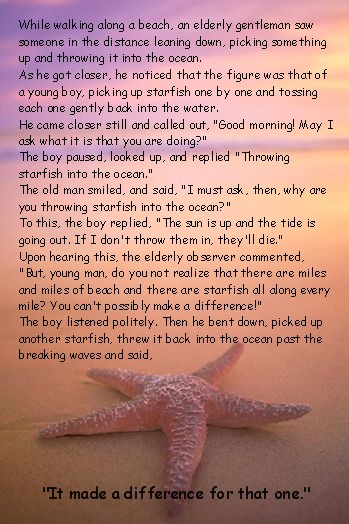
But what can we do? How can you and I overcome such an enormous global issue? That’s where the Starfish Story comes in (adapted from The Star Thrower by Loren Eiseley).

howtohelp_starfish_story

We cannot solve the world’s literacy problem, but we can make a difference for one or two.

Picture 2
This is Marie. My husband and I have been sponsoring her through New Missions, a small organization operating in Haiti and the Dominican Republic, since she was in primary school. She now attends high school and dreams of becoming a nurse. For approximately one dollar a day, we provide her with the opportunity to go to school in Haiti where only 2% of the children finish high school and about 40% of the adult population is illiterate. She also receives a hot meal at school each day as well as regular health check-ups and medical care when it’s needed. There are many similar organizations, including World Vision, that offer you the opportunity to provide a child with the chance to go to school. Perhaps that child could be your starfish!

I also choose to give Kiva loans to impoverished women in third world countries who are helping support their families and educate their children. By investing in women’s lives, society as a whole benefits because women typically reinvest 90% of their income back into their families. In so doing, they break the cycle of illiteracy and help lift their families out of poverty.

Closer to home, encouraging literacy is as simple as reading to a child! Fill your home with books and let the children in your life see you enjoying the gift of reading.

IMG_4301

Going back to school!

If money had been no object, I’d have gone straight back to university after earning my education degree. I would have pursued a second bachelor degree, this time in cultural anthropology, simply because I loved it. At the time, however, that wasn’t an option. My first degree was paid for by a grant from the Government of the Northwest Territories but that had run out and it was time to find a job and begin supporting myself.

Since retiring from teaching seven years ago, I’ve often thought that if I lived closer to a college or university I’d probably enroll in a few courses just for fun. Although anthropology still interests me, at this point I’d probably choose women’s studies. I’ve never considered myself a feminist because I’m adamantly opposed to abortion (except when continuing a pregnancy places the mother’s life in grave danger). By definition, I suppose I’m a pro-life feminist as I’m keenly interested in the plight of women worldwide, believing that girls and women should have equal rights and opportunities to men. It pains me to know that, in this day and age, girls and women in many parts of the world continue to be denied access to education and to endure obscene cruelties such as female genital mutilation and forced marriage.

Okay, let me climb down off my soapbox and continue what I started off to say!

Though I don’t regret the fact that I didn’t go to Bible college as a young person and I didn’t encourage my own children to do so, in recent years I’ve also thought that I wouldn’t mind taking a few Biblical studies courses. Recently, I learned of an opportunity to combine all three of my academic interests and audit a course entitled Biblical Theology of Womanhood: Old Testament online for free!

The women’s studies course, offered by Southwestern Baptist Theological Seminary in Fort Worth, Texas, is described as “an amplified and comprehensive study of womanhood in the Old Testament which overlaps in a general way and is supplementary to systematic theology, especially as concerns the doctrine of anthropology.”

Auditing the course means that I’m not taking it for university credit. I get to enjoy all the lectures and do as many of the readings as I want, but I don’t have to write any of the papers or take the final exam. There are also online discussion groups that I can participate in. I must admit that I felt a tingle of excitement when I received the email with my student ID number! It’s been 39 years since I had one of those!

The course actually started on August 21 but since I was on vacation, I chose to wait until I was back home to begin. As an online student, I’m not tied to the regular Thursday evening schedule. Instead, I can watch the two and a half to three hour lectures whenever I choose. The first one, which I watched this evening, was an introduction to the course and laid the groundwork for what lies ahead. I’m not sure that I’ll agree with everything that’s taught but I do know that I’ll be challenged to dig into scripture and to seek a better understanding of what God’s Word says to and about women. I also know that I’m excited to be going back to school even if it is in the comfort of my own living room!

Kids helping kids

We went on our second Mission to MARS this week!

That’s right! Two years ago, on the island of Saipan, we directed a Vacation Bible School program with an outer space theme. This week, we brought the same program, Mission to MARS (Meet A Risen Savior), to our own local church. Every morning approximately 30 excited children between the ages of 5 and 12 gathered for games, crafts, songs and Bible stories.

One of the verses that they learned was 1 Chronicles 16:29 which speaks of bringing an offering. With this in mind, we wanted to incorporate a Missions project that the children could identify with and contribute to throughout the week.

MARS
The escalating civil war in Syria has left an increasing number of families in chaos. According to the United Nations, an estimated two million refugees have fled into Lebanon, Jordan, and surrounding countries while more than four million people have been displaced within the country itself.  Schools across Syria are closing as children and families flee dangerous areas, and the public schools in Lebanon and Jordan are overcrowded. They simply can’t continue to absorb the number of refugee children who are flowing in. Many Syrian children have already lost a year of school due to violence and transition.

The Church of the Nazarene runs four schools in Jordan, Syria, and Lebanon. These schools are in neighborhoods where Syrian refugees and internally displaced people are struggling to survive but they can’t operate without funding. Many displaced, traumatized families have little or no income and are unable to pay school fees.

With the beginning of a new school year just around the corner, this was an issue that our VBS kids were easily able to identify with and they amazed us with their compassion and generosity.

  • $400 will enroll a Syrian child in a Nazarene school for an entire year
  • $100 will provide books and clothes for the school year
  • $45 will support a child’s school fees for one month

My faith was small. When I made up the poster shown below, I set $100 as our goal for the week but with the help of the church’s mission committee who agreed to match the children’s offerings dollar for dollar, we surpassed that amount on Wednesday! I was going to add another column to the poster that evening but one of our older girls suggested that I’d better make that two. Even that wasn’t enough! After taking this morning’s offering and adding in the matching amount from the missions account (shown in teal on the poster), we had raised $335.10!

IMG_3094

In a country where we take so much for granted and where most children will soon go off to school wearing brand new clothes and carrying backpacks stuffed with shiny new supplies, it was gratifying to spend the week with kids whose hearts were touched by the plight of boys and girls in a faraway land whose lives have been uprooted by the tragedy of war.

Life’s not fair!

One of the original goals of communism was to create a classless society where everyone would be equal. That might sound great in principle, but in reality, it doesn’t work. Like anywhere else in the world, China has the filthy rich and the very poor.

Most of our students come from well to do families. Our university students pay approximately $500 per semester over and above their regular tuition for 70 hours of instruction with a native English speaker instead of attending the university’s regular English classes with Chinese teachers. In China, that’s a lot of money; more than one month’s salary for many people. Then there are our full time English immersion students who are preparing to study abroad. Only the wealthy can dream of giving their child that opportunity or afford the more than $8000 that this year of preparation cost.

With a mark of 95% on the final exam, Grace ended the year at the top of one of my university English classes but she won’t be back in this program next year. Her family simply can’t afford it. Grace grew up in the countryside where her parents own a small plot of land. In addition to growing rice and oranges, they both work seven days a week in a factory.

Grace’s birth was a disappointment. She wasn’t born a boy. China’s one child law allows rural families to have a second child if the first one is a girl so her parents tried again and Grace has a younger sister! She says that her father has accepted the fact that he’ll never have a son but as the oldest, responsibility for her family falls squarely on Grace’s shoulders.

Though her parents have very little formal education, Grace excelled as a student and graduated at the top of her high school class. Unfortunately, coming from a rural school, she didn’t do well on the university entrance exam that students across the country write during their final month of high school. Once again, she was a disappointment.

Just like the people, universities in China are not all equal. Students can’t freely choose which one to attend or even which major to study. Those who do best on the entrance exam are admitted to the most prestigious universities while those who don’t do as well end up at lower tier institutions like the one where we teach.

Grace dreams of being a primary school teacher but she’s studying accounting. She’s doing extremely well. Well enough, in fact, that she’s been recommended for an upcoming exam that could win her a place at a better school of finance but her heart isn’t in it. She’s only studying accounting because her parents feel that it will lead to a better job; one that will pay a higher wage and enable her to pay off their debts and take care of them in their old age. It’s normal for Chinese parents to make these decisions for their children so she doesn’t feel that she has a choice in the matter.

How do we advise a girl like Grace? She isn’t the only one of our students who isn’t able to follow her dream. David loves the Chinese language and wanted to train to teach it but his mark on the university entrance exam was too high for that! Instead, he’s studying physics. It doesn’t help to tell these kids that life isn’t like this everywhere. It is like this in China!

What we did tell Grace was that education is never a waste and that being fluent in English will open many doors for her. Sadly, it may not open the door that she most wants to walk through. I also told her that life’s not fair but I think she already knew that. After all, if she’d been born into a wealthy family, her parents could simply buy her a good job! Yes, life’s like that in China too.

It’s a weird and wonderful life!

It occurred to me today that I live a weird life; or perhaps I’m just a weird person!

I’m a 60 year old woman preparing to go to China to teach English. In between weight lifting sets this afternoon, I’ve been working on editing a master’s thesis for someone in Japan and taking apart a dress for my son! Yup, definitely weird!

I started weight lifting 18 years ago before it became a popular activity for women. According to Wikipedia, nearly 20% of American women now lift weights on a regular basis but I doubt that many of them are in their sixties and most of them probably weren’t total non athletes like I was in my younger days.

I like what Adam Campbell, fitness director of Women’s Health and author of The Women’s Health Big Book of Exercises says:

But do I look like I lift weights? Absolutely. I’m lean and fit, and my muscles are well-defined, even if they’re not busting out of my shirt. 

You see, lifting weights isn’t just about building 20-inch biceps. In fact, for most women, it’s not about that at all, since resistance training may be the single most effective way to lose fat and look great in a swimsuit. What’s more, the benefits of lifting extend into nearly every aspect of your health and well-being. So much so that after nearly 12 years of reporting in the field of health and fitness, I’ve come to one rock-solid conclusion: You’d have to be crazy not to lift weights—even if bigger biceps are the last thing you want. 

The truth is, lifting weights gives every woman an edge. Over belly fat. Over stress. Over heart disease, diabetes, and cancer. Lifting even makes you smarter and happier. 

To read more, including his 20 reasons why you shouldn’t live another day without lifting, click here.

If you’ve been reading my blog for very long, you know that I also love writing and keeping my mind active. That’s why when my friend, Smoky, asked if I would be willing to edit his thesis on factors that affect Japanese junior high school students’ motivation to learn English, I jumped at the opportunity.

Smoky's family

Besides, is it any wonder that he doesn’t have as much time as he’d like to polish his own writing? Those darling children are three of our “Japanese grandchildren” and I’d way rather he spent his time loving them!

dressNow, what about the dress? As I mentioned in an earlier post, on February 9th Nate will be skiing the 31 km Canadian Birkebeiner in an African schoolgirl dress to raise funds so that little girls in Sierra Leone can go to school. He’s already raised enough to provide a full year of schooling for one girl and is hoping that money will continue to come in.

The dress is snug on his 6 foot 3 inch frame. He needs more room for a warm layer underneath and to ensure that his arms can move freely when he skis. I’ve opened the seams down both sides and am adding panels of stretchy sportswear fabric to provide the space and mobility that he needs.

Yes, my life might be weird but it’s also rich and full and I wouldn’t have it any other way!

Definitely a word nerd!

Imagine being able to exercise your brain and your butt at the same time. That’s exactly what I’m going to be doing over the next few months!

I like a lot of things about living in a small prairie town but sometimes I wish we lived closer to a bigger centre. One thing I’d really like to be able to do in my retirement is take a few college courses just for fun but distance makes that impractical.

Then my sister told me that she was enjoying university lectures on DVD while walking on her treadmill! For more than 20 years, The Great Courses have been producing college level courses taught by the best professors that major American universities like Harvard and Stanford have to offer. Their lectures are available on CD and DVD as well as either audio or video download.

The Great Courses offers something for everyone; everything from science and mathematics to business and economics, from gourmet cooking to world history. I could have borrowed DVDs from my sister but our interests are very different. Her lectures on statistics and probability would have put me to sleep and I would have ended up a broken heap on the basement floor behind the treadmill! Knowing that, she suggested something entirely different for me, a course entitled The Secret Life of Words: English Words and Their Origins. I was intrigued!

There’s absolutely no question about it; I’m a word nerd! I even got excited reading the introduction to the course guidebook.

We’ll travel back in time to the invasions by Vikings and the Normans to explore words from sky to story, which are so familiar they hardly seem borrowed at all. Then, we’ll immerse ourselves in the classical revival of the Renaissance, which gave English related sets of Latinate words, including omnivorous, carnivorous, piscivorous, and voracious. 

I know, if you’re not a word lover like me, you’re probably falling asleep already. I hope you’re not on a treadmill! I, on the other hand, could hardly wait for my DVDs to arrive in the mail. I watched the first lecture this evening and wasn’t disappointed. My professor is Anne Curzan PhD, Professor of English at the University of Michigan. She’s an excellent speaker; clear, easy to follow and obviously in love with her subject matter. I could hardly believe it when the 30 minute lecture was over. I’d walked almost two miles and hardly noticed!

I’ll continue to use my walking videos from time to time. In fact, I’ve been walking on the Isle of Capri lately but I can hardly wait to spend more time in the “classroom”. In this evening’s lecture, Professor Curzan introduced four main themes that will be covered by the course.

  • English is a mixed linguistic bag with many borrowed words giving it a rich, multi-layered vocabulary.
  • Words are powerful.
  • English is a living, ever-changing language.
  • Studying English asks us to rethink some very common notions about language.

Oops! There I go putting some of you to sleep again!  I hope you’ll bear with me though if I share a few tidbits from the course over the next few months. I probably won’t be able to help myself!