Resort fashion

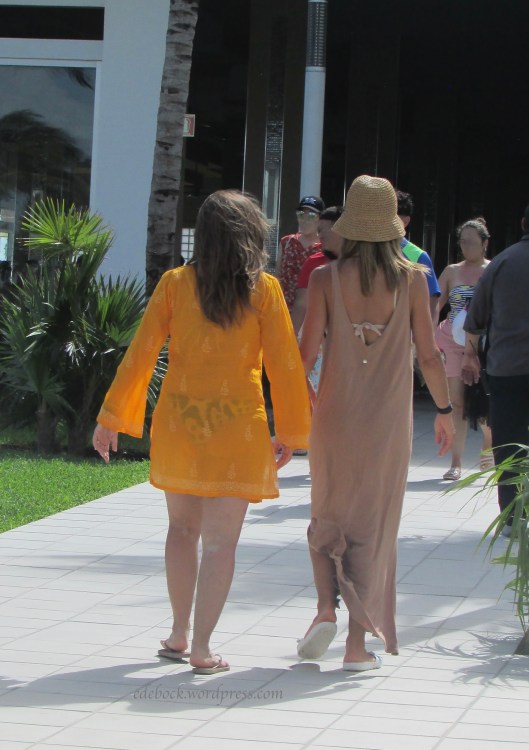
Logo by SamA resort is a great place for people watching and with more than 700 rooms, Riu Dunamar certainly provided us with lots of people to watch! I was, of course, particularly interested in seeing what everyone was wearing. The introvert in me has never been bold enough to approach a stranger and ask her if I could photograph her for the blog, but I did spend awhile one afternoon surreptitiously taking pictures so that I could share some resort wear with you today.

IMG_6525

Lightweight swimsuit cover-ups that went from beach or poolside to buffet were by far the most popular item for women and it seemed that no two were exactly alike.

Some were colourful and flowy…

IMG_6520

while others were black…

IMG_6519

Some were long and others were short…

IMG_6521

Crochet styles were very popular…

IMG_6535

This was one of my favourites…

IMG_6522

I also loved a versatile blue and white striped shirt style cover-up that one woman wore. Though I saw her several times, I didn’t get a photo, but her cover-up looked very similar to this one. Not only could it be worn open or buttoned up over a swimsuit, but she could also have worn it over shorts, capris or leggings or even layered over a dress on a cool evening.

c62ff1614cbad9478390cf360046987b

Overall, the resort was pretty casual as far as dress was concerned. Swimsuits were not allowed in the main buffet restaurant without a cover-up and while the dress code for the other restaurants states that men must wear long pants, collared shirts, and shoes, not sandals, that doesn’t seem to be very strictly enforced. We definitely saw men in dressy shorts and sandals. Some women dressed similarly while others wore dresses. Next week, I’ll show you a little bit of what I wore.

Dress codes for travelers

Logo by SamWhenever you travel to a foreign country, it’s a good idea to learn a bit about the culture and traditions before you go. It’s also wise to know what to pack so that you don’t get into trouble by wearing something inappropriate or possibly even illegal.

It may not surprise you to know that modest attire is usually expected when visiting religious sites such as churches, temples, and mosques. Visitors to Cambodia’s famed Angkor Wat temple complex and to the Vatican are required to wear pants or skirts that fall below the knee and shirts that cover their shoulders. Sleeveless and low-cut garments, shorts that end above the knee, and miniskirts are not allowed and men entering the Vatican must also remove their hats. Some religious sites may require women to cover their heads, so it’s always a good idea to pack a scarf just in case.

Afghanistan is the only country that requires women to wear a burqa in public today, but did you know that there are countries where these garments are forbidden? That’s right! It is illegal to wear a burqa or a niqab in France, Belgium, the Netherlands, Cameroon, Chad, Congo-Brazzaville, Niger, and parts of Russia. In fact, face coverings of any kind including masks (with the exception of those worn to prevent the spread of Covid and other respiratory illnesses), scarves, motorcycle helmets, and balaclavas are illegal in France, Belgium, and the Netherlands.

I was surprised to discover a long list of countries that forbid the wearing of camouflage. Leave your camo at home if you plan to visit Barbados, St. Vincent, St. Lucia, Antigua, Grenada, Jamaica, Nigeria, Oman, the Philippines, Saudi Arabia, Trinidad and Tobago, Zambia, or Zimbabwe.

For your own safety, you aren’t allowed to wear sandals while driving in Spain and those who hike the steep, hilly terrain connecting the five villages of Italy’s Cinque Terre are prohibited from wearing flip-flops, sandals or high heels. High heels are also forbidden at some historic sites in Greece such as the Acropolis and Delphi to prevent damage to the ancient monuments.

Most dress codes are a matter of modesty and what is considered appropriate differs greatly from place to place. All women in Iran must cover their hair or wear a hijab in public areas. Women must have their arms and shoulders covered at all times in Oman. Swimwear is not allowed except at the beach in Majorca, Croatia, Maldives, Turkey, and some cities in Spain including Barcelona. In France, men must wear speedos in public pools. Boxers aren’t permitted! In Thailand, one must wear a shirt while driving and must always wear underwear in public (although how anyone would know if you weren’t, I’m not sure!)

Perhaps Saudi Arabia and Sudan have the strictest dress codes. In Saudi Arabia men are required to have their shoulders and legs covered at all times. They’re not even allowed to go shirtless at the beach! Women must dress modestly at all times, covering both their knees and shoulders. Sleeveless shirts, short dresses, loose tops, shorts, crop tops, miniskirts and bikinis are all forbidden. In some places they must also wear a headscarf. Similarly, in Sudan, men cannot wear makeup, shorts or sleeveless shirts and women cannot wear shorts, pants, sleeveless shirts, anything see-through, or skirts shorter than mid-calf.

I’m not sure why anyone would want to visit North Korea, but if you do and you’re a woman, you need to know that you can’t wear pants there either.

And I saved the funniest for last… it would be a good idea not to wear clothing with Winnie the Pooh on it near schools and playgrounds in Tuszyn, Poland. Apparently Pooh’s uncertain sexuality and indecent exposure (he doesn’t wear pants!) are proof that the loveable bear is “wholly inappropriate for children.”

Winnie-the-Pooh-10

Dress codes for airline travel

Logo by SamIf any of you are fortunate enough to be flying somewhere this summer, you might be interested in knowing that airlines have the right to refuse to board passengers who are deemed to be dressed inappropriately. By purchasing a ticket, you automatically consent to abide by the rules and conditions outlined in a legal contract known as the “conditions of carriage.”

United Airlines has the right to refuse to board passengers if they are “barefoot, not properly clothed, or whose clothing is lewd, obscene or offensive.” Similarly, American Airlines has a section in its conditions of carriage that instructs passengers to “Dress appropriately; bare feet or offensive clothing aren’t allowed.” Delta Airlines can refuse to transport passengers whose “conduct, attire, hygiene or odor” may create an unreasonable risk of offending or annoying other passengers. Their conditions of carriage also ban bare feet.  And the list goes on.

While comfort and safety take precedence over appearance, there are several reasons why passenger dress codes exist and why some frequent flyers suggest that they need to go beyond the minimum and somewhat vague standards mentioned above. Clothing that exposes too much skin or with offensive language on it can make other passengers feel uncomfortable, but what one person considers offensive might be perfectly acceptable to another. Keeping the peace is important when hundreds of people are packed into an aircraft, often for several hours.

According to the International Air Transport Association, the number of unruly passenger incidents worldwide increased by a shocking 37% in 2022 from the previous year. The organization reported one unruly incident for every 568 flights last year, up from one in every 835 flights in 2021. Psychologists believe that people tend to behave more respectfully when they’re dressed up. “When people dress better, they tend to behave better,” said Thomas Plante, a psychology professor at Santa Clara University in Santa Clara, California. “A dress code might help.”

So how should you dress for a flight? Think classy but comfortable. Choose clothing made of breathable fabric and items that allow for ease of movement. As always, I recommend dressing in layers. Planes are often chilly, so a scarf or a wrap can be a good addition to your travel wardrobe. Although I’ve never worn them myself, compression stockings are often recommended for long flights as they reduce the risk of developing blood clots when sitting for long periods of time. You’ll probably want to wear your bulkiest footwear, especially if you’re traveling carry-on only, but it’s important to ensure that your shoes are also comfortable. Hopefully, it never comes to this, but it’s also wise to choose clothing and footwear that would allow for smooth evacuation in the event of an emergency.

Airplane-flying-Facebook

Once you reach your destination, there might also be dress codes that you should be aware of, so we’ll look at what to wear when you travel the world next Friday. Some of the rules are quite unusual!

Modesty and cultural sensitivity

IMG_3548

Screen Shot 2016-03-18 at 11.07.24 PM 3Visitors who dress immodestly will no longer be allowed to enter Cambodia’s famed Angkor Wat temple complex, the agency that oversees the site announced last week. Beginning August 4th, all tourists will be required to wear pants or skirts that fall below the knee and shirts that cover their shoulders.

When I read that, I immediately went back to our photos from Jan 4, 2009 to see what we were wearing the day we visited the UNESCO World Heritage Site that is also Cambodia’s biggest tourist attraction. Would we meet the new standard, I wondered.

We got up at 4:30 a.m. the day we toured Angkor Wat so that we could be there in time to watch the sun rise over it’s towers. It was still a bit chilly when we arrived and at that point, dressed in a warm fleece hoodie and capri pants, I would definitely have met the new dress code.

IMG_3507

Richard would not have, however, as he was wearing shorts and later, in the heat of the day, I wouldn’t have either.

I almost hate to post that picture because I look so frumpy, but please keep in mind that we were basically backpacking through southeast Asia. We had just traveled the length of Vietnam by night bus and we were staying in a $12/night guesthouse that wasn’t much more than a roof over our heads. I may not have looked great, but I was having the adventure of a lifetime and fashion was the farthest thing from my mind!

The question here, though, is what is modesty? My tank top may not be particularly attractive, but is it immodest?

In 1 Timothy 2:9, the apostle Paul advises women to “adorn themselves in modest apparel, with propriety and moderation” but he doesn’t give a lot of detail about what that looks like. He does go on to say, “not with braided hair or gold or pearls or costly clothing” but to understand what he was getting at, one needs to look at the culture and the context. In this passage, Paul was advising women on how to dress for church, telling them to adorn themselves in a manner that was considered appropriate for worship. In Ephesus, where his protégé, Timothy, was pastoring at the time, the elite of that culture were known for their gaudy and extravagant wardrobes, their elaborate hair styles, and their expensive clothing that communicated extraordinary wealth. Paul’s description of immodest dress conjured up a picture of someone preoccupied with appearance, fashion, luxury, and perhaps even sexual prowess. He was simply advising the Christian women of that time and place not to mimic that behaviour, but to dress in a way that showed that they desired attention to be on God, not on themselves.

Dictionary definitions of modesty include “behavior, manner, or appearance intended to avoid impropriety or indecency” and “the quality of behaving and especially dressing in ways that do not attract sexual attention.”

In discussing dress codes, it’s important to note that modesty must involve cultural sensitivity. We don’t find the wearing of shorts or sleeveless tops offensive here in North America,  but Cambodia is a completely different culture. Angkor Wat was the spiritual centre of the Khmer empire that dominated that region from the 9th to 15th centuries. It’s a symbol of great national pride and is depicted on the Cambodian flag. As such, it is worthy of utmost respect. If, to the Cambodian mind, that means a certain manner of dress, then visitors definitely need to honour that.

Though it’s unlikely that I will return to Angkor Wat (only because there’s so much world that I have yet to see), but if I do, I won’t be wearing a tank top. If you haven’t been yet, I would definitely suggest adding it to your bucket list, but make sure you pack accordingly. After August 4th, those who are not dressed appropriately will be turned away or required to change their clothes before being allowed to enter.

IMG_3496

IMG_3532

IMG_3530


International Women’s Day 2016

Yesterday, March 8th, was International Women’s Day. My search for something relevant to write about led me to a headline that caught my interest:

Ditch the sexualized dress codes, Ontario employers told

Compared to many of the issues and abuses such as poverty, female genital mutilation, and child marriage, that women in other parts of the world face,  being required to wear sexy, cleavage-baring outfits or heels to work is definitely a first world problem, but one that I’m happy to see being addressed.

The Ontario Human Rights Commission has told that province’s employers to stop demanding that their workers dress provocatively as a condition of employment. Requiring female staff, most often restaurant and night club servers, to adhere to a sexualized dress code that frequently includes tight skirts, low-cut tops and high heels is discriminatory and, according to US research, leaves them vulnerable to a higher than normal rate of sexual harassment.

Those in the industry claim that dressing in a sexualized manner garners greater tips. That may be true, but isn’t that a rather sad statement about our culture? Should a restaurant server have to sell her body to make a living? Personally, I would rather eat at an establishment that builds its reputation on quality food and excellent service and I tip accordingly.

Hooters is, of course, the first to come to mind. It built an empire on its young, attractive and scantily clad waitresses. With their tank tops, short shorts, tights and socks, at least they get to wear comfortable shoes!

hootersgirls-1024x682

photo:  http://www.hooters.ca

Some employers insist that servers, who are on their feet all day, must wear heels. According to the Earls communication manager, that company recommends wearing heels “to reduce safety hazards.” A heel or wedge is preferred because apparently ballet flats don’t offer enough protection against stepping on glass. That’s a feeble excuse if I ever heard one! She also claims that heels provide more support, but the American Osteopathic Association would disagree. According to their website, “statistics show that high heels are one of the biggest factors leading to foot problems in women, with up to a third suffering permanent problems as a result of prolonged wear. Over time, wearing high heels can shorten the muscles in your calves and in your back, leading to pain and muscle spasms.” I have nothing against women choosing to wear heels, but to require it of someone who is on her feet day in day out puts her long term health in jeopardy.

It was the comments on the articles about this issue that disturbed me most, however. Over and over again, I read responses like this one:

” If women go to Moxie’s or Hooters to work they know they will have to flaunt their equipment. Unbelievable how women would complain knowing full-well going into the job what it’s all about.”

and

“This is a free country, Women have the choice to  accept or decline employment at businesses that require revealing uniforms.”

Tell that to the many young women who are working in these places to put themselves through school or feed their children. How many options do many of them have, especially in today’s economy?

Obviously objectifying and exploiting women is still alive and well in our culture.