Book of the month – April 2025

I often pick up books to read at the local thrift stores, so they’re not always recent releases. The book I’ve chosen for this month’s review was published in 2015.

The Hummingbird

Stephen P. Kiernan

This book is really three stories in one, each distinct, but all connected. Deborah Birch is a seasoned hospice nurse assigned to care for an embittered and lonely history professor whose career ended in academic scandal. As his life slowly ebbs away, the professor, an expert in the Pacific Theater of World War II, begrudgingly puts his trust in Deborah and begins to share with her an unpublished book that he wrote. As she reads to him from his story about a Japanese fighter pilot who dropped bombs on the coastline of Oregon, he challenges her to decide if it is true or not.

The chapters that Deborah reads to the professor alternate with chapters of the primary story. At first I found that disconcerting. I even wondered if it would be okay to skip those, but I’m very thankful that I didn’t as they are an essential part of the story. Like Deborah, I was soon drawn into the substory and wanted to know if it was factual. I even found myself searching the internet to find out!

At home, Deborah’s husband, Michael, has recently returned from his third tour of duty in Iraq. Suffering from PTSD and haunted by the faces of those he had to kill, he is a changed man. While gently helping the old professor die, Deborah also struggles to help her husband heal and to restore the loving marriage that they once had. It is through the professor’s book that she begins to understand Michael and how to help him conquer his demons.

The author does a masterful job of intertwining the three stories and tying them together. The Hummingbird is a powerful, thought-provoking book that deals very sensitively with human frailty, dignity in dying, the effects of war, and the healing power of love. Ultimately, it is a deeply moving story of forgiveness and redemption.

Often, when I finish reading a second-hand book, I return it to the thrift store for someone else to buy, but this one’s definitely a keeper!

What not to say to grieving parents

This has been a very tough week. Young friends of ours were involved in a tragic accident that took the life of one of their children. Two others are still in critical condition. Immediately after the accident occurred, we were called and asked to go to the hospital because, as parents who lost a child a long time ago, “you will know what to do.”

What do you do in a situation like that? What do you say? We went, but we said very little. There really are no words that are adequate at a time like that. A hug, a gentle touch, or even just your presence might be all that is needed.

Sometimes even the most well-intentioned words can be hurtful, so here are a few things not to say to a grieving parent.

  1.  “I know how you feel.” No, you don’t! Regardless of how close you are or even if you’ve lost a child yourself, you can’t know how another person feels.
  2. “She’s in a better place.” Even if you believe that to be true, it doesn’t address the parent’s tremendous sense of loss. A parent wants their child to be right here, right now.
  3. “God must have needed another angel.” First of all, that’s theologically unsound. People don’t become angels when they die and even if they did, according to Revelation 5:11 God has “thousands upon thousands” of angels. He doesn’t need another one. 
  4. “Everything happens for a reason.” What possible comfort could that be to a parent who has lost a child?
  5. “At least you have other children.” or “You can always have another child.” While these statements might be true, one child can never replace another. 
  6. “Be thankful for the time you had with him.” Unless the parent expresses this sentiment themselves, it’s not appropriate to tell them how they should feel. 
  7. “Call me if there’s anything I can do.” While this is a generous thought, asking for help is difficult at the best of times and a parent in the midst of profound grief might not even know what they need. Instead, look for something specific that you can to do, then offer or if it’s appropriate, simply go ahead and do it.
  8. Finally, try not to make suggestions about what you think they should or shouldn’t do. As Ernest Hemingway once said, “In our darkest moments, we don’t need advice.”

Do offer sincere condolences. It’s enough to simply say, “I’m so sorry for your loss.” Don’t be afraid to show emotion and as time goes by, don’t hesitate to mention the child by name and to share favourite memories of him. 

Lastly, remember that the old adage “time heals all wounds” is not true. While the intense pain of immediate loss does soften with time, a parent’s heart never truly heals. We don’t “get over” our loss, we simply learn to live with it.  

Book of the month – September 2024

Hope for the Best, Plan for the Rest

Dr. Sammy Winemaker and Dr. Hsien Seow

Screenshot 2024-09-09 at 11.49.03 AMBeing diagnosed with a life-changing illness can be completely overwhelming. In Hope for the Best, Plan for the Rest, Drs. Sammy Winemaker and Hsien Seow offer a valuable guide to help patients and families deal with their new reality. Combining their decades of palliative care research and experience caring for seriously ill patients and harnessing the advice of thousands of patients, they offer 7 keys for navigating a life-changing diagnosis. With real-life stories, tips, and exercises, these compassionate experts empower patients with practical tools to help them successfully navigate the health care system with knowledge and confidence.
The 7 Keys:

  1. Walk Two Roads. Hope for the best, and plan for the rest. Toggle between being realistic and being hopeful.
  2. Zoom Out. Understand the big picture of your illness and what might lie ahead.
  3. Know Your Style. Review your past patterns for insights into how you will journey through your illness. Identify your coping strategies and your ways of processing information.
  4. Customize Your Order. Communicate your wishes, values, and beliefs to help tailor your care plan to your preferences.
  5. Anticipate Ripple Effects. Recognize that those caring for you will also need to be supported.
  6. Connect the Dots. Play a central role in coordinating your care (or identify someone who can).
  7. Invite Yourself. Speak up. Initiate conversations about what to expect and advocate for yourself.

These 7 keys are not steps or stages to be followed in a particular order, but are meant to be blended together and used as needed. After devoting one chapter to each of the keys, the writers wrap up with a chapter entitled Putting It All Together and then two final chapters that deal in more detail with the late and end stages of disease and the actual process of dying. They caution their readers to read those two chapters only if they feel comfortable doing so. The book would be a complete and helpful tool without them, but personally I found both chapters informative and reassuring.

This book, published in 2023, wasn’t available ten years earlier when I received my first cancer diagnosis. Looking back, I think that over time I implemented most of the keys either intuitively or through bits and pieces of advice that I received along the way, but how much better it would have been to have a book like this one to guide my way. It’s a book about hope (my one word for 2024) in the face of uncertainty. It’s about living well, being fully informed, and getting the best care available. It’s about being a whole person and not just a patient. It’s a call for patient-led, patient-centred health care.

Book of the month – July 2024

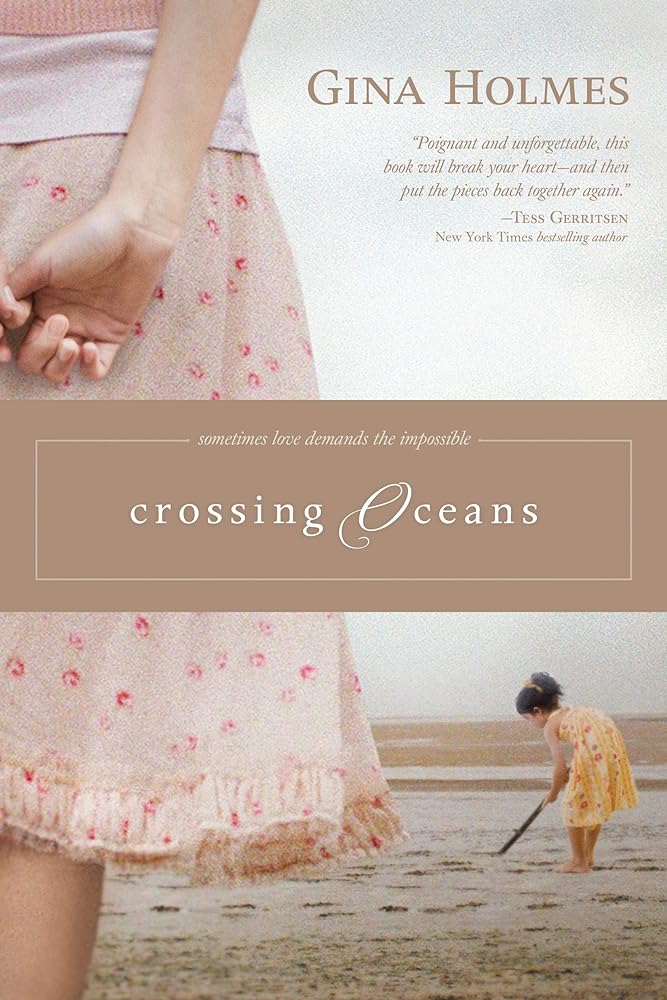
Crossing Oceans

Gina Holmes

9781414333052At the outset, Gina Holmes’ Crossing Oceans reminded me of a sappy Christmas movie. You know the ones… after several years away, beautiful young woman returns to her quaint mid American hometown where she encounters sweet, kindhearted, and inexplicably single man from her past who sweeps her off her feet and solves all her problems.

I was okay with that. Having just finished reading the memoir of an esteemed Chinese professor who lived through the horrors of the Cultural Revolution, I was ready for some fluff; some light summer reading.  

Crossing Oceans surprised me. First of all, I didn’t realize that it was a Christian novel. Had I known that, I might not have picked it up. As strange as it might sound, considering the fact that I’m a committed follower of Christ, I read very few Christian novels. Although there are exceptions, too many of them are unrealistic, happy ever after romances somewhat on par with those mushy Christmas movies. While the main characters in Holmes’ novel are professing Christians, it isn’t preachy. They are far from perfect, and their problems aren’t swept away because they believe in God. 

When Jenny Lucas left home, single and pregnant, she promised herself that she’d never look back. Six years later, knowing that she’s dying of cancer, Jenny returns to the sleepy North Carolina town where she grew up to decide who will raise her little girl when she is gone. Will it be her father with whom she has had a difficult relationship since the death of her own mother when she was a teen? Or will she choose Isabella’s dad who doesn’t even know that he has a daughter? Animosity between the two families adds to her dilemma. Can they put aside their differences and help both Jenny and Isabella face what lies ahead? 

This is a sad story, but not a depressing one. It’s a poignant story of love and loss, but also forgiveness and healing. Jenny faces her situation with determination, courage, stoicism, and even a sense of humour. As I neared the end, I couldn’t help wondering how the story could possibly end in a satisfying manner, but without giving anything away, I’ll simply tell you that I wasn’t disappointed.