Historic Mexico City

On Wednesday morning we took a taxi into Xalapa and then a bus back to Mexico City. Arriving at our hotel in the historic centre of the city a few minutes after 3 o’clock, we checked in, dropped our baggage in our room, and headed out to explore our surroundings. We had about four hours before dark to see as much as we possibly could!

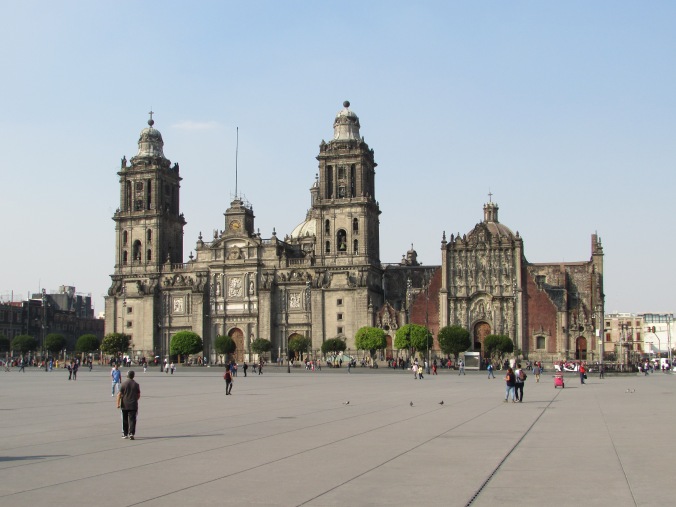
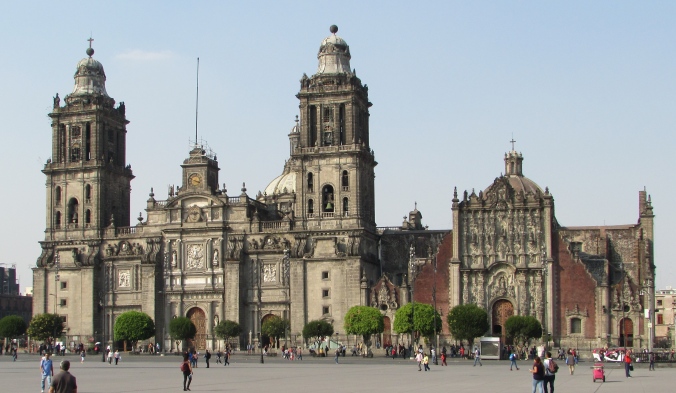
About six blocks north of our hotel, we came across the expansive Plaza de la Constitución. There was a protest of some sort happening just off the south side of the square, but it was the amazing Metropolitan Cathedral (or to give its full name, the Metropolitan Cathedral of the Assumption of the Most Blessed Virgin Mary into Heaven) on the north side of the plaza that completely captured our attention.
IMG_7059

Latin America’s largest and oldest cathedral, the imposing structure is the seat of the Roman Catholic Archdiocese of Mexico and one of the country’s most treasured architectural masterpieces. Built on the site of Templo Mayor, an ancient temple in what was the centre of the Aztec capital of Tenochtitlan, it includes much of the stone from that original structure. Construction of the cathedral, which incorporates several different architectural styles, spanned three centuries from 1573 to 1813! The bell towers house a total of 25 bells, the largest one weighing 13 000 kilograms!
IMG_7059 - Version 2

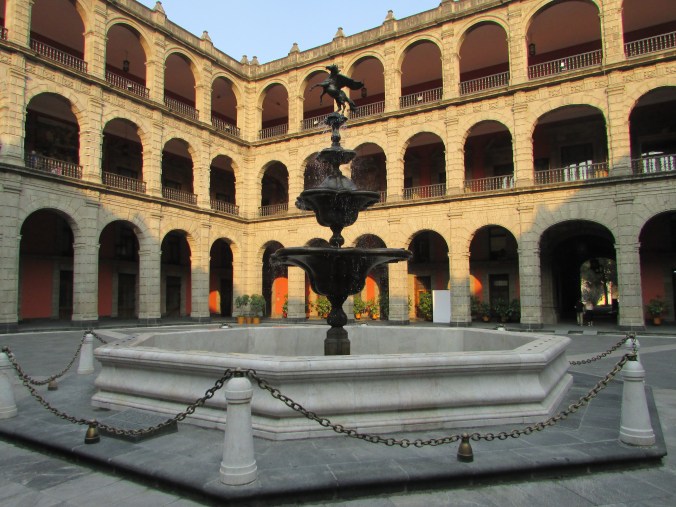
After a quick peek inside the Cathedral, we moved on. The Palacio Nacional, home to the offices of the president of Mexico as well as the federal treasury, is located on the east side of the Plaza de la Constitución. The palace’s main courtyard is surrounded by a three level arcade and has at its centre an enormous fountain topped by an elegant bronze statue of Pegasus, the winged stallion of Greek mythology.
IMG_7102

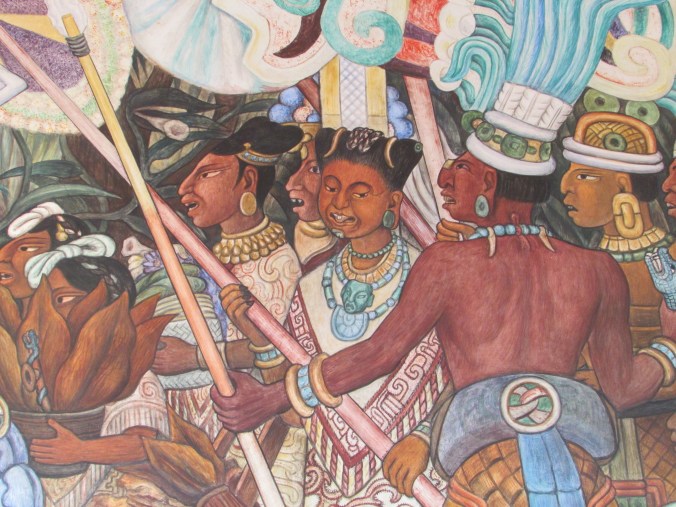
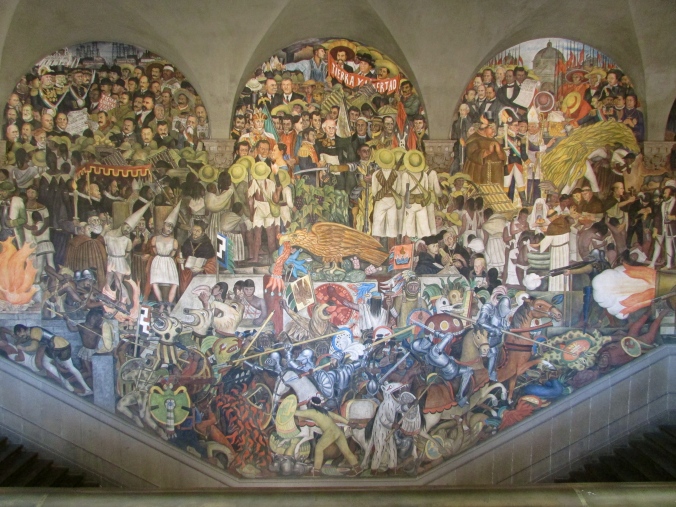
It was the Diego Rivera murals, painted between 1929 and 1951 and depicting the history of Mexico from the Aztec era to the early 20th century that drew us to the Palacio Nacional. The enormous staircase murals, located between the first and second floors, are sometimes compared to an epic poem including the legendary pre-Hispanic past, the Spanish conquest, and the more recent past. Tucked into the mural over the left staircase is an portrait of Rivera’s wife and fellow artist, Frida Kahlo (wearing a green dress and a star necklace).
IMG_7070 2

Nine more murals chronicling indigenous life before the Spanish conquest of Mexico cover the north and east walls of the second level. This series of panels was intended to go all the way around the second storey, but the project was incomplete when Rivera died in 1957.

IMG_7082

IMG_7081

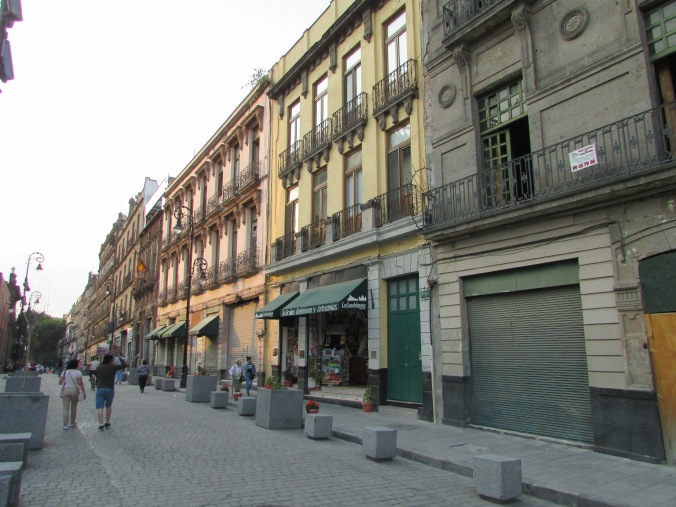
After leaving the Palacio Nacional, we wandered the nearby streets enjoying the sights and sounds of this small part of one of the world’s largest cities.
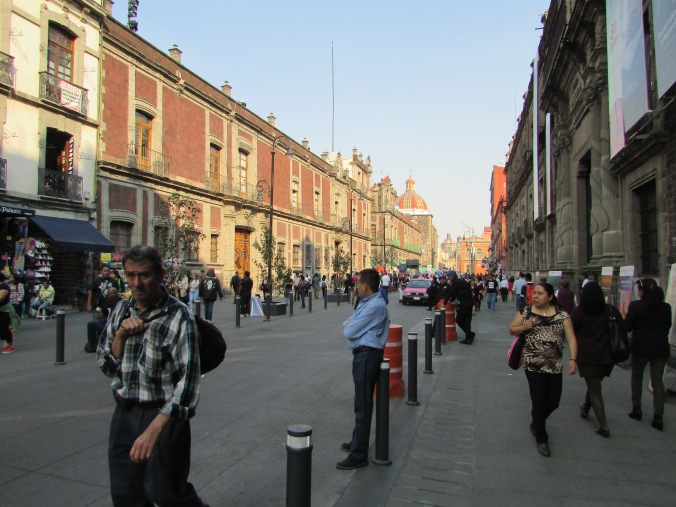
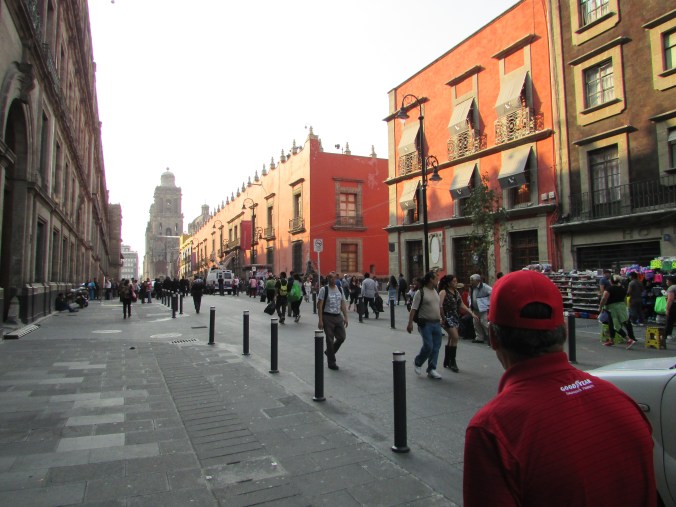
IMG_7066

IMG_7067

IMG_7112

To the north and east of the central plaza, we discovered the remains of a portion of the Templo Mayor that was excavated between 1978 and 1982.
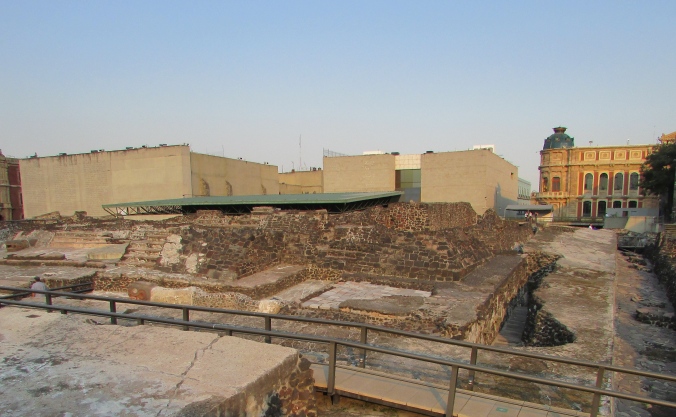
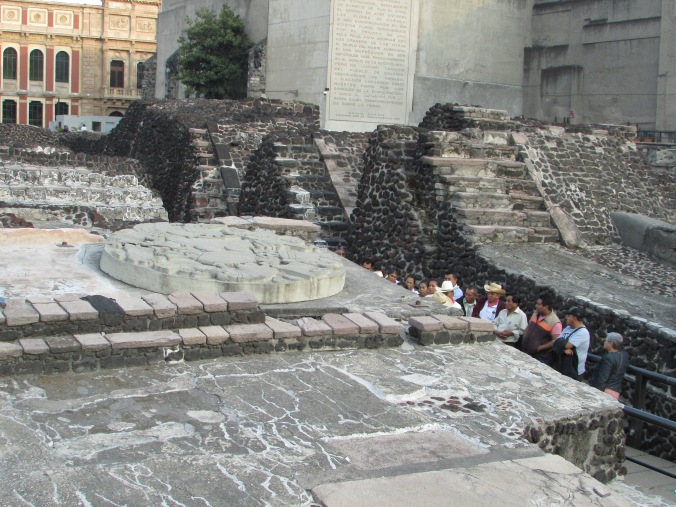
IMG_7106 - Version 2

IMG_7110

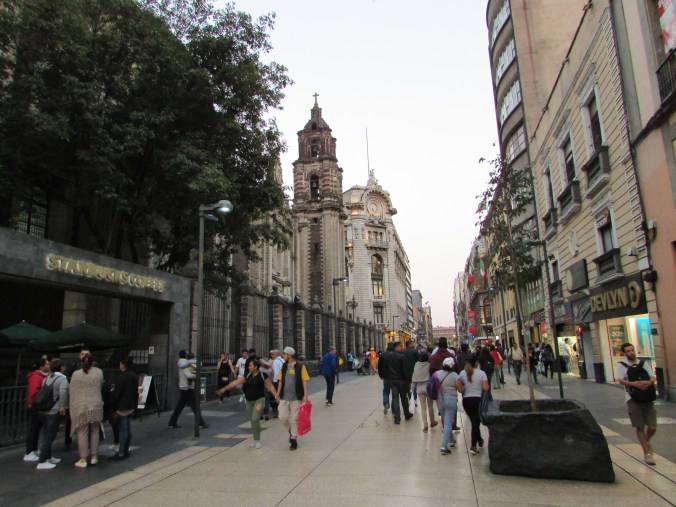
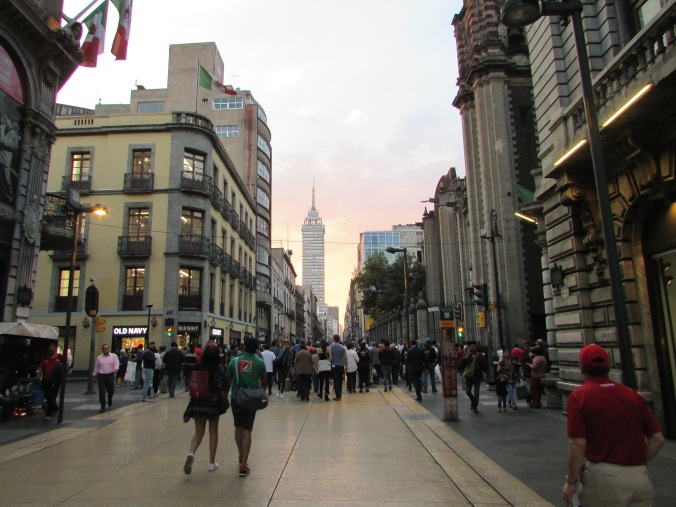
Continuing our walk, we eventually came across a long pedestrian street lined with shops and restaurants that included a number of American chains such as Old Navy, Starbucks, H&M, and Forever 21. Though it was a midweek day at suppertime, the street was full of people. Photos hardly do it justice as without sound they fail to fully capture the festive atmosphere. On one block a young boy played an accordion, on another a trio of men in traditional costume played lively music on stringed instruments, on yet another a boy played guitar and sang. In each case, of course, they had a hat or container out to catch the coins of passersby.
IMG_7116

IMG_7121

We stopped for a quick bite to eat in a tiny Mexican restaurant and dessert from Santa Clara, a Mexican ice cream shop chain. Then as the sun slipped below the tall buildings surrounding us, we headed back toward our hotel. We had to be up very early the following morning to catch our flight home.

And that’s a wrap folks! After a fantastic visit with our friends in Mexico, we’re back home on the frozen Canadian prairie revelling in the memories of another wonderful trip completed.

Cultural appropriation… what do you think?

Utah teen, Keziah Daum, has been harshly criticized online and in the media for herLogo recent choice of a dress for prom. Hoping to find something unique, Keziah decided to browse a vintage store in downtown Salt Lake City. There she found a beautiful red cheongsam; a high-collared, form-fitting traditional Chinese dress.

Screen Shot 2018-05-02 at 11.51.55 AM

photo – Twitter

The problem is that Keziah Daum is not Chinese. The dress “gave me a sense of appreciation and admiration for other cultures and their beauty,” she said, but she has been accused of cultural appropriation.

What is cultural appropriation and how is it different from cultural appreciation?

Cultural appropriation deals with the adoption of elements of a minority culture or a marginalized group by members of a dominant culture without permission and usually with little respect for or knowledge about the original culture. In true cases of cultural appropriation, elements that may have deep meaning to members of the original culture are sometimes reduced to exotic curiosities by those adopting them. For example, decorating your home with a Buddha statue when you are not, in fact, Buddhist would seem to me to be culturally inappropriate. If you are white North American and you include items that are representative of First Nations culture in your Halloween costume, that too is clearly cultural appropriation and may also help perpetuate harmful stereotypes. I question, however, whether using the same items or garments in the ways that they were originally intended is harmful to anyone at all.

The problem, in many cases, is that there is often no agreement amongst members of a supposedly offended cultural group about what is or is not acceptable to them. While Keziah Daum’s choice of prom dress elicited plenty of criticism from both Chinese and non Chinese, scores of other people also identifying as Asian Americans, defended her choice, saying that they did not consider it offensive. One of them tweeted, “I am a Chinese woman. I support you. You rocked that dress!!”

I have a Japanese yukata (summer kimono) that I purchased in Tokyo. The shopkeeper had no problem selling it to me and showing me how to wear it properly even though I was clearly a gaijin (foreigner). In fact, I believe that many of their customers are visitors to the country looking for a special piece of Japanese culture to take home with them. I also have a traditional Vietnamese ao dai, a two piece silk outfit comprised of a long tunic and pants that was made to measure in a tiny tailoring shop in Hoi An. When I traveled to  Vietnam I had no intention of buying an ao dai, but when I visited a few of the 200+ tailoring shops in Hoi An and admired the beautiful garments, the seamstresses were all anxious to make one for me and I couldn’t resist. I also have a Chinese silk jacket from Hong Kong as well as a beautiful silk abaya from the Middle East, both gifts from friends. I have worn all of these on special occasions and meant absolutely no disrespect to the cultures they came from. In fact, like Keziah Daum, I consider it a special privilege to be able to wear such gorgeous and meaningful pieces.

I also wear a beautiful ring made to order by Haisla artist, Hollie Bear Bartlett. A Christmas gift from my husband, it’s hummingbird motif in traditional Northwest Coast style is symbolic of love and beauty. I am originally a coastal girl of European descent. I do not think that my wearing a ring bearing the art of a different group of coastal people is inappropriate or disrespectful. I also have Northwest Coast and Inuit art in my home, as do many other Canadians.

On the other hand, I do think that our Canadian Prime Minister made an absolute ass of himself, roving around India recently on a highly publicized trip with his family, all of them wearing brightly coloured Indian garb. Their insensitive overuse of and excessive photo-ops wearing Indian clothing drew criticism from their host country with prominent Indian personalities referring to the outfit choices as “tacky” or “fake and annoying.”

Allegations of cultural appropriation have grown increasingly common in recent times with critics casting doubt on the legitimacy of everything from team logos to burrito shops. We in North America are privileged to live in multicultural countries where we can share in the rich heritage and traditions of our neighbours. It behooves us to be sensitive in how we do so, but I think that condemning a young girl for her choice of prom dress goes way overboard.

I realize that this is a controversial topic and that there are people with strong feelings on both sides of the issue. I welcome all opinions as long as they are offered respectfully. I am particularly interested in knowing how my readers from other parts of the world feel about this topic.

The Hazeltons

After six weeks in the trailer, we are home! Though it was our plan from the beginning to arrive home today, I really wasn’t ready to end our gypsy wandering and I would have happily extended our travels indefinitely. Real life issues beckoned, however, and so it seemed wise to follow through on our original plan. As much as I loved being away from home, I did miss having access to wifi and being able to update the blog on a regular basis. Now that I’m connected again, I’ll do my best to share the remainder of our travels with you over the next few days.

The Hazeltons, a collection of small communities, located around the confluence of the Skeena and Bulkley Rivers in northwestern British Columbia, have been home to the Gitxsan people for centuries. The Gitxsan are a matrilineal society made up of the Frog, Eagle, Wolf, and Fireweed clans. Though their territory is inland, their villages with intriguing names like Kispiox, Gitanmaax, and Hagwillget as well as Hazelton, New Hazelton, and South Hazelton, are a centre of Northwest Coast native culture and, as such, are a place that I’ve long dreamed of visiting. My love for the art and the culture of the native peoples of the Pacific Northwest began as a child growing up on the coast of British Columbia and grew as a student of anthropology during my university years.

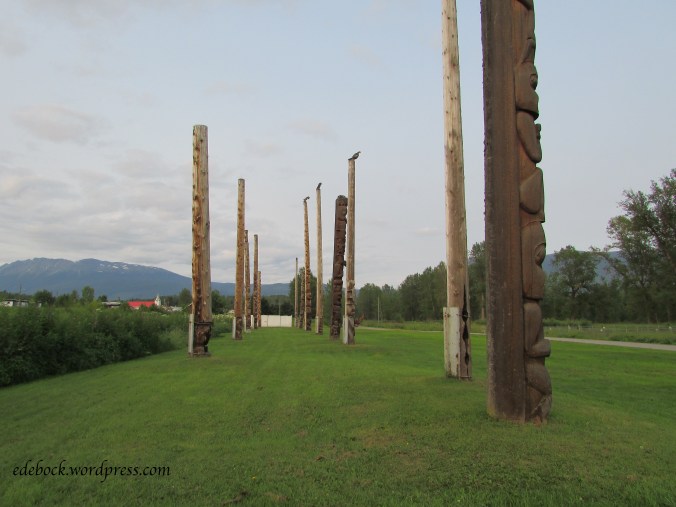
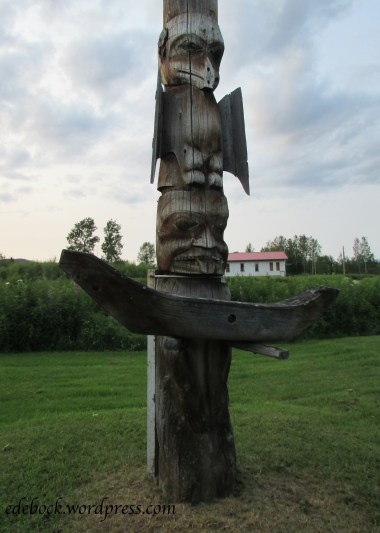
After settling into our campsite, we drove a few miles north to Kispiox, best known for the 15 totem poles, some dating back to 1880, that stand in the village alongside the Kispiox River. On the way into the village, we stopped to look at the art work decorating the band office.

IMG_4723

IMG_4732

IMG_4729

IMG_4733

IMG_4730

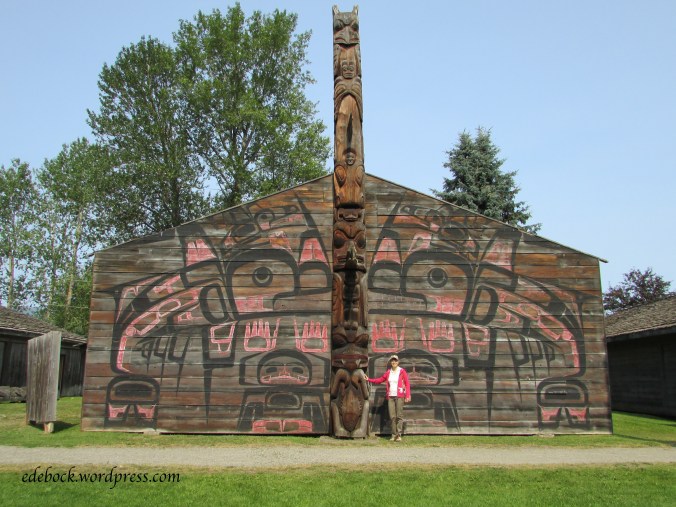
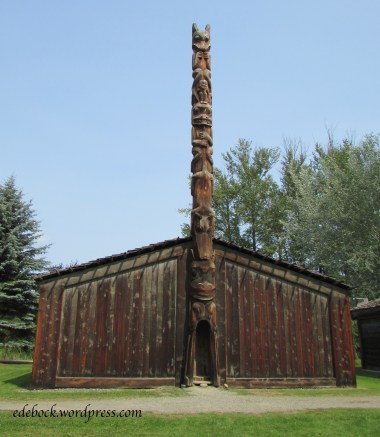
The following morning, we took a fascinating interpretive tour of the ‘Ksan Historical Village adjacent to our campground. It consists of seven replica cedar longhouses. One of the longhouses contains a small museum and a gift shop that are open to visitors who are also free to enjoy the grounds and photograph the buildings and totem poles. Only the guided tour, available in several languages, allows entrance into the three of the longhouses that contain an abundance of artifacts. The price is nominal and was well worth it! Aside from the Museum of Anthropology at the University of British Columbia in Vancouver, I have not seen such an extensive collection of Northwest Coast history anywhere! Unfortunately, photography was not allowed inside the longhouses, so I’m not able to share that part of the experience with you.

IMG_4774

IMG_4759

IMG_4763

IMG_4762

The small, narrow door in the last photo was designed to prevent enemies from entering in full armour.

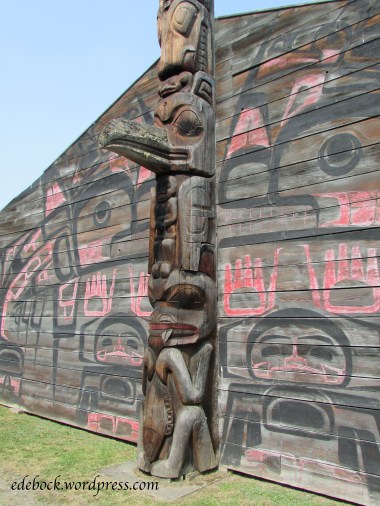
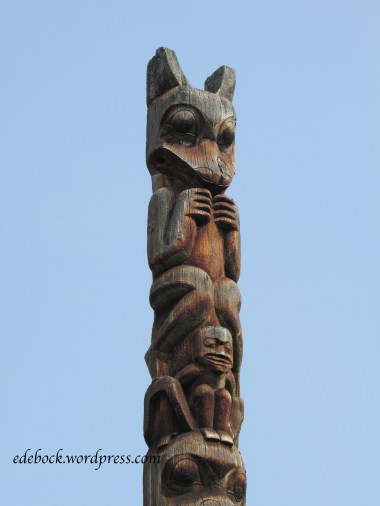
As always, the totem poles fascinated me. Here’s a closer look at a few of them.

IMG_4767

IMG_4776

IMG_4761

IMG_4760

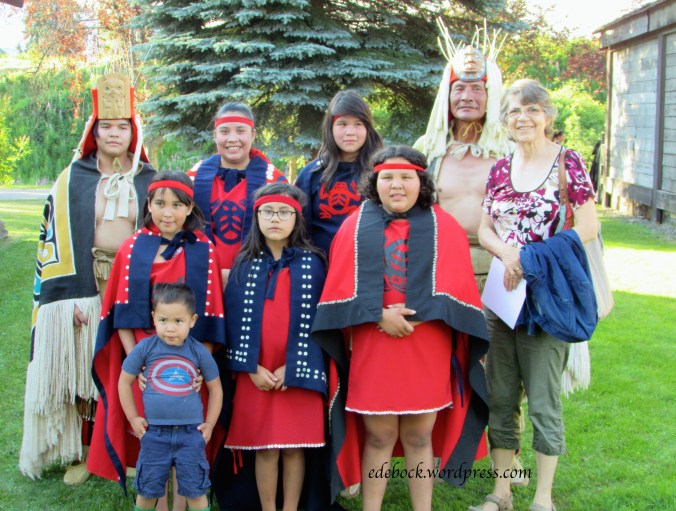
We were especially fortunate to be in the area on a Wednesday. Every Wednesday evening during the summer months, a local group offers a traditional song and dance presentation in the Wolf House, one of the historical village’s longhouses. Again, for a nominal fee, I was thrilled to have the unique opportunity to see and experience this aspect of the Northwest Coast culture. I was especially delighted to see that the group included all ages; that the traditional songs and dances are being passed on to the younger generations.

IMG_4799

As we explored the various villages that make up the Hazeltons, we were especially impressed with how welcoming the First Nations residents were. While we were strolling around the historical section of Old Hazelton a local woman stopped to chat and told us about an easy 10 minute hike from New Hazelton to a beautiful waterfall. Had she not been willing to share with us, we would never have known about it!

IMG_4792

Hello Xalapa!

We first woke up at 4 o’clock this morning because the house was shaking and the windows rattling. The 4.4 magnitude earthquake with its epicentre beneath the ocean less than 150 km east of here, was not something I had expected to experience during our stay in Mexico. After living for a year in Japan where the earth moves almost every other week, we’re pretty blasé about such things though and soon went back to sleep.

Later in the morning, we took a 20 minute bus ride into Xalapa (pronounced Halapa), a city of approximately 400 000 people that is the capital city of the Mexican state of Veracruz. Xalapa is also known as a centre of arts and culture.

We enjoyed strolling around the central part of the city including Parque Jaurez, one of the city’s most popular attractions. The park, located next to the provincial government building, is home to an amazing dragon play structure; it’s tongue a two sided slide, its body a climbing wall and its tail a rope climbing apparatus. I could imagine my five grandchildren having a blast playing on it.

We also enjoyed the Greek inspired statues of the four muses, especially this one!

img_3641-version-2

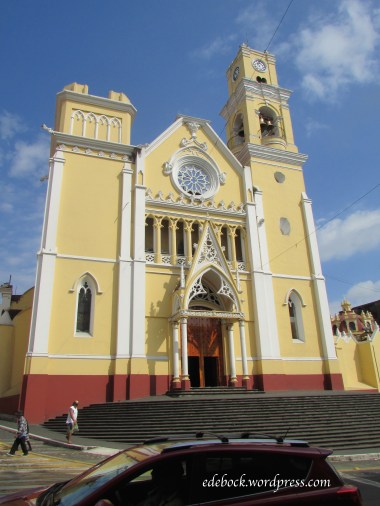
Across the street from the government building stands the impressive Xalapa cathedral, beautiful both inside and out.

img_3648

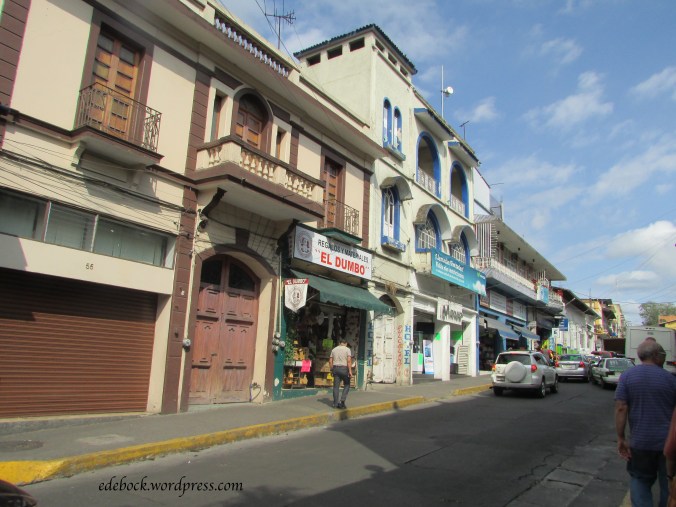
As we walked the nearby streets stopping into a few little shops, we joked that this one must be part of the empire owned by the newly elected president of a certain country to the north!

img_3654

img_3653

Clearly it was a fun filled morning! After a fabulous lunch in one of Xalapa’s finest restaurants, we returned to Coatepec but we’ll be back in Xalapa on Friday evening to hear the city’s symphony orchestra in concert.

img_3647

img_3662

Modesty and cultural sensitivity

IMG_3548

Screen Shot 2016-03-18 at 11.07.24 PM 3Visitors who dress immodestly will no longer be allowed to enter Cambodia’s famed Angkor Wat temple complex, the agency that oversees the site announced last week. Beginning August 4th, all tourists will be required to wear pants or skirts that fall below the knee and shirts that cover their shoulders.

When I read that, I immediately went back to our photos from Jan 4, 2009 to see what we were wearing the day we visited the UNESCO World Heritage Site that is also Cambodia’s biggest tourist attraction. Would we meet the new standard, I wondered.

We got up at 4:30 a.m. the day we toured Angkor Wat so that we could be there in time to watch the sun rise over it’s towers. It was still a bit chilly when we arrived and at that point, dressed in a warm fleece hoodie and capri pants, I would definitely have met the new dress code.

IMG_3507

Richard would not have, however, as he was wearing shorts and later, in the heat of the day, I wouldn’t have either.

I almost hate to post that picture because I look so frumpy, but please keep in mind that we were basically backpacking through southeast Asia. We had just traveled the length of Vietnam by night bus and we were staying in a $12/night guesthouse that wasn’t much more than a roof over our heads. I may not have looked great, but I was having the adventure of a lifetime and fashion was the farthest thing from my mind!

The question here, though, is what is modesty? My tank top may not be particularly attractive, but is it immodest?

In 1 Timothy 2:9, the apostle Paul advises women to “adorn themselves in modest apparel, with propriety and moderation” but he doesn’t give a lot of detail about what that looks like. He does go on to say, “not with braided hair or gold or pearls or costly clothing” but to understand what he was getting at, one needs to look at the culture and the context. In this passage, Paul was advising women on how to dress for church, telling them to adorn themselves in a manner that was considered appropriate for worship. In Ephesus, where his protégé, Timothy, was pastoring at the time, the elite of that culture were known for their gaudy and extravagant wardrobes, their elaborate hair styles, and their expensive clothing that communicated extraordinary wealth. Paul’s description of immodest dress conjured up a picture of someone preoccupied with appearance, fashion, luxury, and perhaps even sexual prowess. He was simply advising the Christian women of that time and place not to mimic that behaviour, but to dress in a way that showed that they desired attention to be on God, not on themselves.

Dictionary definitions of modesty include “behavior, manner, or appearance intended to avoid impropriety or indecency” and “the quality of behaving and especially dressing in ways that do not attract sexual attention.”

In discussing dress codes, it’s important to note that modesty must involve cultural sensitivity. We don’t find the wearing of shorts or sleeveless tops offensive here in North America,  but Cambodia is a completely different culture. Angkor Wat was the spiritual centre of the Khmer empire that dominated that region from the 9th to 15th centuries. It’s a symbol of great national pride and is depicted on the Cambodian flag. As such, it is worthy of utmost respect. If, to the Cambodian mind, that means a certain manner of dress, then visitors definitely need to honour that.

Though it’s unlikely that I will return to Angkor Wat (only because there’s so much world that I have yet to see), but if I do, I won’t be wearing a tank top. If you haven’t been yet, I would definitely suggest adding it to your bucket list, but make sure you pack accordingly. After August 4th, those who are not dressed appropriately will be turned away or required to change their clothes before being allowed to enter.

IMG_3496

IMG_3532

IMG_3530


Threads of Hope

I’m wearing a simple thread bracelet today that was handmade in the Philippines.

IMG_1452

In early 2003, Christian missionary Alex Kuhlow and his wife Chris, while visiting the beautiful beaches of Puerto Galera on the island of Mindoro, became aware of a heartbreaking reality. Many impoverished families flocked to the popular vacation destination to sell woven baskets or colourful bracelets and anklets to the well-to-do tourists, but some of them, realizing that they still couldn’t generate enough income to live on, were making the desperate choice to sell their children into prostitution. Moved by their circumstances and wanting to help, Alex ordered $100 worth of bracelets to be picked up on his next visit. That became the beginning of a non-profit organization called Threads of Hope that now provides a steady income to over 250 families who were previously at risk! In addition to providing life-sustaining income and protecting their children from exploitation, selling their beautiful hand-made bracelets and other products including necklaces, keychains, bookmarks and headbands, fosters a new sense of hope and brings dignity to these families.

Through the sale of simple bracelets like mine, Threads of Hope has also been able to purchase land and build a ministry centre that accommodates 1000 people for church and other activities. A full-sized basketball court provides a recreational outlet for the community and pineapples planted on the remaining property bring more income into the community at harvest time.

Last night our church hosted a visiting missionary from the Philippines who, in addition to her regular responsibilities at a Christian international school in Manila, has partnered with Threads of Hope to spread awareness of their ministry and help raise support through the sale of their products. The bundle of colourful bracelets that she brought with her were quickly gobbled up. One public school teacher in our congregation bought enough for every child in her class!

Though the majority of sales are generated through a network of individuals who have been moved with compassion for the economically oppressed of the world, Threads of Hope products can also be purchased individually or in bulk through their website. Customized orders in school or team colours can also be provided. What an easy way to provide protection and support for some of the world’s most vulnerable children!

sunsetbanner


International Women’s Day 2016

Yesterday, March 8th, was International Women’s Day. My search for something relevant to write about led me to a headline that caught my interest:

Ditch the sexualized dress codes, Ontario employers told

Compared to many of the issues and abuses such as poverty, female genital mutilation, and child marriage, that women in other parts of the world face,  being required to wear sexy, cleavage-baring outfits or heels to work is definitely a first world problem, but one that I’m happy to see being addressed.

The Ontario Human Rights Commission has told that province’s employers to stop demanding that their workers dress provocatively as a condition of employment. Requiring female staff, most often restaurant and night club servers, to adhere to a sexualized dress code that frequently includes tight skirts, low-cut tops and high heels is discriminatory and, according to US research, leaves them vulnerable to a higher than normal rate of sexual harassment.

Those in the industry claim that dressing in a sexualized manner garners greater tips. That may be true, but isn’t that a rather sad statement about our culture? Should a restaurant server have to sell her body to make a living? Personally, I would rather eat at an establishment that builds its reputation on quality food and excellent service and I tip accordingly.

Hooters is, of course, the first to come to mind. It built an empire on its young, attractive and scantily clad waitresses. With their tank tops, short shorts, tights and socks, at least they get to wear comfortable shoes!

hootersgirls-1024x682

photo:  http://www.hooters.ca

Some employers insist that servers, who are on their feet all day, must wear heels. According to the Earls communication manager, that company recommends wearing heels “to reduce safety hazards.” A heel or wedge is preferred because apparently ballet flats don’t offer enough protection against stepping on glass. That’s a feeble excuse if I ever heard one! She also claims that heels provide more support, but the American Osteopathic Association would disagree. According to their website, “statistics show that high heels are one of the biggest factors leading to foot problems in women, with up to a third suffering permanent problems as a result of prolonged wear. Over time, wearing high heels can shorten the muscles in your calves and in your back, leading to pain and muscle spasms.” I have nothing against women choosing to wear heels, but to require it of someone who is on her feet day in day out puts her long term health in jeopardy.

It was the comments on the articles about this issue that disturbed me most, however. Over and over again, I read responses like this one:

” If women go to Moxie’s or Hooters to work they know they will have to flaunt their equipment. Unbelievable how women would complain knowing full-well going into the job what it’s all about.”

and

“This is a free country, Women have the choice to  accept or decline employment at businesses that require revealing uniforms.”

Tell that to the many young women who are working in these places to put themselves through school or feed their children. How many options do many of them have, especially in today’s economy?

Obviously objectifying and exploiting women is still alive and well in our culture.


Shabbat Shalom!

We were in Israel for two Shabbats, the Jewish Sabbath that begins at sundown on Friday and lasts until sundown Saturday. Most schools, businesses, shops and even tourist sites close at 3:00 pm on Friday and don’t reopen until Sunday morning.

According to Old Testament law, work is forbidden on Shabbat. The 4th commandment says, “Remember the Sabbath day by keeping it holy. Six days you shall labour and do all your work, but the seventh day is a Sabbath to the Lord your God. On it you shall not do any work, neither you, nor your son or daughter, nor your manservant or maidservant, nor your animals, nor the alien within your gates. For in six days the Lord made the heavens and the earth, the sea, and all that is in them, but he rested on the seventh day. Therefore the Lord blessed the Sabbath day and made it holy.” (Exodus 20:8-11)

Over the centuries, Judaism has attempted to interpreted what is work and what isn’t, what is forbidden on Shabbat and what is allowed, ending up with a complex and somewhat overwhelming list of rules to be followed. Here’s a basic list of activities that ought to be avoided on Shabbat:

  • writing, erasing, and tearing
  • business transactions
  • driving or riding in cars or other vehicles
  • shopping
  • using the telephone
  • turning on or off anything which uses electricity, including lights, radios, televisions, computers, air-conditioners and alarm clocks
  • cooking, baking or kindling a fire
  • gardening and grass-mowing
  • doing laundry
  • carrying anything outdoors or transferring objects between an enclosed domain, such as the house, and a public domain, such as the street

There are detailed rules pertaining to each of these. For example, the refrigerator can be used because it is on all the time, but to ensure that it’s use doesn’t involve turning something on or off, the fridge light should be disconnected before Shabbat by unscrewing the bulb slightly. The rule about carrying things outdoors would include carrying anything in your pocket or even having gum in your mouth! Of course, as in any culture or religion, there are those who follow the Shabbat rules to the nth degree and those who don’t.

Clearly our Lord took exception to the interpretations of the 4th commandment that were in vogue in His day as He was criticized by the religious leaders for healing the sick on the Sabbath (John 5:1-15) and for allowing His disciples to pick heads of grain and eat them when they passed through the fields on that day of the week. (Matthew 12:1-2)

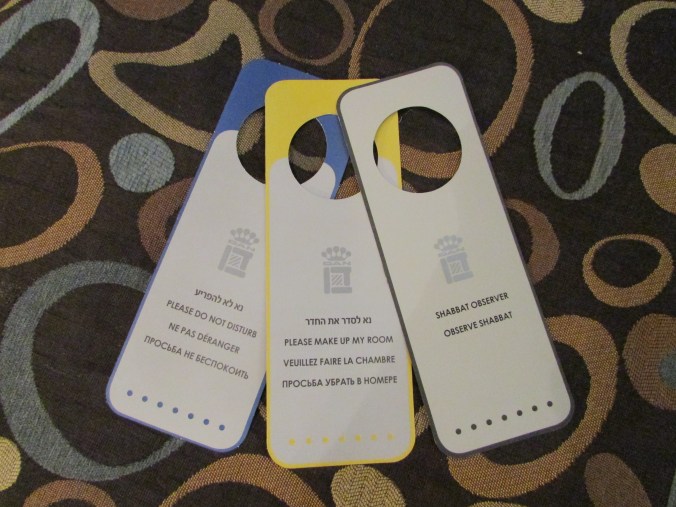
In one of our hotels, we had the choice of three door hangers to notify the staff of our various needs or intentions.

IMG_0185

Many hotels in Israel allow a late checkout on Saturday for Shabbat observers, enabling them to stay in the hotel until after sundown. Attending synagogue on Shabbat is considered essential by most Jews, so many hotels also have a synagogue within the building.

We were warned to avoid using the specially designated Shabbat elevators in our hotels unless we had lots of time to spare. Set to go up and down continuously, stopping and opening at every floor for the entire 24 hour Shabbat period, these elevators ensure that Shabbat observers don’t have to push any buttons which would be construed as work.

Friday dinners in our hotels were festive affairs with many Jewish families there to celebrate Shabbat. Going out for dinner ensured that they kept the no cooking rule and they didn’t seem to object to the fact that someone else had to work to prepare and serve the meal! The already sumptuous buffets were even more elaborate on those days and it definitely wasn’t all food that was prepared in advance. Saturday breakfasts, however, were more basic than the other days and involved very little hot food.

Of course, the people we saw at dinner in the hotels were not the ultra-Orthodox Jews. They would have been at home observing Shabbat in a much more traditional way. We drove through an ultra-Orthodox neighbourhood on our way back to our hotel in Jerusalem on a Friday afternoon and observed them scuttling about making their last minute purchases and preparations before retiring to their homes.

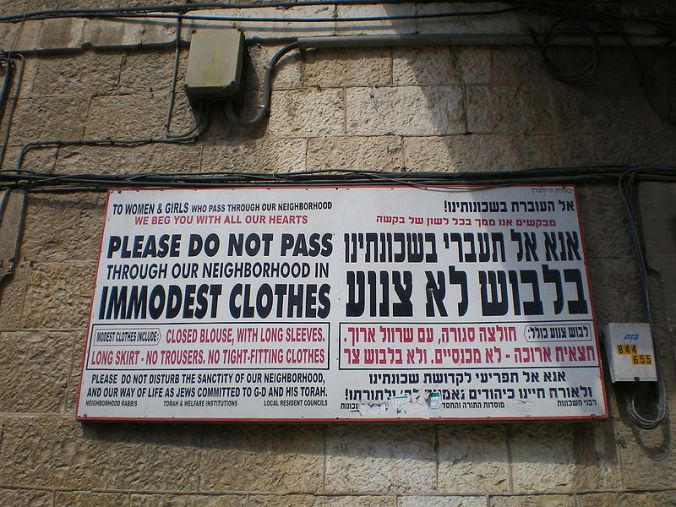
Our guide pointed out that the various ways that the men were dressed indicated membership in different sects. Height or style of hat, coat length, whether his socks are black or white, and whether or not his pants are tucked into his socks are all indicators of which group a man is part of. The women’s clothing is much less distinctive, but very conservative. For example, they would never be seen in public wearing pants. A large overhead billboard as we entered the neighbourhood advised us how we ought to dress while we were there.

billboard

Photo:  Lisa Mathon – https://commons.wikimedia.org/w/index.php?curid=2024503


So who are these ultra-Orthodox people? Though they consider themselves the most religiously authentic Jews, they don’t seem to be very productive members of Israeli society and are seen by many as a drain on the economy. Less than 50% of the men are employed. Instead, many spend long hours every day praying and studying scripture while the family lives off Israel’s generous social welfare system. Like many other Israelis, our guide, Shimon, resents how much he pays in taxes to support these people. Apparently, this is a huge political issue at election time. Another source of resentment for many is the fact that, upon the establishment of the State of Israel in 1948, ultra-Orthodox males of military age were exempted from universal conscription into the Israel Defense Forces. Officially, those who were enrolled in yeshiva, an institution focusing on the study of traditional religious texts, were granted deferred entry into the IDF, but in practice few serve at all. At the time when this agreement was made, only about 400 individuals were affected, but due to their extremely high birth rate, the ultra-Orthodox are now estimated to make up approximately 10% of the Israeli population!

Well, even though the days are getting longer it’s now past sundown on a Friday afternoon in my part of the world so I wish you Shabbat Shalom or, in English, Sabbath Peace!

Slippery slope?

My granddaughter is five. She still sleeps with her favourite purple blanket and believes that she’s going to grow up to be a unicorn, but in some countries her parents might already be looking for a husband for her. Every day, more than 25000 girls under the age of 18 are married worldwide. One in 9 girls in developing countries are married before the age of 15; many by age 8 or 9.

We, in North America, think we’re enlightened. It will never happen here, we tell ourselves. Really? A few decades ago, did any of us expect to see same sex marriage legalized? In 1974, the American Psychiatric Association (APA) removed homosexuality from its catalogue of illnesses. Instead, it became a sexual orientation. Today, there are those who want to see pedophilia treated in the same manner. Until recently, it has been widely viewed as a psychological disorder triggered by early childhood trauma, but no more. Now, many experts see it as a biologically rooted condition that does not change; a sexual orientation. In fact, in the fall of 2013, the latest edition of the APA’s Diagnostic and Statistical Manual of Mental Disorders referred to pedophilia as a sexual orientation for the first time. After inquiries from news organizations, the APA issued a “correction” stating “sexual orientation” is not a term “used in the diagnostic criteria for pedophilic disorder,” but do you see where this is going?

“It should be clear to anyone with any grey matter that pedophilia is just another oppressed sexual orientation or interest, and age doesn’t somehow magically make consensual sex between two people into something evil,” writes one user of a website for self-identified individuals who are sexually attracted to children. So can a 5 year old give consent? What about an 8 or 9 year old? If a man she trusted asked my granddaughter if she wanted to “play” with him, what might she say? Would that be consent? I know this sounds horrifying or perhaps even ridiculous to most, but is it any more abhorrent or ridiculous than the concept of same sex marriage would have been to our grandparents?

Sadly, it isn’t only pedophiles themselves who think that sex with children is okay. A National Council for Civil Liberties (UK) report, written for the Criminal Law Revision Committee in 1976, included the following:

“Childhood sexual experiences, willingly engaged in, with an adult result in no identifiable damage. The Criminal Law Commission should be prepared to accept the evidence from follow-up research on child ‘victims’ which show there is little subsequent effect after a child has been ‘molested’. The real need is a change in the attitude which assumes that all cases of pedophilia result in lasting damage.”

With ideas like that floating around, is it really so outlandish to think that we might someday see marriage between children and adults become legal in the western world? Not in my lifetime, I hope, and not in my granddaughter’s!

Personally, I think that polygamy, which is actually already practiced in our country, will likely come first, but that’s a different topic.

What do you think? Once again, I invite all opinions as long as they are presented in a non confrontational manner. You can even tell me that you think I’m crazy, as long as you do it politely!

Girls Not Brides

Girls Not Brides Website

Cultural surprises

Sheila has been with us for over two weeks already but she continues to be amazed by something new almost every day. In her eyes, my kitchen is a magical place. Most of the small appliances and gadgets that we take for granted are brand new to her. Like most Chinese kitchens, the one in her parents’ home doesn’t have an oven let alone a toaster, a bread maker or a food processor. Her eyes nearly popped out of her head the first time she saw me using my electric knife!

It’s not only the appliances that surprise her, however. Most of our food is also new to her. Though she’s familiar with a lot of the ingredients, we cook them entirely differently and even I’ve been surprised at how many convenience foods I use. We tend to eat a healthy diet avoiding a lot of processed foods but I do depend on things like pancake mix that are completely foreign to her. Breakfast cereal is also something she’s never eaten before. So far, Harvest Crunch, a sweetened granola with coconut and almonds, is her favourite. She’s accustomed to a spicier diet than ours and the ketchup bottle has become her best friend. In fact, she’s dubbed herself a “ketchupholic”!

The rest of the house contained many surprises for her too. Not unexpectedly, even though I’d explained the bathroom to her the evening she arrived, it took a flooded floor to remind her that the shower curtain must be inside the tub when you take a shower! That’s a common blunder for Asians when they first arrive on our shores as an Asian bathroom is basically an oversized shower stall and bathtubs are not common in China.

Laundry brought more surprises. Though we had a fitted sheet on our bed in China, Sheila had never seen one until we stripped the beds to wash the sheets! She thought I must have sewn the elastic corners myself. (In case you were wondering, fitted sheets were actually invented by an African American lady named Bertha Berman in the 1950s.) The clothes dryer also fascinates her as clothing is hung to dry in China.

That brings me to a topic that has been a big surprise to Richard and I. When we lived in China, we were amazed to see people in the street wearing their pyjamas. What we didn’t realize until Sheila came to stay is that Chinese people wear their pyjamas whenever they’re at home! Sheila only dresses to go out and immediately changes back into pyjamas when she gets home. Of course, if you’re just stepping out to run a quick errand, why bother changing at all? Sheila has been out with me more than once now in her pjs and I finally understand why we saw people walking down Little Street dressed that way!

While we continue to learn much about Chinese life from Sheila, it’s definitely been fun looking at our own lives through the eyes of someone for whom almost everything is brand new!