Alaska cruise: Exploring Juneau, Skagway, and Ketchikan

As I mentioned in my last post, our 7-Day round trip Alaska cruise from Vancouver stopped at Juneau, Skagway, and Ketchikan and also included a side trip up Endicott Arm to see Dawe’s Glacier.
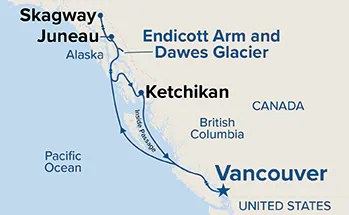
There were a vast number of possible shore excursions to choose from at each location, but we chose only one, the White Pass Scenic Railway at Skagway. Rather than purchasing other shore excursions, I did what I usually do when we travel. I researched each location and planned our own self-guided tour.

Juneau, Skagway, and Ketchikan all depend heavily on tourism in the summer and each has what my sister-in-law refers to as “trinket alley”, a street close to the cruise ship wharf that’s lined with shops selling souvenirs. We wanted to go beyond those areas to see more of each community.

Juneau  
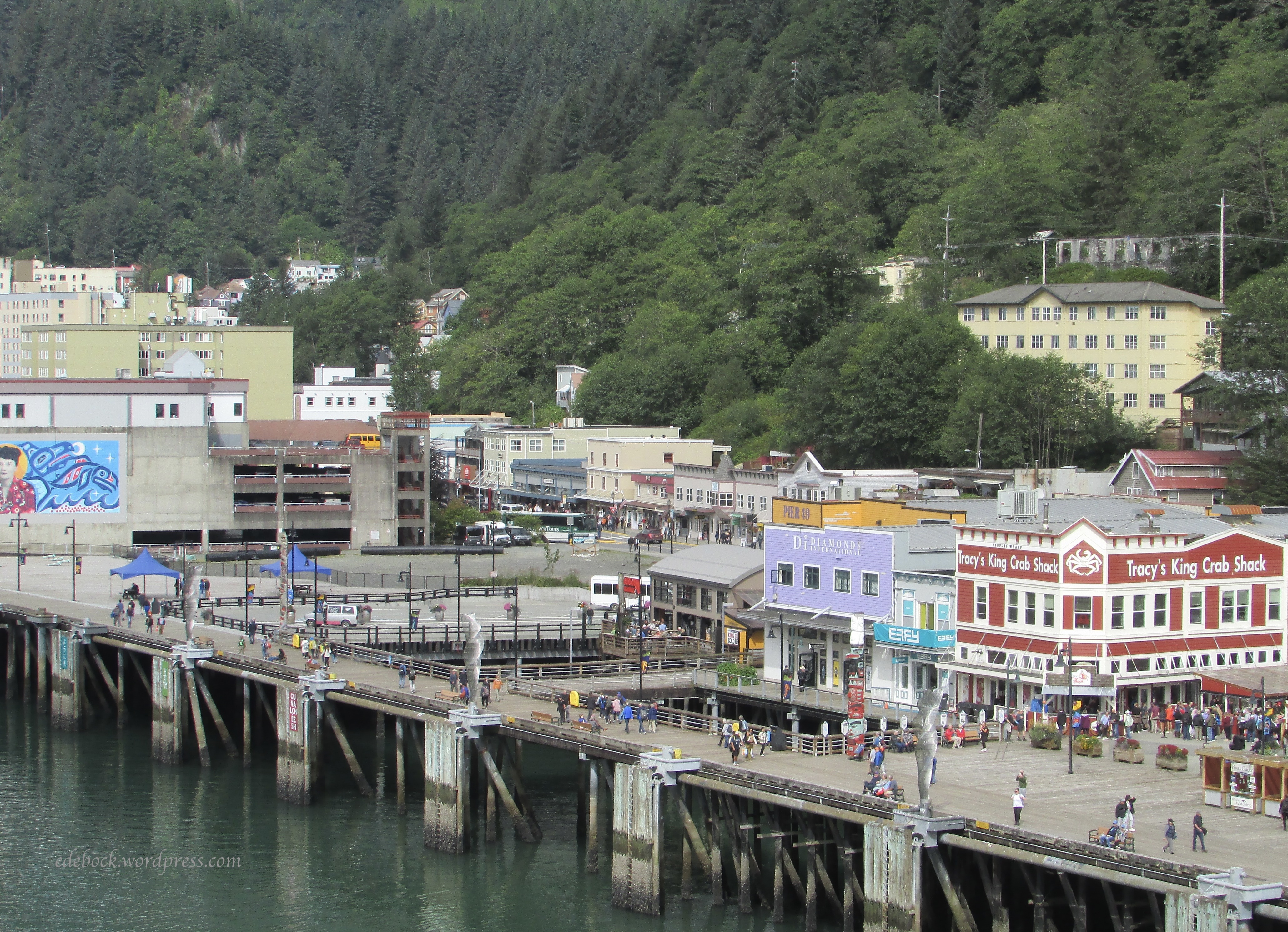
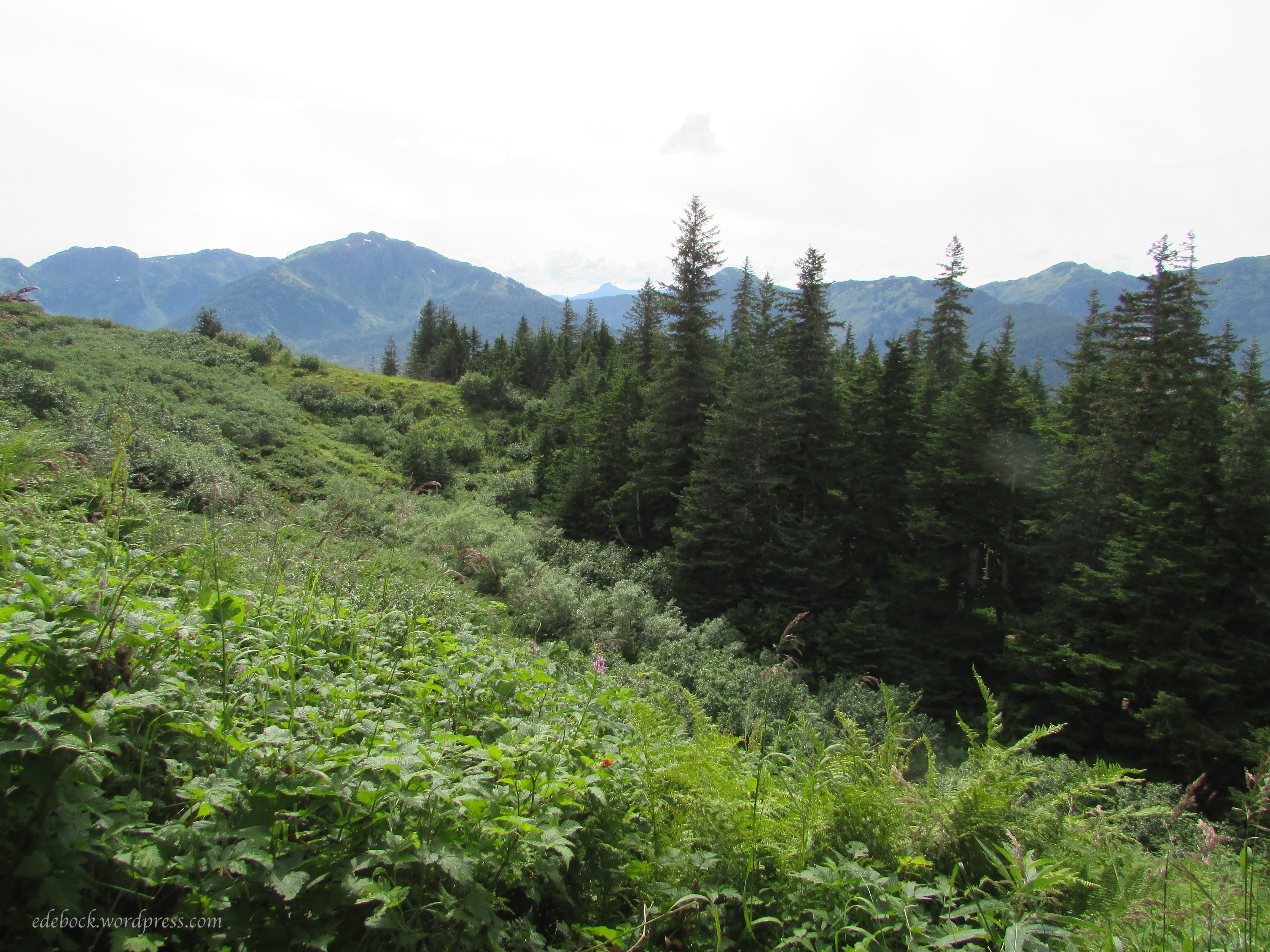
After 48 hours at sea, we docked at Juneau, the capital city of Alaska. As soon as we disembarked, we headed for the Goldbelt Tram, just steps from the cruise ship dock and took a six minute ride up Mount Roberts to a height of about 550 metres (1800 feet).

There we did a short hike and enjoyed the spectacular views. That’s our cruise ship, the Grand Princess, in the bottom left corner of the first photo. She didn’t look as big from up there!

Before descending and beginning to explore the town, we watched Seeing Daylight, an 18-minute award-winning film on Tlingit history and culture, in the Chilkat theatre. The Tlingit are one of three Indigenous people groups living in Southeast Alaska. The other two are the Tsimshian and the Haida. I was particularly interested in the fact that these groups are matrilineal societies. 

In the heart of downtown Juneau, we visited the Sealaska Heritage Institute. Dedicated to perpetuating and showcasing the Tlingit, Tsimshian, and Haida cultures, it houses a cedar clan house and an exhibit gallery. I love Northwest Coast Indigenous art and was amazed by the stunning glass screen at the front of the clan house. Made by Tlingit glass artist Preston Singletary, it is apparently the largest glass screen in the world. 

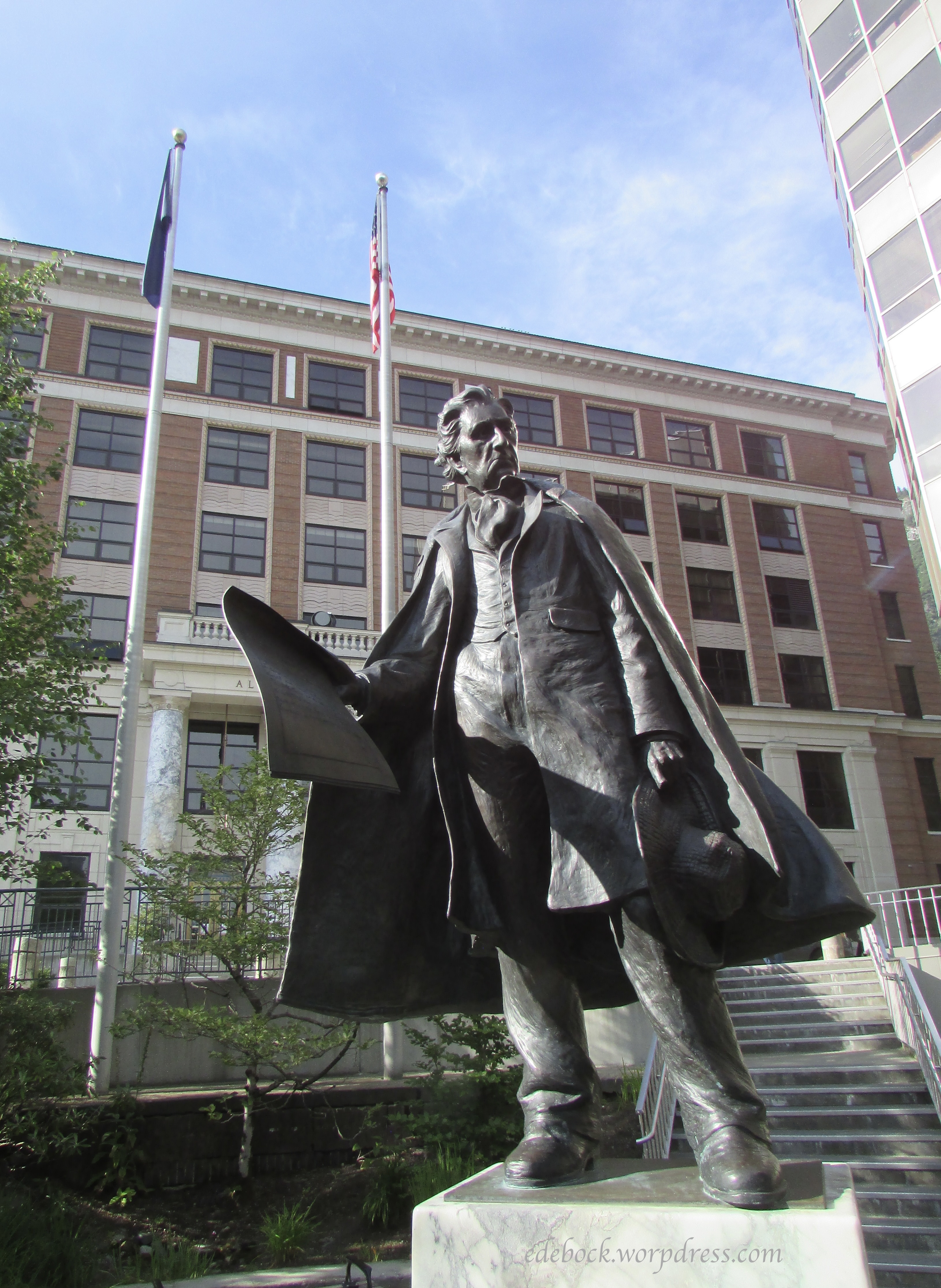
Like most coastal towns, Juneau is built on a hillside. We walked up a few steep blocks to see the Alaska State Capital building and the nearby statue of U.S. Secretary of State William Henry Seward who orchestrated the purchase of Alaska from Russia in 1867.

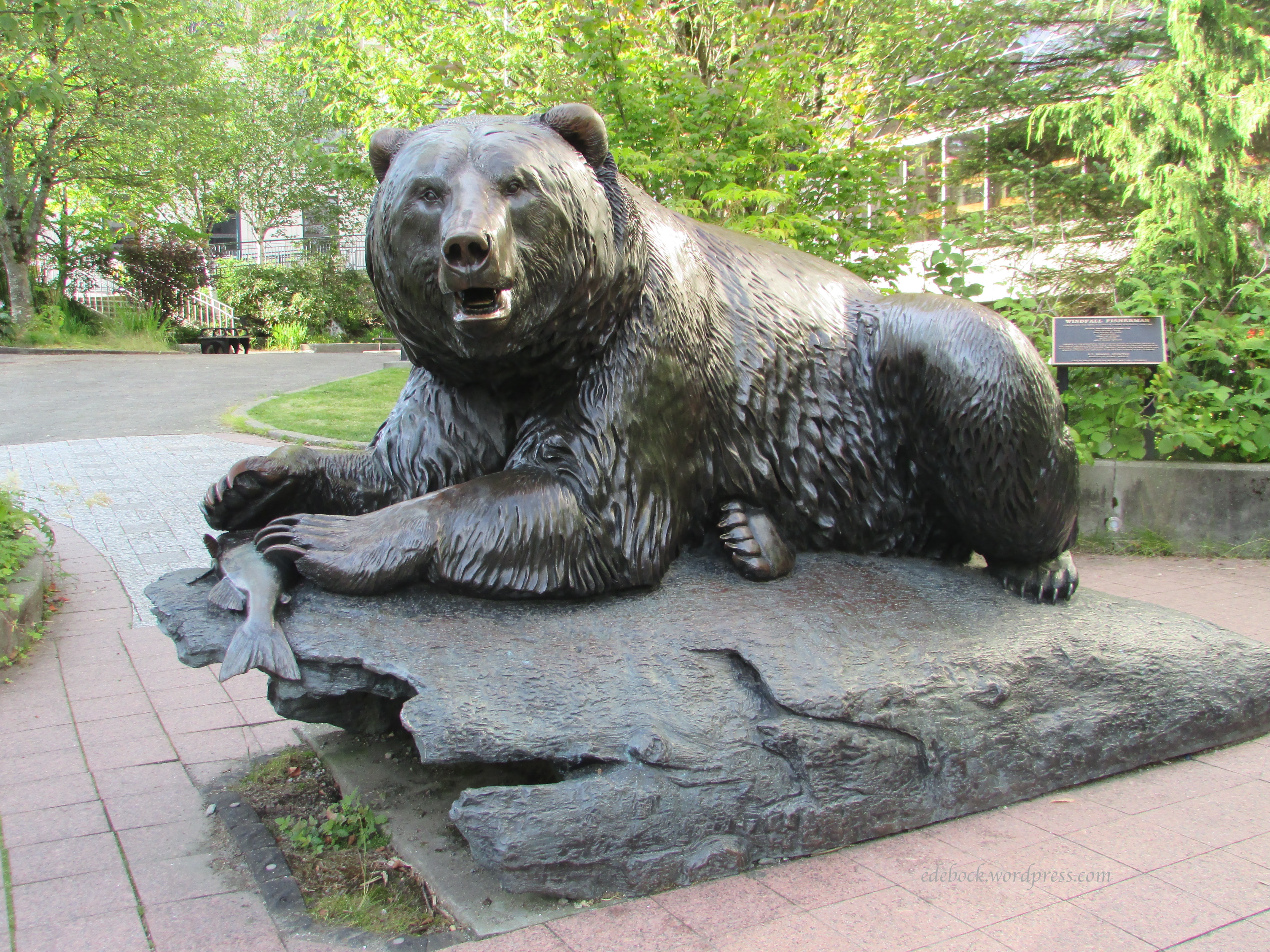
Close by was another bronze statue called Windfall Fisherman, a life-sized and very realistic brown bear by artist R.T. Wallen. 
Hubby’s feet were getting sore by this point, so we headed back downhill toward the waterfront and the seawalk where many of the city’s totem poles are found. Here’s just one example, the Ishkahittaan pole by Tlingit carver, Jon Rowan. At the top is Raven with the Box of Daylight. According to oral tradition, Raven opened the box and released the sun, bringing daylight to the world. Below Raven, you can see Frog and Sea Lion. 

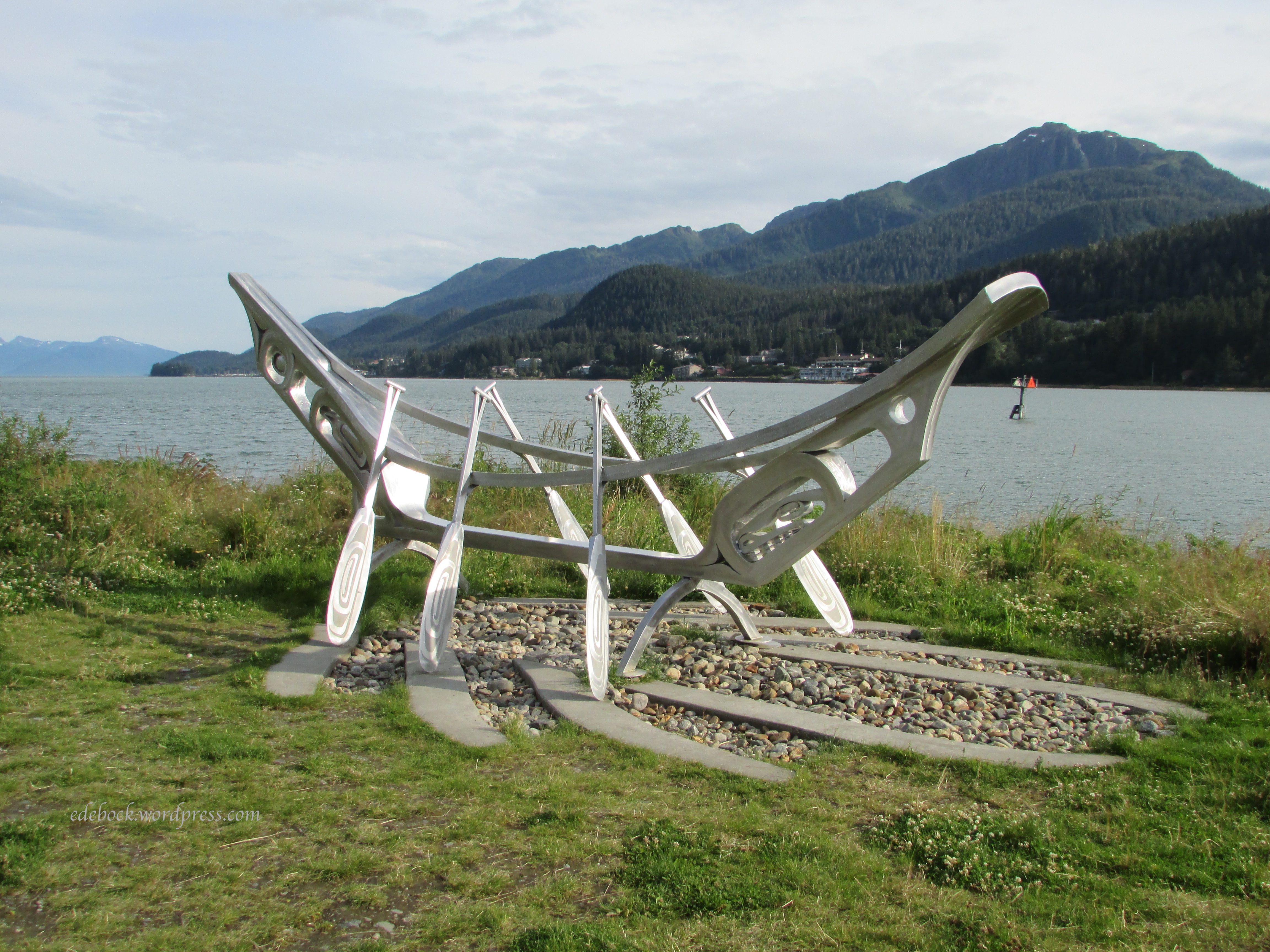
I loved the aluminum sculpture of a 20-foot 9-inch canoe, Yaadachoon, by native artist Robert Mills. The name means “straight ahead” in the language of the Tlingit. 
Although we didn’t see any whales close up while on our cruise, we did see Tahku, the life-sized bronze sculpture depicting a breaching humpback whale, also by artist R.T. Wallen, at the end of the seawalk. 

Skagway

I awoke very early the next morning to the haunting sound of the ship’s horn warning others of our presence. Standing on our stateroom balcony breathing in the heavy fog that surrounded us, I was transported back to my childhood on the waterfront. Crawling back into bed I fell back to sleep to the familiar sound of the foghorn. Later, when I woke again, the sky had cleared, the sun was shining, and we were docking at Skagway. 

Skagway is rich in Klondike Gold Rush history. 1897 and early 1898 saw tens of thousands of fortune-seekers pile off steamships, eager to head overland to the Yukon gold fields via the White Pass Trail from Skagway or the Chilkoot Trail from nearby Dyea.

It was from Skagway that we took the scenic White Pass rail excursion, a 40 mile, 2 hour and 45 minute round trip to the White Pass summit. Considering how long this post is becoming and how much I still have to share, I’m going to save that for a separate post. 

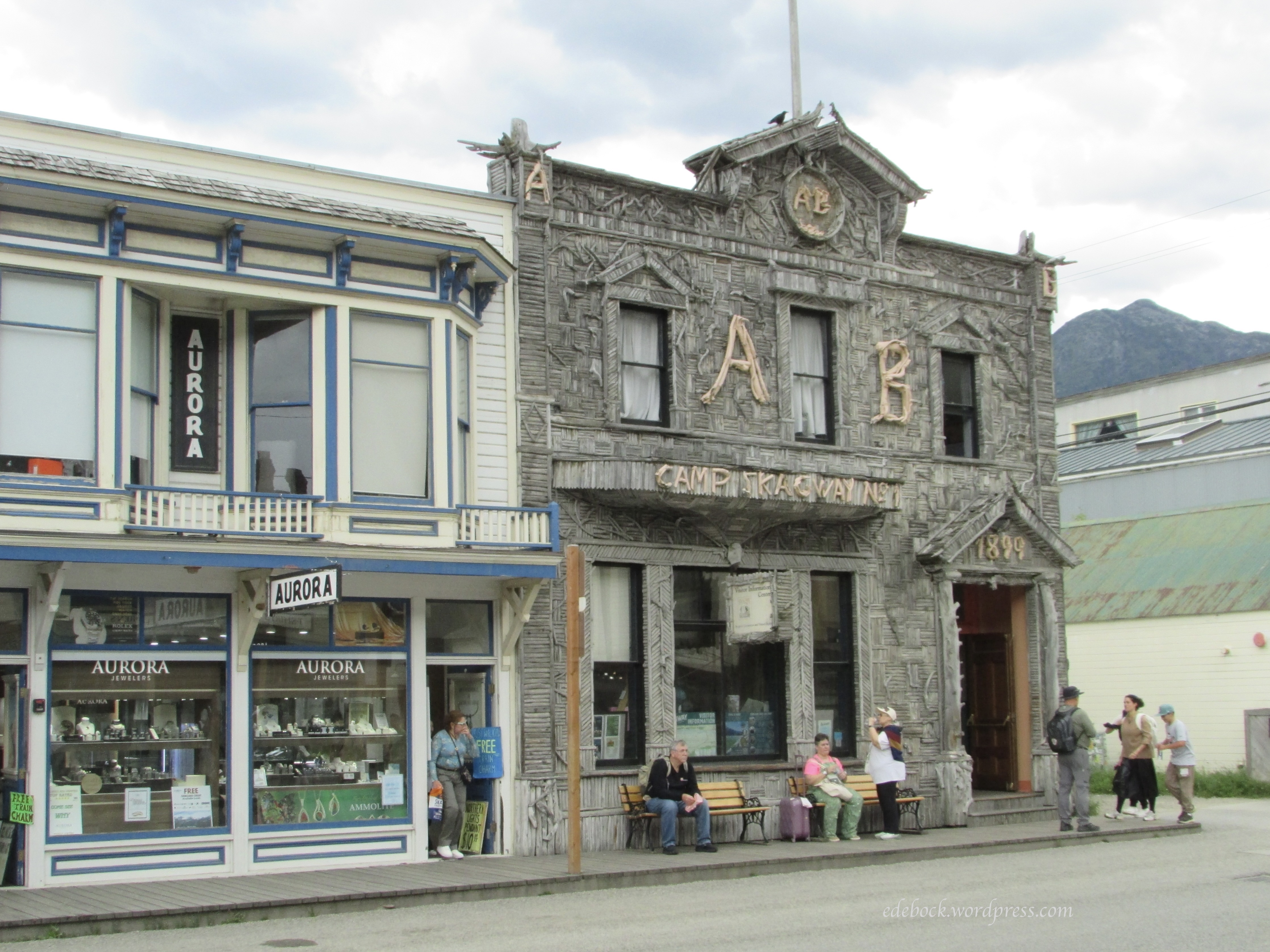
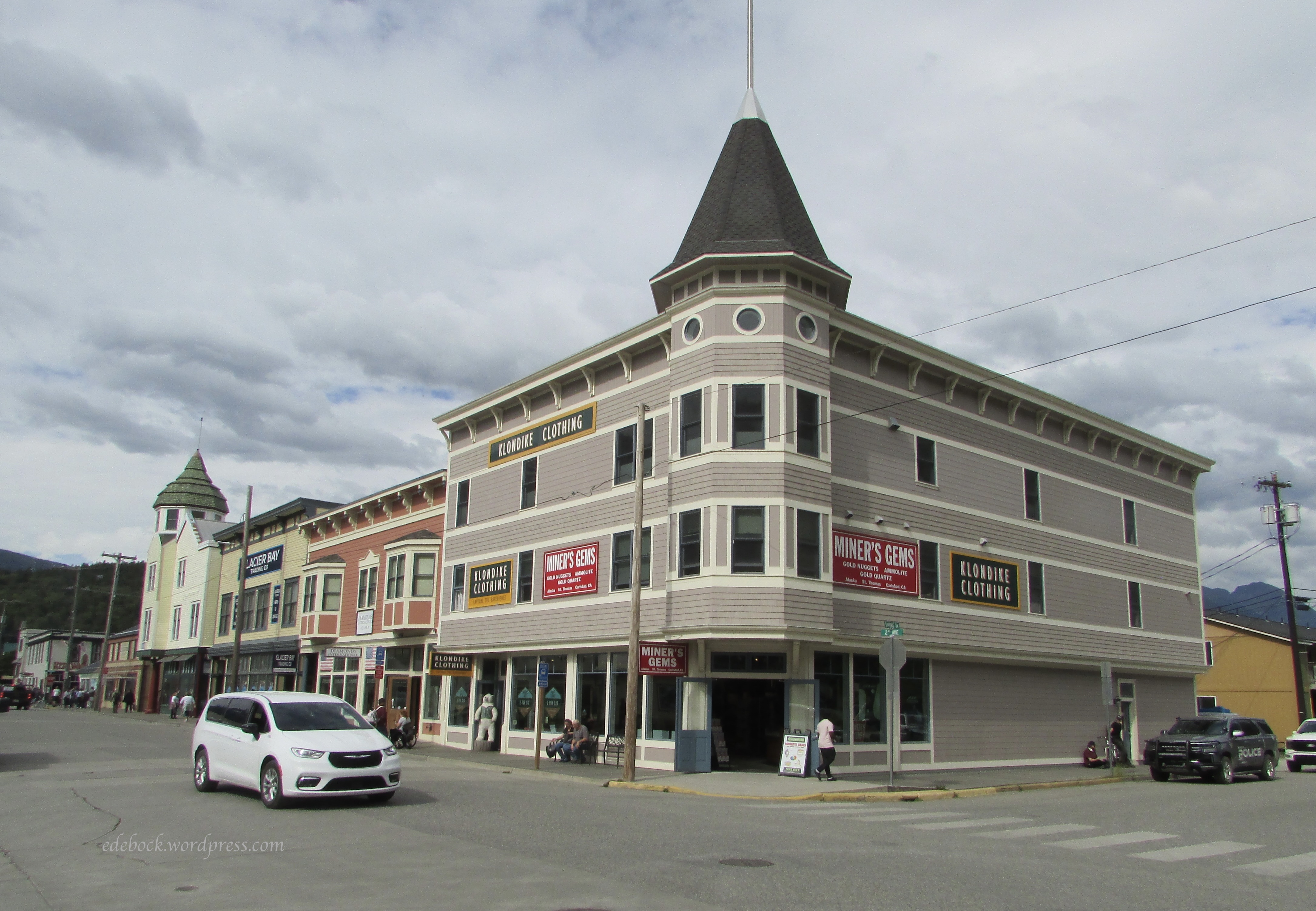
When we disembarked from the train, we were met by hubby’s sister and her husband who live across the Canadian border near Whitehorse in the Yukon. They drove about two hours each way to spend the afternoon with us. They took us to their favourite fish and chips restaurant for lunch and then we just walked around town while we visited. Hubby and I had been to Skagway by road many years ago and were well versed in gold rush history from our previous visits to the Yukon, so I didn’t take very many photos. Here are just a few to show you what the town, which has a year round population of about 1200, looks like. Most of the shops that cater to tourists are closed during the winter months. 
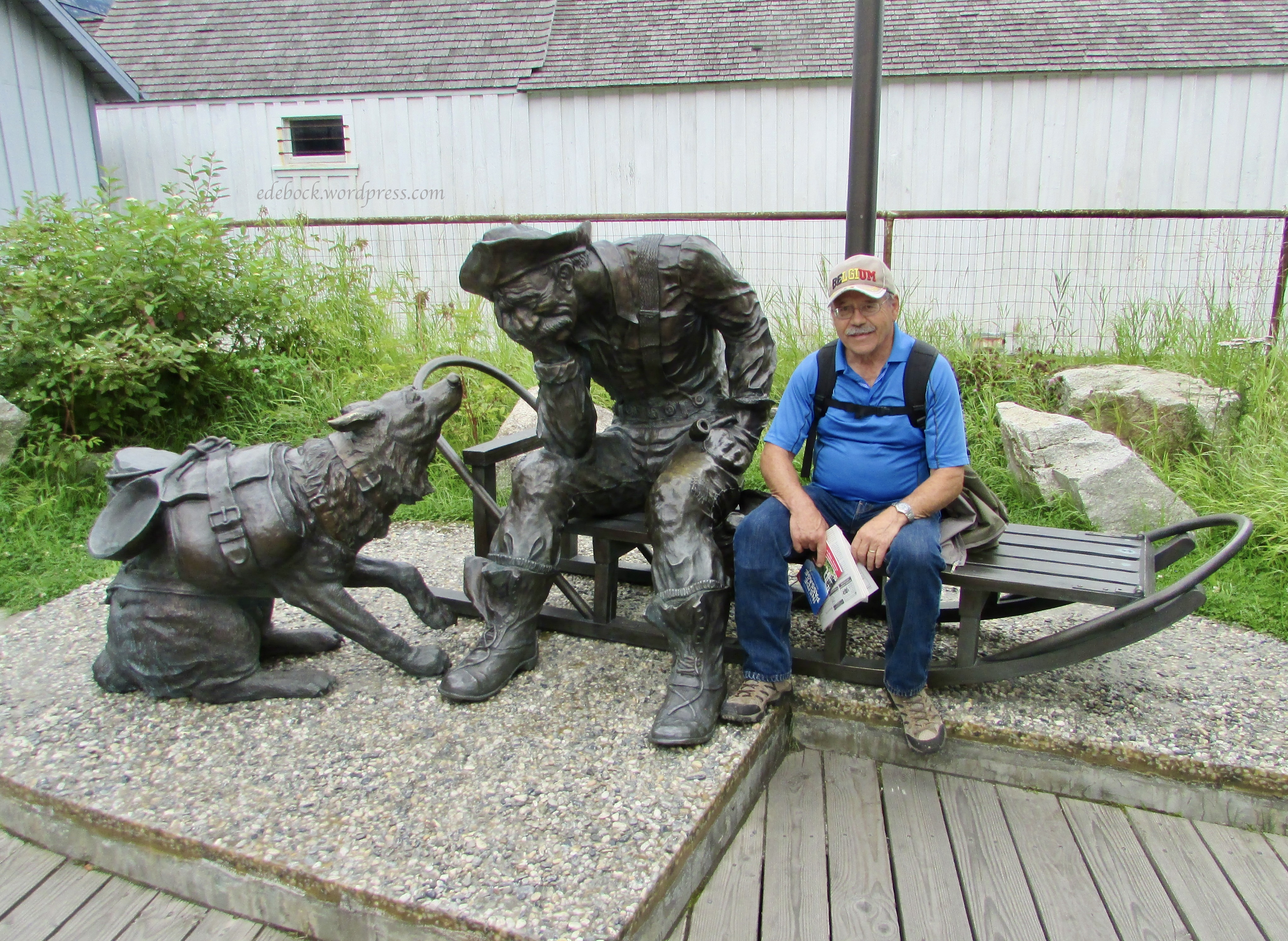
Here’s hubby hanging out with an exhausted gold seeker and his dog. 
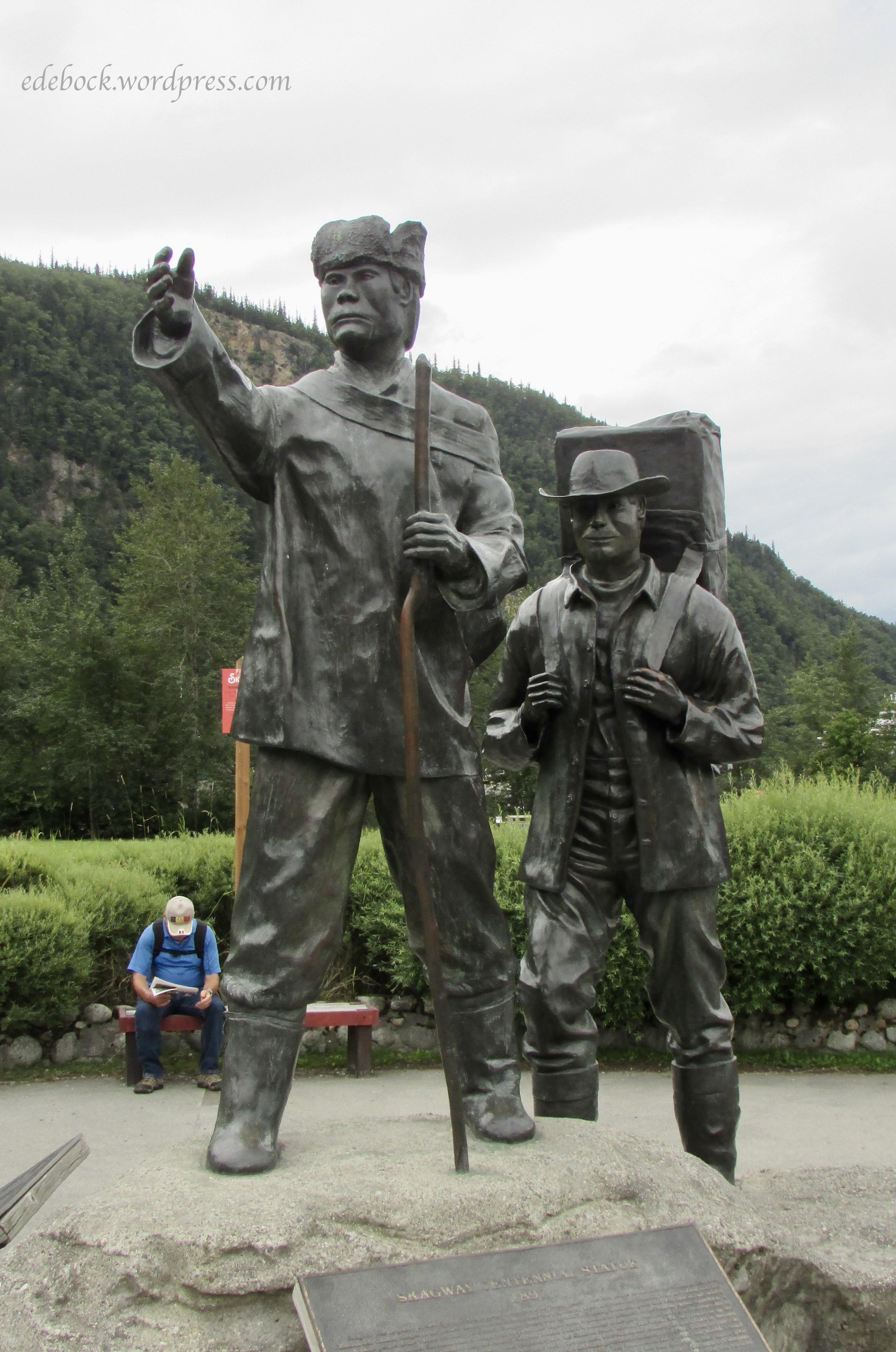
And perhaps you can spot him in this photo too. This is the Skagway Centennial Statue erected in 1997 in a park close to the train station.  
Endicott Arm and Dawes Glacier

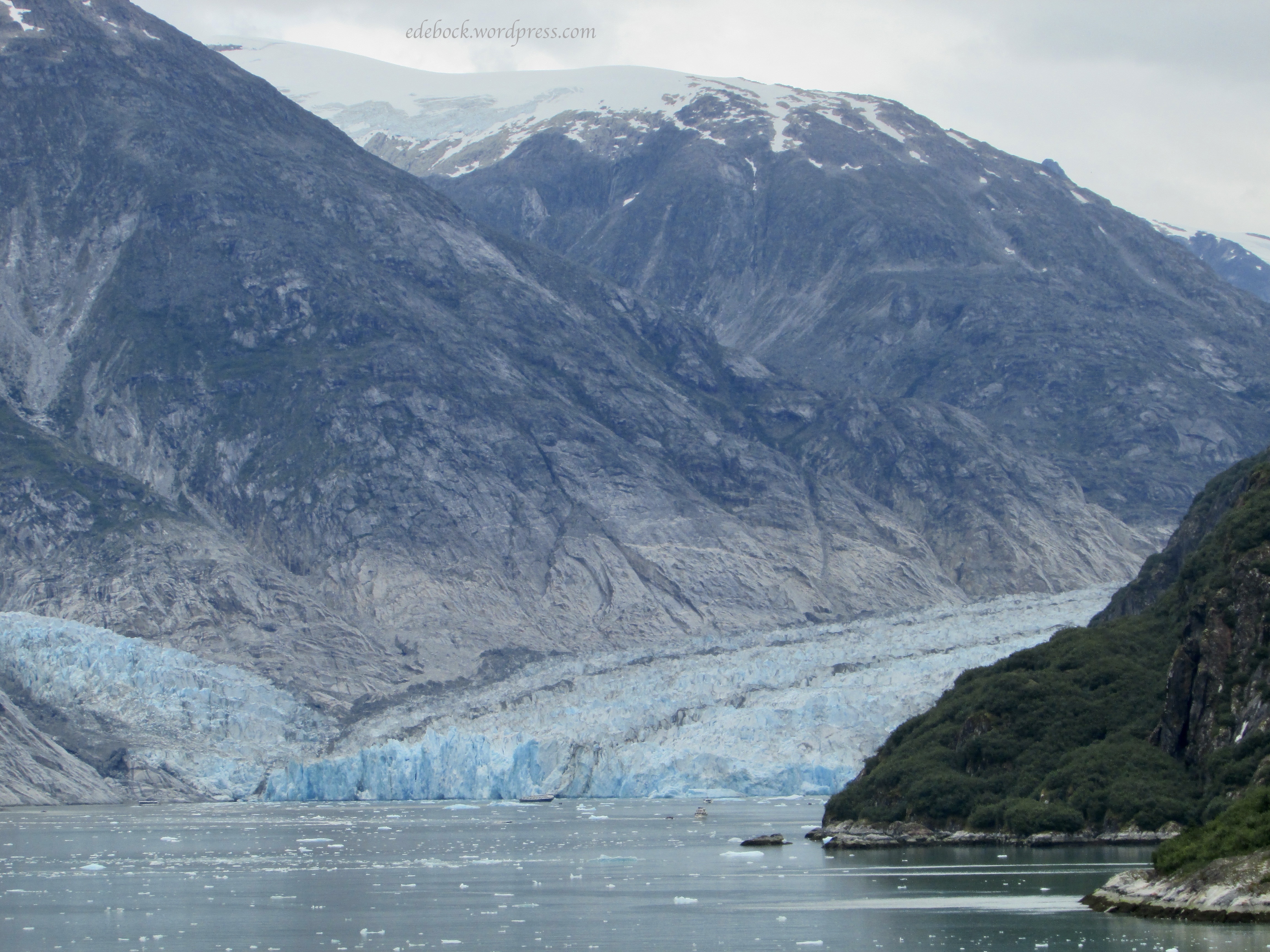
Next on our itinerary was a scenic cruise up Endicott Arm to view the Dawes Glacier. The further up the beautiful Arm we cruised, the more and bigger chunks of ice we began to see in the water. 

There were other glaciers like this one along the way, but they were high in the mountains and far from the shore. 
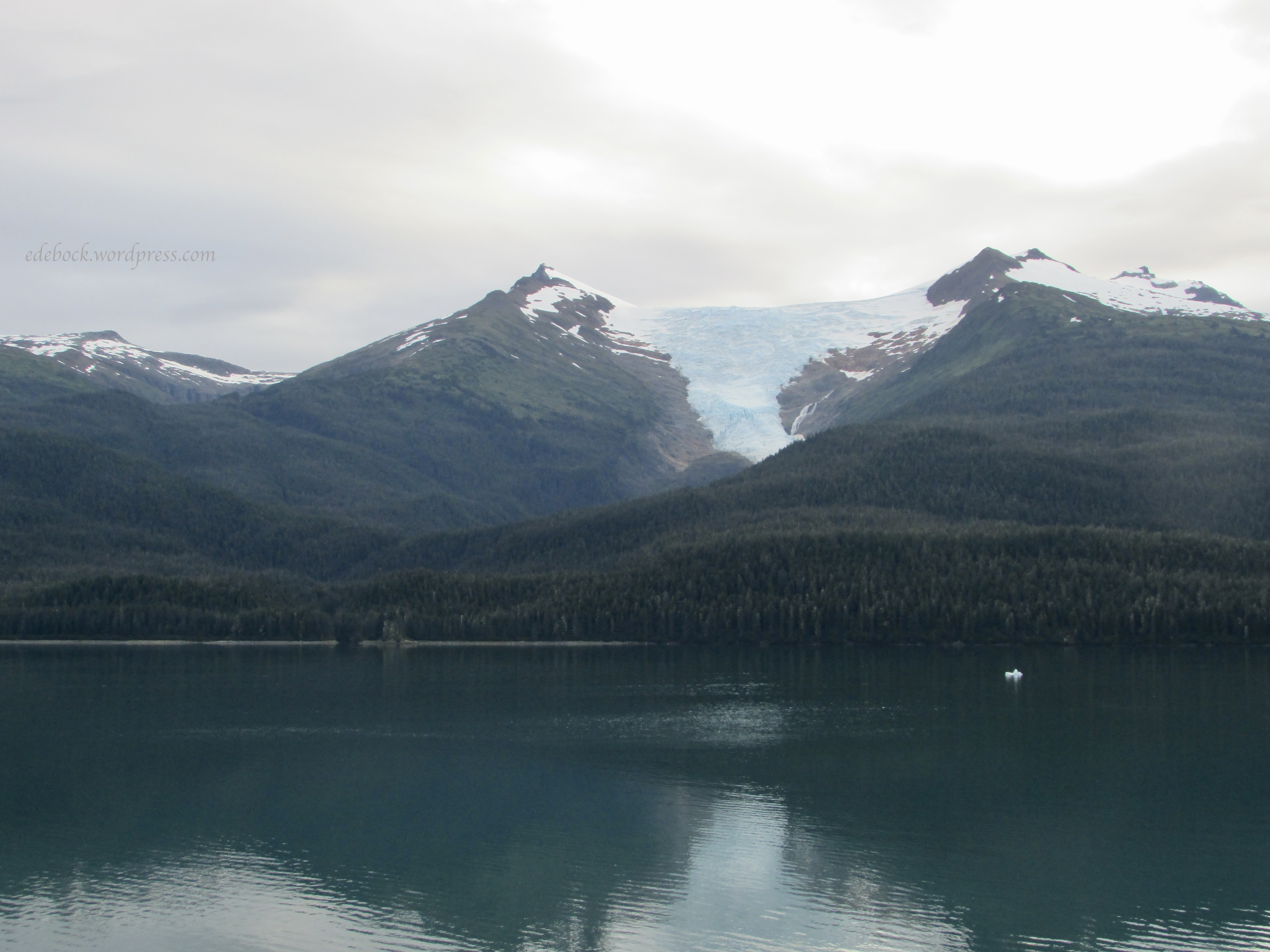
Eventually Dawes came into view. 

Because of the enormous size of our ship, we couldn’t get as close to the glacier as smaller ones could, so this was one of the times that we were very happy to have binoculars with us. The captain turned the ship in a complete slow circle so that everyone on either side could get a good view and lots of photos. 
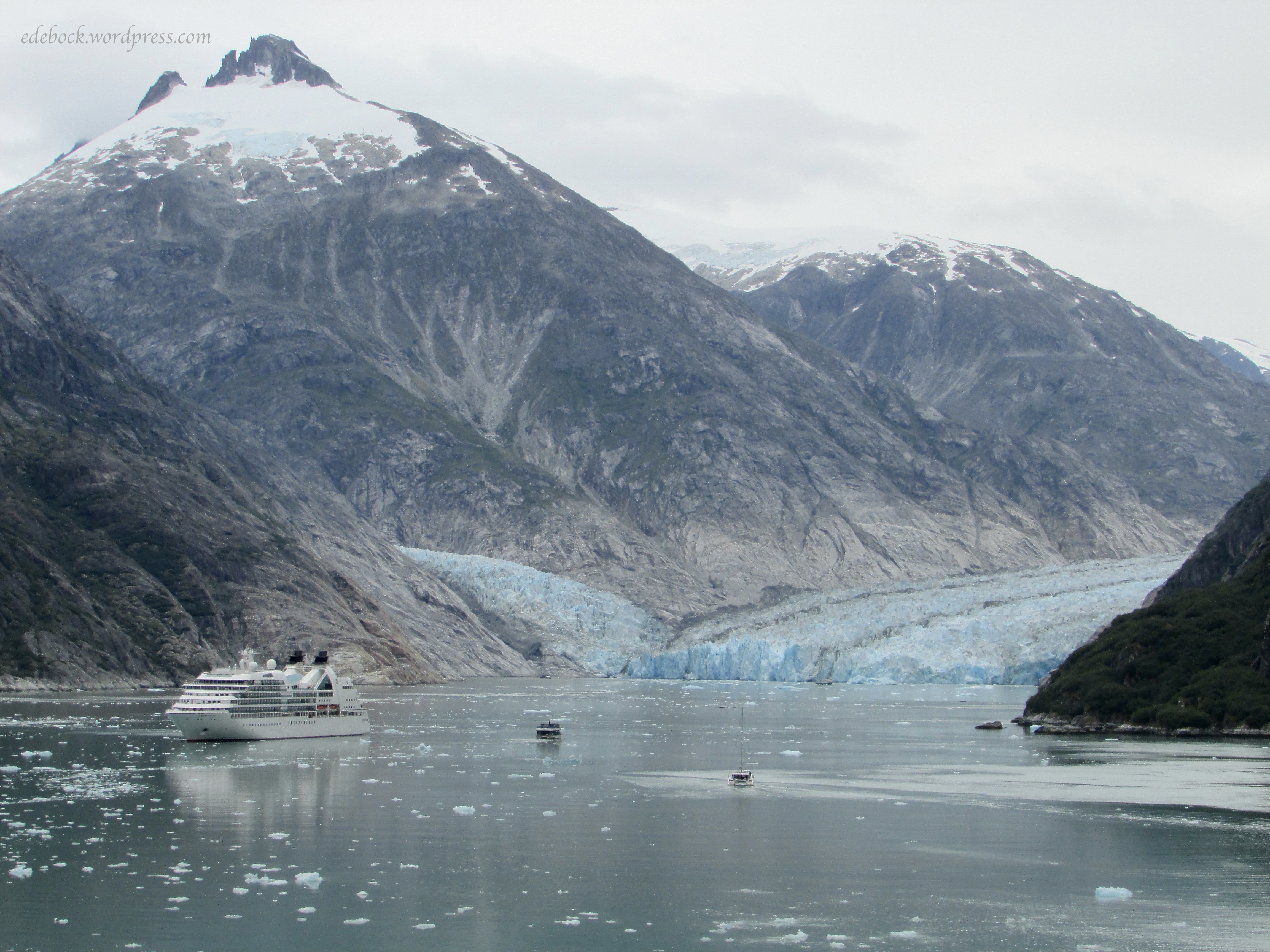
Why is the glacier blue, you ask? The naturalist on board explained that that’s because the ice is incredibly dense, having lost almost all of its air over time due to the immense weight of snow that compacted it. This dense ice absorbs most of the long-wavelength colours of white light, such as red and green, while allowing the short-wavelength blue light to pass through or scatter, which is what we see.

Ketchikan
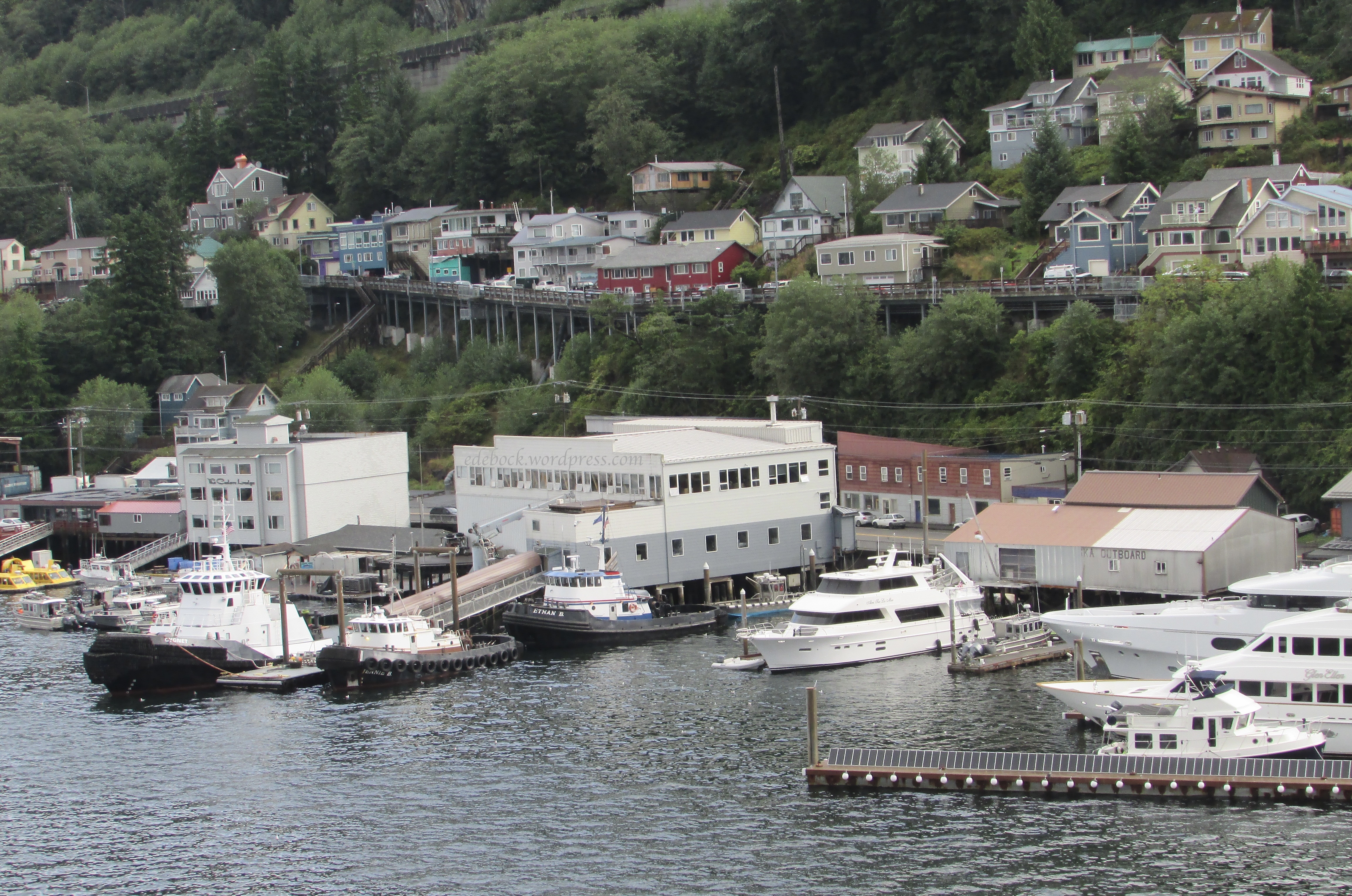
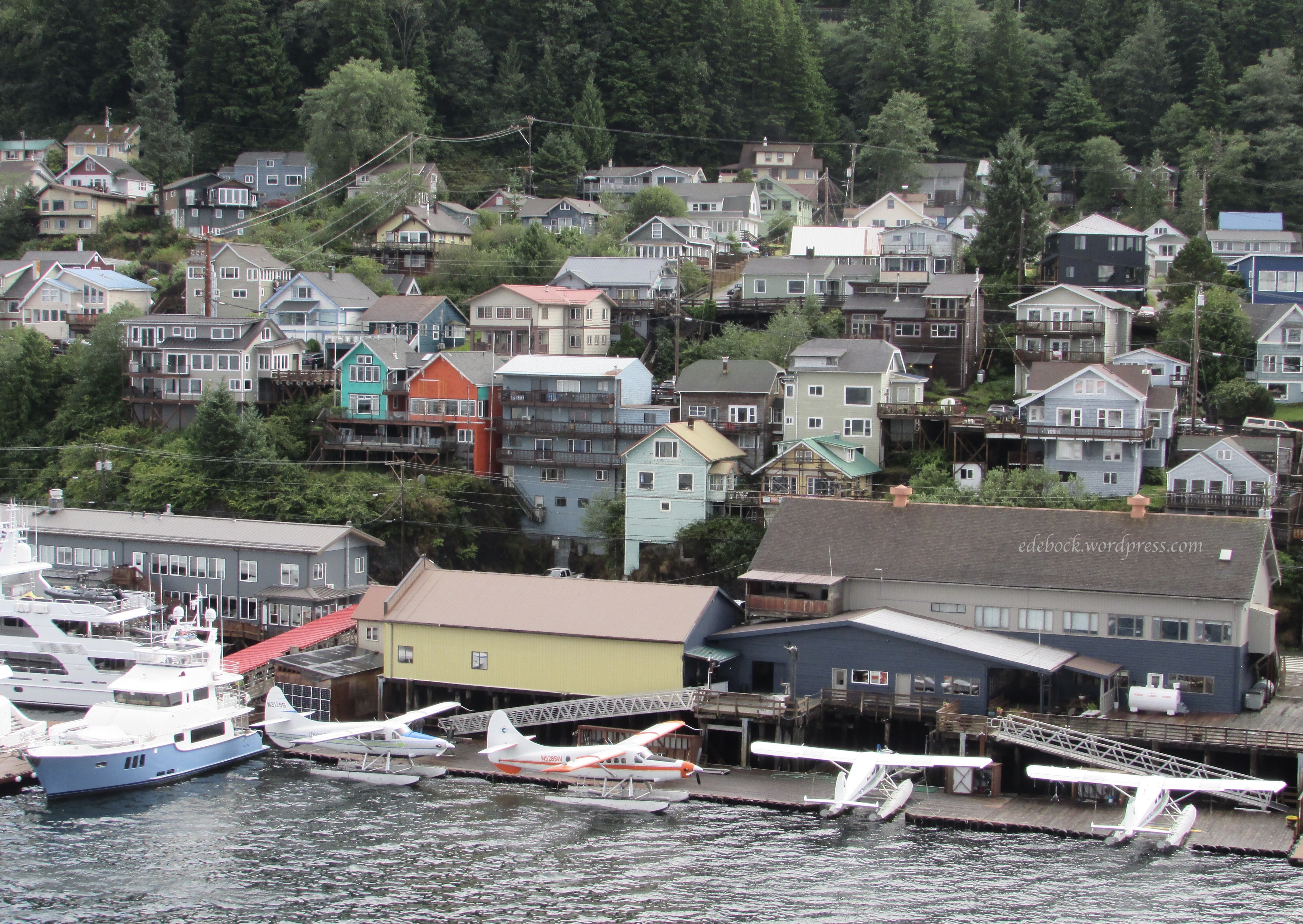
Ketchikan, with a permanent population of about 8000, was our last port of call. Like Juneau, it is inaccessible by road. It receives an average of approximately 150 inches of rainfall a year. Some of that fell while we were there, but we didn’t let that put a damper (pun intended) on our once in a lifetime opportunity to be there and see the sights.

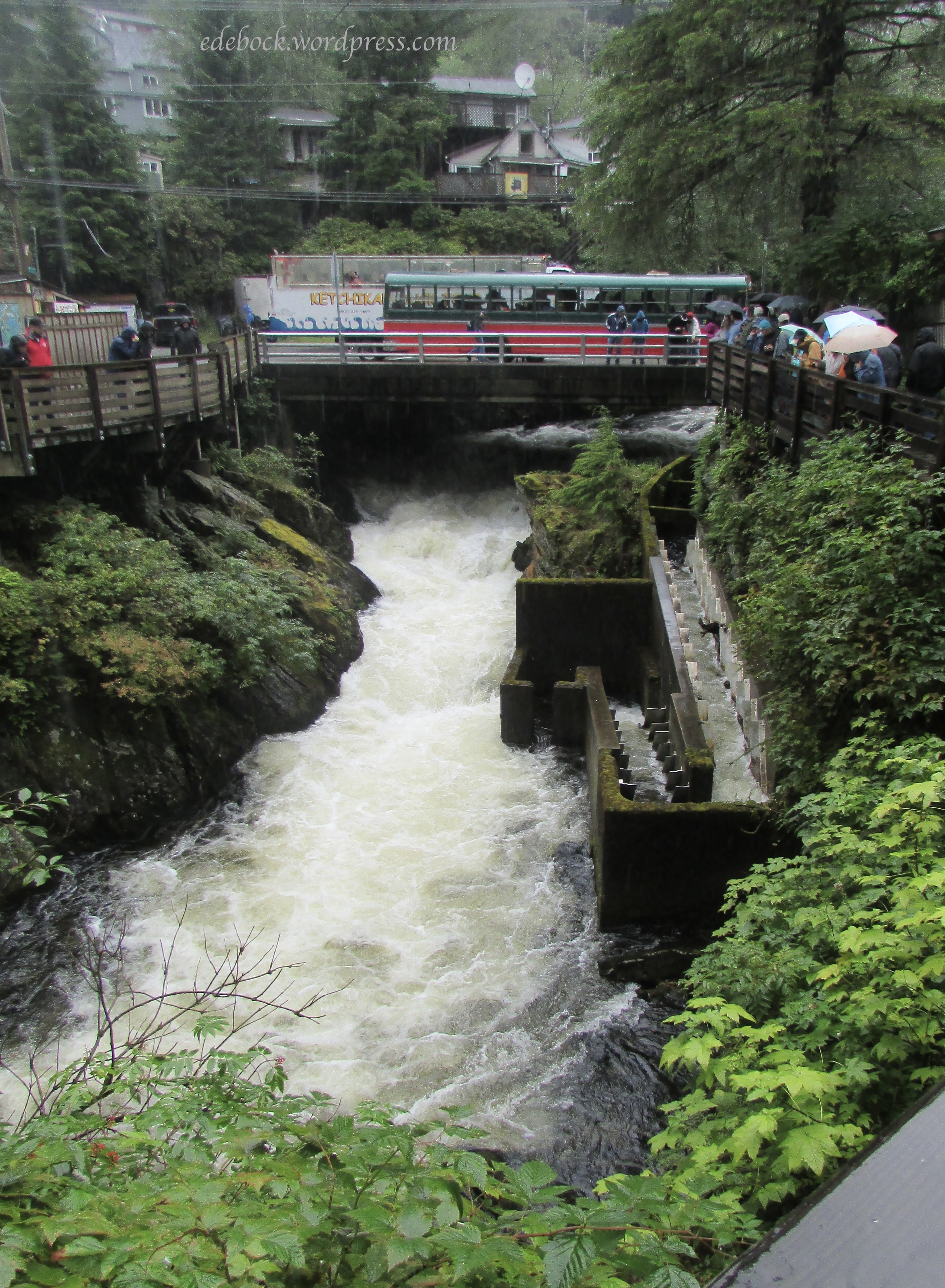
We started by walking the 1.5 mile (2.4 km) Salmon Walk which is dedicated to the importance of salmon to the area and to encouraging good stewardship of the fish and their habitat. The walk upstream along Ketchikan Creek  in the direction that the salmon swim took us past a fish ladder and a hatchery, then along a forest trail before continuing back into the downtown area. 
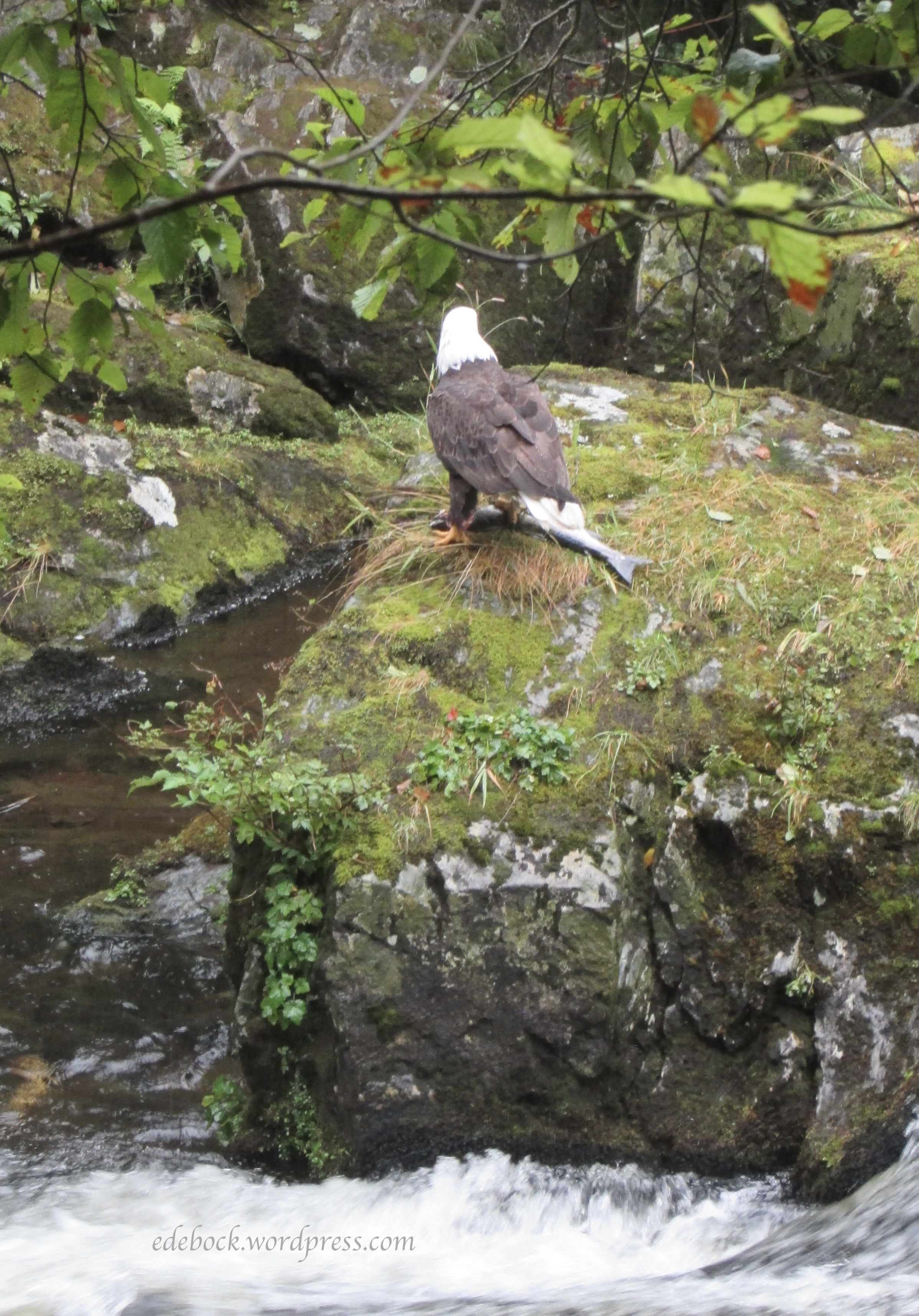
Along the way, we stopped to watch a bald eagle eating a freshly caught salmon. Unfortunately, it wouldn’t turn around and pose for me!
Halfway through the walk, we stopped at the Totem Heritage Center which houses an invaluable collection of 19th century poles retrieved in the 1970s from some of the nearby islands. It was a good place to escape the rain for a little while! 

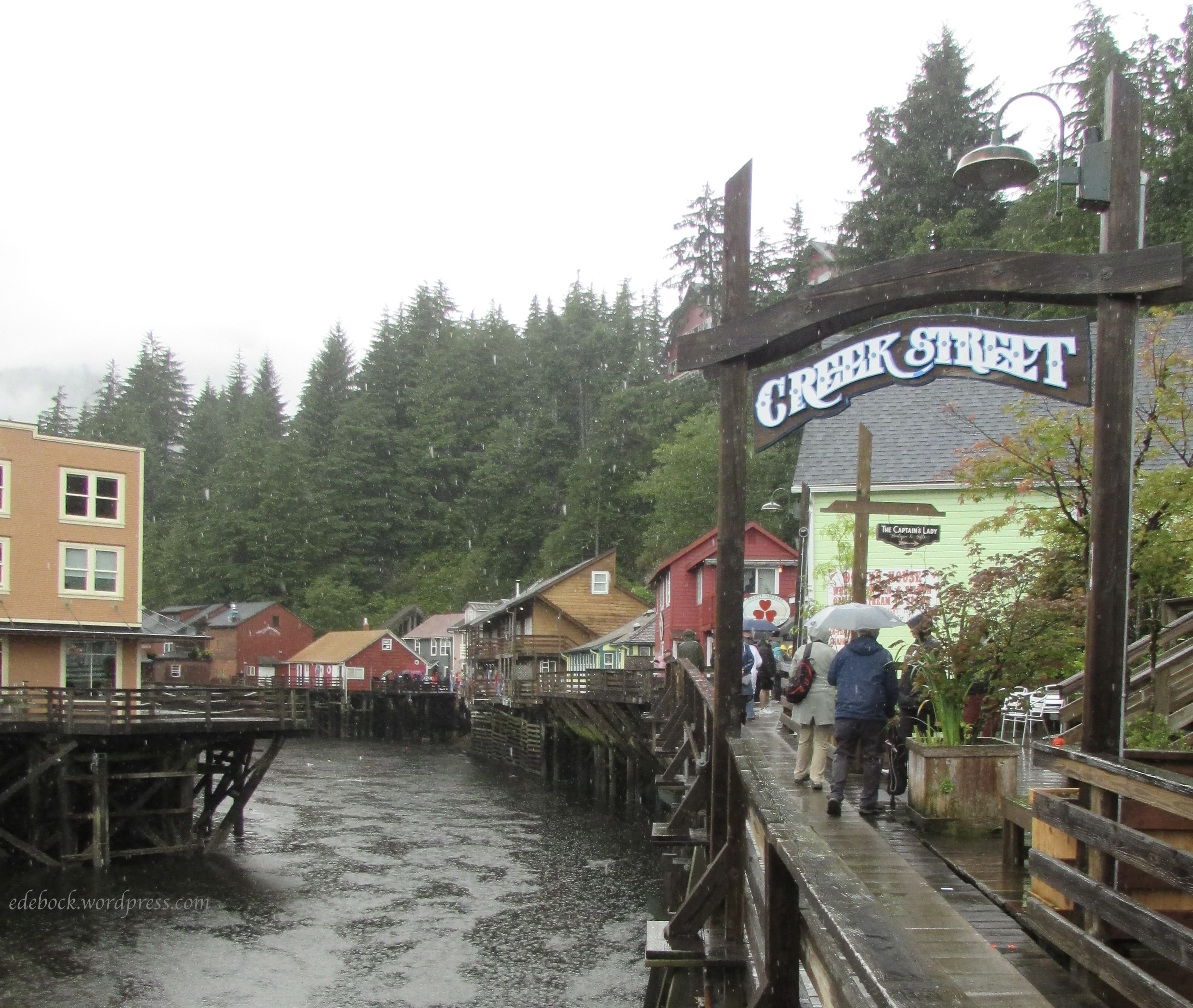
Our walk ended with a stroll along Creek Street, once the town’s red light district, but now a charming historic area known for it’s picturesque boardwalk built over the creek. We watched a couple of seals cavorting in the water there. 
After returning to the ship for lunch, we took a taxi to Saxman Totem Park about 2.5 miles (4 km) south of Ketchikan because we didn’t want to walk that far in the rain and the city bus only goes once an hour. Of all the things we saw and did on this this trip, Saxman was the only one that we considered to be a bit of a rip off. We were charged $8 USD apiece to walk around and look at the collection of totem poles, authentic replicas of original poles that were left in abandoned villages in the past. There was no map available to guide us and most of the descriptive signs were missing. The traditional clan house and the carving centre were closed and all that was open was the gift shop!  We did manage to tag along with a tour group that made a very quick stop there and heard the stories of a few of the poles from their guide. 
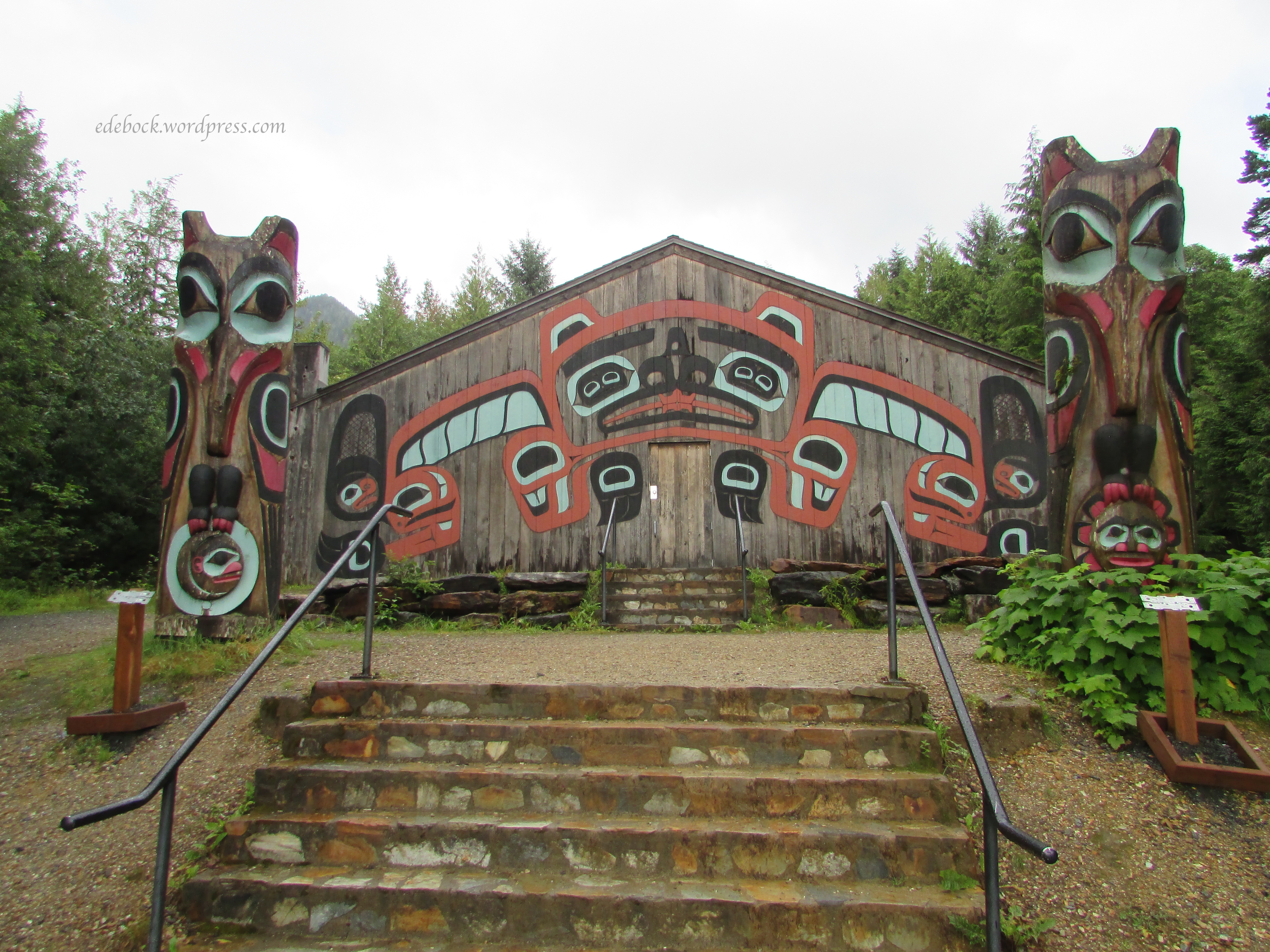
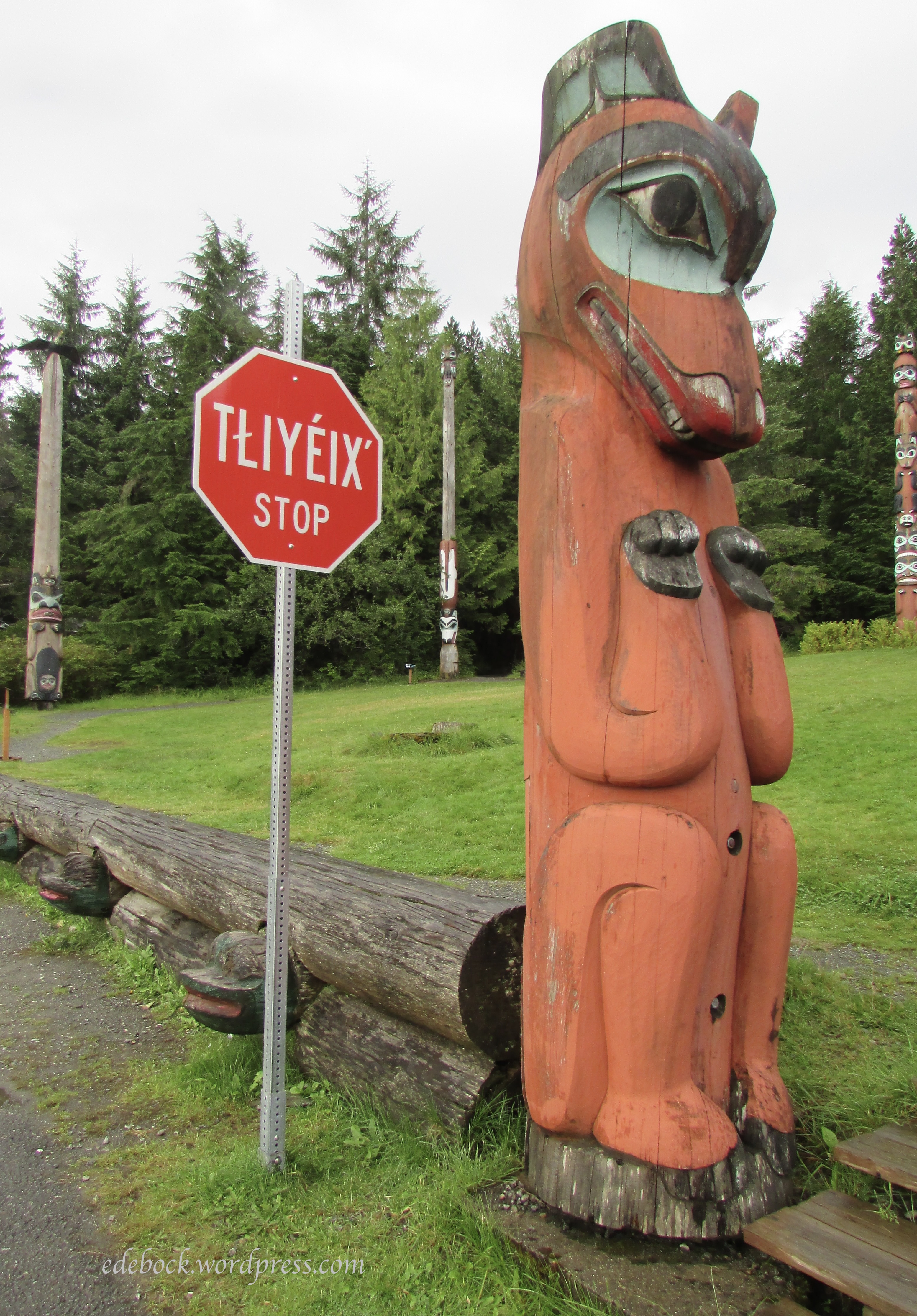
And that brings this very long post to a full STOP. If you’ve stuck with it and read this far, you are to be commended! 
 

Book of the month – June 2024

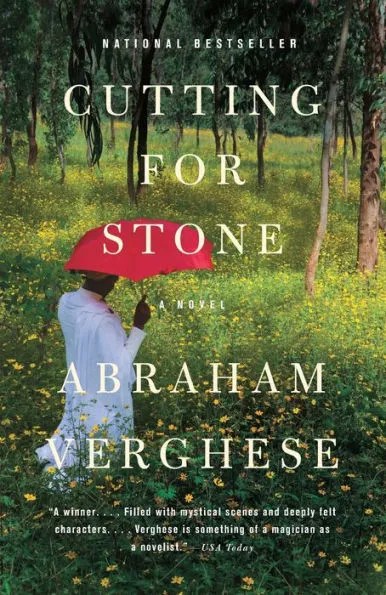
Cutting for Stone

Abraham Verghese

cutting-for-stoneFrom India to Ethiopia to America, Cutting for Stone, is an epic story that captured my attention and held it for the entire 658 pages! Although it’s a work of fiction, it reads more like a memoir.

Marion and Shiva Stone are twin boys born in a mission hospital in Addis Ababa to a nursing nun from India who dies in childbirth and a British surgeon who disappears immediately after their birth. Raised on the hospital compound by two Indian doctors, the boys grow up with a love for medicine and though their pathways are very different, both eventually become doctors.

This emotional and complex family drama combines elements of Indian and Ethiopian culture, coming of age, third world medicine, political revolution, and emigration. It’s a tale of abandonment, betrayal, loss, loneliness, love, lust, envy, friendship, disease, poverty, education, and so much more. Most of all it’s a story about home, family, and belonging.

The author, Abraham Verghese, is a physician, a professor, and Vice Chair of Education at Stanford University Medical School. Born of Indian parents who were teachers in Ethiopia, he grew up near Addis Ababa and began his medical training there before emigrating to the United States. I’m always amazed when a doctor has time to write anything other than medical papers and reports, but Verghese has authored four best-selling books; two memoirs and two novels.

Cutting for Stone contains a lot of medical detail. Other than what I’ve learned as a patient, I have no medical background or knowledge, but I found that aspect of the story quite fascinating. Verghese has a gift for describing medical procedures in such a way that they are interesting, easily understood, and while sometimes quite graphic, not gross at all.

I tend to agree with the Goodreads reviewer who wrote, “It is statistically improbable that I will read a book as good as this one anytime soon.”

Book of the month – November 2023

The Tea Girl of Hummingbird Lane

Lisa See

81URNOpF3vL._SY522_I read mostly for enjoyment, but I love a book that transports me to another place or perhaps another time and a book that teaches me something. The Tea Girl of Hummingbird Lane was such a book. Before reading it, I knew absolutely nothing about the Akha people, a minority hill tribe who live in small villages in Thailand, Myanmar, Laos, and Yunnan province in China.

As the story opens in the late 1980s, the families of Spring Village are living a very traditional lifestyle without modern conveniences and with very little contact with the outside world. Traditional beliefs and rituals dominate their existence and their lives are aligned around the seasons and the growing of tea. When twins are born to a young village couple, the father is required to kill his babies and the couple is banished from the village.

That’s when I had to put the book aside to do a bit of research. Who were these Akha people? Did they really exist? Were they still living that way in the late 1900s? I learned that indeed they were. The Akha believed that only animals could give birth to more than one offspring, therefore until about 20 years ago, twins were considered an extremely ominous occurrence and were killed immediately, as were babies born out of wedlock.

Now, back to the story… Gradually, the outside world begins to encroach on Spring Village. Li-yan, daughter of the local midwife and one of the few educated girls on the mountain, slowly begins to reject the customs that shaped her early life. When she gives birth to a baby out of wedlock, she rejects tradition and travels with her newborn daughter to a nearby city. There she leaves the baby, wrapped in a blanket with a tea cake tucked in its folds, near an orphanage.

While Li-yan eventually leaves her village for further education, a job, and city life, her daughter, Haley, is raised in California by loving adoptive parents. Despite her privileged childhood, Haley wonders about her origins and across the ocean, Li-yan longs for her lost daughter. Over the years, each searches for meaning in the study of Pu’er, the tea that has shaped their family’s destiny for centuries.

Perhaps the well-researched story tells us more about the history and the production of tea than we really care to know, but it’s also an enthralling family saga; a captivating story of mothers and daughters, families, fate and love. A secondary narrative depicts what it might be like to be one of the many Chinese girl children adopted by American families.

My favourite quote? “Those who suffer have earned contentment.”

373533072_273279982227296_6534294399832151140_n

Fashion Friday will return next week. 

Book of the Month – September 2023

I Am a Bacha Posh

Ukmina Manoori

9781629146812-usThe subtitle of this short, but intriguing memoir, My Life as a Woman Living as a Man in Afghanistan, tells much about the content of the book, but it could also be misleading to those of us living in western cultures. This is not a book about living a trans experience.

You will be a son, my daughter.” With these stunning words young Ukmina learned that she was to spend the remainder of her childhood as a boy. This had nothing to do with gender confusion on her part. In Afghanistan’s heavily patriarchal, male-dominated society, it is customary for some families, especially those without sons, to choose a daughter to live, dress and behave as a boy, even taking on a boy’s name. These children are known as bacha posh which means “dressed up as a boy” in the Persian dialect, Dari.

Families have various reasons for making this choice and there are no statistics on how many families have daughters living as bacha posh. In most cases, due to the somewhat secretive nature of the practice, only the family, close friends, and necessary health and education officials know the bacha posh’s biological sex.

As a bacha posh, a girl has all the freedoms denied to her as a member of the female sex. Instead of staying at home cooking and cleaning, she can move about freely in public, attending school, running errands, playing sports, and sometimes finding work to help the family make ends meet.

Once a bacha posh reaches puberty, however, she is expected to revert to traditional female roles putting on the veil, staying at home unless accompanied by a male, and preparing for an early marriage. What makes Ukmina’s story unique is that when that time came, she refused. Confronting societal and family pressure, she continued to live as a man, not because of gender dysphoria, but because she doesn’t want to give up the the rights and privileges of a male in Afghan society.

Ukmina’s choice paved the way for an extraordinary destiny. She acted as a scout for the resistance when the Soviet Union invaded Afghanistan and ultimately commanded the respect of everyone she encountered. There did come a period of time when she lived in isolation and fear of the Taliban and even of some of her fellow villagers who didn’t agree with her life choices. Eventually, however, she entered politics and as an elected member of her provincial council, fights tirelessly to improve women’s rights.

Rather than telling you any more of her story, I’m simply going to share three quotations that I think wrap up Ukmina’s thoughts about her experience and the life of women in Afghanistan.

Living in men’s clothing has given me a certain freedom. A life as a woman in Afghanistan is a life of destruction.

I say to myself that I have sacrificed nothing. I have done what I had to do. I became what I was. I found my destiny. And there is nothing I lack.

I also told myself that women were beautiful creatures of God. Men were cruel. I often asked Allah: “Give me the power of men and the kindness of women.””

If a novel about bacha posh would be more to your liking, I would highly recommend The Pearl That Broke Its Shell by Nadia Hashimi.

Art to wear

LogoI grew up on the Pacific coast of Canada with a deep appreciation for the art of the Indigenous people of that area. Four years ago, I shared the story of the beautiful hummingbird ring made by Haisla artist, Hollie Bear Bartlett, that hubby gave me for Christmas.

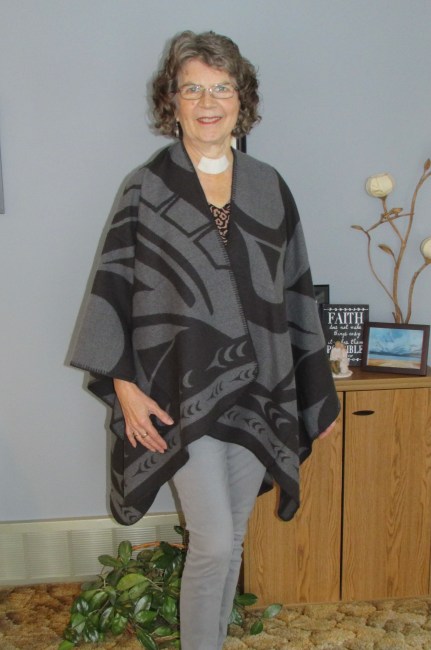
This Christmas, I received some more wearable Pacific coast art!

IMG_3493

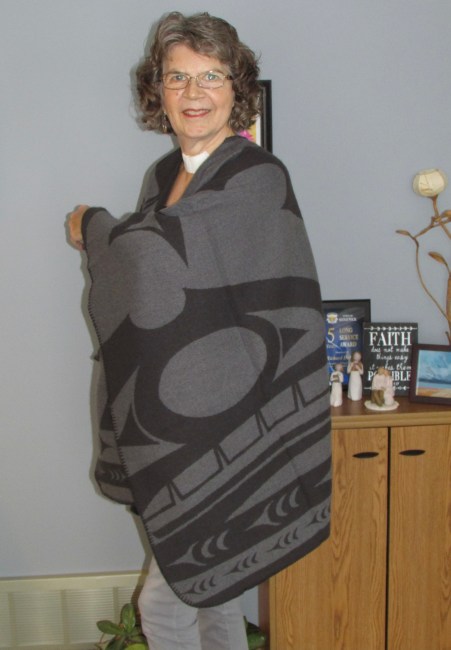
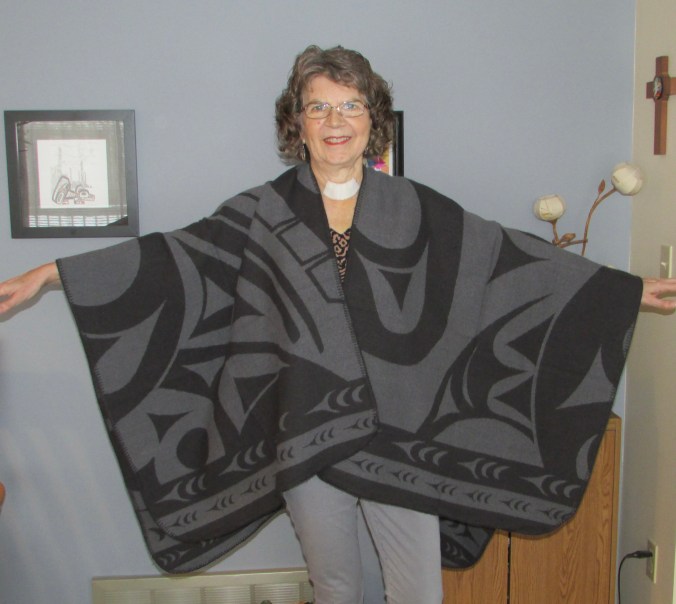
The cozy, reversible wrap, was a gift from the Vancouver branch of our family; our oldest son, his wife, and their two sons. A product of Native Northwest, it features the work of Coast Salish artist, Doug Horne. You can probably see the whale motif best in this photo. Look for the rounded head, the toothy mouth, and the blowhole on top.

IMG_3498

In the stories of the Northwest Coast, the killer whale, or orca, is associated with strength, dignity, prosperity, and longevity.

IMG_3503

100% of the art featured on Native Northwest products is designed by Indigenous artists and used with their consent. Artist names and cultural affiliations are acknowledged on all packaging and the artists are paid in fees and royalties.

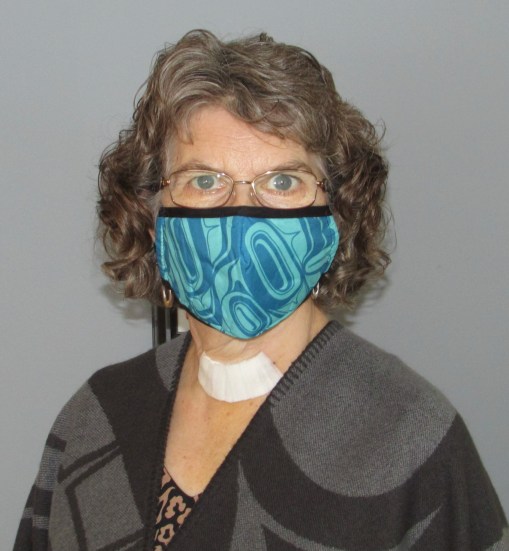
In addition to my beautiful wrap, hubby and I received two Native Northwest masks from another family member. Here, I’m wearing the eagle design by Haida artist, Roger Smith. Eagles are associated with guidance, hope, healing, and the pursuit of freedom.

IMG_3507

IMG_3509

You can easily see the tentacles on Ernest Swanson’s octopus on the mask on the right. Swanson comes from a long line of established Haida artists. The octopus is respected in the Northwest coast culture for its ability to adapt to change. The raven mask on the left, by well-known Tsimshian artist, Roy Henry Vickers, is one that I purchased when we were in Vancouver in October. It was produced by Oscardo, another company that partners with Canadian and Indigenous artists and pays royalties for each product sold. The raven is an important figure in Northwest coast art and mythology. Known as a trickster, he has the power to transform both himself and other beings. He can even change animate to inanimate, and vice versa. Hopefully, when I wear the mask, he transforms Covid into something harmless!

IMG_3495

Perhaps this is a good time to talk about the difference between cultural appropriation and cultural appreciation. Cultural appropriation involves adopting an element of another culture without respect for its meaning or significance or with the purpose of exploiting the culture for personal gain. Appreciation, on the other hand, involves a desire to learn about another culture in order to broaden one’s perspective and understanding. It also involves fair compensation and giving credit where credit is due. That’s why it’s so important to me to learn the meaning behind the symbols that appear on my wearable art and why I appreciate the fact that companies like Native Northwest and Oscardo credit the artists and pay royalties for their work.

If you’re interested in knowing more about the stories behind the symbols and creatures that appear in the art of the Pacific Northwest, the book Understanding Northwest Coast Art by Cheryl Shearar is an excellent resource.

The ancient art of henna

LogoThough I have nothing against them, I’ve never had any desire to have a permanent tattoo. For quite some time, however, I’ve wanted to try the ancient art of henna and I finally had the opportunity when I came across Dinkal Patel‘s booth at a recent community event.

While the use of henna is most often associated with India and Pakistan, it’s origin is difficult to pinpoint. It’s earliest use appears to date back to the Pharaohs of ancient Egypt. Cleopatra, the last reigning queen of that early civilization, is said to have used it to adorn her body and beautify herself.

In modern times, until fairly recently, intricately designed henna tattoos, or mehndi, were predominantly used as part of traditional Indian wedding celebrations. Designs symbolizing good luck, wealth and health are applied to the hands and feet of the bride the night before her wedding. It is believed that the henna will cool the body’s nerve endings and help keep her calm throughout her big day. This custom holds great cultural significance in Hinduism and the symbols that are used are considered sacred.

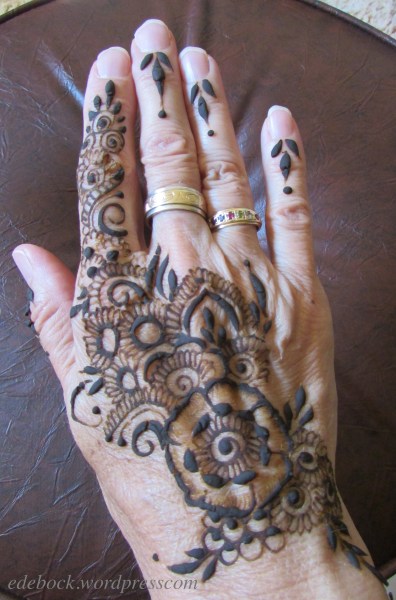
These days, however, henna tattoos have found their way into western culture where they act as a form of body jewelry. Though Dinkal does do bridal henna, the designs that she offered at her booth were more generic. After looking at some of the examples on display, I chose to have a floral design applied to the back of my right hand. I was astonished at how quickly she applied the henna paste. Working completely freehand, she was done in no more than ten minutes and charged only $15!

with dried paste

Dinkal told me to leave the dried paste in place for 2 to 3 hours before removing it. I left it a little longer than that until it began to crumble and fall off. When I removed the remainder, because I didn’t know how henna dye worked, I was hugely disappointed. Most of the design was indistinct and looked like I’d simply spilled something orange on my hand or as hubby said, like I’d scraped my hand on the concrete!

Immediately after removing paste

Dinkal had also told me to try to keep the design dry until the next day, so even though it didn’t look like the henna was going to amount to much, I followed her instructions. That’s a little tricky to do when it’s on your right hand, but hubby took over supper making for the day and I kept it out of water. As the evening progressed, I thought perhaps it was beginning to darken, but I chalked that up to wishful thinking or an overactive imagination. Imagine my surprise and delight when I woke up the next morning and this is what I saw!

next morning

The design continued to darken until it looked like this at the end of the following day. I was delighted!

end of day 2

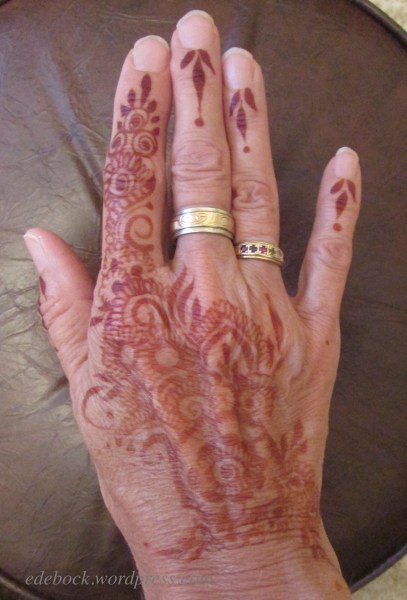
Over the next week or so, had numerous comments and compliments, even from total strangers! The most frequently asked questions were where I’d had it done and how long it would last. Though I’d read that henna tattoos can last from 1 to 4 weeks, Dinkal told me to expect about a week and a half and it appears that she was correct. Here’s how it looked at the end of day 8. Gradually disappearing, but not yet unattractive.

IMG_2994

By yesterday morning, almost two weeks after the henna was applied, only the darkest bits remained. There was no design left on the back of my hand, just a smattering of brown dots. I did some research into how to remove faded henna tattoos and found several different suggestions. The most common ones involved baking soda and lemon juice. Another suggestion that sounded like it would be kinder to my skin involved using either baby oil or coconut oil. I didn’t have either of those on hand, so I decided to try olive oil which, like henna, has been used on skin since ancient times. It’s loaded with nutrients, is a natural humectant, and is rich in antioxidants. I applied it to the back of my hand, left it for 10 minutes, then gently scrubbed it off using a facecloth and hand soap. It worked like a charm! The designs at the ends of my fingers, though faded, still looked okay, so I left them for now.

Next time… and yes, I’m pretty sure there will be a next time… I’d like to try a henna tattoo on my shoulder or forearm. Since my hands are in and out of water constantly, I thinking that perhaps it would last a little longer in one of those locations.

How did pink become a girls’ colour?

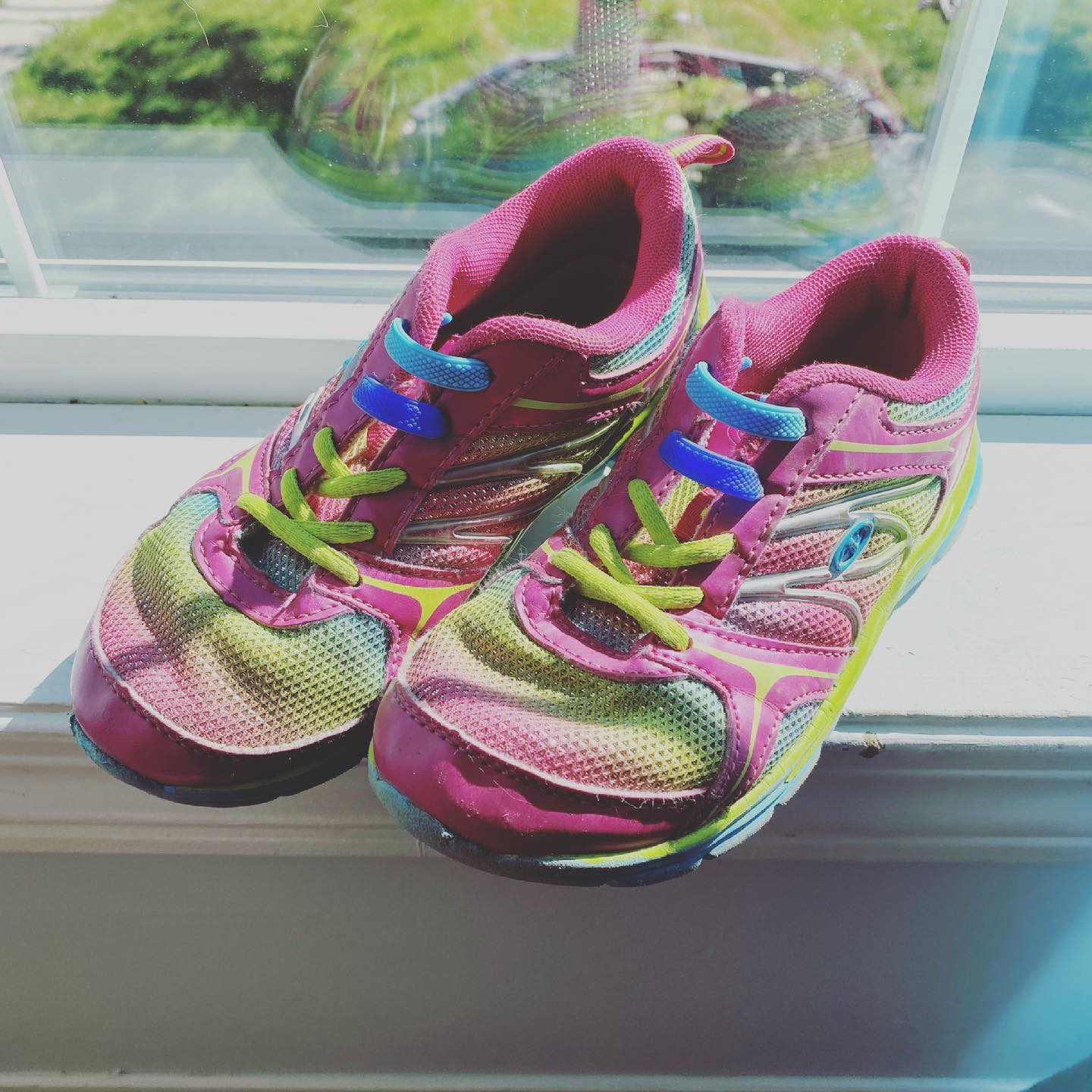
pink shoes

Our grandson, Simon, loves the colour pink. He always has. Last week he was so excited to have finally grown into this pair of his sister’s hand-me-down shoes. He proudly wore them to school, but only once. The next morning he sadly told his mother that he would never wear them to school again because he was picked on so badly for wearing “girl” shoes. He’s in grade one. In my opinion, there’s something seriously wrong with a world where a little boy is bullied for wearing his favourite colour to school.

So how did pink become a girls’ colour anyway? It hasn’t always been. Historically, pink was just another colour worn by men and women alike. In many parts of the world, it still is.

In the past, in both Europe and North America, most parents dressed their children, boys and girls, in white dresses until they were about six years old, which was also when they usually had their first haircut. The outfit was practical. White cotton could be bleached and dresses made diaper changes easy.

Franklin-Roosevelt

Franklin Delano Roosevelt, age 2 1/2, wearing a gender neutral outfit.

In the mid 19th century, pastels became popular for babies, but at first they weren’t gender-specific. It wasn’t until just before World War I that pink and blue emerged as indicators of gender, but you might be surprised to learn that, at that time, pink was considered a boys’ colour and blue, a girls’! An article in the June 1918 issue of the trade publication Earnshaw’s Infants’ Department said, “The generally accepted rule is pink for the boys, and blue for the girls. The reason is that pink, being a more decided and stronger color, is more suitable for the boy, while blue, which is more delicate and dainty, is prettier for the girl.”

Babies of the 1940s were the first to be dressed in the sex-specific clothing and colours that we’re familiar with today. The popularity of pink for girls and blue for boys actually waned in the 1960s and 70s during the height of the women’s liberation movement. Parents who felt that dressing their daughters in feminine or stereotypically “girly” clothes might limit their opportunities for success favoured dressing their children in neutral colours and fashions, but by the 1980s, gender oriented children’s clothing was back in style. 

It seems to me, however, that there’s a big discrepancy between what’s deemed acceptable for little boys and little girls. I suspect that many of the girls in Simon’s class wear blue to school. Are they bullied? No! Does anyone question their femininity? Of course not! Then why can’t a little boy wear pink shoes to school without being harassed?

Children aren’t born with prejudices about certain colours. That’s a learned behaviour. I lay the fault at the feet of fathers and grandfathers who were raised with the idea that pink is only for little girls and that a boy should never wear pink. Only when men become bold enough and secure enough in their own masculinity to take back the colour pink will it become just another colour again. Only then will Simon be able to wear his favourite colour without fear of being tormented.

Logo

Crazy (old) sock lady

LogoI’m a long-legged 5’8″ tall. For much of my life I worried about finding pants that were long enough to ensure that my socks didn’t show. Then along came ankle length cropped pants. Suddenly everyone’s ankles were showing. It took me awhile to warm up to the trend, but it really has made life easier for me.

I usually wear white sports socks with my jeans and other casual pants and black socks when I want a somewhat dressier look, but when I was cleaning out my drawers recently I realized that I’ve gradually accumulated a fairly sizeable collection of patterned socks. There are certainly much more colourful and fanciful pairs available, usually worn by gals who are several decades younger than me, but once in awhile it’s fun to look down and see something funkier than plain old black or white.

Some of my patterned socks, like these two weather themed pairs, are quite subtle. I’ve obviously worn the snowflake ones on the left a lot as they’re almost worn out. You can begin to see my gold toenail polish shining through!

These are definitely bolder! Both pairs were gifts from my daughter-in-law. There’s a story behind the zebra print pair on the left that make them very special to me. Robin is a long distance cyclist. She rides with a club that expects members to be able to ride at a minimum speed of 23 km/hr for at least 50 km and has taken part in many longer races and fundraising rides. If you’ve been reading my blog for very long, you know that I have neuroendocrine cancer (NETS) and that the zebra is our symbol. Robin wore the zebra socks for the first leg of a 2 day fundraising ride for cancer and then gave them to me (freshly washed, of course!)

IMG_0302

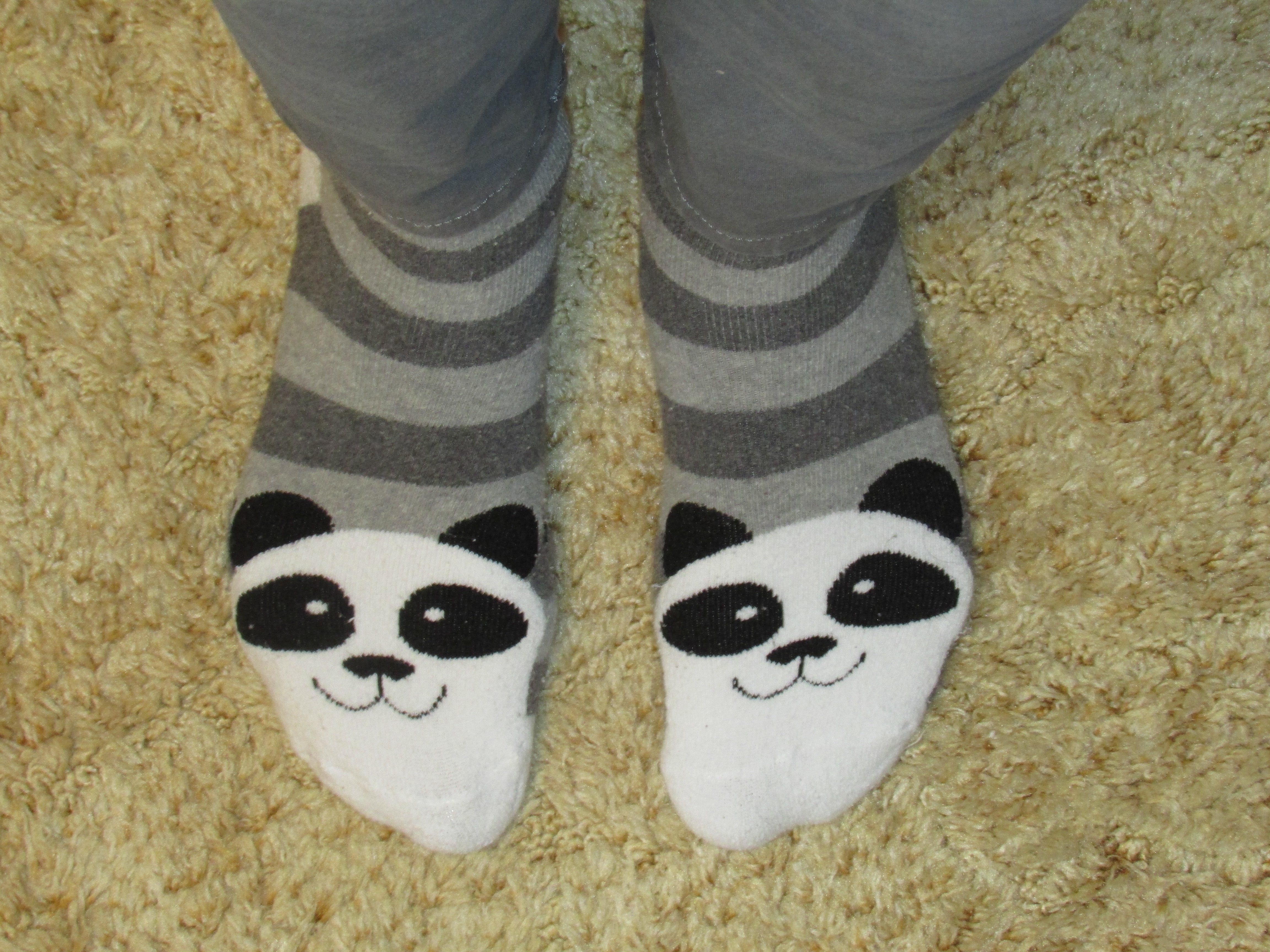
While zebra stripes hold special significance to me as a NETS patient, the giant panda is my favourite animal. Apparently Santa Claus knows that as this pair was in my Christmas stocking last year.

When we lived in Japan, I discovered that I love wearing toe socks which are very popular there. I brought several pairs home with me. I don’t wear them very often only because they’re a bit of a bother to put on, but once on they’re warm and comfortable. We were in Japan to teach English and I specifically bought this pair to wear to my Saturday morning preschool classes. Teachers and students alike take their shoes off before entering the classroom, so these were perfect for my little ones who were learning to count in English. They loved them!

IMG_0303

I didn’t realize until I started preparing for this post that almost all my patterned socks are in shades of black, white, and grey. Clearly, if I’m going to become a crazy (old) sock lady, I’ll have to invest in some coloured ones!

What about you? Do you wear patterned or brightly coloured socks? Would you?

Ribstones in the rain

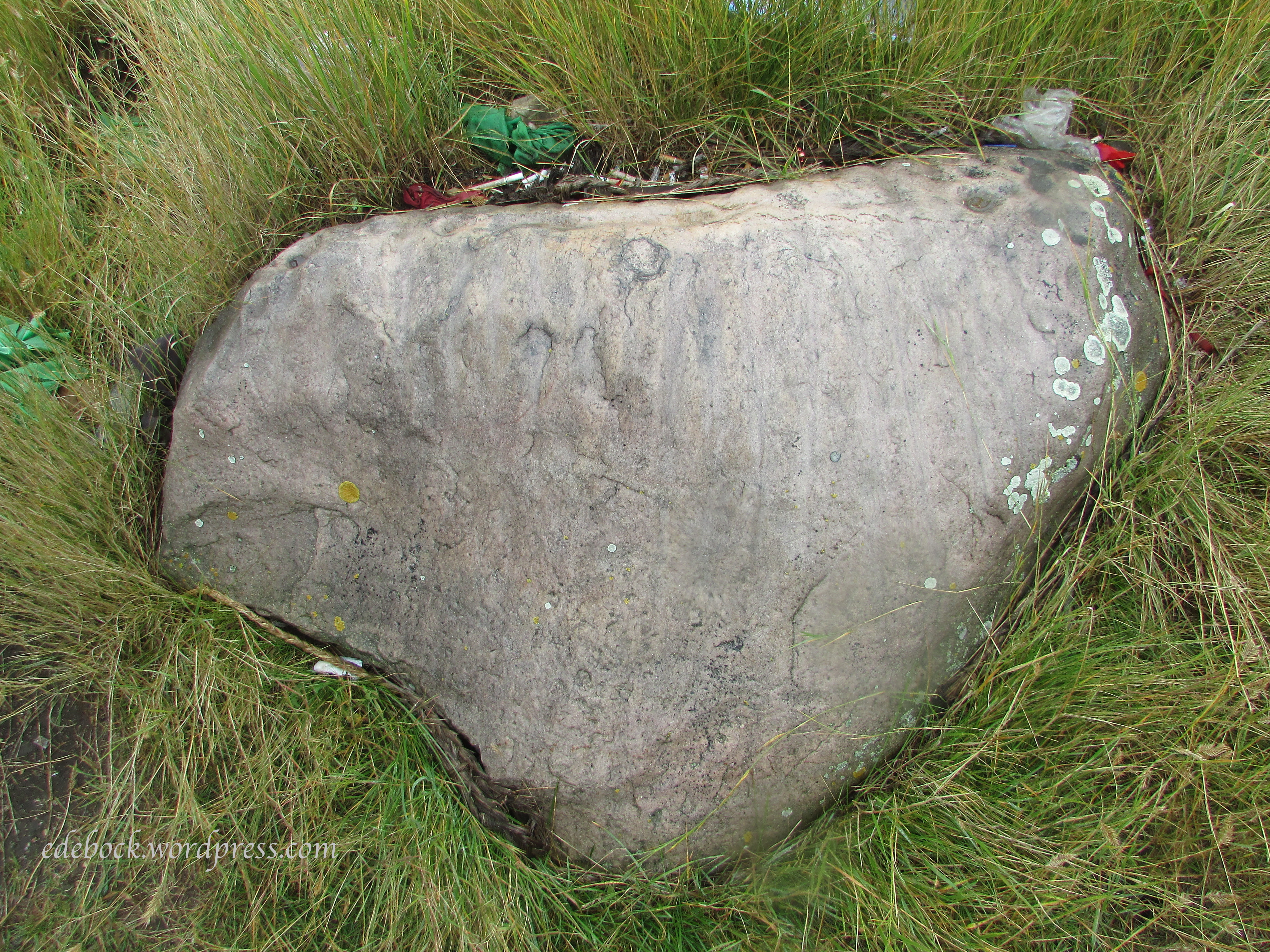
On the top of a hill about half an hour northeast of here, is a collection of rocks with a long history and a story to tell. The Viking Ribstones are quartzite boulders carved by the nomadic First Nations people who inhabited the prairie in years gone by. The stones stand as a monument to Old Man Buffalo, the spirit protector of the herds that provided them with food, hides, utensils, tools, and so much more. Grooves carved in the two largest rocks in ancient times are thought to represent the ribcage of the buffalo and circular holes may represent arrow or bullet holes.

IMG_9919

IMG_9918

We weren’t too keen on spending a cool rainy afternoon cooped up in the house with three restless grandchildren who are visiting for the Labour Day weekend and Drew, the oldest, has been wanting to see the Ribstones since he first heard about them, so off we went. Thankfully, the rain was nothing more than a light drizzle as we approached the hill, the highest point for miles around.

IMG_9936

Historically, natives in the area left offerings to Old Man Buffalo at the Ribstones before hunting and after a successful hunt. Today, this is still a sacred and revered site to the First Nations people who continue to visit and leave offerings that include braided sweetgrass, tobacco or cigarettes, and other small trinkets. Five-year-old Simon was naturally curious and wanted to play with some of these objects, but in an attempt to teach him respect for the sacred nature of the place, we explained that it was something like a church and that the objects were similar to what we put in the offering plate at church.

Ribstone sites are very rare and this one has been designated a provincial historic resource. Only nine have been found in Alberta and this one is particularly significant because the stones remain in their original setting.

IMG_9927

Colourful ribbons and prayer cloths hang from the fence enclosing the site and trees in a nearby grove. Some have clearly been there for a long time, while others are newer.

The hilltop is a peaceful spot overlooking fields of grain in every direction. Hopefully the rain will let up and harvest can begin soon.

IMG_9924


Tea, the universal drink

After water, do you know what the world’s most widely consumed beverage is? Would you say coffee? Beer? Wine? Coke? Wrong every time! It’s actually tea!

There was always tea available in our house when I was growing up in the 1950s and 1960s, but only plain black tea. We drank green tea on the rare occasions when we went to a Chinese restaurant. Now I drink two mugs of green tea every morning and the basket of other teas in my kitchen cabinet is overflowing.

In Canada, our increasingly multicultural society plays a large part in the growing popularity and availability of so many different teas. Over the years, the world has come to us and it has brought its teas with it.

Screen Shot 2019-02-25 at 9.03.21 PMDrinking tea is a tradition that is said to date back to 2737 BCE. According to legend, Chinese emperor Shen Nung was sitting under a tree while his servant boiled drinking water. When some dried leaves from the tree blew into the water, Shen Nung decided to try the infusion that was created and found it to his liking. Since then, tea drinking has spread around the world.
While black tea is more popular in Western countries, green tea is preferred in China and Japan where it is a common part of daily life. Green tea is unoxidized, giving it a lighter taste and aroma than black tea. The tea that is used in the traditional Japanese tea ceremony is matcha which is powdered and not infused. This means that the leaves themselves are consumed resulting in a much higher concentration of the antioxidants, minerals, and vitamins that make green tea healthy. For this reason, matcha has become quite trendy.

Taiwanese bubble tea is a modern innovation. This high calorie tea has as its base an iced tea (typically black, green, jasmine or oolong) with milk and a sugary syrup. The “bubbles” are actually tapioca pearls. As much as I like tea, this one has never appealed to me!

From Thailand comes the very popular Thai tea. Made from strong black tea, often spiced with ingredients such as star anise, crushed tamarind, and cardamom, it’s usually sweetened with sugar and condensed milk and served over ice.

India produces and consumes more tea that any other country in the world. It is best known for it’s chai blends that mix black tea leaves with spices like cinnamon, ginger, nutmeg, cloves, cardamom, and black pepper. Assam is another popular variety of black tea which is grown in the Assam region of India. It is used in many breakfast blends including English Breakfast and Irish Breakfast, but is also consumed on its own. It has a strong, malty flavour, a reddish colour, and is high in caffeine. Darjeeling is yet another tea that is grown in India, specifically the mountainous Darjeeling region in the northern part of the country.

In Morocco, drinking tea is more than simply a social custom, it’s also part of doing business. If you find yourself in a Moroccan market, you’ll likely be sat down and offered a glass of mint tea by a vendor wanting to sell you a beautiful carpet. This is touareg tea, a green tea prepared with spearmint leaves and sugar.

It was Portuguese and Dutch traders who first brought tea to Europe in the early 1600s. By the mid 18th century it had become Britain’s most popular beverage with the East India Company using fast ships called tea clippers to bring the leaves from India and China.

Then there are the herbal teas which aren’t considered “real” tea at all because, unlike black, white, and green teas, they aren’t made from the leaves of the tea bush (Camellia sinensis). Popular among the herbal teas is rooibos or bush tea from South Africa which is made from the leaves of the red bush, a broom-like member of the Fabaceae family.

One of my favourite teas is Earl Grey, a black tea flavoured with oil from the rind of the bergamot orange, a fruit grown mostly in Italy. It is thought to have been named for Charles Grey, 2nd Earl Grey, who was British Prime Minister from November 1830 to July 1834. In addition to regular Earl Grey, I have Vanilla Earl Grey, Lavender Earl Grey, and even Double Bergamot Earl Grey in my collection!

There are apparently all kinds of health benefits to drinking tea, especially green tea. The comparative lack of processing means that it has a higher level of antioxidants and polyphenols. Studies have shown that it may:

  1. lower cholesterol
  2. lower blood pressure
  3. reduce the risk of heart attack and stroke
  4. reduce the risk of neurological disorders like Alzheimer’s and Parkinson’s diseases
  5. lower blood sugar
  6. encourage weight loss
  7. aid digestion
  8. inhibit intestinal inflammation
  9. strengthen the immune system
  10. help fight infection
  11. help fight various cancers
  12. prevent bone loss
  13. reduce plaque buildup and tooth decay
  14. help cells regenerate and repair
  15. help slow down aging
  16. increase mental alertness
  17. lower stress hormone levels
  18. prevent arthritis

If nothing else, it’s a flavourful way to stay hydrated, it contains no calories, and it has less caffeine than coffee.

Tea, the healing beverage that knows no borders! 

IMG_7153

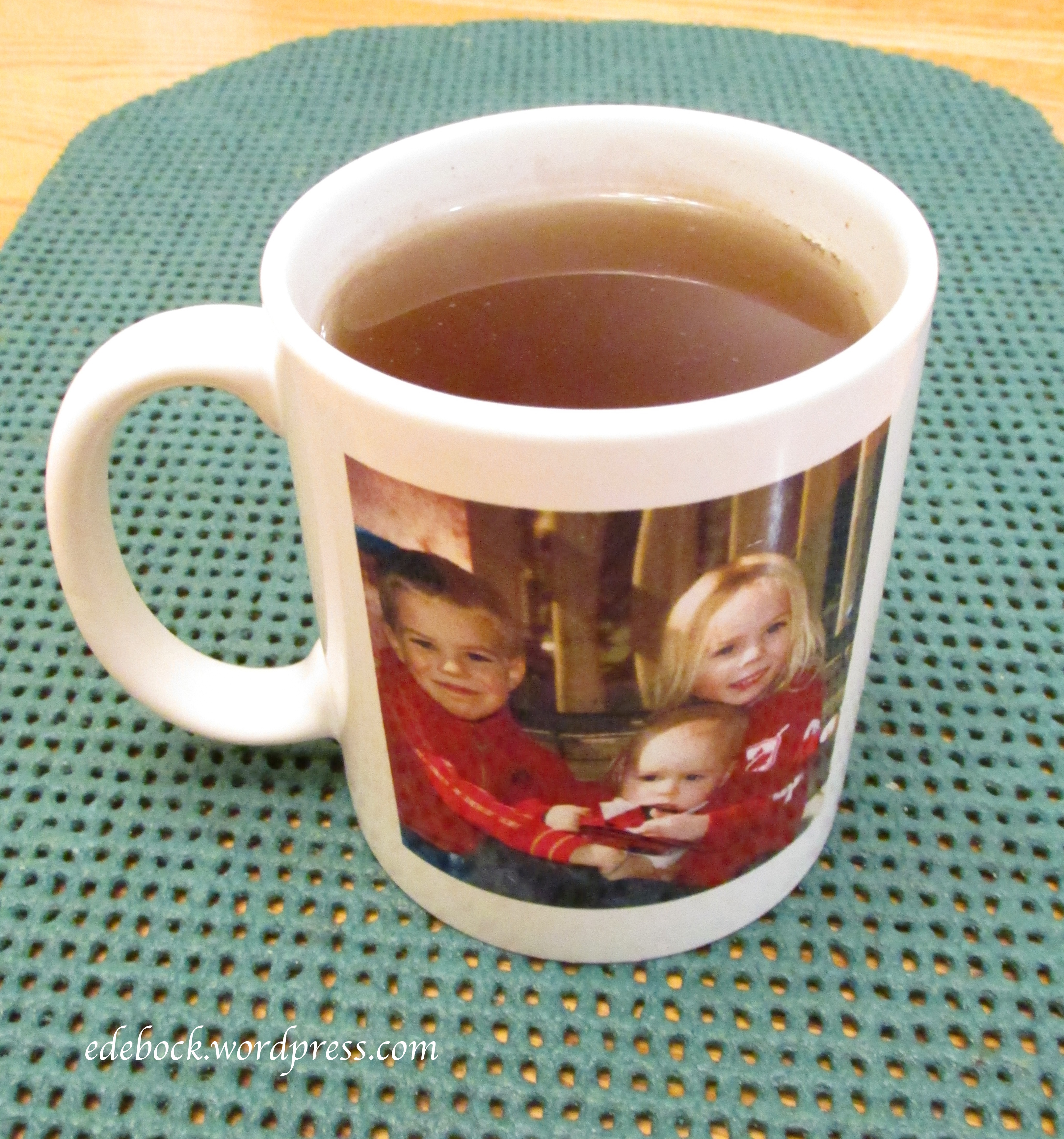
That’s 3 of my grandchildren on the cup!