
Art to wear

LogoI grew up on the Pacific coast of Canada with a deep appreciation for the art of the Indigenous people of that area. Four years ago, I shared the story of the beautiful hummingbird ring made by Haisla artist, Hollie Bear Bartlett, that hubby gave me for Christmas.

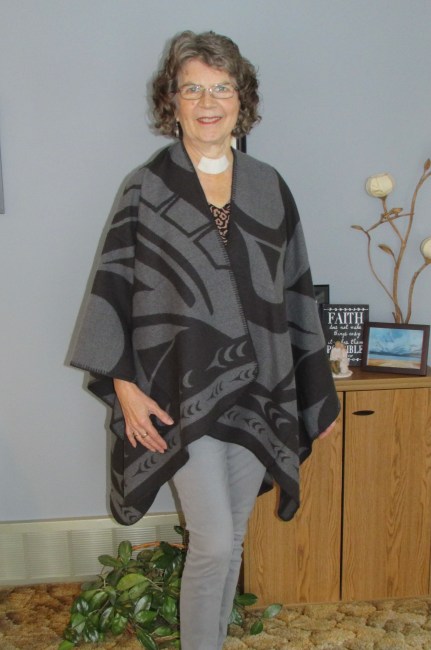
This Christmas, I received some more wearable Pacific coast art!
IMG_3493

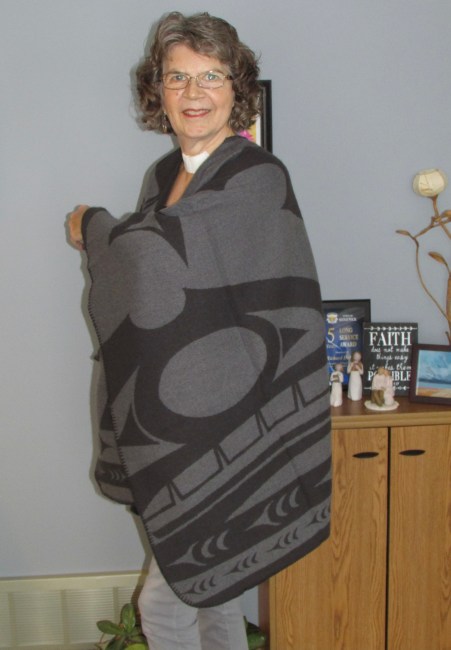
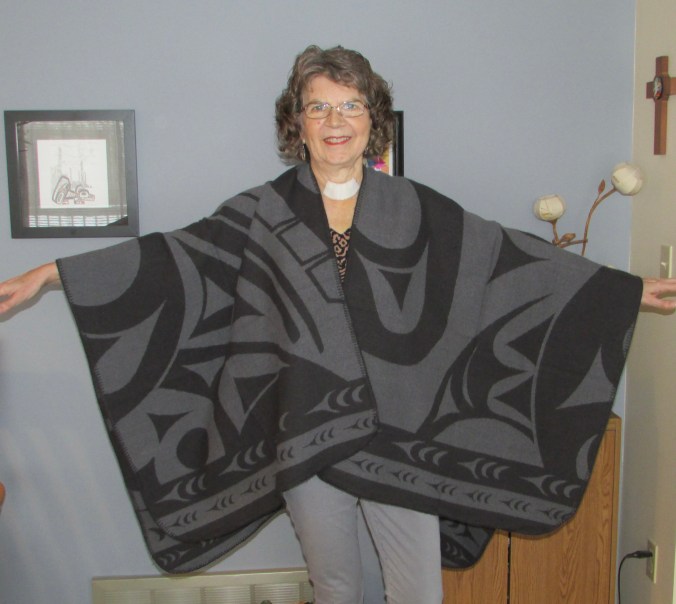
The cozy, reversible wrap, was a gift from the Vancouver branch of our family; our oldest son, his wife, and their two sons. A product of Native Northwest, it features the work of Coast Salish artist, Doug Horne. You can probably see the whale motif best in this photo. Look for the rounded head, the toothy mouth, and the blowhole on top.
IMG_3498

In the stories of the Northwest Coast, the killer whale, or orca, is associated with strength, dignity, prosperity, and longevity.

IMG_3503

100% of the art featured on Native Northwest products is designed by Indigenous artists and used with their consent. Artist names and cultural affiliations are acknowledged on all packaging and the artists are paid in fees and royalties.

In addition to my beautiful wrap, hubby and I received two Native Northwest masks from another family member. Here, I’m wearing the eagle design by Haida artist, Roger Smith. Eagles are associated with guidance, hope, healing, and the pursuit of freedom.

IMG_3507

IMG_3509

You can easily see the tentacles on Ernest Swanson’s octopus on the mask on the right. Swanson comes from a long line of established Haida artists. The octopus is respected in the Northwest coast culture for its ability to adapt to change. The raven mask on the left, by well-known Tsimshian artist, Roy Henry Vickers, is one that I purchased when we were in Vancouver in October. It was produced by Oscardo, another company that partners with Canadian and Indigenous artists and pays royalties for each product sold. The raven is an important figure in Northwest coast art and mythology. Known as a trickster, he has the power to transform both himself and other beings. He can even change animate to inanimate, and vice versa. Hopefully, when I wear the mask, he transforms Covid into something harmless!
IMG_3495

Perhaps this is a good time to talk about the difference between cultural appropriation and cultural appreciation. Cultural appropriation involves adopting an element of another culture without respect for its meaning or significance or with the purpose of exploiting the culture for personal gain. Appreciation, on the other hand, involves a desire to learn about another culture in order to broaden one’s perspective and understanding. It also involves fair compensation and giving credit where credit is due. That’s why it’s so important to me to learn the meaning behind the symbols that appear on my wearable art and why I appreciate the fact that companies like Native Northwest and Oscardo credit the artists and pay royalties for their work.

If you’re interested in knowing more about the stories behind the symbols and creatures that appear in the art of the Pacific Northwest, the book Understanding Northwest Coast Art by Cheryl Shearar is an excellent resource.

Cultural appropriation… what do you think?

Utah teen, Keziah Daum, has been harshly criticized online and in the media for herLogo recent choice of a dress for prom. Hoping to find something unique, Keziah decided to browse a vintage store in downtown Salt Lake City. There she found a beautiful red cheongsam; a high-collared, form-fitting traditional Chinese dress.

Screen Shot 2018-05-02 at 11.51.55 AM

photo – Twitter

The problem is that Keziah Daum is not Chinese. The dress “gave me a sense of appreciation and admiration for other cultures and their beauty,” she said, but she has been accused of cultural appropriation.

What is cultural appropriation and how is it different from cultural appreciation?

Cultural appropriation deals with the adoption of elements of a minority culture or a marginalized group by members of a dominant culture without permission and usually with little respect for or knowledge about the original culture. In true cases of cultural appropriation, elements that may have deep meaning to members of the original culture are sometimes reduced to exotic curiosities by those adopting them. For example, decorating your home with a Buddha statue when you are not, in fact, Buddhist would seem to me to be culturally inappropriate. If you are white North American and you include items that are representative of First Nations culture in your Halloween costume, that too is clearly cultural appropriation and may also help perpetuate harmful stereotypes. I question, however, whether using the same items or garments in the ways that they were originally intended is harmful to anyone at all.

The problem, in many cases, is that there is often no agreement amongst members of a supposedly offended cultural group about what is or is not acceptable to them. While Keziah Daum’s choice of prom dress elicited plenty of criticism from both Chinese and non Chinese, scores of other people also identifying as Asian Americans, defended her choice, saying that they did not consider it offensive. One of them tweeted, “I am a Chinese woman. I support you. You rocked that dress!!”

I have a Japanese yukata (summer kimono) that I purchased in Tokyo. The shopkeeper had no problem selling it to me and showing me how to wear it properly even though I was clearly a gaijin (foreigner). In fact, I believe that many of their customers are visitors to the country looking for a special piece of Japanese culture to take home with them. I also have a traditional Vietnamese ao dai, a two piece silk outfit comprised of a long tunic and pants that was made to measure in a tiny tailoring shop in Hoi An. When I traveled to  Vietnam I had no intention of buying an ao dai, but when I visited a few of the 200+ tailoring shops in Hoi An and admired the beautiful garments, the seamstresses were all anxious to make one for me and I couldn’t resist. I also have a Chinese silk jacket from Hong Kong as well as a beautiful silk abaya from the Middle East, both gifts from friends. I have worn all of these on special occasions and meant absolutely no disrespect to the cultures they came from. In fact, like Keziah Daum, I consider it a special privilege to be able to wear such gorgeous and meaningful pieces.

I also wear a beautiful ring made to order by Haisla artist, Hollie Bear Bartlett. A Christmas gift from my husband, it’s hummingbird motif in traditional Northwest Coast style is symbolic of love and beauty. I am originally a coastal girl of European descent. I do not think that my wearing a ring bearing the art of a different group of coastal people is inappropriate or disrespectful. I also have Northwest Coast and Inuit art in my home, as do many other Canadians.

On the other hand, I do think that our Canadian Prime Minister made an absolute ass of himself, roving around India recently on a highly publicized trip with his family, all of them wearing brightly coloured Indian garb. Their insensitive overuse of and excessive photo-ops wearing Indian clothing drew criticism from their host country with prominent Indian personalities referring to the outfit choices as “tacky” or “fake and annoying.”

Allegations of cultural appropriation have grown increasingly common in recent times with critics casting doubt on the legitimacy of everything from team logos to burrito shops. We in North America are privileged to live in multicultural countries where we can share in the rich heritage and traditions of our neighbours. It behooves us to be sensitive in how we do so, but I think that condemning a young girl for her choice of prom dress goes way overboard.

I realize that this is a controversial topic and that there are people with strong feelings on both sides of the issue. I welcome all opinions as long as they are offered respectfully. I am particularly interested in knowing how my readers from other parts of the world feel about this topic.