World Cancer Day 2025: United by Unique

February 4 is World Cancer Day. There are more than 200 different kinds of cancer and every patient’s experience is different. That’s why the new World Cancer Day theme, United by Unique, resonates so strongly with me. While each of our stories is unique, we are united in our message and in our desire to raise awareness and see progress made in fighting this dreadful disease. 
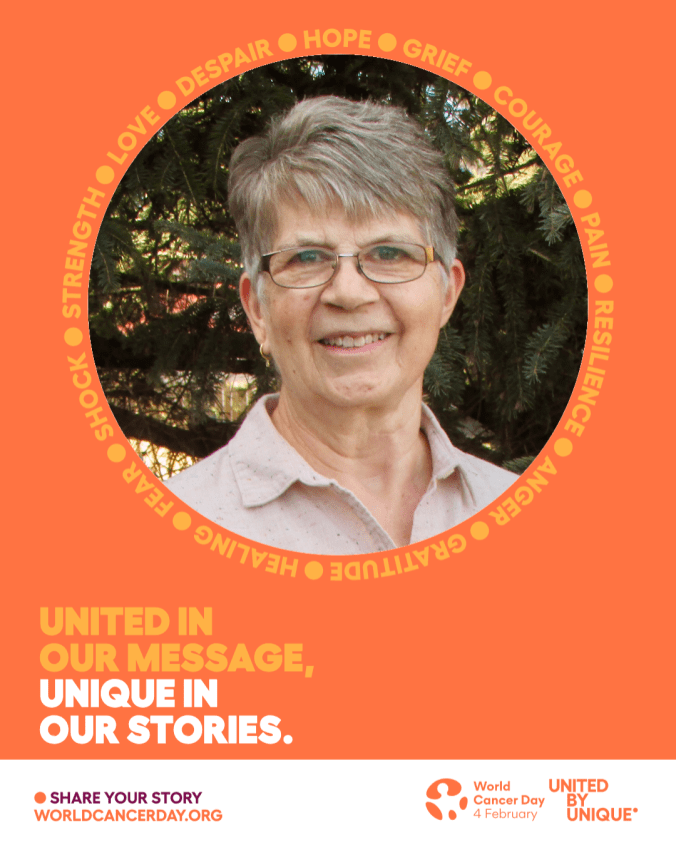
The emphasis of the 3-year United by Unique campaign that kicks off today will be people-centred care. Behind every diagnosis lies a unique human story. These are stories of grief, pain, healing, resilience, love and so much more. A people-centred approach to care that listens to patients’ stories and fully responds to each individual’s unique needs with compassion and empathy will lead to the best possible outcomes.  

People living with cancer don’t always feel heard, seen, or understood. They are often bewildered, feeling isolated and voiceless at a time when they’re also learning to navigate an unfamiliar and confusing health care system and dealing with the emotional highs and lows of cancer diagnosis, treatment, or recovery. That’s why the first year of this campaign will focus on telling our unique stories.

I feel very fortunate to receive my cancer care at the Cross Cancer Institute in Edmonton, Alberta, Canada, a facility where it is common practice to look beyond the patient to the person as a whole and to consider the impact of their cancer on all aspects of their life. When I go for appointments, I’m routinely handed a clipboard with a questionnaire that delves into not only the physical symptoms that I might be experiencing, but also the psychosocial ones. The CCI offers a wide range of supportive services that go far beyond the patient’s physical well-being. The health care team there includes professionals in psychology, social work, spiritual care, nursing, and psychiatry and available services include individual, couple, and family counselling; professionally-led support groups; and practical supports for financial and other basic needs. While the need for these supports has not been part of my unique story thus far, I’m glad to know that they’re available should I ever need them and I wish that that was true for patients everywhere.  

I have been invited to share my unique patient story at a Canadian Neuroendocrine Tumour Society (CNETS) conference in May. The big challenge is going to be condensing the approximately 20 years from initial symptoms to present day into a 10 minute talk that educates, encourages, and inspires those in attendance, especially those who are in the early days of their journey and who need to know that it’s possible to live long and live well in spite of their diagnosis. 

United in our goals, unique in our needs.
My final goal

Just a quick HOOFING IT Across Canada post today as I have grandchildren here and don’t intend to spend much time sitting at the computer! With just two weeks left in the fundraising campaign for neuroendocrine (NET) cancer research, I have walked 136.56 km and raised $1595 in donations. If you’ve been following my progress, you know that I originally set 100 km as my walking/hiking goal. When I accomplished that before the middle of this month, I decided to add another 50 km to my distance. Now, with that goal in sight, I’ve decided to push myself a little bit further.

The distance by road from my front door to the Cross Cancer Institute in Edmonton, Alberta is 177 km. That’s where I receive all my NET cancer care, so 177 km seems like a very meaningful goal to pursue. It might be a bit of a stretch, but I CAN DO IT!

I also passed my fundraising goal of $1500 in early August. It hasn’t grown a lot since then, but I would dearly love to see a few more donations come in. I’m still in the top ten fundraisers and would love to hold onto that position, but much more important is the need for funds to continue research into this unusual cancer. It will be 7 years tomorrow since I started this journey and while there’s been progress made, we still know nothing about what causes NET cancer and have a very long way to go to find better treatments and ultimately a cure.

The overall goal for the HOOFING IT Across Canada campaign is $100,000. This afternoon we’re sitting at just under $54,000, so we still have a long way to go! You can help by visiting my fundraising page and adding to my total. Thank you so much for being with me on this journey!

287226b0-bda3-11ea-a9f0-2d2856e5b296

As good as my last scan

Fellow NET cancer patient and blogger, Ronny Allen, published a post awhile back entitled, “I’m only as good as my last scan.” That sentiment definitely resonated with me as I never know what to say when people ask me how I’m doing. For the past while, I’ve been feeling absolutely great, 100% even, but unless I’ve had a recent scan, I really have no idea how I’m doing on the inside. That’s why I was actually looking forward to this week’s treatment and it’s follow-up scans, the first look at my cancer in 6 months.

Today, let me walk you through what this two day process looks like. On Tuesday morning at 9:30 a.m. Richard and I sat down with Dr. Sandy McEwan, scientist and doctor extraordinaire and head of my cancer care team. I told him how great I’ve been feeling, he told me how great I look, and I signed consent for the treatment procedure. He also shared some of the recent findings of the clinical trial that I’m part of including the exciting news of one patient who has been surgically proven to be tumour free!

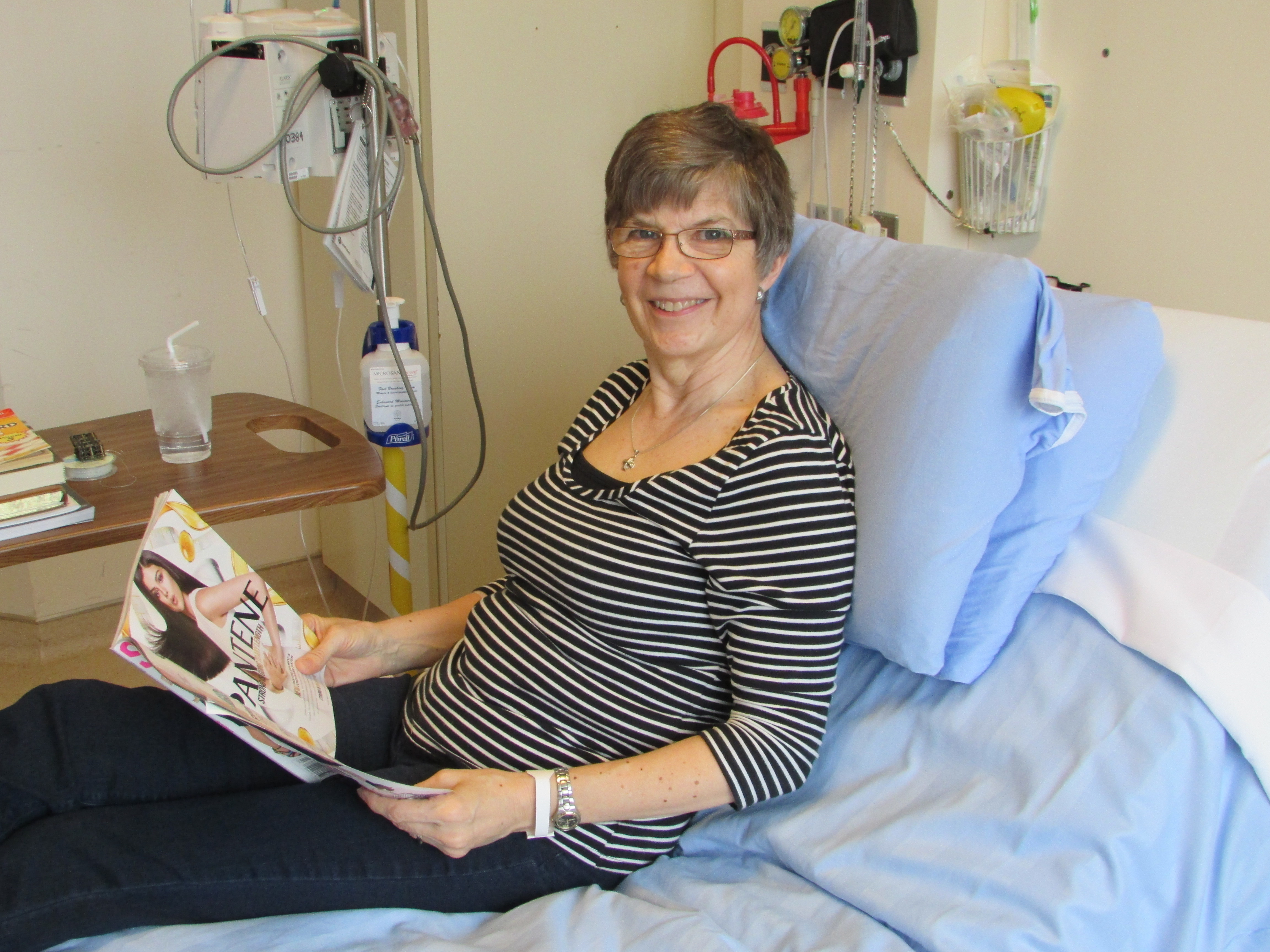
Next, we were off to the volunteer run Sunroom Cafe to kill time over a cup of tea while we waited for the next step which was having my IV inserted at 11:00. Shortly after that, we headed up to the third floor to check into my private room in the nuclear medicine corner of the inpatient ward. In preparation for the treatment itself, I was given an anti nausea pill and a saline drip was started. Then I sat back and relaxed until the arrival of the radioactive Lutetium-Octreotate, which had just been flown in from the Netherlands where it is produced. At that point, Richard had to leave and I continued to relax  while it flowed through my veins seeking out and attaching itself to my tumours. Because I’m part of a clinical trial, there is lots of monitoring to be done, so Michelle, who administers the treatment, was in and out of my room over the next hour or so constantly checking my vital signs. My blood pressure remained good and she was astonished by my slow, steady heart rate. Obviously, I wasn’t experiencing any stress. Why should I? After all, this was my sixth treatment and I’m an old hand at this now!

IMG_1543

Once the Lutetium was in and the lines were flushed, the IV was removed. If I lived in the city, I’d have been free to go home, but since I live a couple of hours away and had to be back for my scan by 8 o’clock the next morning, I stayed the night. Richard came back to visit bringing me a Subway sandwich as my one and only complaint about the Cross Cancer Institute is the food. It’s so bad that even the staff apologizes for it! Dr. McEwan dropped in to see how the treatment had gone and then I settled in for a quiet evening. I spent awhile visiting and exchanging stories with the patient in the room next to mine, a retired farmer from northern Saskatchewan. At the Cross, Lutetium is administered to three patients at a time.

I slept well and was up bright and early to head back downstairs for my scans. After spending the night at our son’s place, Richard met me there. For the full body scan, I had to lay perfectly still on my back with a pillow beneath my head and another under my knees. Covered by a warmed blanket, I was quite comfortable as my body slowly moved beneath the enormous camera just a few inches above me. Dr. McEwan had planned on having a second, 3D scan done as well, but that machine was down. The technicians were working on it and if he’d felt it was necessary, we’d have waited around until it was up and running again. He was certain, however, that the first scan showed all that we needed to know. My cancer is stable! The tumours haven’t grown and there aren’t any new ones. There’s also no sign of recurrence of my second, unrelated cancer. While it would have been nice to hear that the tumours were continuing to shrink or that, as in the case of the woman mentioned above, they had disappeared completely, that is most unusual and no change is also good news.

I hope Ronny doesn’t mind me borrowing his title, but he is right. I’m only as good as my last scan and right now, that’s very good!

Fitness from the shoulders up!

“Normally you should be able to place the two middle joints of your index and middle fingers in your mouth” reads one of the many handouts that I was given at the Cross Cancer Institute this week.

You tried it, didn’t you? I knew you would!

I can do it, but barely. In fact, when I do, I’m left with imprints of my teeth on my fingers.

I’m amazed at all the services available to patients at the Cross and I haven’t even had to go looking for them. This week, I had appointments with a speech language pathologist (who knew that they also deal with swallowing issues?), a nutritionist and an occupational therapist and now I have a whole new exercise routine to follow. I have lip exercises, swallowing exercises, jaw exercises and neck exercises to do! Sadly, none of them requires cute exercise attire!

The lip exercises are meant to help correct the crooked smile that I was left with after last month’s surgery. It has been gradually improving as the facial nerve recovers and if it never got any better than it is right now, I could certainly live with that, but I might as well do what I can to help it along.  The exercises, which involve making a variety of funny faces, are simple and easy do while I’m engaged in other activities.

Surgery also left me with a fair amount of stiffness in the neck and jaw area, hence the difficulty getting two knuckles between my teeth. Radiation can cause increased stiffness in these areas so, rather than becoming a permanently stiff-necked person, I’ll be doing neck and jaw exercises at least 3 times a day for the duration of my radiation treatments and for several weeks or possibly months afterwards. Fortunately, they’re also simple to do and don’t take very long.

Dysphagia, or difficulty swallowing, is a common side effect of radiation to the head and neck so the swallowing exercises that I’m doing are preemptive, designed to minimize or prevent problems from arising. They’re not particularly difficult to do, but because they’re done with sips of water, they involve consuming copious amounts of H2O. Since staying well hydrated is important, this isn’t a particularly bad thing but it does mean having to break the exercises down into manageable amounts spread throughout the day.

I haven’t lifted weights since having surgery and the treadmill is gathering dust again now that the weather is suitable for walking outdoors, but I’m still fitting in my regular morning exercises 4 or 5 days a week. This is the first time I’ve worked on being physically fit from the shoulders up though!