10 fashion mistakes and what to do about them

As I wrote in this post three years ago, I don’t follow fashion rules. Instead, I believe in wearing what makes you feel comfortable and confident. I do believe, however, that many of us make fashion mistakes that keep us from feeling great in what we wear. Today, let’s take a look at 10 of those mistakes and what to do about them.

Not knowing your personal style

It’s important to dress in a way that reflects your personality and says what you want to say about yourself. As I’ve written before, one way to identify your personal style is to choose 3 to 5 adjectives to guide your fashion choices. My style adjectives are classy, casual, comfortable, confident, and authentic. When I look in the mirror, I’m happiest when my outfit ticks all five boxes.
Not wearing the right colours for your skin tone

Knowing whether your skin has cool or warm undertones can help you choose colours that are best for you. A personal colour analysis can help, of course, but an easy way to figure this out is to look at the veins on the inside of your wrist. Do they look blue or green? If they appear more blue, you are cool-toned; if they’re more green, you’re warm-toned. If you are cool-toned, bright blues, deep purples, emerald greens, and frosty shades of lavender, ice blue, and pink will look good on you. If you’re warm-toned, think fiery reds, peach, coral, oranges and rusty tones, creams, camel, and earth tones. While sticking to a specific colour palette might seem restrictive, knowing which colours make you come alive and which, especially when they’re worn close to your face, make you look tired or washed out, can definitely help you look your best.

Buying things you don’t love

Shopping with friends can be a lot of fun, but their taste might be different than yours. Consider their advice, but resist buying something that they like unless you know that it’s actually right for you. Similarly, don’t let the fashion industry dictate what you wear and don’t buy something simply because it’s on sale. Instead, wear what makes your heart sing!

Having a crowded, disorganized closet

If you can’t see what’s in your closet or if it’s full of clothes you don’t actually wear, set aside some time to take everything out, try things on, and decide what to keep and what to donate. Ask yourself: Do I love this? Does it fit my personal style? Is it the right colour for me? What can I wear it with? Do I have too many of these?

Wearing the wrong undergarments

Undergarments are the foundation that an outfit is built on. Prioritize comfort and fit. Consider going for a professional bra fitting to ensure that you’re wearing the right size. In addition to enhancing how your clothes look, a proper fit provides essential support that can reduce back, shoulder, and neck pain.

Buying quantity over quality

In addition to being terrible for the environment, fast fashion is usually characterized by shoddy workmanship and low quality fabrics that will cheapen your look. Buying fewer, better quality pieces will give you a more polished appearance and if you consider cost per wear, will also be the wiser choice financially.

Wearing clothes that don’t fit well

Oversized clothes look frumpy and clothing that’s too tight looks uncomfortable and shows off bits and bulges that are better left unseen. If you shop online, use a measuring tape and pay close attention to sizing charts. When shopping in person, try everything on and if possible, look in a three way mirror. Make sure shoulders seams align properly and buttons don’t pull. Horizontal lines in the crotch area indicate that pants are too small. When you get the fit right, your clothes will skim over your body and you’ll feel comfortable.

Sacrificing comfort for style

It isn’t necessary to choose between comfort and style, but comfort is of paramount importance in choosing what to wear. This is especially true of footwear. It’s almost impossible to look good when your feet are killing you!

Trying to follow every fashion trend

Not every trend will suit your personal style or body type. Instead, invest in quality basics that stand the test of time and add occasional trends that fit your aesthetic.

Wearing too many or not enough accessories

Accessories are the finishing touches that can take an outfit from drab to dramatic. Almost any outfit will benefit from a few carefully chosen accessories, but too many will look tacky and overwhelm your look. If you like bold jewelry, choose one statement piece and let it take centre stage while keeping other jewelry understated.

Can you think of any other fashion mistakes?
Mindful shopper or impulse buyer?

Logo by SamMindfulness, the practice of being fully aware and in the present moment, has become a popular buzzword these days. There’s mindful meditation and mindful eating, but today we’re going to look at mindful shopping. 

Mindless or reckless, impulsive (and sometimes even compulsive) shopping is a trap that’s easy to fall into especially in this day of online, credit card shopping. Unfortunately, it can lead to buyer’s remorse, unnecessary debt, anxiety, and even relationship problems. It can also mean having a closet full of clothes, but still experiencing that all too familiar feeling of having nothing to wear. 

Shopping

So how can you move from impulse buyer to mindful shopper?

When I shop for groceries, I do so mindfully. I shop with a list. Before I leave home, I check the fridge and the cupboards to make sure that the list includes everything we need. Though I might occasionally buy something that isn’t on the list, I read labels and think about what goes into the grocery cart. My husband has cholesterol issues and I’m diabetic, so I take those factors into consideration when I decide what to buy. I don’t buy pineapple or kiwi because I’m allergic to them and I’ve never liked parsnips, so I don’t buy them even if they’re on sale and look really fresh.  Perhaps we can apply some of these same or similar practices to shopping for clothes.  

Here are 10 tips to help you make the transition: 

  1.  Change your mindset. Consider shopping a necessity, not a hobby or a leisure time activity. That doesn’t mean that it can’t be enjoyable, but if you’re simply shopping for fun, find another pastime.
  2. Don’t indulge in retail therapy. If you shop because you’re feeling down and need a pick-me-up, find another way to treat yourself. 
  3. Avoid temptation. Don’t go to the mall unless you actually have a reason to be there. Don’t spend your time watching “shopping hauls” on YouTube. Don’t window shop, especially online. We all know that as soon as you look at an item on the internet, you’ll be bombarded with ads for similar items all meant to convince you to buy. 
  4. Make a mindful shopping list. This involves taking stock of what you already have and thinking about what you actually need. Go through your wardrobe and take note of things that need replacing or gaps that need filling.  
  5. Resist the urge to buy something simply because it’s on-trend. Don’t buy something simply because everyone else has it.  
  6. Don’t be seduced by sales. I’m a frugal fashionista and I like a sale as much as anyone else, but a bargain is only a bargain if it’s something you need or something you’ll actually wear. Buying something on sale is still spending, not saving. 
  7. Be cautious of marketing campaigns. “Buy one, get one half price” is only a bargain if you need more than one of a particular item. 
  8. Take a breather before you buy. The next time you’re tempted to buy something that isn’t on your list, something that you don’t actually need, especially something that’s tempting you because it’s on sale, hit pause and take time to think about it. Leave the store and come back later if you’re still convinced that you ought to buy it. 
  9. Think quality, not quantity. Shopping mindfully is about buying less, but buying better, and having a well curated wardrobe that puts an end to that feeling of having nothing to wear. 
  10. Consider cost per wear. Ask yourself if you’ll wear the item often enough to make it a worthwhile purchase.  

retail-shopping-package_4460x4460-scaled 2

As a mindful shopper, you’ll learn to make intentional choices that help you save money while feeling good about what you’re wearing. Does that mean that you should never make an impulse purchase?  No, of course not, but don’t fill your closet with them. An occasional splurge, as long as you can afford it, might turn out to be something that you love and wear over and over again.

For the most part, I try to limit my impulse buys to second-hand shopping. Once in awhile, like last week, I’m lucky enough to find something that’s on my mindful shopping list in a thrift store, but that’s not likely to happen very often. The prices in our local volunteer-run, not-for-profit thrift stores are very low. When I can buy a top, a dress, a pair of jeans, or a pair of boots for less than the price of a latte, I know that cost per wear will be extremely minimal and even if I don’t end up wearing the item very often, I won’t have lost much. In that case, I can afford to let mindfulness go out the window!   

When is a bargain not a bargain?

LogoIn anticipation of spring (I saw my first robin earlier this week!) I’ve been looking through my winter closet and thinking about which items to keep for another season and which to get rid of. In the process, I’ve stopped to ponder a few pieces that I’ve rarely ever worn. Why did I buy them in the first place, I’ve asked myself, and why don’t I wear them? That led to the topic for today’s post. When is a bargain not a bargain?

As a frugal fashionista, I’m always drawn to the sales racks and I love thrift store shopping. Much of my wardrobe was purchased at a fraction of it’s original price. I’ve learned, however, that a bargain isn’t a bargain unless it’s something you’re actually going to wear!

When considering whether a bargain is actually a bargain, here are a few questions to ask yourself:

Does it fit properly? Shop for the body you have right now, not the one you wish you had or the one you hope to have someday in the future. If you can’t wear it today, put it back on the rack unless you intend to have it altered. If you do, unless you have the ability to do it yourself, you also need to factor in the cost of tailoring.

Does it fit your lifestyle? Do you actually have somewhere to wear it?

Does the colour flatter your complexion? This is especially important to consider if it’s something that will be worn close to your face.

Does it work with your existing wardrobe?  Know what’s already in your closet and where the gaps are. If you have to buy several other items to make something work, it’s no longer a bargain.

Does it say what you want it to say? Choose 3 to 5 adjectives that describe what you want your wardrobe to say about you and keep them in mind when you’re shopping. When I look in the mirror I want my outfit to say classy, confident, and comfortable. I also look for pieces that might add a bit of creative flair.

Do you love it? My shopping mantra has become “If you don’t love it, don’t buy it!”

When deciding whether or not something will be a bargain, another factor to consider is cost per wear. Let’s look at a couple of examples from my closet. One of the first pieces of cabi that I bought was the Shirttail Cardigan from the Fall 2016 Collection. I still love it and I wear it frequently during the winter months. The original price was $149 CAD, but as a party hostess, I was able to purchase it at 50% off. I have no idea how often I’ve worn it, but I’m guessing maybe 100 times. If we do the math ($74.50 ÷ 100) that works out to 75¢ per wear. The following year, I bought the cabi Silk Blouse, also at 50% off. It originally sold for $159 CAD, but I paid $79.50. I’ve probably worn it half a dozen times. That works out to $13.25 per wear! It’s easy to see which of these items was a bargain and which wasn’t! That doesn’t mean that the blouse wouldn’t have been a bargain for someone else, just not for me.

I’m sure I’ll still make some shopping mistakes, but I’m hoping that there will be less of them in the future!

Dressing for an autumn hike

Dressing for a hike is all about comfort, not style. I don’t want to look terrible when I’m on the trail, but I’m much more concerned about wearing clothes that are comfortable and well suited to the conditions. When we set out last Saturday morning, the sky was overcast and the temperature was 17ºC (about 63ºF). We knew that it was likely going to get warmer as the morning went by, so as always, layering was the key.

I started with a long sleeved grey and white striped Breton tee and a comfortable pair of jeans that used to be black, but are now faded to a dark charcoal grey. (Any tips for keeping black jeans from fading would be much appreciated.) Both items are several years old. Next, I added a lightweight athletic jacket that I bought at our local thrift store back in January. It was like new and was definitely one of the best $3 investments I’ve ever made! It’s been to Mexico and Europe with me and I’m sure its cost per wear is already just a few cents. The final layer was my Uniqlo ultra light down vest.

I wear a ball cap to shade my face. There’s a good reason for that. I have no depth vision. I never have had so I don’t know what I’m missing. My brain has other ways of compensating, but wearing sunglasses removes whatever sense of depth I have and makes walking on uneven ground treacherous. As a result, I never wear them when I’m hiking.

Being surefooted on the trail is important, so good sturdy footwear is vital. My Merrell hiking shoes may not be particularly glamorous, but they’re comfortable and provide excellent support.

One thing I’m not wearing is makeup. Why would I? I admit that I look a little washed out in the photos, but I was hiking! I did wear sunscreen though. Even when it’s overcast, I want to protect my skin.

As the morning progressed, the sky cleared and the temperature rose. Layers came off and by the end of our hike the jacket was tied around my waist, the vest was tucked into it’s little sack and tied to one of my belt loops, and my sleeves were pushed up.

Fashion math… thinking about cost per wear

LogoIf you’re like me, there have probably been times when you’ve stood in a dressing room trying to decide whether or not to buy an item because the price seems too high. It fits well, looks great on you, and you love it, but can you really justify spending that much?
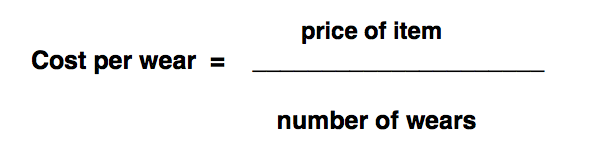

That’s when you need to think about cost per wear (CPW). I was never very good at math, but this formula is so simple that even I can handle it!

Screen Shot 2018-08-23 at 11.56.29 AM

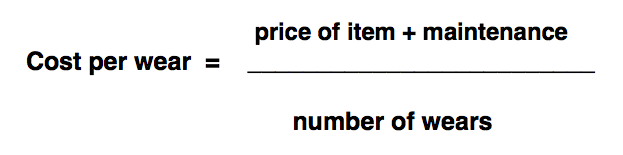
The simplest version involves dividing the price by how many times you estimate that you’ll wear the item. Of course, there are other factors to take into consideration. For example, does the item need to be dry cleaned. If so, it’s a good idea to factor that cost into the equation.

Screen Shot 2018-08-23 at 11.57.28 AM

Obviously, no one knows exactly how many times they’ll wear a particular item, but here are some questions that can help you estimate:

  • Where will I wear it?
  • Is it a single season item or something that I’ll wear year round?
  • Is it a trend that will likely disappear quickly or something that I’ll probably wear for several years?
  • Is it well made? Will it keep its shape and colour through multiple wears and washes or will it wear out quickly?
  • Will it play well with other items in my closet?
  • Will I get tired of it?

Let’s look at a couple of examples. I’m planning to buy a new winter coat this year. Imagine that I find the coat I want for $250. I live in a climate where winter lasts from late October until March. Unless I slip away to somewhere warm for a couple of weeks, I’ll likely wear that coat at least once a day all winter long, so let’s estimate that I wear it 150 times over the winter months. If I keep that coat for just one year, the cost per wear would be $1.67, but I’m likely to wear it for several winters so let’s multiply the number of wears by 3. Now I’m dividing $250 by 450 and the CPW is only 56 cents! On the other hand, if I spend $250 on a dress to wear to a wedding and I only wear it a couple of other times, the CPW is over $80! In my mind, the coat is a good buy, but the dress probably isn’t.

Here’s another way to look at it. Let’s imagine that you’re shopping for a basic black sweater and trying to choose between buying a high quality one for $120 or a cheaper, poorer quality version for $24. Which one is the better buy? As counterintuitive as it might sound, sometimes buying cheap is actually more expensive. If you would wear the more expensive sweater 200 times over the next few years, the CPW would be 60 cents, but you might only get 20 wears out of that cheaper sweater before it starts to pill, stretch out of shape, or even unravel. In that case, the CPW would be 83 cents. Clearly, the more expensive sweater is actually the better buy.

For CPW to work to your advantage, you have to love and enjoy wearing your clothes to such an extent that you’re willing to continue wearing them long term instead of constantly buying new ones; you have to be willing to make fewer and more intentional purchases. That’s the whole idea! Rather than forking over more and more of your hard earned dollars for cheap quality pieces that won’t last, you’ll spend more for clothes that will last longer.

Cost per wear isn’t a hard and fast rule. Splurging on something trendy that you won’t wear long term isn’t all bad. Getting dressed ought to be fun, so achieving a low cost per wear isn’t always the desired end, but it’s a handy tool to use, especially when you’re considering a major purchase or when sales racks tempt you to buy on impulse.

So next time you go shopping for clothes, shoes, or accessories, why not do the fashion math?

How much is too much?

LogoIf you know me or you’ve been reading my blog for very long, you already know that I’m not a Trump supporter, but what does that have to do with fashion?
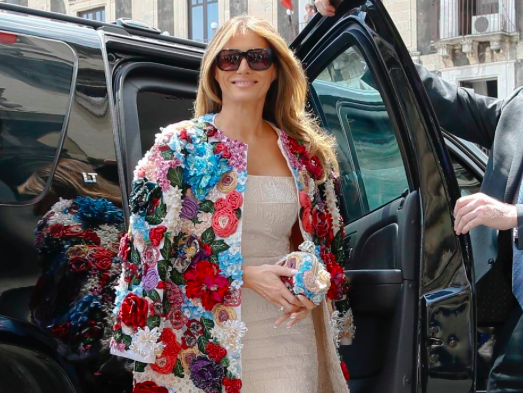
Earlier this week, while traveling with her husband, Melania Trump stepped into the Sicilian sunshine wearing a colourful appliquéd jacket by Italian fashion house, Dolce & Gabbana, that sells for $51,000 USD.

Excuse me?

$51 000! 

And that probably doesn’t even include the matching clutch!

Screen Shot 2017-05-29 at 7.09.53 PM

For those of us north of the border, that’s almost $70 000 CAD!

Contemplate for a moment the fact that electing Donald Trump was considered a triumph for the common man. He fashioned himself as a proud champion of the ordinary American who was fed up with big money running the country. Then consider that his wife’s jacket sells for just $5516 less than the median household income for the United States in 2015 (the most recent year for which data is presently available) which was $56 516. I don’t know of any common man, or woman, with a clothing budget like that one!

I can’t help wondering what the common American would do with that $51 000. Pay off their mortgage? Send their kid to college? Pay for health insurance? $51 000 would buy a lot of groceries!

One of the things to consider when trying to decide if the price of a garment is too high is cost per wear. It makes sense to put more money into an investment piece that will be worn many times season after season than an item that will only be worn a few times. If Mrs. Trump wore her jacket once a week for the next five years, it would still cost almost $200 a wear!

Unbelievable, and in my opinion, inexcusable!

SaveSave