A life transformed

Back in August when I wrote this post about several 50 year milestones in my life in 2025, I mentioned that In October it would be 50 years since I made the life-changing decision to follow Christ. A couple of readers mentioned that they would be interested in hearing more about how I reached that decision. I had already been thinking about sharing that story on the blog, so I decided I would do it today, the 50th anniversary of the day that my life was transformed.

As far back as I can remember, my family went to church every Sunday morning. I attended Sunday School and youth group and for several years, church camp was the highlight of my summers. In my early teens, I attended confirmation classes to learn more about the church and the Christian faith. The purpose of these classes was to prepare us for church membership, but when the classes ended and the minister asked me if I was ready to join the church, I said no. I felt that something was missing, but I didn’t know what it was. I knew that Jesus loved me and that He had died for me, but I felt that there must be more to it than that. When I discovered that all the other students in the class were going to join, however, I didn’t want to be the only one who was left out, so I changed my mind. After all, I was a good kid, a quiet kid who didn’t like to stand out from the crowd.

The summer before my final year of high school, my father took a job in the Northwest Territories and we moved from Vancouver to Yellowknife; from the third largest city in Canada to a small, isolated  community in the middle of nowhere. I had to leave my home, my friends, my school, my church, and everything else that mattered to a teenage girl. I wouldn’t get to graduate with my class. I was angry and I made a very conscious decision to rebel. I decided that I was going to find out how the other half lived. I quit going to church and started drinking and partying. I abandoned the morals that I had been taught and less than two years after leaving Vancouver, I entered into a teenage marriage that never should have happened.

We had only been married for a year and a half when my husband, a very charismatic narcissist, told me that he had fallen in love with someone else. He didn’t want our marriage to end though. Instead, he wanted to invite her to move in with us! I absolutely refused to allow that to happen and tried for another year to make our relationship work, but midway through my third year of university, it was over and we went our separate ways. I was broken. My dreams were shattered and I felt like unwanted, unloved garbage. That led to more unhealthy relationships.

In spite of all that was going on in my personal life, I managed to graduate from university with my teaching degree and I accepted a job in the very small town where we still live today. I realized that as a teacher in such a small community, my life would be on display for everyone to see. It was the mid 1970s and I was sure that if I continued to live the way I had been, parents wouldn’t want me teaching their kids.

Once again, I made a conscious decision to turn my life around. I thought I could do it on my own, but God had a much better plan. Richard was also a new teacher at the school that year. One evening early in the fall, he shared with me what it meant to be a Christian in a way that I had never heard before. He told me that if I acknowledged my sins, asked for God’s forgiveness, and surrendered my life to Christ, I could have a personal relationship with Him and my life would be transformed. I quickly realized that this was the missing piece that I hadn’t heard about growing up. I didn’t know that I had to make an actual decision to follow Christ or that I could have a personal relationship with Him.

At the same time, I also realized that making that decision would mean giving up control of my own life. Considering what a mess I’d been making of it up to that point, you would think that this would be an easy or obvious decision, but I wrestled with it. Eventually though, I couldn’t deny that God was calling me and I finally surrendered my stubborn will to His. When that happened my life changed completely. There were no flashes of lightning or tongues of fire, just an incredible peace that I had not known before. I felt like a brand new person, free of any guilt or shame over my past. I no longer had any desire to live the way I had been.

I quickly learned that God didn’t want to be a distant deity who cared about me, but who wasn’t personally involved in my life. Like a Japanese kintsugi artist, He began to fill the broken places in my life with gold and turn me into a vessel that He could use for His good purposes.

I wish that I could tell you that life was always easy after that, but of course, it wasn’t. In John 16:33, Jesus tells us, “In this world, you will have trouble. But take heart! I have overcome the world.” Over the past 50 years, I have suffered great loss and betrayal. I have spent the last 12 of those years fighting cancer, but I have never been alone in any of these dark times. One of my favourite Bible verses is Isaiah 41:10 which says, “Do not fear, for I am with you; do not be dismayed, for I am your God. I will strengthen you and help you; I will uphold you with my righteous right hand.” I can testify to the truth of that!

Whatever you take away from this post, please note that this is not about church or even about religion, it’s about an intimate, personal relationship with the Creator of the universe; a relationship that is available to everyone regardless of who you are and what you’ve done. If you have any questions or would like to chat about this, please feel free to comment below or send me an email at debock2@gmail.com.
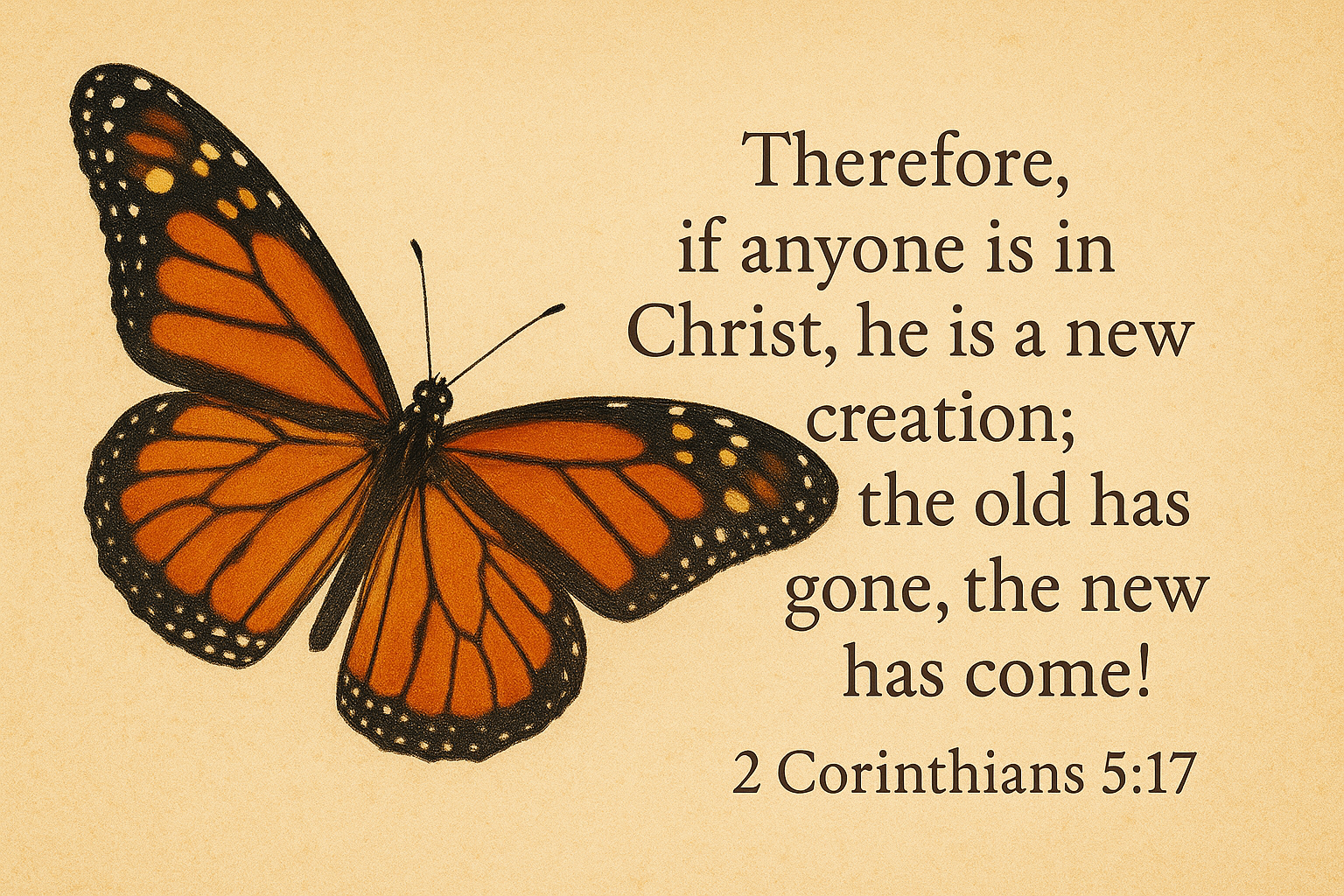
Image: ChatGPT

Geghard Monastery

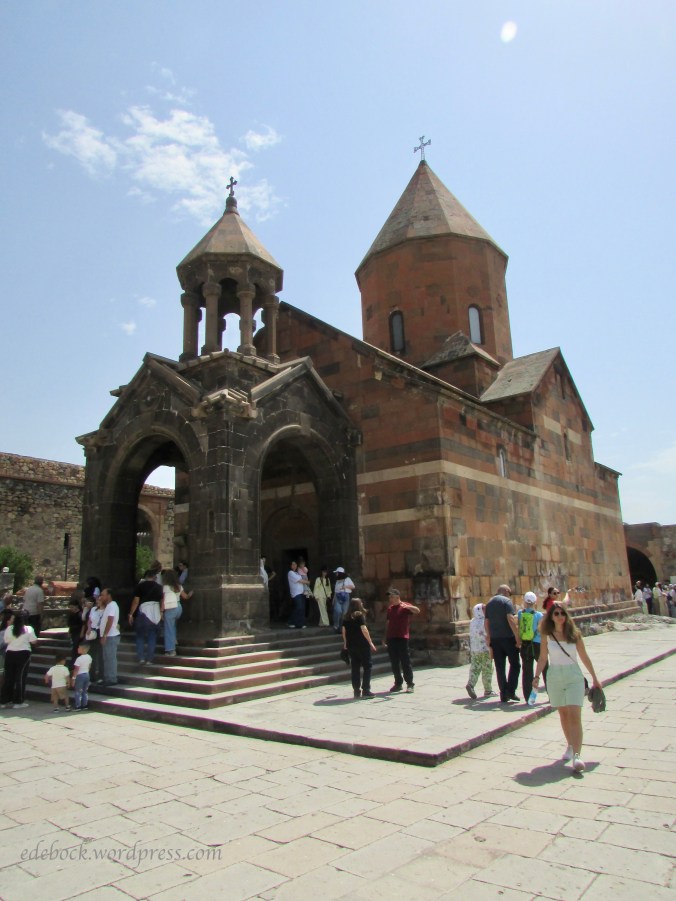
Geghard Monastery, declared a World Heritage Site in 2000, is nestled into the dramatic Azat River Gorge, approximately 35 km (22 miles) east of Yerevan, the capital city of Armenia. Can you spot it in this photo taken from the open air restaurant where we stopped for a delicious lunch.

Here’s a closer look.

Views of the gorge from the restaurant were absolutely spectacular. We could hear the river in the bottom of the canyon, but lush growth obscured our view of it.

One of the oldest Christian monasteries in the world, Geghard is one of the country’s most visited tourist destinations. It is believed to have been founded in the 4th century by Saint Gregory the Illuminator, following Armenia’s adoption of Christianity in 301 AD. Until the 13th century, the monastery consisted of churches, chapels, and chambers cut into the rock. 

The main cathedral was built during the 13th century and is an exceptionally well-preserved example of medieval Armenian architecture. The entire complex blends seamlessly into the surrounding mountainous terrain.  

Geghard Monastery was an important spiritual and cultural hub during the Middle Ages housing numerous monks and scholars. It also became a destination for pilgrimages because it was believed that the spear that pierced the side of Christ during His crucifixion was stored there for a period of time. Geghard means “spear” or “spearhead” in Armenian. 

A unique feature of monastery is a spring flowing from the rock inside the church. Believed to be holy water, it has worn a groove into the rocky floor over many hundreds of years. Outside, a very short walk from the main church takes one to a stream tumbling down the rocky mountainside. 

Tomorrow we depart for an undisclosed location where we will engage in the ministry that is the main reason for this trip. The blog will continue when we complete that work and resume travelling as tourists. 

Khor Virap: The Birthplace of Armenian Christianity

Although I’m not sleeping particularly well yet, I think I’ve sufficiently recovered from jet lag to begin sharing some of the things we’ve seen since arriving in Armenia.

In 301 AD, Armenia became the first country in the world to officially adopt Christianity and it all started here at Khor Virap, one of the country’s most sacred and visited sites. During the reign of Tiridates III, Saint Gregory the Illuminator (originally known as Grigor Lusavorich) angered the king by refusing to participate in pagan rituals and instead preaching Christianity. The king had him imprisoned in Khor Virap which literally means “deep pit” or “dungeon” in Armenian. There in the depths of the earth, he languished for 13 years, surviving only because of the kindness of a local woman who provided him with food and water. Eventually, when Tiridates fell ill with a form of madness, his sister is said to have had a dream that the imprisoned Gregory could heal him. Pulled from the dark pit, Gregory was washed, dressed and taken to the king where he prayed urgently for his healing. When Tiridates recovered, he became a loyal and dedicated supporter of Christianity and officially declared it the state religion.

A chapel was initially built at Khor Virap in the 5th century and the present St. Astvatsatsin (Holy Mother of God) church was constructed in 1662. The 6 metre (19.7 feet) deep pit where Gregory was held is still present at Khor Virap and tourists can descend into the dungeon on a narrow ladder. While hubby was brave enough to do that, I declined!

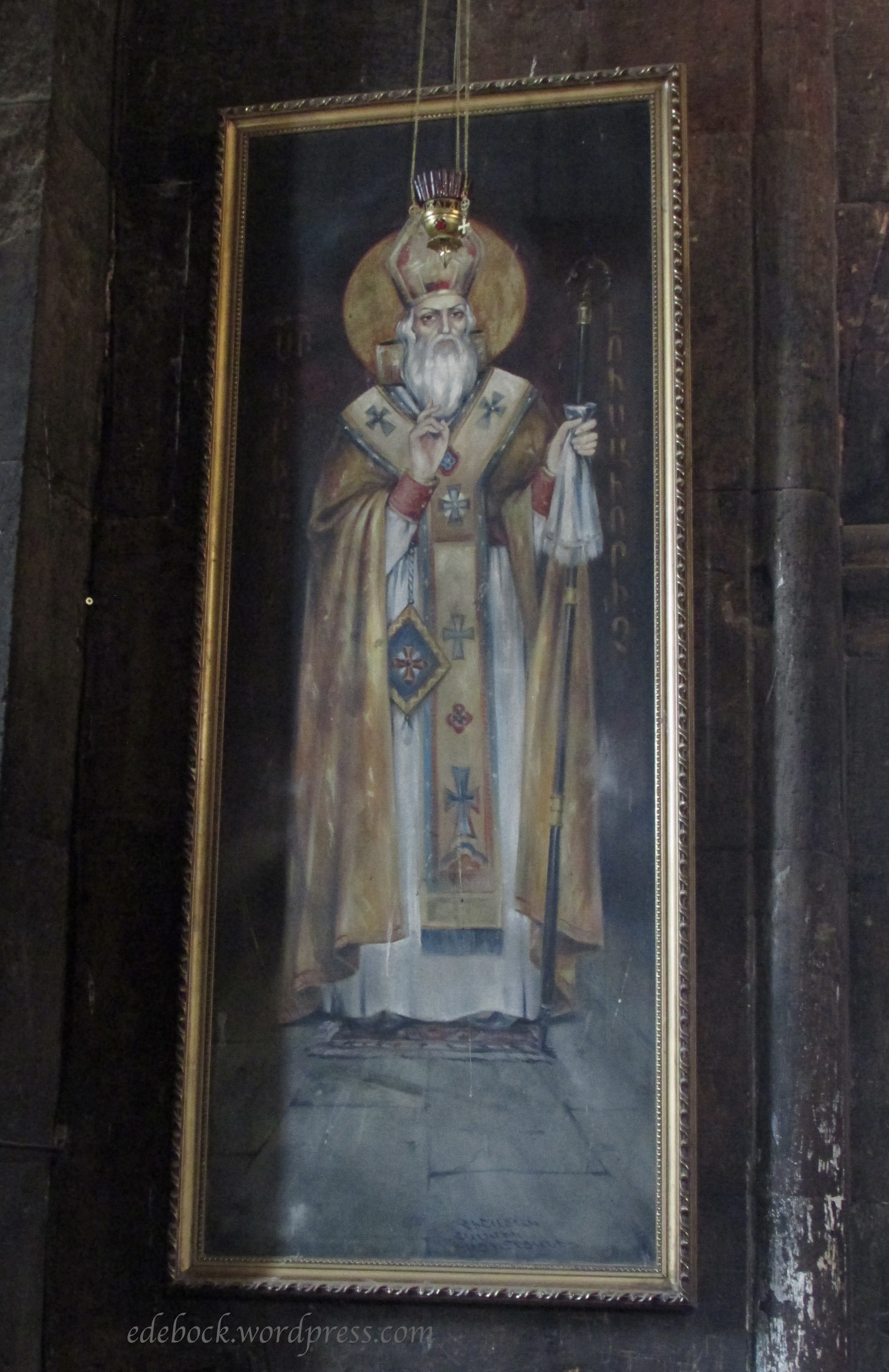
Images of Saint Gregory are found both in and outside the church.   


Khor Virap is located on the Ararat plain about a 45 minute drive from Yarevan, the capital city of Armenia. While the monastery was well worth the visit, part of the excitement of being there was looking out across the border between Armenia and Turkey at Mount Ararat where Noah’s ark is said to have come to rest! There are actually two volcanic cones, Greater Ararat on the right and Little Ararat on the left. Greater Ararat, known as the “Holy Mountain” of the Armenian people was actually in Armenia until the 1921 Treaty of Moscow and Kars officially made it part of Turkey following the Turkish-Armenian war of 1920. If you look closely at the photo, you can see the fence that marks the border between the two countries.  

Resurrection Sunday!

If you are one who usually reads my blog on Fridays, you will have noticed that there wasn’t a new post this week. We spent Good Friday with family and it was indeed a good day. In the morning, we attended a solemn service commemorating the final 24 hours leading up to our Lord’s crucifixion. I don’t think there’s any better way to explain the significance of Good Friday than by sharing the B.C. comic. It says it all. Jesus took my place. He took your place. And He did it willingly. Thankfully though, that wasn’t the end of the story.


Today is Easter, the day that we celebrate the fact (yes, it is a fact) that the broken, battered body that was laid in a borrowed tomb overcame death and rose again! A more fitting name for the day would actually be Resurrection Sunday.

It is thought that the word, Easter, which doesn’t appear in the Bible, was probably derived from the name of Eostre, a pre-Christian goddess in England who was celebrated at beginning of spring. Given the symbolism of new life and rebirth, it seems fitting to celebrate the resurrection of Jesus at this time of year, but the real reason that this time of year was chosen is the close proximity to the Jewish Passover. It was during the Passover festival that Jesus was executed.

Regardless of what we call it though, Easter is the most important day on the Christian calendar. It is the day that we celebrate victory over sin and death.

“Jesus said to her, “I am the resurrection and the life. The one who believes in me will live, even though they die.”  John 11:25

If you haven’t accepted Jesus as your Lord and Saviour, this verse might seem like nonsense to you. How can we live if we die? Look back at the comic. Death is the punishment for our sins, our wrongdoings. The Bible tells us that there is no one without sin, not even one, except for Jesus Christ, and He chose to take our punishment. Yes, our bodies will eventually die, but the essence of who we are is not this physical body. It is the spirit that lives within. On Resurrection Sunday, we celebrate the fact that if we accept His payment for our sin, the spirit that is the real me, the real you, will spend eternity with Him. We will not die!

This is not religion. It’s not a set of rules and regulations. It’s a relationship; a relationship with the one who made us and who willingly died for us.

How do I know that this is true? I know because almost fifty years ago He changed my life completely. He took a messed-up life that would surely have ended in despair and transformed it into one that experiences deep inner peace and joy even in the most trying of times. I know because He speaks to me. Like a child with a parent, I don’t always like what He says, but I’ve learned that He always wants what is best for me. I know because He is always with me. I am never alone.

If you don’t know this kind of peace, why not make this Resurrection Sunday the day you decide to accept His free gift of life? It’s as simple as ABC. Admit that you are a sinner (we all are!) Believe that Jesus willingly took your place, died for your sins, and rose again in victory over sin and death. Confess Him as Lord of your life and choose to live in obedience to Him. If you choose to do that today, please let me know, or if you have any questions, feel free to email me at elainedebock@gmail.com.

The tomb is empty. Happy Easter!

When the church disappoints

building-simple-flat-black-white-icon-logo-vector-castle-church_653669-14312

This topic has been weighing heavily on my heart for the past couple of days. I don’t know whether I’ll be able to do it justice or not, but since writing is the best way I know to process heavy things and I need to get this off my chest, I’ll give it my best.

I know I’m not the only one feeling completely disheartened by the results of this week’s election in the US. There is no question that we are living in difficult times. What disturbs me most and what has prompted me to write this post is the fact that the election was won with the support of so many so-called evangelical Christians.

There was a time when I might have used that term to describe myself, but I no longer do. Don’t get me wrong. I’m not abandoning my faith. I’m still a Christian although the term that I prefer is Christ-follower. I will not, however, call myself an evangelical Christian. There is no way that I can possibly identify with the overwhelming number of evangelicals who bow down in adoration to a convicted felon, a racist, a misogynist, a liar. How is it that they can possibly believe that God is pleased with their choice? How can they have been so deceived?

Scripture tells us that, as Christians, we are to be “the pleasing aroma of Christ” (2 Corinthians 2:15-16), but frankly, something smells really bad right now!

The Christian church has a long history of going wrong. From the slaughter of Jews and the destruction of their communities during the Crusades to the devastating effect of church-run residential schools on our Indigenous population in the past century, the church has missed the mark in big ways and small.

There’s a common saying amongst believers that the reason there are no perfect churches is that there are no perfect people. That’s true, of course. The church is a collection of sinners, of failures, of flawed human beings, but I think that sometimes we like to use that truth to excuse the inexcusable.

I know that I’m painting the church with a broad brush here. Certainly there are individual congregations or individuals within congregations that are as disappointed as I am with the outcome of the recent election. So how do we respond? What do we do when the church disappoints?

Do we bail out? Do we turn our backs on the church and walk away? Hebrews 10:24-25 advises us to “consider how we may spur one another on toward love and good deeds, not giving up meeting together, as some are in the habit of doing, but encouraging one another“. If there’s ever a time when we need encouragement, it’s now!  So no, I don’t advise abandoning the church altogether. We’re living in a post Christian era. Clearly the recent election outcome is just one more sign that society is moving farther and farther away from the teachings of Jesus. Whether it’s in a formal church setting or some other kind of gathering, we need one another.

Personally, I will pray and I will continue to nurture my own relationship with Christ, the all-sufficient one. After all, the church is not the saviour of the world and whether or not he would agree, the president-elect isn’t either. That is solely Jesus’ role.

Colossians 3:15 tells us to “let the peace of Christ rule in your hearts, since as members of one body you were called to peace. And be thankful.” (italics are mine) We can fight our disappointment with gratitude remembering that even in the midst of a world that seems so wrong, we have much to be thankful for.

And finally, let’s not give in to fear. One of my favourite verses, Isaiah 41:10, says, “So do not fear, for I am with you; do not be dismayed, for I am your God. I will strengthen you and help you; I will uphold you with my righteous right hand.”

As the Jim Bailey song says, “I don’t know what the future holds, but I know who holds the future”. In days that seem dark, that gives me a glimmer of hope.

I’m a Christian feminist

I’m a Christian feminist. Yes, there is such a thing and no, that f word isn’t an obscenity.

The label may not be a familiar one, but Christian feminism predates well known secular feminists and activists including Simone de Beauvoir, Betty Friedan, and Gloria Steinem. There is, in fact, a long history of Christian women devoting themselves to fighting for the status of women, and the right of women to vote, to own property, and to defend themselves in a court of law against rape and domestic abuse. Women like Nellie McClung who, based on her understanding of God’s intention for creation, together with Emily Murphy, Henrietta Muir Edwards, Irene Parlby and Louise McKinney, launched a legal challenge that would pave the way for women to be declared “persons” under law and to participate equally in all aspects of life in Canada. Thankfully, theirs is a rich tradition of pro-life feminism that continues today.

Within the Christian church, there are two schools of thought regarding the roles of men and women. Complementarians believe that men and women, though equal in worth, are meant to have distinctly different roles. Egalitarians, while agreeing that men and women are equal in worth, believe there should be no gender restrictions on what roles they can fulfill. Marriage and ministry are the primary points of disagreement between the two viewpoints.

When we first married, I was a baby Christian. I tried to be the submissive wife that my husband had been taught was his due simply because he was born with a Y chromosome and an extra appendage. It didn’t work. He wasn’t a good leader and, truth be told, I wasn’t a good follower. All the while, I wondered why God would want me to submit to a sinful man. Then I realized that He didn’t. We were meant to be partners, submitting to one another (Ephesians 5:21) with God as the head of our household.

But what about Ephesians 5:22-24 and Colossians 3:18, verses that exhort wives to submit to their husbands? We can’t simply ignore portions of scripture because they make us uncomfortable or dismiss the parts we don’t like. Sometimes we have to grapple with scripture. We have to understand the context and the time in which the words were written. We have to dig deep and seek to understand the principles being taught and then figure out how to apply them in our time and place.

“It’s dangerous to cherry-pick a few stand-alone verses, particularly when they are used as a weapon to silence and intimidate, effectively benching half the church… We can’t read letters written to specific people with specific situations in mind in a specific context and then apply them, broad-brush, to the whole of humanity or the church or even our own small selves.”  Sarah Bessey, Jesus Feminist

These select verses telling wives to submit to their husbands line up with the Greco-Roman household codes that were part of Pax Romana law at the time and in the place that the apostle Paul was writing his epistles. They were the law of the land at that time and, as in Romans 13:1-2, Paul is telling his readers that “everyone must submit himself to the governing authorities.”

Interestingly, just four verses after Colossians 3:18 instructs women to submit to their husbands, verse 22 tells slaves to obey their earthly masters. While wives must submit is a core teaching in most Christian churches today, no one takes that verse literally and suggests that slavery is actually a godly practice. I jokingly respond that if I have to submit to my husband, I also want my slave!

In addition to slavery, which is never actually prohibited in the Bible, the church has rightfully done away with many Biblical practices including polygamy, the buying and selling of daughters, stoning, the requirement that baby boys be circumcised, and many other ancient practices that were once culturally acceptable. Gender inequality is just one more example of an injustice that we need to let go of.

Nowhere in the Bible does it suggest that any of the gifts of the Spirt, which include teaching, pastoring, prophecy, evangelism and leadership (Romans 12, Ephesians 4, 1 Corinthians 12), are gender specific and yet many Christian churches today exclude women from these roles. Sadly, in spite of the fact that there are numerous examples of women leading, teaching, ministering, and prophesying in scripture, patriarchy is alive and well in many churches today. This is clearly contrary to Acts 2:18 which says “Even on my servants, both men and women, I will pour out my Spirit in those days, and they will prophesy.” Paul himself says in Galatians 3:28 “There is neither Jew nor Greek, slave nor free, male nor female, for you are all one in Christ Jesus.”

I served on the board of our previous church for seven years, but in our present church I would not be allowed to because I’m a woman. I’m okay with me not being on the board, but I’m not okay with half the church being denied full opportunity to use their God-given gifts simply by virtue of being female and I’m not okay with a church board not having the benefit of the female perspective. The very first chapter of the very first book of the Bible makes it abundantly clear that God created male and female in His image and gave THEM dominion over all that He had made.

According to Genesis, God did create Adam first, but He also said, “It is not good for the man to be alone. I will make a helper suitable for him.” The original word translated in English Bibles as helper or helpmeet is ezer, a word used twenty-one times in the Old Testament: twice in Genesis for the woman, three times for nations that Israel appealed to for military aid, and sixteen times for God Himself as Israel’s helper! God created His daughters to be ezers, strong and resourceful partners for His sons. He also makes it clear that in relationship, they are to become one. That’s partnership, not patriarchy! When a woman is held back, hushed up, minimized or lessened in any way, she is not free to walk in the fullness that God intended for her as His image bearer, His ezer.

“When half the church holds back – whether by choice or because we have no choice – everybody loses and our mission suffers setbacks.” Carolyn Custis James, Half the Church

So what do I make of 1 Corinthians 14:35 which says “If they want to inquire about something, they should ask their own husbands at home; for it is disgraceful for a woman to speak in the church.”? Again, if we were to delve into the historical context for this verse, we would find that it was written in direct response to disruptions that were occurring in the Corinthian church at that time. The underlying principle is not that women 2000 years later should be forbidden from speaking in church, but that a church service ought to be orderly, not chaotic, a topic that Paul actually begins to address at the beginning of chapter 11.

And what about 1 Timothy 2:12 “I do not permit a woman to teach or have authority over a man; she must be silent.”? Again, Paul’s restriction was given in the context of a personal letter to Timothy giving advice about a specific issue concerning false teaching that had arisen in the church at Ephesus. There is no suggestion that he was establishing church policy for all time. Neither is there any mention of this in the rest of Paul’s writings or elsewhere in the Bible. As has already been mentioned, there are clear examples elsewhere in scripture of women teaching, prophesying, and taking leadership roles.

So why do I, a Christian feminist, stay in a male-dominated church? First of all, there aren’t a lot of options in our small community. Fortunately, however, there are ways that I can use my spiritual gifts of teaching and faith within the confines of a patriarchal setting and I’ve always been comfortable worshipping with genuine believers who don’t see eye to eye with me on all matters. I also believe that God has placed me behind enemy lines, so to speak, for a reason. Though it likely won’t happen in my lifetime, I can pray for change and speak for justice for the women of the future. I may not be allowed to preach from the pulpit, which I don’t feel called to do anyway, but I can speak the truth, as I know it, when opportunity presents itself and I can certainly preach it from my keyboard!

For further reading on this topic, I highly recommend:

  1. Half the Church: Recapturing God’s Global Vision for Women, Carolyn Custis James
  2. Jesus Feminist: An Invitation to Revisit the Bible’s View of Women, Sarah Bessey
  3. The Making of Biblical Womanhood: How the Subjugation of Women Became Gospel Truth, Beth Allison Barr
  4. A Year of Biblical Womanhood, Rachel Held Evans

This is, of course, a controversial topic. I invite dialogue in the comment section, but I also insist that it remain a safe and respectful place for the expression of differing viewpoints and experiences.

The last ten

When I sat down to write this evening, my initial plan had been to start working on this Friday’s fashion post, but something else has been weighing on my mind and I decided to go in that direction instead. I’ve written about the Christian and social media before, but tonight that’s where I found myself going again.

I’ve been using Facebook since December 2007. We were about to leave for a year-long teaching assignment in Japan and our daughter insisted that I had to have Facebook as a way of staying in touch. In fact, she actually created my account and chose my first password and profile picture! She was right. In those days, Facebook was a great way to connect with friends and family. We enjoyed exchanging news and posting photos of our families and our daily lives. I even reconnected with a few people that I had completely lost touch with over the years.

Over time, however, Facebook has morphed into something very different than it was in those early days. I don’t mind the proliferation of ads on my Newsfeed because I realize that very little in life is free and someone has to pay for this platform. No, it’s not the ads that bother me, it’s the negativity, the anger, and the misinformation. Gone are the days when people annoyed one another or flirted with one another by “poking” each other on Facebook. Now, many use social media to lash out at one another or to hurl insults at those who disagree with them. Instead of sharing our lives, we try to prove each other wrong.

So, what does the Christian do? Can we be salt and light on social media or would we be better to avoid it altogether? These were the questions that I was wrestling with in late January when I learned of a free 10-day challenge called Instagram for Jesus. Offered by an online women’s ministry called Well-Watered Women, the challenge is simply a series of 10 short emails designed to help users of Facebook, Instagram, Twitter, or TikTok examine their motives for using social media and the potential that it holds, as well as set life-giving boundaries. If this sounds like something that might be of interest to you, check it out and sign up here.

If I had to choose the one thing that impacted me most from the 10 short messages, it was this recommendation from Day 8, “Scroll through your last ten posts, and ask yourself what a follower would know about you through those images and words. Consider opportunities to shift that understanding to a clearer image of what it means to walk as a sinner saved by grace.” Even if you’re not a Christ-follower, that first sentence is worth considering. What do your last ten posts tell the world about you? Is that the image you want to portray? If you are a believer, is this how you’re called to represent Christ to the world? If not, what are you going to do about it? For me, the simple practice of looking at my last ten posts, which I’ve been doing from time to time since completing the challenge in February, has been an excellent way to ensure that I’m being the kind of online presence that I want to be. 

Shot of an unrecognizable young woman working on her laptop at home

Reclaiming Christmas

The fact that the world has ‘stolen’ our Christian holy days and turned them into commercial extravaganzas has been one of my pet peeves for a very long time. Walk up and down the aisles full of Christmas decorations in any store and what do you see? Santas, reindeer, snowmen, and Disney characters galore. What do any of these have to do with the real meaning of Christmas? Look at the outdoor decorations in your neighbourhood. You might see a nativity scene, particularly in front of a church, but where is Christ in most of those decorations? What does an inflatable penguin or puppy have to do with Christmas? I don’t know either, but you can get one for just $19.98 CAD at Walmart!

Don’t even get me started on that stupid Elf on a Shelf! Whoever thought that one up did nothing but add more meaningless stress to an already over-stressed season for anyone who bought into it.

Don’t get me wrong. I’m not a total Grinch! I love Christmas lights. After all, it was Christ Himself who said, “I am the light of the world. Whoever follows me will never walk in darkness, but will have the light of life.” John 8:12 NIV

Though standing a tree in the house and decorating it with lights and ornaments often strikes me as a weird tradition, I also love the Christmas tree that stands in front of our living room window. Many of its decorations point to the true meaning of Christmas. That’s very intentional. It’s one small attempt at reclaiming Christmas.

IMG_0445

Although a beautiful nativity scene also has a place of prominence, our home isn’t completely devoid of the fun side of Christmas. Santa and one of his reindeer stand atop a cabinet in the living room. Surrounded by teddy bears and twinkly lights, he’s checking his list and preparing for his round the world gift giving flight, but it’s the little Santa bowing over the manger on another shelf that holds greater meaning for me.

IMG_0452

So what is the real meaning of Christmas? “I bring you good news of great joy that will be for all the people,” an angel told some shepherds keeping watch over their flocks outside Bethlehem that night so long ago; a night that would forever change the world. (Luke 2:8-10 NIV) That night the mighty Creator of the universe chose to come to earth in the form of a tiny babe, to live among us, and to show us who He really is. That night, He began His journey to the cross where He would pay the penalty for all our failures and give us the gift of eternal life with Him. There is no better gift than that! It costs nothing but the willingness to humble ourselves and surrender to His leading in our lives. That’s what Christmas is really all about! That’s true love and that’s why I want to reclaim Christmas. I can’t take it back from the masses who celebrate by overindulging and running up their credit card bills, but I can keep the love of Christ at the centre of my Christmas season.

When we were teaching in Japan, I asked one of my adult students why so many Japanese people celebrate the birth of a God they don’t believe in. “We love to decorate and we love to shop,” she told me. Perhaps that’s why most people celebrate a holy day that has no real meaning to them.

Why do you celebrate Christmas? What does it mean to you?


Sometimes it’s hard to be humble

One of the characteristics of grace listed in yesterday’s post was “acts with humility, not pride.” As I pondered my One Word for 2018 and asked myself how I’m doing at becoming a woman of grace, I was also challenged to examine myself and wonder how I measure up in the area of humility.

The Bible has plenty to say about being humble. The book of Proverbs contains many warnings for those who refuse to put others before themselves and both the Old and New Testaments tell of blessings for those who do. Colossians 3:12 has become my life guide. “Therefore, as God’s chosen people, holy and dearly loved, clothe yourselves with compassion, kindness, humility, gentleness and patience.

There’s an old country and western song that says, “Oh Lord it’s hard to be humble when you’re perfect in every way!” I’ve also heard it said that if you think you’re humble, you probably aren’t. So how can we know if we’re humble or not?

After much reading and pondering, I came up with the following 20 characteristics of a humble person. I’m sure it’s not exhaustive, but I think it’s a reasonably good checklist.

A humble person…

  1. is not boastful
  2. is able to set aside personal preferences for the sake of others
  3. treats others with respect
  4. is not easily offended
  5. is grateful for what they have
  6. is able to rejoice with others
  7. is not wise in their own eyes
  8. is teachable
  9. is able to seek advice or ask for help
  10. willingly serves other people without drawing attention to themselves
  11. accepts their own limitations
  12. accepts correction without becoming defensive
  13. takes responsibility for their actions and apologizes when wrong
  14. is merciful, forgiving quickly and not holding grudges
  15. doesn’t get frustrated with the weaknesses of others
  16. is self-controlled
  17. listens to others and doesn’t feel the need to speak their mind in every situation
  18. is comfortable allowing others to have centre stage
  19. doesn’t always have to be right
  20. doesn’t insist on their own way

In a “me first” world, it isn’t always easy to be humble and there are many misconceptions about what it means. In the same way that being gracious is not the same as being wishy-washy or weak-kneed, humility is not a sign of weakness. Being humble is not belittling or undervaluing oneself, nor is it an indication of poor self-esteem. Like grace, humility is actually a strength.

Humility

Growing in grace

With a thick blanket of snow still on the ground, it’s hard to believe that it’s the middle of March already. We’re two and a half months into a new year and an incident this week reminded me of my One Word for 2018.

Grace.

How am I doing? My initial response indicated to me that I still have some growing to do in order to become the woman of grace that I would like to be.  It also prompted me to think about what that woman would look like. How would she respond in challenging situations where it’s sometimes difficult to show grace?

Almost three years ago, Christian author, speaker, and Bible teacher, Kathy Howard, penned this list of 15 characteristics of grace (compiled from passages in Ephesians and 1 Corinthians) on her blog.

A person of grace…

  1. Doesn’t insist on being right, but seeks to make things right
  2. Is willing to be inconvenienced
  3. Seeks the welfare of the other person
  4. Speaks words that build up, not tear down
  5. Doesn’t demand to be heard, but strives to listen
  6. Focuses on others needs instead of their own
  7. Acts with humility, not pride
  8. Doesn’t keep score
  9. Looks for ways to help and encourage others
  10. Freely forgives
  11. Seeks to understand
  12. Doesn’t expect a return
  13. Focuses on the important over the urgent
  14. Doesn’t pick and choose whom to show grace
  15. Doesn’t overlook sin, but encourages holiness

I would also add…

16. Doesn’t always have to have the last word

After this week’s incident, I think perhaps I need to focus on #4. I consider myself quite gifted with words, but it’s a gift that can be used positively or negatively. I can speak life or condemnation. It’s pretty easy for me to write a scathing response to something that irritates or upsets me, but as a person of grace I would choose to use gentler words.

Does this mean that a gracious person is wishy-washy? Absolutely not! It’s entirely possible to be strong, even assertive, and yet still be gracious. Jesus was a perfect example.

That thought brings me to #7, another area for self-examination. Humility. But that will be the topic of another post.

grace not perfection