Unless the weather changes dramatically in the next little while, this may be the first day in over three months that we don’t leave our little 390 square foot apartment! It’s been pouring rain and the wind has been howling all day long. Since we don’t work on Mondays and had nothing more than a trip to the supermarket to pick up a few groceries planned, it’s been a good day to stay indoors catching up on emails, reading, and playing a few games of Carcassonne. I won three in a row! It’s also a good day to reminisce about all the places we’ve explored since coming to China and to share with you some of the great examples of Engrish that we’ve found along the way!
Engrish, or Chinglish as it’s usually called in China, is what often happens when an Asian language is translated into English. You’ve probably seen some of it when you’ve tried to make heads or tails of the instructions that came with something produced in Asia. As a lover of words, I find Engrish highly amusing. I love to visit www.engrish.com, a website that posts one example of Engrish every day but I’m even more delighted when I find my own examples like the ones pictured below.
"Rain and snow carefully slip" appears beside an escalator in downtown Dalian. Richard waited patiently while I rode up and down several times trying to get the best picture possible!
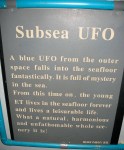
The "Subsea UFO" sign is found in the aquarium that we visited with some of our students. We had no idea what it was referring to and it made absolutely no sense to any of us! Note that it includes the word harmonious which seems to be a very popular one in China. Even the students in my beginner level university class use this word frequently. The concept of harmony is clearly at the core of Chinese thought and culture. Confucius said, " Let the states of equilibrium and harmony exist in perfection, and a happy order will prevail throughout heaven and earth, and all things will be nourished and flourish."
I don’t know how well you can read the sign that we found at the entrance to Fu Jia Zhuang Park but I especially love #3 and #10. #3 reads "Pre-school age child or psychopath should be accompanied by a guardian." I’m having a hard time typing that one without laughing! #10 is longer. It reads "The tourist who suffers from heart disease, epi lepsy, cold, neuroticism, asthma, diabetes, high (low) blood pressure, rhinopharyngitis, earache or getting drunk are not allowed to dive and swim. If the tourist conceals the above-mention situation, he or she is responsible for the consequence if the accident happens."
One of many signs at the North Korean border warned, "Forbidden to cross border in border area." Um… where else might we try to cross it?
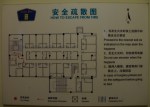
The How to Escape From Fire sign on the back of our hotel room door in Jinan also tickled my funny bone. Fortunately, we didn’t have to proceed to the nesrest exit but we did put on the safeguord before going to bed to prevent burglery from happening.
On our recent walk along the Daxishan Reservoir boardwalk there were many little wooden signs to guide our behaviour. We could figure out the intent of most of them but one was particularly entertaining. We did hold hands but it would have been pretty difficult to walk while holding our feet! The final sign was near the end of our walk. We had to look closely at the little icon to figure out what kind of nuisance people might commit. Believe it or not, though we haven’t actually seen anyone committing that kind of nuisance, we’ve definitely seen evidence of it on some of our walks!
I’m thinking about submitting a couple of these to www.engrish.com. Which ones made you chuckle?
-

- img 0948 2
-
- img 1200 2
-

- img 1224
-

- img 1121
-
- img 1313
-

- img 1757
-

- img 1793
-

- img 1793 2
 Following Augustine