Book of the month – July 2024

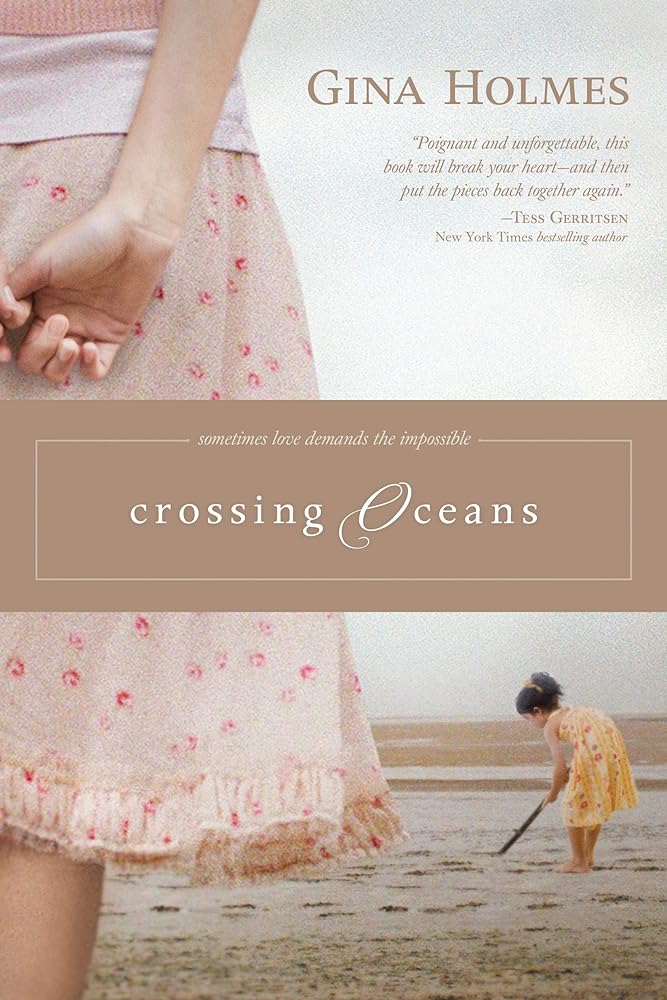
Crossing Oceans

Gina Holmes

9781414333052At the outset, Gina Holmes’ Crossing Oceans reminded me of a sappy Christmas movie. You know the ones… after several years away, beautiful young woman returns to her quaint mid American hometown where she encounters sweet, kindhearted, and inexplicably single man from her past who sweeps her off her feet and solves all her problems.

I was okay with that. Having just finished reading the memoir of an esteemed Chinese professor who lived through the horrors of the Cultural Revolution, I was ready for some fluff; some light summer reading.  

Crossing Oceans surprised me. First of all, I didn’t realize that it was a Christian novel. Had I known that, I might not have picked it up. As strange as it might sound, considering the fact that I’m a committed follower of Christ, I read very few Christian novels. Although there are exceptions, too many of them are unrealistic, happy ever after romances somewhat on par with those mushy Christmas movies. While the main characters in Holmes’ novel are professing Christians, it isn’t preachy. They are far from perfect, and their problems aren’t swept away because they believe in God. 

When Jenny Lucas left home, single and pregnant, she promised herself that she’d never look back. Six years later, knowing that she’s dying of cancer, Jenny returns to the sleepy North Carolina town where she grew up to decide who will raise her little girl when she is gone. Will it be her father with whom she has had a difficult relationship since the death of her own mother when she was a teen? Or will she choose Isabella’s dad who doesn’t even know that he has a daughter? Animosity between the two families adds to her dilemma. Can they put aside their differences and help both Jenny and Isabella face what lies ahead? 

This is a sad story, but not a depressing one. It’s a poignant story of love and loss, but also forgiveness and healing. Jenny faces her situation with determination, courage, stoicism, and even a sense of humour. As I neared the end, I couldn’t help wondering how the story could possibly end in a satisfying manner, but without giving anything away, I’ll simply tell you that I wasn’t disappointed.

The notebook

No, I’m not talking about Nicholas Sparks’ debut novel or the award winning movie adaptation. I’m talking about an actual notebook.

Some of the very best advice that I received in the early days following my first cancer diagnosis almost eleven years ago was given to me by a medical technician administering an unrelated bone density test. “Get yourself a notebook,” she told me. “One of those ones with several sections where you can keep track of different things. Take it to your appointments with you and write things down.” It sounded like good advice, so as soon as I left the clinic I headed over to Walmart and found exactly what I needed, a Five Star 5-subject notebook.

IMG_7130

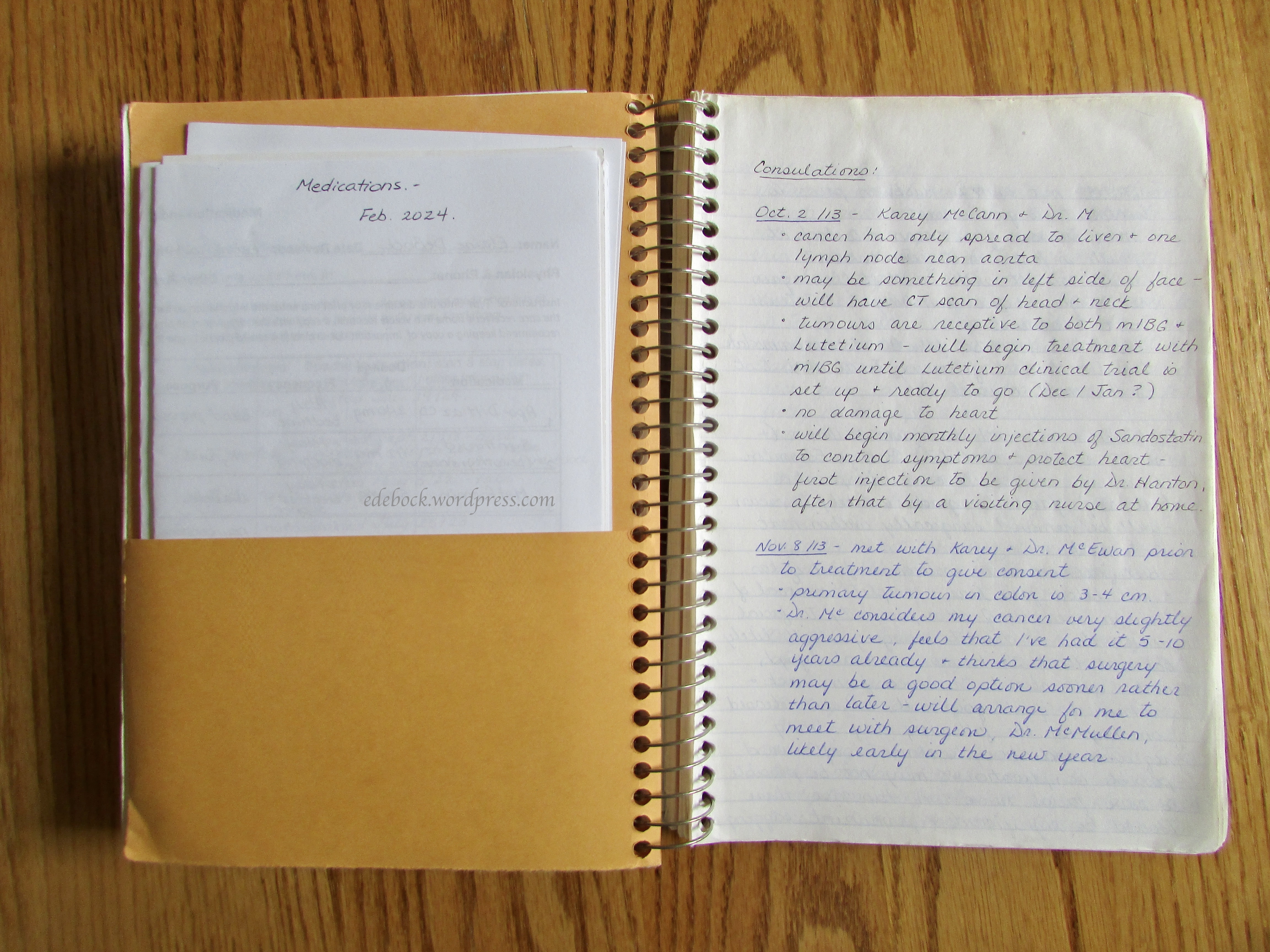
There’s a section where I record tests, procedures, and treatments; another one for consultations; and one where I keep a record of the injections that I receive every 28 days… when, where, who administered it, and any reaction that I might have. There’s also a section where I record some of my test results. I have access to those online at MyAHS Connect, but there are a couple of tests that are done regularly that I like to keep a written record of so that I can easily note trends. Finally, there’s a section where I write down questions to ask at my next appointment. More than one of my doctors has commented that they wish more of their patients would do that.

IMG_7132

Not only is my notebook separated into sections, but each divider has a pocket front and back. Those have been great for storing business cards, handouts, consent forms, vaccination records, a family medical history, and my personal directive. One pocket also holds two very important lists; my current medication list and a list of my past surgeries, all fourteen of them. Unless you spend a lot of time seeing doctors, you probably have no idea how often I’ve needed those two lists; how many times I’ve been handed a clipboard and asked to fill out forms that require me to list all my medications and past surgeries. Without those lists, I’d be stumped. What year did I have my gall bladder out? What’s the name of that blood pressure med and what dose do I take? With my notebook in hand, all that information is at my fingertips.

IMG_7134

Thankfully, the notebook has a strong plastic cover and a stiff cardboard back. Without those, I doubt that it would have lasted all these years. After all, I’m sure it’s been to at least 150 appointments with me!

If you or anyone you know is ever diagnosed with a serious or chronic health condition, I’d definitely recommend getting a notebook. It really has made my journey easier.

IMG_7137

Cancer metaphors and an update

Patients, caregivers, fundraisers, and even medical professionals use a variety of different metaphors to describe life with cancer.

From day one, I’ve referred to my cancer experience as a journey. As a seasoned traveller, when I was diagnosed I felt as if I was embarking on a trip into the unknown. It’s been a long and tumultuous trip, but the metaphor is one that still works for me. Some patients, however, are bothered by it believing that a journey should always be fun and something that you have control over.

An even more controversial metaphor is the one that refers to life with cancer as a battle. Although it’s very common, many people take exception to using the vocabulary of violence at a time when patients are at their most vulnerable. Within the language of winning and losing, there’s also the uncomfortable implication that those who’ve died of cancer are losers and that maybe if we just fight hard enough we can win. While I realize that there are limitations to any metaphor, I think that the battle metaphor can be empowering. I am in a fight for my life and cancer is the enemy.

Thankfully, no one fights cancer alone and that’s also where the battle metaphor works well. My closest ally is my husband who accompanies me to every appointment and is involved in every decision regarding my care. An army of skilled medical professionals with a vast array of formidable weaponry (chemical, biological, and nuclear) at their disposal direct my care and they are backed up by a battalion of prayer warriors around the world. Ultimately, the commander in chief, the only one who knows the final outcome, is the Lord Himself. As we sang in church yesterday,

So when I fight, I’ll fight on my kneesWith my hands lifted highOh God, the battle belongs to YouAnd every fear I lay at Your feetI’ll sing through the nightOh God, the battle belongs to You

360_f_141399140_3bi2tlzvts4ek3a81nu6askenc8pjsnd

While my life with cancer is both a journey and a battle, at times it’s also a roller coaster and that brings me to the latest news that I want to share with you. After several years of stability, things began to change about 18 months ago. The first sign that my cancer was becoming active again were some changes in lab results. Two markers that are of particular significance for neuroendocrine cancer (NETS) patients had been gradually climbing and were now flagged as being higher than the normal range. Suddenly, the roller coaster went over the top and I felt like I was falling! More frequent surveillance eventually showed significant growth to the largest tumour on my liver. That led to the Therasphere treatment that I had in March of this year. The roller coaster dropped again when a post treatment CT scan showed what appeared to be a new growth in my lower abdomen raising concerns that my cancer was spreading. In mid April I met with a new oncologist. After reviewing my case, he requested a Gallium scan (the most detailed scan for NETS) and another CT scan. Last week, I met with him again to discuss the results and the news was fantastic! First of all, the Therasphere treatment was successful in destroying the large tumour on my liver. Equally exciting was the news that what had looked like a new tumour in my abdomen was nothing more than a harmless diverticulum, a bulge in the lining of my colon! There are other tiny growths that we will need to continue to keep an eye on with regular surveillance, but those don’t appear to have changed significantly. Since my cancer is incurable, this news is about as good as it gets and I’m hoping for a smooth ride for some time to come!

So, what metaphors should you use when talking to or about a cancer patient? It is, of course, valid for a person to speak about their own illness in any way they choose and their loved ones ought to adopt the same language as a way of reflecting those experiences. Simply take your cues from the patient and you won’t go wrong.

Lyrics: Battle Belongs, Phil Wickham

Debunking common cancer myths

Penn Medicine

Image: Penn Medicine

The post that I recently wrote about what not to say to someone with cancer clearly resonated with a lot of people. In fact, it rapidly became one of my most read posts of the past year.

As I thought about the things that people say and particularly the advice that is often given, I realized that much of it is the result of common myths and misconceptions that people have accepted as truth. As a result, I decided to write a companion piece to try to debunk some of those popular cancer myths.

The internet, and social media in particular, have been responsible for spreading vast amounts of dubious or misleading information as well as much that is entirely false, but cancer myths existed long before the advent of the internet. In the early 1980s, when our daughter was dying of leukemia, I was told by a well-intentioned gentleman that I simply needed to boil up some spruce needles and give her the resulting tea to drink and she would be fine! That may not be one of the more common myths, but it is the kind of miracle cure that cancer patients are routinely advised to try. According to this study from a few years ago, almost 40% of Americans believe cancer can be cured solely through alternative therapies.

So, without further ado, here are 12 popular beliefs about cancer that are not true.

Sugar feeds cancer and makes it grow faster.

All cells in the body, both healthy and cancerous, depend on glucose, a type of sugar, to function. There is, however, absolutely no scientific evidence showing that eating sugar will make cancer grow or spread more quickly or that cutting out sugar will slow its growth or prevent the disease. This is not to say that there is no connection between sugar and cancer. Consuming too much sugar causes weight gain and obesity does increase the risk of developing certain cancers.

Artificial sweeteners cause cancer. 

According to the National Cancer Institute, questions about artificial sweeteners and cancer arose when early studies showed that cyclamate in combination with saccharin caused bladder cancer in laboratory animals. Further studies, however, including one with more than half a million participants, found no evidence that artificial sweeteners increased the risk of cancer or posed any other threat to human health.

An acidic diet causes cancer and an alkaline diet cures cancer.

Although it’s true that cancer cells can’t live in a very alkaline environment, neither can any other cells in our body. While our blood may become slightly more acidic or alkaline after eating certain foods, it will not remain that way for any meaningful amount of time. Our kidneys ensure that our blood stays in its healthy, slightly alkaline range. If or when our blood becomes too acidic or too alkaline, our body automatically eliminates the excess through our urine. A healthy balanced diet, with lots of fruits and vegetables, plenty of whole grains, and healthy sources of protein, can help maintain a healthy body weight and reduce the risk of cancer, but there is no evidence to show that diet can significantly change our body’s pH, or that a diet of a certain pH has any impact on cancer.  

Cancer is a fungus and can be cured with baking soda. 

No, cancer is not a fungus! Scientists have proven that cancer begins when mutations within our own cells cause them to grow in an uncontrolled way. Oddly though, even if cancer were a fungal infection, baking soda (sodium bicarbonate) wouldn’t be an appropriate or recommended treatment. In fact, high doses of sodium bicarbonate are poisonous and can lead to very serious consequences.

Herbal medicines can cure cancer.

There is no evidence that herbal medicines can effectively treat or cure cancer, but certain complementary and alternative therapies, such as acupuncture, meditation, and yoga, are known to help with the psychological stress associated with cancer and some of the side effects of its treatment.

Plastic bottles and containers cause cancer. 

Reducing the use of plastics definitely has environmental benefits, but it will not affect your cancer risk. Drinking from plastic bottles (including those that contain BPA) and using plastic containers and bags to store food have not been proven to cause cancer. Although studies have shown that certain chemicals in plastics may end up in the things we consume, the levels are very low and within a range considered safe for humans. This is even true in experiments where plastics are heated for many hours at a time.

5G, wifi, cell phones and power lines cause cancer. 

Behind these myths, which I’ve lumped into one, is the misunderstanding that these emit radiation that can damage DNA and cause cancer. High energy radiation (often called ionising radiation), such as UV rays from the sun, do indeed release enough energy to damage DNA, but these technologies transmit radio frequency radiation (non-ionising), which is very weak in comparison. It doesn’t have enough energy to damage DNA or cause cancer. 5G, wifi, and mobile phones are still relatively new technologies so long term effects can’t be completely ruled out and research is still ongoing. At this point, however, several large-scale studies in people have been conducted and have found no clear evidence that these technologies cause cancer. Cell phone use has risen dramatically over the last few decades, with billions of people now using them around the world, and yet no significant rise in the rates of conditions such as brain, thyroid or salivary cancers has been observed.  

Microwaves cause cancer. 

Just like cell phones, microwaves emit non-ionising radiation that is too weak to damage DNA and cause cancer. Despite some common misconceptions, microwaves do not make your food radioactive and it’s safe to stand in front of the microwave oven while your food is heating.

Deodorants cause breast cancer.

This popular myth probably grew out of the fact that women are asked not to wear deodorants or antiperspirants when they go for mammograms. That’s because deodorants and antiperspirants contain aluminum which can mimic calcium on an X-ray or mammogram and interfere with the test results. Studies so far have found no evidence linking the chemicals typically found in antiperspirants and deodorants with changes in breast tissue or an increased risk of breast cancer.

Attitude affects cancer outcome. 

There is no scientific proof that a positive attitude gives you an advantage in cancer treatment or improves your chance of survival. It does, however, improve your quality of life during cancer treatment and beyond. People with a positive attitude are more likely to stay active and maintain social connections that provide the emotional support they need to cope with their cancer.

Cancer spreads when exposed to air during surgery or biopsy. 

There is absolutely no evidence that exposing a tumour to air causes it to grow more rapidly or to spread to other parts of the body. The chance of surgery causing cancer to spread is extremely remote and surgeons take many precautions to prevent this from happening. The reality is that many cancers are aggressive and will spread. This is because of the biology of the cancer, not because of a biopsy or surgery.

The cure for cancer already exists, but the pharmaceutical companies are keeping it secret.

First of all, cancer is really more than 200 different diseases. There is not, nor will there ever be, a one size fits all cure. In spite of this fact, the claim that a cure for cancer has actually been found and is being suppressed by pharmaceutical companies who make money off the disease is a popular one. Logic would say, however, that it would be in the best interest of those pharmaceutical companies to reveal such a cure if it actually existed because huge sales of the antidote would be sure to follow. It’s also important to remember that doctors, medical researchers, and the people who work for pharmaceutical companies also get cancer. Their loved ones get cancer. The idea that they would intentionally withhold a cure from their own loved ones is rather difficult to believe. Surely someone who is part of that nefarious plot would break and the secret would be out of the bag!

This is by no means an exhaustive list of all the cancer myths that are out there, but I’ve tried to address the most common ones. You many not agree with everything I’ve said, but please know that if you disagree, you will also be disagreeing with many of the primary cancer organizations around the world and the researchers that they support.

What not to say to someone with cancer

freepik dot com

Image: freepik.com

While most people mean well, knowing what to say to a cancer patient can be challenging and as a result, many people say things that are are far from helpful. As you know, I have chosen to be very transparent about my experience and how I’m doing. For the most part, people have been supportive and I appreciate that greatly, but I’ve also been taken aback by some of the things that have been said. So, from the perspective of someone who has been dealing with the disease for over a decade, here are 12 things not to say to someone with cancer. 

I know how you feel. 

No you don’t! Even if you have or have had cancer yourself, everyone experiences the journey uniquely. As similar as your story might be, how you felt might be completely different from how the person you’re speaking with feels. 

My aunt / grandmother / next door neighbour’s cousin had cancer and they… 

There are more than 200 different kinds of cancer and even two people with the same kind may experience it and its treatment entirely differently. 

My friend / family member died of cancer. 

It is never a good idea to remind someone who is battling cancer that people die of the disease. We already know that! We all know someone who died of cancer. We don’t need to be reminded of our mortality. 

Do they know what caused it?

Saying this seems to imply that the person might have an underlying genetic flaw or worse, that unhealthy lifestyle choices might have led to their diagnosis. Many of us have no known risk factors or family history that would explain our cancers and introducing feelings of doubt or guilt are not helpful! 

You should try [insert an alternative therapy here]. 

This is one of my pet peeves! It is never okay to suggest that a patient might not be getting the best care possible or that you, an armchair expert, know better than the professionals in the field of cancer care. The rule of thumb here should be, don’t give any advice unless you’re asked for it. 

You should eat more / stop eating …

This is another one that really irks me. I’ve been given so much, and sometimes even conflicting, dietary advice by well-meaning people that I could probably write an entire blog post about it, but I won’t. Good nutrition is important during cancer treatment, but there is absolutely no scientific evidence that certain foods or specific diets can cure cancer. 

Big pharma is blocking or withholding new cancer treatments.

This is one of many common myths or misconceptions about cancer treatment that should be stopped in its tracks. Unfortunately, scientific studies and clinical trials to determine the safety and effectiveness of new cancer treatments take time. That may create the appearance or lead to reports that effective new treatments are being blocked, but that simply isn’t the case. No one is hiding the cure to cancer or withholding help from those who need it. 

A positive attitude is all you need to beat cancer.

There is absolutely no scientific proof that a positive attitude gives you an advantage in cancer treatment or improves your chance of survival. It does, however, improve your quality of life during cancer treatment and beyond. I can definitely attest to that, but it’s also a reality that no one can stay positive all the time. Everyone will have down days.  

You don’t look sick. It must not be that bad.  or  You don’t look like you have cancer.  

Outward appearance isn’t always indicative of how serious a person’s cancer is. I may look good on the outside, but you can’t see the mess that my insides are in! 

You’re so brave.

No, I’m not! Courage is choosing to willingly confront agony, pain, danger, uncertainty, or intimidation. Those of us with cancer didn’t have any choice in this. We are simply dealing with what was dealt us and trying to make the best of a bad situation. 

God won’t give you more than you can handle.

Oh, yes he will! Nowhere in scripture does it say that God won’t give us more than we can handle. In fact, it says that there will always be suffering, trials, temptations, pain, and situations that we won’t be able to handle on our own. It also promises that He will be with us through those times. We aren’t meant to handle them on our own; we’re meant to depend on Him. 

Let me know if there’s anything I can do. 

While this sounds great, it’s too vague. Instead, offer something more specific. Ask if they need a ride to appointments or if some freezer meals would be helpful after a treatment or surgery. If they have children, offer to provide childcare while they receive medical care or just take a much needed break. When you make a specific offer, the person can say yes or no, and they are also more likely to ask for help when they actually need it. 

Several of these tips would also apply to other serious illnesses as well as to loss. Sometimes it’s better not to say anything at all than it is to say the wrong thing. In fact, your presence is often what’s needed most. Simply be there; be willing to listen if the person wants to talk, but understand if they don’t. Even those of us who are very open about what we’re going through want to be seen as more than just a person with cancer, so talk to us about the same things you’d talk to anyone else about. 

Stripes for spring

First of all, a very big thank you for all your kind responses to last Friday’s post on here, on Facebook, and on Pam Lutrell’s blog, Over 50 Feeling 40. I especially appreciate those who promised to pray for me! The medical oncology team discussed my case earlier this week and I now have an appointment on April 17 with a doctor that I haven’t met before to discuss their recommendations and make decisions about further treatment. I will keep you posted.

And now, on to fashion!

LogoStripes are a forever classic that never really go out of style, but they’re everywhere this season. Horizontal, vertical, pin stripe; on shirts, dresses, sweaters, pants, and even accessories, stripes are the print of the season. Bold, high-visibility stripes, often in eye-catching colours, are especially on trend.

IMG_6653 2

Ads for this long-sleeve crew-neck sweater from Reitmans kept popping up on my Facebook feed, but I seldom shop for clothes online. I prefer to see things in person, feel the fabric, and try things on. I also like to support brick and mortar stores that provide employment and I detest the fact that more than 25% of all returns end up in the garbage! The ads caught my attention though and I was tempted, but I waited until we went into the city for my recent treatment and shopped in person instead. I’m glad I did as the sweater fits a bit large and I probably would have ordered the wrong size.

(Please ignore my hair in the photos! I’m way overdue for a cut, but my hairdresser has been sick.)

IMG_6656

I love the relaxed fit, the length, and the soft, cozy knit. While the sweater is also available in a true white, Reitmans calls the light oatmeal colour of mine Heather Latte, an off-white that works well with my complexion. Here, I’m wearing the sweater with jeans, but it would pair well with leggings and I’ve also worn it with black pants for a dressier look.

I also came home with a second striped top, but I’ll save that one for another post, maybe next week.

Clothe me in peace, hope, and inner strength

This will not be a fashion post in the traditional sense. I won’t be showing you an outfit today or giving any style advice. I’ve held off on writing an update about my health since undergoing the TheraSphere treatment on my liver on March 11 because I needed time to wrestle with what’s been happening. Time to figure out how to “wear” the latest news.

The treatment itself went very well. I was in and out of the hospital in approximately eight hours and walked away feeling pretty good. A CT scan following the treatment showed that the vast majority of the radioactive microspheres that were injected during the treatment had been deposited on target at the site of the largest tumour on my liver while a minimal amount had reached a second smaller tumour and surrounding tissue. This was exactly what was hoped for. 

Had that been all that the scan showed, I would have weathered the post treatment fatigue and mild nausea with ease, but unfortunately, it also showed a nodule elsewhere in my abdomen that has grown significantly since a previous scan five months ago. That raises concerns that the cancer has spread. Knowing the importance of being proactive and advocating for myself, I contacted my specialist’s office as soon as I read the scan report and was able to have a phone consult with her earlier this week. She is going to refer my case to the medical oncology team asking them to review my file and make recommendations. 

So how do I deal with all of this? 

I feel a bit like I did at the beginning of this journey over 10 years ago. Once again, I’m facing a huge unknown. At that time, I prayed for strength to walk this pathway with grace and I continue to ask for that. In my morning prayer time this week, I’ve been meditating on a snippet of scripture from 2 Peter 2:19. “… a man is slave to whatever has mastered him.” Whatever happens, I do not want to become a slave to fear! 

428687383_10168379011675307_73446089108254976_n

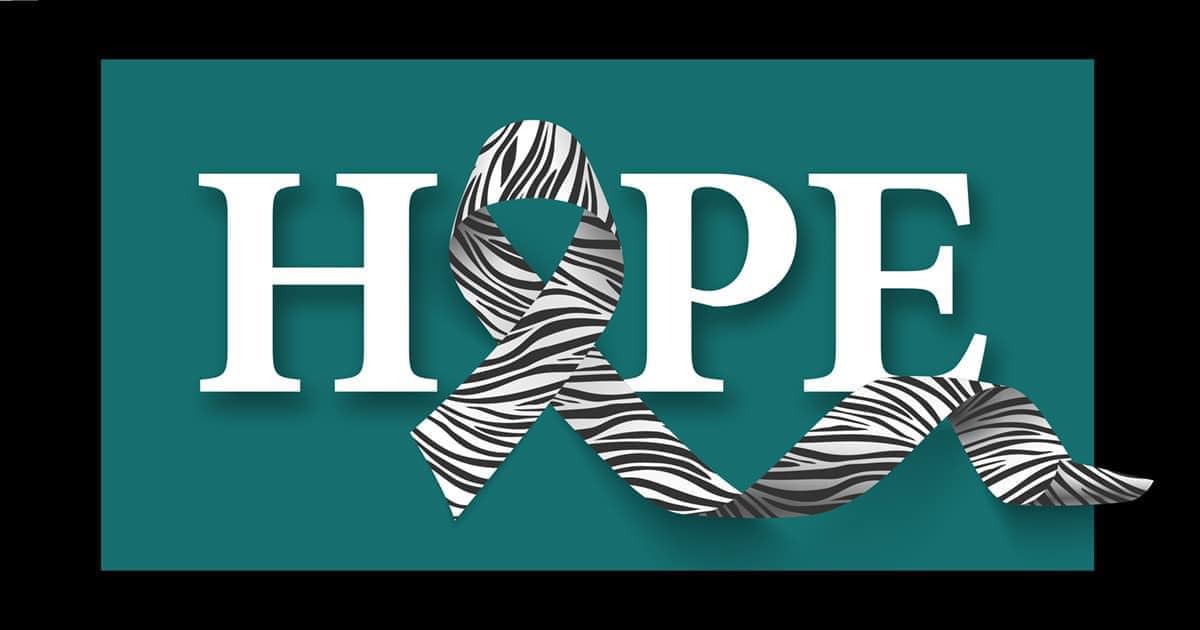
You may remember that my one word for 2024 is hope. This beautiful graphic, which I found on Rare Disease Day, perfectly combines my word with the zebra ribbon representing rare diseases and more specifically, neuroendocrine cancer (NETS) which, though no longer considered rare, is definitely not well-known. Though the pathway may become rough, I am not giving up hope!  

Clothe me in peace, hope, and inner strength.

Let that be my style! 

A World Cancer Day update

World-Cancer-Day-2024-1-1

When I posted a World Cancer Day graphic on Facebook this morning and mentioned that I’m currently waiting for a treatment to destroy a tumour on my liver, the outpouring of support from people near and far was immediate and heartwarming. I was also asked recently whether this was related to my original cancer or something new. In response, I decided that today would be a good day to share an update on what’s been happening in my ongoing battle with cancer.

For those of you who may be new to the blog, I was diagnosed with neuroendocrine cancer (NETS) in 2013. The primary tumour was in my cecum (a pouch at the beginning of the large intestine that the appendix is connected to) and, as is very common with NETS, it had already spread to lymph nodes and my liver. A series of radioactive treatments (PRRT) resulted in some shrinkage and stability that lasted until about 17 months ago when we started to notice gradual changes in my regular lab results and scans. As neuroendocrine cancer is usually a slow-growing disease, we took a cautious approach. We started monitoring more often and eventually changed the medication that I receive by injection every 28 days. Unfortunately, that didn’t have the desired result.

The last time I wrote an update on the blog was back on November 10, NET Cancer Day. At that time, it was clear that the tumours that had been basically dormant for several years, or at least the largest one which is on my liver, were growing and producing an excess of hormones again. I was waiting for the tumour board at the Cross Cancer Institute to discuss my case and make their recommendations.

Shortly after that, I was referred to the Interventional Radiology department at the University Hospital and my NET specialist told me that I would undergo a radiofrequency ablation, a fairly non-invasive procedure that would destroy the cancer cells without damaging much of the surrounding tissue. I was all for that. Let’s zap that tumour, I thought! As it turns out, however, at 5 cm (2 inches) my tumour is too large for that procedure to be successful. Instead, I’ll be undergoing a transarterial radioembolization, also known as a TheraSphere treatment. (I love words, but as a cancer patient, I’ve learned a lot of big ones that I wish I’d never had to hear!)

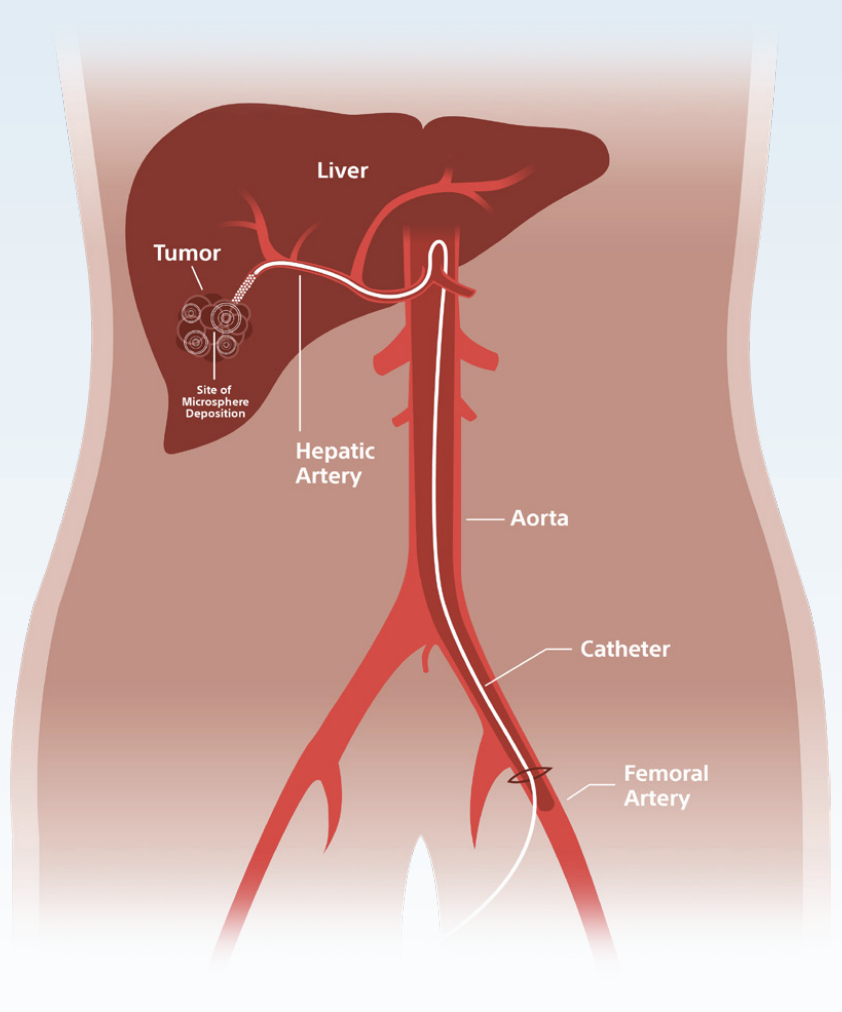
The treatment is a minimally invasive procedure that deposits millions of glass microspheres, each about one-third the width of a human hair, containing a radioactive isotope (Y-90) inside the blood vessels that supply a tumour. This blocks the blood supply to the cancer cells and delivers a high dose of radiation to the tumour. The treatment will destroy a significant portion of my liver, but thankfully, it has the amazing capacity to regenerate itself after damage.

Three weeks ago, I had a work-up which was basically a trial run. As will happen in the actual treatment, a catheter was inserted through the femoral artery in my groin and guided via x-ray to the hepatic artery supplying my liver. Mapping and measurements of the blood vessels feeding the tumour were done and then a contrast was injected and various images taken to ensure that the Y-90 would stay in my liver and not travel anywhere else in my body. During this entire time, which took several hours, and for four hours afterward, I had to lie on my back without raising my head or moving my right leg. It was a long and somewhat grueling day and after almost eleven hours, I was very happy to walk out of the hospital with no ill effects. I may not be quite as fortunate after the real deal. I’ve been told that common side effects include abdominal discomfort, nausea, and fatigue for a week or two afterward, but it will be worth it if it successfully destroys the tumour!

I was initially told that the treatment would take place two to five weeks after the work-up, but three weeks later, I haven’t been given a treatment date yet. Wheels often move very slowly in the medical world and waiting is something that patients have to get used to. It never seems to get any easier though!

To those of you who suggested in your very kind responses on Facebook this morning that you would be praying for me, I very much appreciate it. While I am enormously thankful to live in a part of the world where I have access to state of the art medical care at no personal expense, and I have a body of amazing doctors taking care of me, I know that God is ultimately my healer and it is He who holds my future. I continue to put my hope in Him!

Screenshot 2024-02-04 at 2.54.31 PM

Image: TheraSphere Patient Info – Boston Scientific

Sixteen years of blogging!

I published my very first blog post sixteen years ago today! It was also the shortest post I’ve ever written; a brief message announcing that hubby and I had just accepted positions teaching conversational English in Japan. The blog was meant to share that year-long adventure with friends, family and anyone else who might be interested. Never in my wildest dreams did I imagine that it would still be alive and well sixteen years later!

The title, Following Augustine, no longer fits the blog as well as it did in those early days, but since it’s what I’ve been known as in the blogosphere for more than a decade and a half, I hesitate to consider changing it. You can read about why I originally chose the title here.

Though I probably already had neuroendocrine cancer (NETS) when the blog was born, I didn’t know about it until several years later. When I finally received a correct diagnosis, blogging became a helpful way to process what was happening and to share the journey with friends and family. I also use the blog to raise awareness of NETS. I’m sure that this will continue to happen as I’ve recently become a member of a newly formed Advocacy Advisory Board that will report to the board of directors of the Canadian Neuroendocrine Tumour Society (CNETS).

When I started the blog, writing about fashion was the farthest thing from my mind. Several years ago, however, I starting following several fashion blogs and began to develop a greater interest in the topic. It was then that I decided to add the weekly Fashion Friday feature. At times, I find it a challenge to come up with a new fashion related topic every week, but it’s been a great way to connect with other women and to ensure that I post something at least once a week. Fashion Friday has a fairly small, but loyal following of interested readers, so I as long as I can continue to think of engaging content, I plan to keep the feature going.

As an avid reader, it was my passion for books that prompted me to add the latest feature to the blog, a monthly book review that first appeared at the beginning of February this year.

I refer to Following Augustine as a lifestyle, travel, and fashion blog, but in recent years, there hasn’t been as much travel content as I would have liked. First, the pandemic and then a number of other health issues, both mine and hubby’s, have limited our ability to spend as much time away from home as we would like, but our brand new ten year passports arrived in yesterday’s mail and we hope to be able to put them to good use in the future. If that happens, the blog will once again chronicle our wanderings.

Following Augustine will probably continue to undergo changes from time to time, but at this point, I don’t see it coming to an end anytime soon. Over the past sixteen years, I’ve published over 1400 posts and I expect that I’ll continue adding to that number until I’m no longer able!

3224919

NET Cancer Day 2023 and an update

For those of us who have neuroendocrine cancer, every day is NET Cancer Day, but November 10 is the one day each year that is set aside to increase awareness of our disease and to promote improved diagnostics, treatments, care, and research. Unlike most cancers, neuroendocrine cancer (NETS) is often overlooked or misdiagnosed. Some patients, myself included, endure symptoms for 5 to 10 years before receiving an accurate diagnosis. All that time, the unseen disease is quietly growing and spreading which is why at least 50% of us, again myself included, have stage 4 cancer by the time we are diagnosed. At that point, it’s treatable, but not curable.

Why is this sneaky disease so easily missed? Why does it take so long to get a correct diagnosis? NETS starts in the cells of the neuroendocrine system which are found throughout the body. Neuroendocrine tumours can hide in many locations, but most commonly originate in the lungs, pancreas, gastrointestinal tract (specifically the large intestine, small intestine, or appendix), the adrenal glands or in rare cases, the brain, breast, or prostate. Without early detection, it spreads to other locations throughout the body including the lymph nodes, liver, peritoneal cavity, and bones.

Not only can the cancer be found in so many different parts of the body, but the symptoms vary and are often non-specific. They might include abdominal pain, diarrhea, nausea and vomiting, heightened anxiety, fatigue, weight loss, skin flushing, chest pain, coughing, wheezing, shortness of breath, and/or back pain. All of these are also symptoms of more common conditions, so it’s completely understandable that doctors don’t immediately consider a little-known cancer like NETS. Many have never encountered a case and know little or nothing about it. As a result, neuroendocrine cancer is often mistaken for other conditions including gastritis, IBS, generalized anxiety disorder, or even menopause. That’s why we need an annual NET Cancer Day and why we need to advocate for increased awareness amongst doctors and patients every day of the year.  

poster (3)

Last year, on NET Cancer Day, I was happy to be able to report that my disease was stable. Unfortunately, this year, that’s no longer the case. Over the past year, my tumours (or at least one of them), which had essentially been dormant for several years, have been waking up and producing excess hormones again. One of the lesions on my liver has also started to grow again. Thankfully, however, NETS is usually a slow-growing cancer and we still have a number of treatment options available. The neuroendocrine cancer team at the Cross Cancer Institute meets on Tuesdays (I absolutely love the fact that they take a team approach), so they’ll be discussing my case next week and deciding where we go from here.

In the meantime, other than an ongoing headache that is probably stress-related, I have no symptoms and I’m able to live a fairly normal life. Considering that fact that I’ve had stage 4 cancer for over ten years, I feel pretty blessed. I consider every day a gift and I continue to trust that I’m not dying of NETs, but living with it! 

There will be no Fashion Friday post today, but stay tuned for a new one next week.