I appreciate the many responses to my last post and particularly those who chose to share it on social media. It appears that I managed to put into words what many people have been feeling. The following post may also be considered a bit controversial and I hope it will be as well received.
I don’t consider myself to be a particularly political person, but with a federal election less than three weeks away here in Canada, I definitely take an interest and occasionally express an opinion on Facebook. In recent weeks, though I managed to avoid saying anything at all about the blackface incidents, I’ve been criticized more than once for posts alluding to what I consider to be flaws in our present Prime Minister’s character. Some people have referred to this as mudslinging or political bashing. “Let’s just focus on the issues,” they say.
While I agree that it’s important to know what each party and its leader stand for, I don’t put a great deal of faith in campaign promises. Their purpose is to garner votes and at best I think we ought to call them proposals. A recent analysis of 353 pre-election promises made by the Liberals in 2015 indicates that by March of this year Trudeau’s government had entirely followed through on only about 50 per cent of its pledges.
We may not agree on all the issues or the directions that we’d like our leaders to take, but I hope that we can agree that it’s of utmost importance to have a man or woman of character at the helm. Unfortunately, as we look around the world at the corruption and scandals involving many of our political leaders, it would seem to me that voters haven’t been giving character enough consideration.
I like what American author, John C Maxwell, says about leadership, “A leader is one who knows the way, goes the way, and shows the way.”
With all this in mind, I googled “qualities of a good leader” and discovered dozens of lists. At the top of many of them was honesty and integrity and I would certainly put these two traits at the top of my list. Although they are very closely linked, there’s actually a distinction between the two. According to the dictionary, honesty means “truthfulness, sincerity, or frankness; freedom from deceit or fraud” while integrity is “adherence to moral and ethical principles; soundness of moral character.” Sadly, I think that there are a number of world leaders, including our own, who fail to measure up in the areas of truthfulness and moral character.
Another quality of a good leader that was high on many lists was good communicator. Though a few listed good listening skills separately, I would include that as part of being a good communicator. I would love to have a national leader who was capable of speaking publicly without scattering “um” and “uh” liberally (pun intended) throughout every speech, but even more important would be one who truly listened to the voices and hearts of the people.
Confidence and humility were also high on most lists. Unfortunately, far too often, confidence and arrogance seem to go hand in hand instead. That certainly seems to be the case with our present national leader as well as the one to the south.
Though there are many other character traits that make a good leader, the last one that I’ll mention here is accountability, the willingness to accept responsibility for or account for one’s actions. Oh my, wouldn’t it be nice to see that in our next political leader!
So, fellow Canadians, on October 21 get out and vote, but please look beyond the issues and the campaign promises to the character of the individual party leaders as well as the candidates running in your local constituencies.
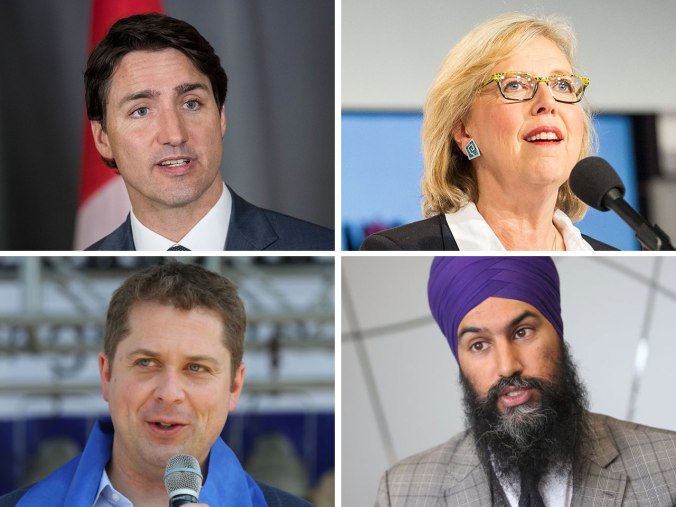
Image: Chatelaine magazine
 Following Augustine