 I grew up on the Pacific coast of Canada with a deep appreciation for the art of the Indigenous people of that area. Four years ago, I shared the story of the beautiful hummingbird ring made by Haisla artist, Hollie Bear Bartlett, that hubby gave me for Christmas.


This Christmas, I received some more wearable Pacific coast art!
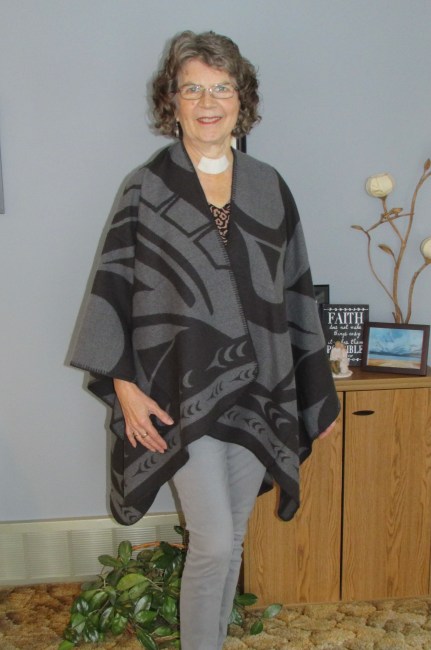
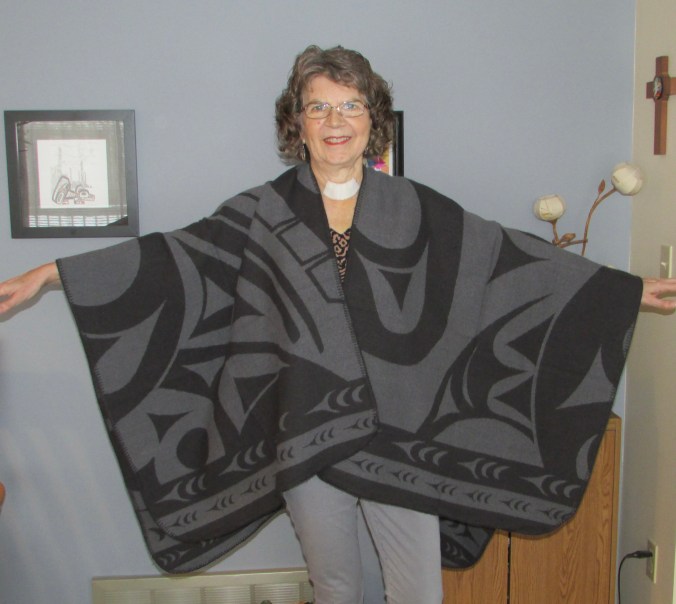
The cozy, reversible wrap, was a gift from the Vancouver branch of our family; our oldest son, his wife, and their two sons. A product of Native Northwest, it features the work of Coast Salish artist, Doug Horne. You can probably see the whale motif best in this photo. Look for the rounded head, the toothy mouth, and the blowhole on top.
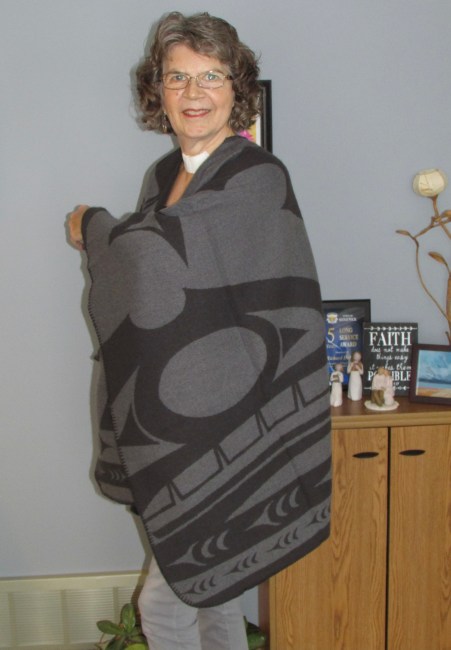
In the stories of the Northwest Coast, the killer whale, or orca, is associated with strength, dignity, prosperity, and longevity.

100% of the art featured on Native Northwest products is designed by Indigenous artists and used with their consent. Artist names and cultural affiliations are acknowledged on all packaging and the artists are paid in fees and royalties.
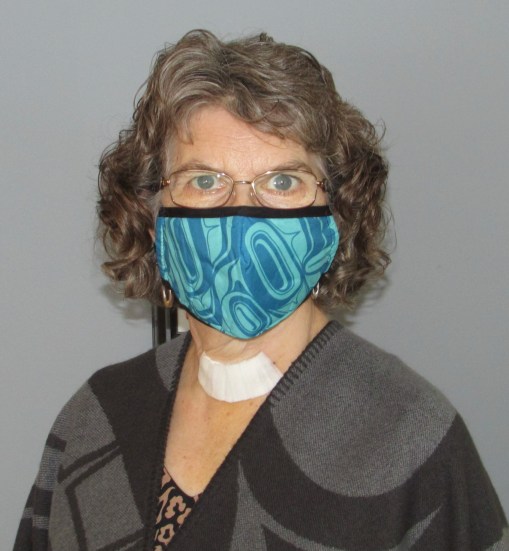
In addition to my beautiful wrap, hubby and I received two Native Northwest masks from another family member. Here, I’m wearing the eagle design by Haida artist, Roger Smith. Eagles are associated with guidance, hope, healing, and the pursuit of freedom.

You can easily see the tentacles on Ernest Swanson’s octopus on the mask on the right. Swanson comes from a long line of established Haida artists. The octopus is respected in the Northwest coast culture for its ability to adapt to change. The raven mask on the left, by well-known Tsimshian artist, Roy Henry Vickers, is one that I purchased when we were in Vancouver in October. It was produced by Oscardo, another company that partners with Canadian and Indigenous artists and pays royalties for each product sold. The raven is an important figure in Northwest coast art and mythology. Known as a trickster, he has the power to transform both himself and other beings. He can even change animate to inanimate, and vice versa. Hopefully, when I wear the mask, he transforms Covid into something harmless!
Perhaps this is a good time to talk about the difference between cultural appropriation and cultural appreciation. Cultural appropriation involves adopting an element of another culture without respect for its meaning or significance or with the purpose of exploiting the culture for personal gain. Appreciation, on the other hand, involves a desire to learn about another culture in order to broaden one’s perspective and understanding. It also involves fair compensation and giving credit where credit is due. That’s why it’s so important to me to learn the meaning behind the symbols that appear on my wearable art and why I appreciate the fact that companies like Native Northwest and Oscardo credit the artists and pay royalties for their work.
If you’re interested in knowing more about the stories behind the symbols and creatures that appear in the art of the Pacific Northwest, the book Understanding Northwest Coast Art by Cheryl Shearar is an excellent resource.












 I’m quite surprised at how easy it’s been to keep Fashion Friday going for over five years without running out of new topics to write about, but lately the well of ideas seems to be running dry. I think it’s more than writer’s block though. I’m sure it’s partly due to the fact that I’m bored with the clothes in my closet and I’ve hardly bought any new ones in the past 14 months, but I think it also has a lot to do with the state of the world we’re living in. Writing about fashion seems pretty frivolous when you’re living in the province with the highest rate of active Covid cases in Canada and the United States and the situation is getting worse every day.




 Before we look at how we dress, let’s consider why we clothe our bodies. First of all, not to would be considered immodest and in most cases illegal! Of course, we also dress to protect our bodies from cold and from the damaging rays of the sun. If those were our only reasons for wearing clothing though, we could all dress the same and we’d only need two outfits each, one to wear and one to launder. We’d need very little closet space, it would be so much easier on the environment, and just think of how much money we’d save! It would also be incredibly BORING!















 Following Augustine