Book of the month – October 2025

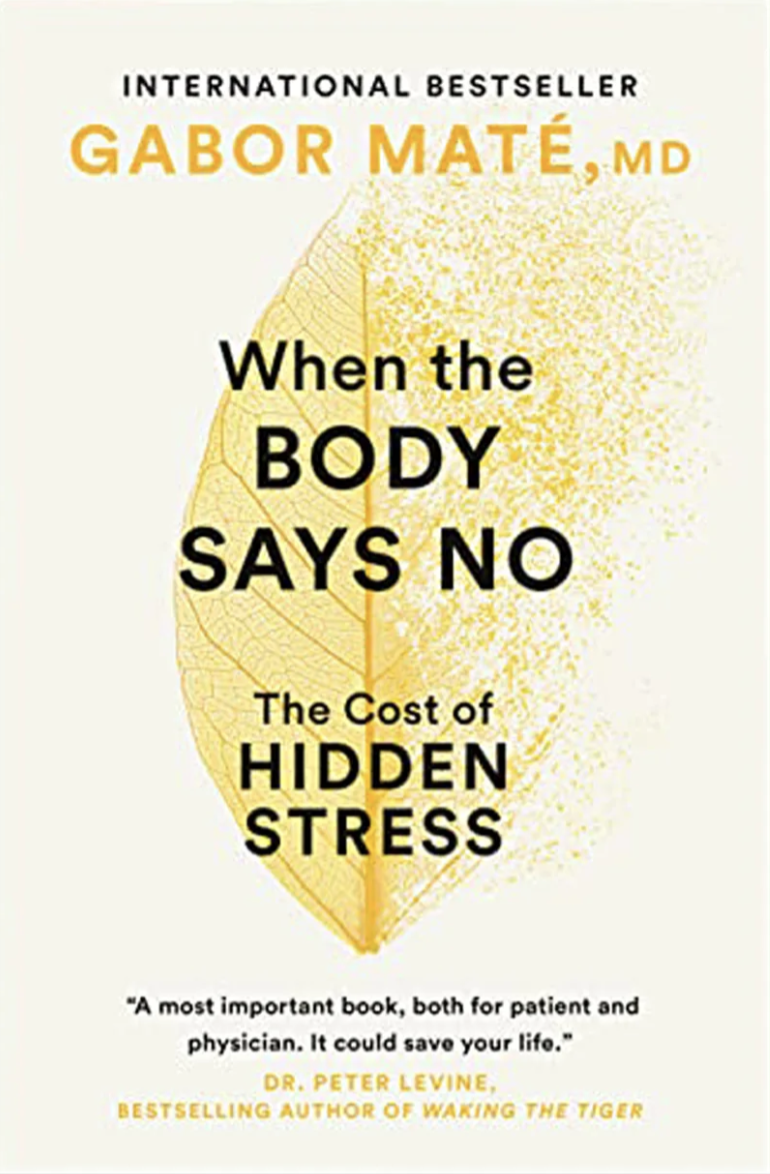
When the Body Says No: The Cost of Hidden Stress

Gabor Maté, MD

In this international bestseller, renowned mental health expert and speaker, Dr. Gabor Maté, provides insight into the critical role that stress and emotions play in the development of many common diseases.

Although written for a general audience, When the Body Says No definitely wouldn’t be everybody’s cup of tea. It’s like reading a textbook, but my daughter and I both read it recently and when I discovered that another friend was also reading it, I decided that it might appeal to more of you and that it would be worth reviewing here.

Dr. Maté has experience as a family practitioner and a palliative care physician and has also worked with the addicted men and women of Vancouver’s Downtown Eastside. He weaves together scientific research, numerous case histories, and his own insights and experience to explain the relationship between psychological stress and the onset of chronic illnesses including arthritis, cancer, diabetes, multiple sclerosis, Alzheimer’s disease, and heart disease. While I don’t agree with everything he says and he definitely needs to update the section on prostate cancer (the book was published in 2003 ), a lot of it makes very good sense. 

What I liked best was the fact that Dr. Maté validated what I have believed for years; that the stress I endured prior to and especially during the early decades of our marriage and the anger that I suppressed during those years contributed to my present health conditions. In fact, the author would probably say that they caused my cancers. As he says, all of us probably have within our bodies the occasional rogue cell that could multiply and become cancer. In most cases, the body has the resources to destroy those cells before they spread, but chronic stress and repressed anger reduce the body’s ability to do that and magnify the risk of developing the disease.  

In the final chapter of the book, Dr. Maté addresses what he calls the seven A’s of healing: acceptance, awareness, anger, autonomy, attachment, assertion, and affirmation. He believes that pursuing these will help us grow into emotional competence and empower us to be our own health advocates.

Note:  This book was published in the US under the title When the Body Says No: Exploring the Stress-Disease Connection.


Losing my mother and finding her again

One night last week, my 92 year old mother went to sleep and didn’t wake up.

When the phone call came the following morning, my initial reaction was shock. It wasn’t completely unexpected but when I’d talked to Dad a couple of days earlier, there were no warning signs; nothing to indicate that the end was so near.

I went through the motions that day, showing up for my treatment and shedding a few tears behind my radiation mask, but as I thought about it, I couldn’t help believing that it was for the best. Mom died in her own bed in the building next to Dad’s in the care complex where they’ve lived for the past few months. She didn’t linger in a hospital bed and we didn’t have to sit helplessly by and watch her suffer.

The timing bothered me because, in the middle of radiation treatments, I couldn’t simply drop everything and fly out to Vancouver. The family has been wonderful, however, agreeing to postpone gathering for a memorial service until my treatments are complete. Dad, ever the stoic, put my needs before his own, feeling it was important to ensure that everyone who wanted to attend would be able to.

And so we wait. I don’t know about the rest of the family, but in the past few days, I’ve begun to experience a sense of closure. In a way, my Mom has already been gone for a very long time. She started to sink into the depths of dementia a long time ago. In fact, I don’t remember the last time I had a real conversation with her, one where she was fully cognizant and engaged, one where she truly knew who I was. In recent years, she’s been trapped in a body that was blind, incontinent and confined to a wheelchair. More recently, she’d started to lose her ability to swallow and could only consume pureed food and thickened liquids. In spite of it all, she managed to retain her sweet spirit, but that’s no way to have to live.

Dad burned himself out trying to care for her before finally recognizing that he couldn’t do it any longer and worrying about the two of them was hugely stressful for the rest of us. Now it’s over. She is at peace and we have only Dad to worry about. As I work on writing her eulogy, I can begin to put aside the agony of watching her mind fade into the mist of confusion and her body fail. I can dig deeper and revive some of my earlier memories, the warm and funny memories of a mother and grandmother who loved her family above all else. It’s actually a pleasant way to mourn.

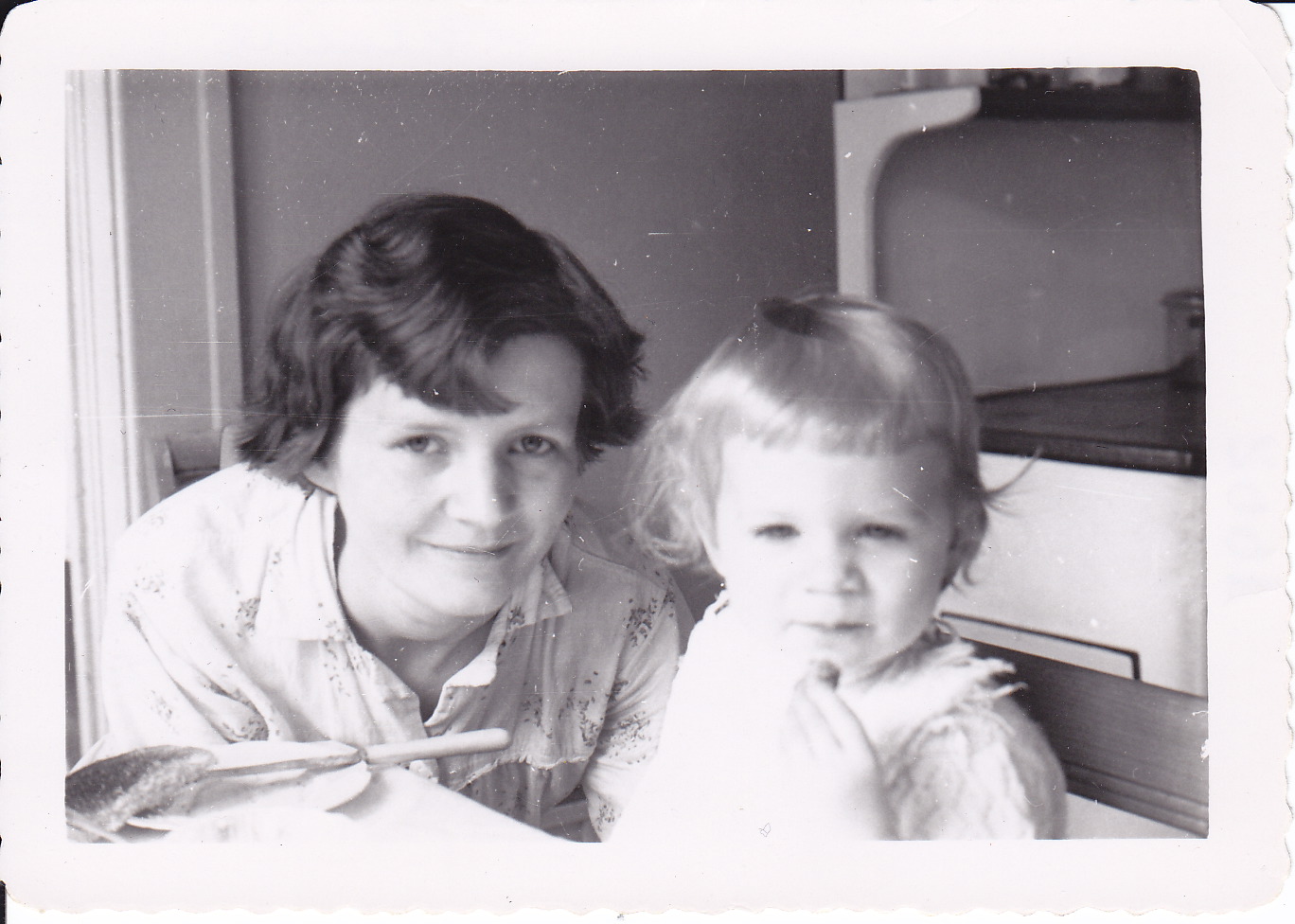
In preparation for the memorial service later this month, I’ve been digging through boxes of old family photographs that are stored at my place and flipping through my photo albums putting together a pictorial display of Mom’s life. In the process, I’ve been finding more than pictures; I’ve been finding memories. Stories that Mom told us about her early life have been coming back to me and I’ve been reliving births, graduations and weddings as well as the day to day events recorded in the pictures. I even found a photo that I don’t ever remember seeing before. Here we are, Mom and I, when I was under two!

Mom & I

In losing my mother, I think I’m beginning to find her again!

Tangled knots of tension

This has been an eventful week.

On Monday, I learned that my Dad had finally made the decision to seek permanent care for my Mom. She’s 90 years old and suffers from Alzheimer’s disease. In addition, she’s virtually blind, incontinent and confined to a wheelchair. Dad has been burning himself out trying to be her primary caregiver and most of the time she doesn’t even know who he is.

I was relieved! I would be able to leave the country knowing that Mom was being well cared for and that Dad could finally relax and possibly regain his flagging health and strength. Then came Wednesday and a phone call from my sister. Dad was suffering from chest pains and she was catching a plane that afternoon to fly out to Vancouver to be with them!

I was already feeling stressed over the delay in getting our visas. This news was almost more than I could handle! Questions and doubts flooded my mind. What was I thinking of? Was going to China at this point sheer insanity? We’d already signed our contracts! What choice did I have now?

I don’t handle stress well. Apparently, neither does my father! His chest pains were not an indication of an impending heart attack as we feared but, as far as we can tell, the result of stressing about the decision he’d made and all its implications. He had lain awake for long hours Tuesday night worrying about where Mom would end up, how he’d get her there, what he should pack for her, whether or not she’d adjust well to her new surroundings and so on and so on until the pain began.

We knew that initially, at least, Mom would go into the first appropriate long term care bed in their area. We prayed that it would be easily accessible by bus so that Dad, who no longer drives due to failing eyesight, could visit her regularly. God did even better than that! Tomorrow morning she’s moving into a care facility just down the street from the apartment building where my parents have lived for over 20 years! It’s literally about 500 metres away, close enough for Dad to walk over anytime he wants!

After more than 64 years of marriage, tonight will be the last night that my parents will spend together. It’s sad, but Alzheimer’s is sadder. In a sense, Mom has already been gone for quite a long time. I’m just glad that Dad will still be able to spend time with her each day and that my sister is there to help them with the transition.

Now, if only the results of our blood tests come back soon so that we can head to Calgary to apply for our visas. Then maybe the knots in my stomach will begin to untangle!

Operation Parent Care

When I wondered at the end of a recent post what October would hold, I had no idea that we’d be spending much of it back in Vancouver!

We’ve lived for a long time with the knowledge that we might have to make a quick trip to the coast at any time if something happened to either of my elderly parents. That moment came when my father’s alarmingly large prostate caused a complete urinary blockage about three weeks ago. He also had a urinary infection. My sister, the doctor in the family, flew out first to provide immediate care but she wasn’t able to stay long term. We drove out arriving just a few hours before she had to leave for the airport to return to her family. Having the vehicle here has made it possible for us to ferry Dad to numerous medical appointments and procedures, some related to the prostate problem and some not.

It was with some trepidation that I took over from my sister knowing that in addition to cooking, grocery shopping, laundry and becoming primary caregiver for Mom, who’s in the late stages of Alzheimer’s disease, I’d also be responsible for caring for Dad’s medical needs. Before leaving home, we asked our church family and friends to pray and I have absolutely no doubt that they’ve been doing so. I’m absolutely certain that without those prayers, I would be completely unable to do all that I’ve had to do with any degree of patience or grace. Nothing in life really prepares you for having to clean your father’s catheter twice a day or help your mother change her soiled pants!

By Day 9 of Operation Parent Care, when Mom appeared to have developed a touch of diarrhea, I thought I might have reached the end of my rope. I didn’t know if I could handle another thing. That’s when something in the back of the toilet broke and we had a sudden flood! Water poured from the top of the tank like a mini Niagara. In minutes the bathroom was full of water and it was flowing out the door! Richard waded in, Dad ran (hobbled) off to find a pipe wrench and I called the apartment emergency number. Within minutes a maintenance man arrived at the door like a rescuing angel and in no time at all a powerful shop vac had sucked up most of the water and the toilet’s inner workings had been completely replaced. What could I do but laugh? The tension of the day had definitely been broken and on we went, tiptoeing over dampened carpet for the next 24 hours or so.

Today is Day 12. At this point, we have no idea how long we’ll be here. We do know that Dad requires surgery and that he’ll be catheterized until that takes place. It wasn’t at all comforting to have the specialist assure us that surgery could probably be booked for sometime before Christmas!

Fortunately, Dad’s infection has cleared and he has regained much of his strength. I’m teaching him to care for his own catheter and he’s beginning help with Mom’s care again. Sadly, her condition has deteriorated significantly since we were here just three months ago. My siblings and I are of the opinion that she needs a level of care that can’t really be provided at home, especially by a frail 89-year-old, but I’m not sure how much success we’ll have trying to convince him of that. I hate the idea of leaving them on their own again but what choice do we have. We’ll definitely ensure that someone is here to help when he undergoes surgery but I can’t stay here forever.

Coming to terms with 60

I absolutely loved being 40. By then I’d lived through some of the best and the worst that life has to offer and figured that I’d learned a few things along the way. I had a past filled with memories and lifelong friends and I had a future to look forward to. 40 was a fabulous midway point!

50 was great too! By the time that birthday rolled around, I was looking forward to early retirement and all the adventures that would follow. My fifties have included everything from climbing Mount Fuji to travelling the length of Vietnam on overnight buses to flying over the jungle of Costa Rica on a zipline!

I really haven’t enjoyed being 59 though because 60 has been hanging over my head all year! I want to embrace the next decade with the same enthusiasm that I greeted my 40s and 50s with but it hasn’t come as easily. 60 is such a big number! No longer can I fool myself into thinking that I’m still young. In fact, middle aged is a stretch unless I truly expect to live to be 120!

You’d think that I would have adjusted to being 59 pretty quickly. Immediately after my birthday, we spent several days with my parents. My mother who suffers from Alzheimer’s disease is obsessed with people’s ages.

“How old are you?” she’d ask.
“Fifty-nine,” I’d reply.
“How old are you?” she’d ask again a few minutes later.
“Fifty-nine,” I’d say again.
Over and over and over again.
“I’m fifty-nine.” “I’m fifty-nine.” “I’m fifty-nine.”
It didn’t really help.

Now 60 is just over a month away and I’ve been thinking about ways to celebrate; ways that might make the transition easier. One of the things that I’m passionate about is making micro-finance loans through Kiva; loans that give a hand up to women who are less fortunate than I am. Last night I invested another $25 in Kiva and gave myself an early birthday present.

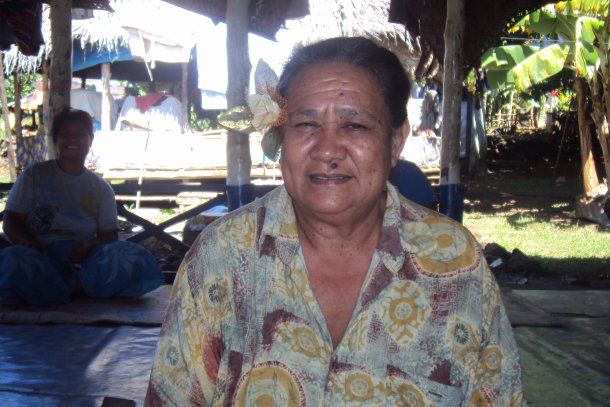
Most of the women that I’ve given loans to have been younger than I am because loaning to mothers with children in their care has been one of my priorities but this time I decided to look for a woman who was 60. Kiva doesn’t list borrowers according to age so finding her took awhile. I scanned the long list of women in need, looking at each thumbnail photo for one who looked like she might be 60. Sadly, I clicked on many well worn faces only to find that they were much younger. I was reminded again how fortunate I am to have had the life I’ve had. Finally, after searching through many profiles, there she was. Sofai!  My loan will enable her to purchase chemicals, sprayers, shovels and fertilizers for her small taro plantation on the Pacific island of Samoa.

Sofai

Over the next few weeks, I’m going to be looking for other ways to celebrate my “coming of age”. I’m not sure what they might be.

Any suggestions?

An added blessing

I spent most of this morning in a dentist’s chair with my mouth wide open. In addition to having a broken tooth prepared for a crown and a temporary crown inserted, I had my annual cleaning and check-up. Little did I know that I might also be helping delay the onset of Alzheimer’s disease!

As I mentioned in an earlier post, though there isn’t enough scientific evidence to prove that a healthy lifestyle can prevent Alzheimer’s disease, studies have shown that regular exercise, a healthy diet, managing stress, getting quality sleep, staying socially active and engaging in mentally stimulating activities may help prevent or delay symptoms. Now it looks like good dental hygiene should be added to that list.

When I got home from the dentist and sat down to read the morning news the headline “Dental health linked to dementia risk” caught my eye. I was already aware of the connection between gum disease and heart disease, but dementia? As is so often the case, upon reading the article I discovered that the headline slightly overstates the case.

Apparently researchers in California who followed approximately 5500 seniors over an 18 year period found that women who reported brushing their teeth less than once a day were up to 65% more likely to develop dementia than those who brushed daily. The effect appeared to be less pronounced amongst men but men who had lost all or most of their own teeth and who did not wear dentures had almost twice the incidence of dementia as their counterparts. Other studies have found that people with Alzheimer’s disease, the most common form of dementia, have more gum disease-related bacteria in their brains than people without Alzheimer’s.

This morning’s article went on to say, however, that these studies do not prove that poor dental health results in dementia or that brushing your teeth regularly will prevent you from getting Alzheimer’s disease. Clearly much more research needs to be done before a link between dental health and the risk of dementia can be proven. For example, could the evidence simply be showing that people in the very early stages of dementia often fail to practice good dental hygiene?

Either way, I was happy to hear my dentist say that, other than the broken tooth, my teeth and gums are in excellent condition. If keeping them that way has any chance of protecting me against my mother’s fate, that’s definitely an added blessing!

Who’s the parent?

As my mother’s Alzheimer’s progresses and caring for her becomes a greater challenge for my father, our relationship is changing. I’m beginning to feel more like parent than child. No longer is a visit a time to kick back and relax. Instead, it’s a time when I do whatever I can to make their lives a little bit easier.

For the past several years, we’ve been in the habit of giving the apartment a thorough cleaning whenever we visited; doing the things that Dad didn’t have the time or energy for or that his failing eyesight kept him from noticing. Now there’s Victoria, the bubbly Filipina housekeeper/caregiver who comes in twice a week. What a blessing she has been! This time we didn’t have to do any housework but there were many other ways that we were able to help out.

Until this visit, my proud and independent father had never asked me for help. In fact, in the past, much of what we did around the apartment we did when he was out because he wouldn’t have wanted us to do it. Now, however, all that has changed. For the first time ever, my father actually asked me for help! Together we took care of paperwork that he would have needed a magnifying glass to struggle through on his own. I also accompanied them to the geriatric clinic, took care of Mom while Dad went to the dentist and shopped for things for Mom and for the apartment.

It would be so much easier if we lived closer and I could drop in for a few hours once or twice a week instead of visiting only three or four times a year but I can’t beat myself up over that. I couldn’t afford to live in Vancouver even if I wanted to. The cost of housing is astronomical. When I start feeling guilty about not being there often enough, I simply remind myself that it was my parents who moved me far away from there in the first place. They chose to return long after I’d grown up and made a life for myself somewhere else.

Each time we visit, I go away happy if I feel that we’ve won a few victories; accomplished a few things that make life better for them. This time that included Richard taking Dad out to shop for some much needed clothing for himself.

I don’t think I’ll ever be completely comfortable with the need to cut my mother’s meat for her and help her dress, the things that she once did for me, but I’m glad to be able to do them once in awhile. I was especially delighted to be able to take her out for a long walk in the sunshine. Though she enjoyed it thoroughly and some of the flowers in Central Park were bright enough for her to actually be able to see, she seldom agrees to leave the apartment except to go to medical appointments.

Awakening memories

Ever since we began our journey through Alzheimer’s disease with my mom, memory and how it works has been of greater interest to me than ever before. There are certain triggers that I know will awaken some of my earliest memories. The smell of Ivory soap always takes me back to my grandmother’s bathroom. Though almost 50 years have passed, I remember it in amazing detail… the old clawfoot tub, the washboard, the bare wooden walls, the violets growing in pots on the windowsill, the old-fashioned curling irons hanging on the back of the door.

Other times I’m completely amazed by something that suddenly comes to the surface of my memory. That’s what happened yesterday in the middle of a funeral! Knowing that she was dying, the lady who’s funeral I was attending had written down some of her own memories and they were shared during the service. She mentioned attending CGIT as a teenager. I, too, was a Canadian Girl in Training but I hadn’t thought about that in years. Instantly the entire CGIT purpose, recited at every weekly meeting for the five years that I participated in the non-denominational program for 12 to 17 year old girls, came back to me. Obviously it was firmly cemented in the deepest recesses of my memory.

As a Canadian Girl in Training
Under the leadership of Jesus
It is my purpose to

Cherish Health
Seek Truth
Know God
Serve Others
And thus, with His help,
Become the girl God would have me be.

I could hardly believe that it was still there in it’s entirety. Though my CGIT pin is still in the bottom of my jewelry box, I attended my last meeting in 1969! This really makes me wonder what else is still hidden deep within my mind and what it would take to access all of it.

Remembering the CGIT purpose has also caused me to do a bit of self evaluation today. Looking back at what I recited so faithfully all those years ago, how have I done? Did I go on to cherish health, seek truth, know God and serve others? I think I can answer with a resounding yes! Those four goals could still be my mission statement today. Does that mean that I’ve become the girl God would have me be? I’d like to think so but I know that I’m still a work in progress!

What am I doing in the basement?

According to a recent article in The Globe and Mail, one in eleven people over the age of 65 suffers from Alzheimer’s disease. The likelihood of developing the disease doubles about every five years after age 65 says the Alzheimer’s Association website. After age 85, the risk reaches nearly 50 percent. A family history of Alzheimer’s increases one’s risk of developing the disease even further.

I don’t make New Year’s resolutions but given the fact that I’ve been watching this disease gradually rob my mother of her memory and her mind, I’ve definitely been giving a lot of thought to what I can do to lead a brain-healthy lifestyle and to reduce my risk of suffering the same fate.

The Secret Life of the Grown-Up Brain by Barbara Strauch was a reassuring read. Impeccably researched and easy to read, the book explores the latest findings that demonstrate that the middle-aged brain like mine is actually more flexible and more capable than previously thought. Apparently standing in the basement wondering what I came down to get or failing to remember a name that I know I should know are not signs that I’m losing it after all!

Though there isn’t enough scientific evidence to prove that a healthy lifestyle can prevent Alzheimer’s, studies have shown that regular exercise, a healthy diet, managing stress, getting quality sleep, staying socially active and engaging in mentally stimulating activities may help prevent or delay symptoms. So how am I doing? The beginning of a new year seems like a good time for a bit of self examination and perhaps some goal setting.

I’d definitely give myself high marks for exercise and diet. I was working hard at maintaining physical fitness and healthy eating long before I began to think about what effect they might have on my brain. Fortunately what’s good for my heart and the rest of my body is also good for my brain. The Christmas season sabotaged my efforts in both these areas but now that I’m back home and into routine again, I’ll soon be back on track and yes, Santa did come… I met my goal of being able to do ten push ups by Christmas morning! Hopefully I’ll soon be doing even more.

Stress management and quality sleep go hand in hand for me. As long as I’m not feeling anxious about anything, I usually sleep well and when I’m well rested I handle stress better. I assume that that’s probably true for most people. Retirement has, of course, been a wonderful stress reducer! I still have crazy school dreams once in a blue moon but not like I used to. For reasons that neither my doctor nor I have been able to figure out, I’ll lay awake for hours if I eat anything sweet after about 8:30 p.m. so I’ve learned not to do that. I also sleep better in the winter time when we have longer hours of darkness. That’s one definite goal for this year; darker blinds for the bedroom before spring arrives. I plan to buy ones to match the newly painted feature wall.

Being away as much as Richard and I are, staying socially active and connected is something we need to consciously work on when we’re at home. While we wander the world, everyone else’s life goes on and if we want to be included we need to keep our connections strong. For that reason, entertaining more is another one of my goals for the coming year. I see the effects of failing to stay socially active in my mother’s life. After Dad retired, they settled into a high rise apartment in Vancouver where Mom didn’t make the effort to get out and develop new relationships. Once a very social person, she gradually became more and more reclusive. Now that she’s truly housebound, she has no friends to come and visit.

I don’t know how much failing to stay mentally active had to do with Mom’s eventual decline but I’m determined not to let that happen to me. I’m a firm believer in the importance of lifelong learning. I’m an avid reader and also a member of Lumosity, a website that offers of a series of engaging brain games and exercises each designed to improve a particular area of cognition; speed, memory, attention, flexibility or problem solving. In addition to playing individual games, participants can enrol in guided brain fitness courses that are designed to improve each of the five areas. Brain training has become as much a part of my daily life as eating and sleeping. Since Christmas, I’ve also been working on logic puzzles. Thank you to the Santa who put a whole book of them in my stocking!

So am I worrying about the possibility of succumbing to Alzheimer’s disease? Not really. When I stand in the basement trying to remember why I’m there, I’ll simply remind myself that that’s normal forgetfulness and that I’m doing everything I can to prevent something much worse.


Alzheimer’s is robbing me of my mother

I originally started this blog to chronicle our travels when we moved to Japan to teach English for a year. For the past several years, our family has also been on a journey of a very different kind as we’ve watched my mother gradually spiral downward and disappear into the depths of Alzheimer’s disease but I haven’t felt at liberty to blog about it until now. Until recently, my father, who is a very private person and also Mom’s primary caregiver, has been one of my most faithful readers. Out of respect for him, I didn’t share our journey publicly but now that his very old computer has died and he’s discontinued his internet service, I feel free to write about it.

I still remember the summer visit several years ago when I first had an inkling that something was wrong. I mentioned one of Mom’s grandchildren and she had no idea who I was talking about. Her question, “Who’s Jessica?” was for me one of those life changing moments when my entire world seemed to shift on its axis. I lay awake at night wondering what the future would hold and experiencing for the first time a deep sense of anxiety that has become more and more familiar to me.

Over the ensuing years, the mother that I grew up with has disappeared and parent has gradually become child. It has been a fairly slow decline. Many times, Mom would seem to slip very noticeably and then plateau for a time giving us a chance to get used to the changes before more drastic ones surfaced. Unfortunately, Dad seemed to be in denial for the longest time making it impossible for us to discuss the situation with him or to be of much help. It’s only in the last year that Mom’s condition has been clearly identified as Alzheimer’s disease and that we’ve been able to talk about it openly. The situation is made worse by the fact that my sister, my younger brother and I live in Alberta while Mom and Dad are here in Vancouver. Only our older brother, mentally handicapped and himself living in care, and our oldest son Matthew are here at the coast. We really can’t saddle Matthew, in his second year of a law career, renovating a house and parenting two very young children with the responsibility of watching out for his elderly grandparents. He and Robin visit as often as they can and do their best to keep us informed of any changes or problems that they notice.

The blessing in all of this, if there is such a thing, is the fact that Mom’s decline didn’t begin until she was over 80. Dad retired at 59 and they spent the next two decades following their dreams and travelling the world. They visited over 60 countries spending more than a year in Europe and 9 months in Australia. (I come by my gypsy blood honestly!) They took their last big trip 8 years ago when they flew to the Dominican Republic to celebrate their 55th wedding anniversary.

For the past few years, it’s been a chore to get Mom to leave their apartment. Now, at 89 years old, she is incontinent, legally blind and confined to a wheelchair. Though these infirmities are fairly recent developments, in Mom’s mind she’s suffered from them for most of her life and she’s constantly coming up with fanciful explanations that are in no way grounded in reality. Last night she told us that people are trying to poison her with peanut butter which has always been a favourite of hers! Sometimes all we can do is laugh. It’s either that or cry. She’s clearly in the sixth of the seven clinical stages of Alzheimer’s and needs constant care and supervision.

After 63 years of marriage, Dad refuses to allow them to be separated and insists on caring for her himself. He’s clearly wearing out and we don’t know how much longer he’ll be able to keep this up but he’s of sound mind and has the right to live life the way he chooses. There are those who suggest that we, as a family, should try to force him to put Mom into care but we are firm believers in the fifth commandment and we know of no other way to honour our parents than to allow them to live out their final years the way they want to while being as supportive as we can given our own circumstances.

This, of course, means more frequent visits. This is our third trip to Vancouver this year and each of my siblings has also been here. When we’re here, we thoroughly clean the apartment, a job that Dad has a hard time keeping up with these days, and try to provide opportunities for him to get out and have a break. This week, he even went on a forest adventure with great grandson, Sam!

Having Matt, Robin, Sam and little Nate here in Vancouver is indeed a blessing at this time in our lives. Visits to Vancouver would be much more difficult if we didn’t have them to stay with some of the time and, of course, grandchildren provide such wonderful stress relief!
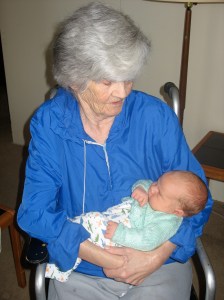
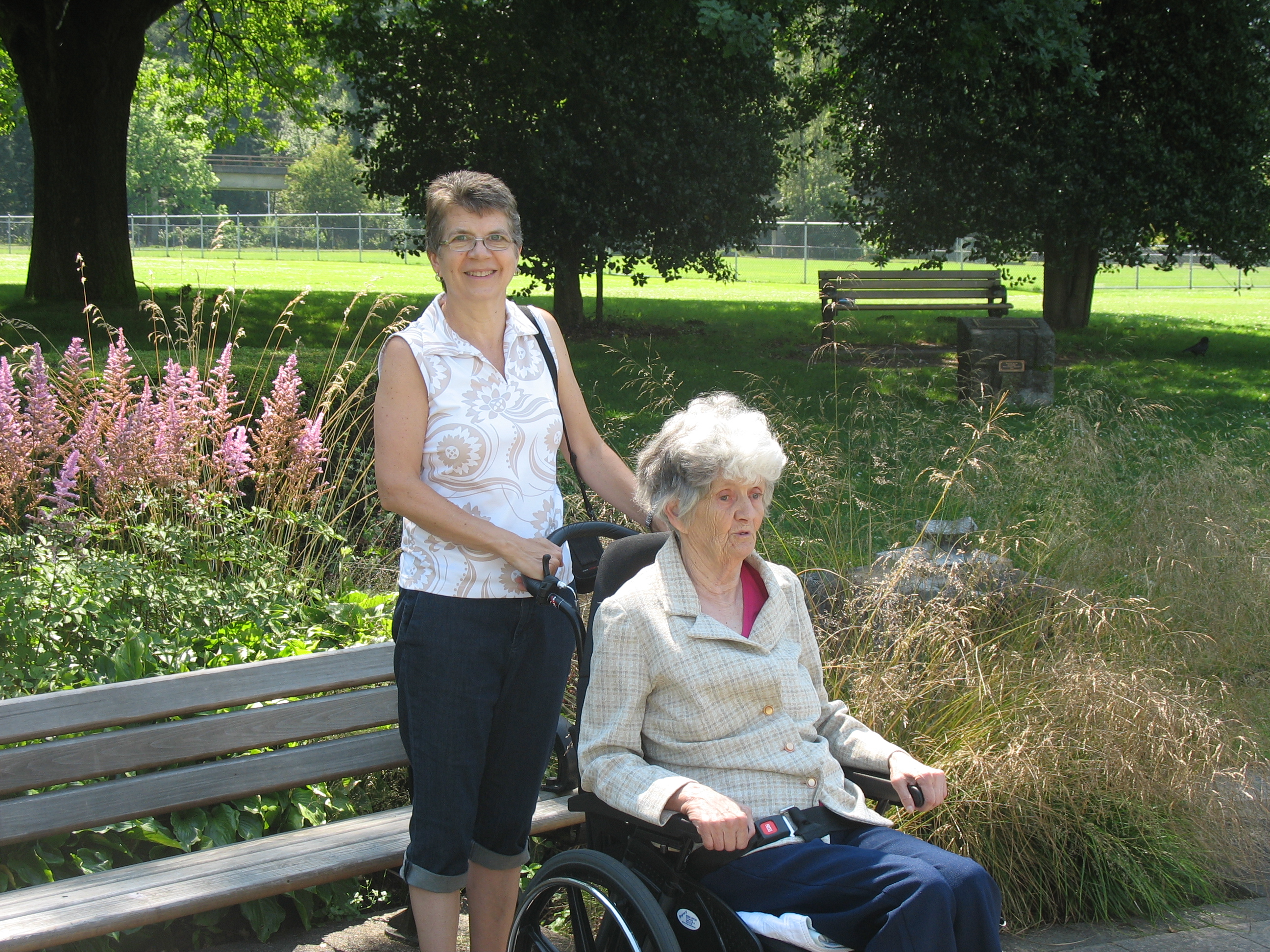
Mom with her youngest great grandchild, Nate, in March 2011