Elderly? Not yet!

I was a bit taken aback when a fellow blogger who’s a few months younger than I am recently referred to herself as elderly. I turned 73 earlier this week. Maybe I’m in denial, but I’ve never thought of myself as elderly! I still don’t. 

I recently read a trashy novel entitled The Best Exotic Marigold Hotel about a group of doddering old people living in a seniors home. I was  bothered by the fact that most of the “elderly” characters were younger than I am now! Did the author really think that that was an accurate representation of people in their 60s and 70s today? 

I don’t mind being called a senior. I’m happy to accept the discounts that go along with that and I certainly don’t mind the fact that the government has been paying me a monthly pension since I turned 65, but that doesn’t make me elderly.

This article explains the difference between senior and elderly in a way that sheds light on why I feel the way I do. “While “senior” is used to describe an age group, “elderly” refers to a matter of capability.” Senior denotes a person’s actual age, generally 65 or older, while elderly indicates diminishing ability due to aging. I may not be quite as spry as I once was, but I’m not there yet! In fact, I plan to go hiking today. 

It’s funny how our concept of age changes as we get older. When I was a child and my grandmother was younger than I am now, I certainly thought that she was OLD! When I started my teaching career, several colleagues who were nearing retirement seemed very old to me. Now I’m significantly older than they were then!

My grandmother when she was younger than I am now. 

Aging is a natural process and one we ought to embrace. One would hope that with age, we’ve gained experience and wisdom. It’s just that word elderly that I’m not ready to embrace yet!

9 signs that I might be 70 going on 40

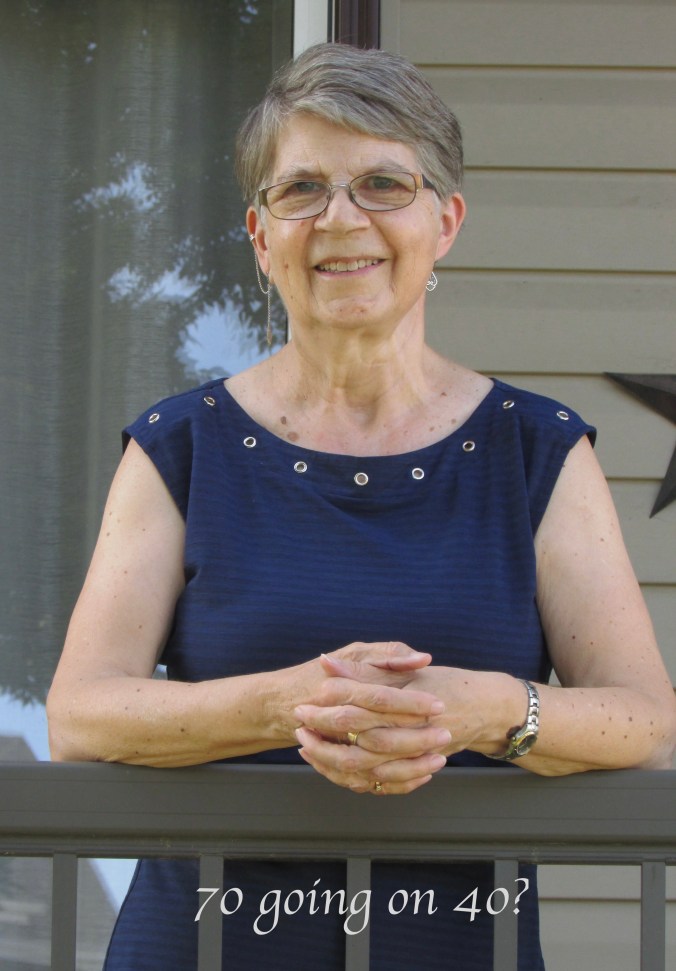
Earlier this week, I played a round of golf with a group of younger women who were astounded to learn that I’m over 70. That got me thinking about a recent post by one of my favourite bloggers, Pamela Lutrell of Over 50 Feeling 40. Pam, who is the same age as I am, shared a very interesting article, 9 signs you’re 70 going on 40 — without even trying by Avery White, and then wrote a self evaluation based on the author’s 9 points. Today, I thought I’d do likewise.

I want to preface my personal evaluation by saying that I’m not interested in trying to look younger than I am. I love the introduction to White’s article… “There’s something magnetic about people who’ve crossed into their 70s but still radiate the spark, wit, and energy of someone thirty years younger. They’re not desperately clinging to youth or chasing trends — they’re just… alive. Fully, authentically alive. And they don’t even seem to be trying.” That’s definitely something I aspire to.
So let’s see how I’m doing.

1. You keep learning just for the thrill of it.

I think I’m doing very well in this category. I consider myself a lifelong learner with a love of reading and a passion for research. 50 years ago, I was that odd student in university who loved researching and writing papers and I haven’t really changed.

We live in an ever changing world, but even in my 70s, I try to keep up with new technology. Like Esther of the Old Testament, I believe that I was born “for such a time as this” and that it behooves me to learn to use the tools of today (although I do have to call on my more tech savvy offspring for help from time to time!)

2. You move because it feels good—not to punish yourself.

Again, I’d give myself an excellent mark in this area. I exercise for about 20 minutes before I leave the bedroom Monday to Friday mornings and I’m striving to walk at least 5 days a week, which reminds me that I’m very thankful to each one of you who has contributed to my Hoofing It fundraiser for neuroendocrine cancer research! I also enjoy bowling during the winter and hiking, kayaking, and playing golf in the summer.

I exercise, not because I’m trying to look younger or to achieve a perfect body, but simply because it feels good and because I believe in the old adage “use it or lose it”.

3. You don’t obsess over your age.

I really don’t. In fact, I’m proud of my age. When I was diagnosed with cancer 12 years ago, I had no expectation that I’d reach my 70s, so I’m just very thankful to be here. My age doesn’t define me and for the most part, it doesn’t limit me although I do get a bit frustrated when I can’t hit a golf ball as far as I used to!

4. You say yes more than no.

I’m not sure that I actually agree with this one. As I wrote in this post earlier this month, it’s okay to say no and to be able to do so without feeling guilty. I like to be spontaneous and I do say yes to lots of things, but I also know my limits and try not to overdo.

5. You have friends of all ages.

This has always been true of me, but these days most of my friends are younger than me, some as young as my own children. Sadly, some of my more elderly friends have passed away in recent years.

6. You laugh easily—especially at yourself.

I don’t know about laughter being the best medicine, but apparently it really is good for our health. According to the Mayo Clinic, one of my first go-tos for all things medical, “When it comes to relieving stress, more giggles and guffaws are just what the doctor ordered.” Knowing that, I admit that I probably don’t laugh as much as I should, but I’m definitely able to laugh at myself. Worrying less about what other people think is one of the benefits of aging for most of us and I certainly don’t embarrass as easily as I did when I was younger.

7. You still chase new goals—even small ones.

I think this fits well with #1, being a lifelong learner. I am always ready to try something new and while I don’t have a written bucket list, there are certainly a few things in the back of my mind that I haven’t done yet.

8. You don’t over-nostalgize.

I definitely do not live in the past. Parts of it are much too painful and dwelling there would rob me of joy. Instead, while trying to learn from the mistakes of the past, I try to live in the present and look forward to the future.

9. You make people feel seen.

As an introvert, this final point is one where I might give myself a failing mark, but it’s something that I’ve been consciously working on. Wherever I happen to be, I try to notice the people around me. Sometimes I simply smile as I pass by, but I’ve started to look for opportunities to offer a genuine compliment or an encouraging word. This is especially true when I’m in the cancer clinic where I know that people are often feeling stressed or overwhelmed and really need to feel seen.

Whether you’re in your 70s or not, do you recognize yourself in any of these points? One of Avery White’s final thoughts wraps up the topic perfectly. “The truest kind of agelessness comes from your mindset, your curiosity, your willingness to stay engaged — with people, with ideas, with life itself.”

Judith Viorst: Embracing age with style

After writing about heavier topics the past couple of Fridays, I wanted to write something lighter this week and I really felt like it was time for another fashion related post. Earlier in the week, I was still thinking about what to write when Pam Lutrell shared a link to an article on her blog, Over50Feeling40, that caught my attention.
If you’re like me, you might be familiar with the children’s book, Alexander and the Terrible, Horrible, No Good, Very Bad Day, but what I didn’t know was that the author, Judith Viorst, has published at least 50 books, many for children, but some for older readers. In fact, I didn’t really know anything about Viorst until I read the article, At 94, I’m Still Worth Looking At.

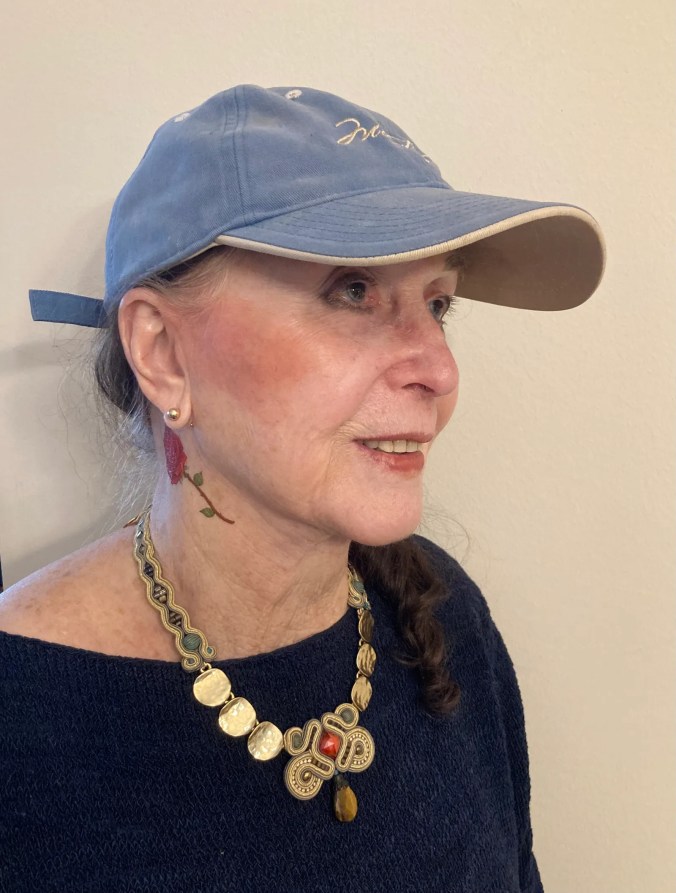
It was fun to read about her “looks” throughout the years. There was her Greenwich Village Girl look in her 20s followed by her With-It Mommy look in her 30s. Later came her Hat Lady years when she seldom went out without a hat from her vast collection. Hats, she says, flattered her face, drew attention away from her aging body, and hid her hair on bad hair days. I can identify with that! Now 94, she says she’s not finished finding new looks yet. Her newest look is Tattooed Grandma. No, she hasn’t gone under the needle. Instead, she wears a temporary tattoo of a rose on the side of her neck, slightly below her right ear. Each tattoo lasts about a week.

I hope I look half as good if I live to be 94!

But what really resonated with me was what Viorst had to say about aging and invisibility, something I’ve written about before on the blog. She asks, “Why does it feel so important to be seen? Aren’t there more meaningful things to think about, to read about, to do?” She writes about people who feel that attention to looks will “obscure and distract us from what is truly significant”. In response she writes, “But the people I love the most embrace what’s playful and fun as well as what’s profound. Celebrate as well as cogitate. And are willing to discuss, without apology, both eyeliner and the meaning of the universe.”

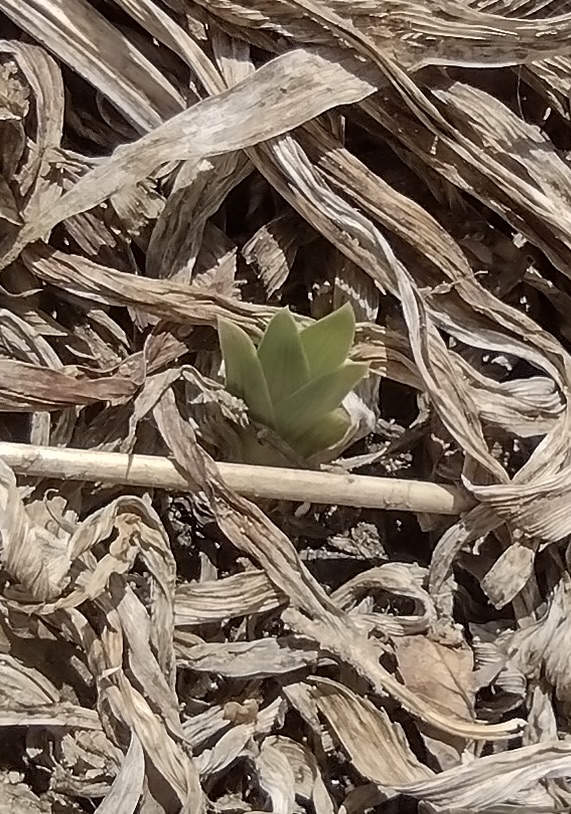
I love that! In times like these when the world seems upside down and sometimes tragedy hits close to home, regardless of our age, let’s not forget to embrace both the serious and the fun side of life. Right now, I’m looking for joy in the little things. In the coming of spring. In the tiny green shoots coming up in the garden beneath my kitchen window and the teeny, tiny buds forming on the trees.

Why volunteer?

April 14-20, 2024 is National Volunteer Week in Canada, a time to recognize and celebrate the impact of the country’s 24 million volunteers who share their time, skills, empathy, and creativity for the well-being of others.

But why volunteer? What are the benefits of giving of your time and energy for the sake of others?

One positive result of volunteering is an increased sense of purpose and satisfaction. Studies actually show that volunteering triggers the mesolimbic system, the portion of the brain responsible for feelings of reward. The brain releases feel-good chemicals like dopamine, spurring a person on to perform more acts of kindness. Psychologists call this “helper’s high.”

For those of us who are retired, this aspect of volunteering can be especially beneficial. “A strong sense of purpose is always in my top five secrets of healthy aging,” says Scott Kaiser, MD, a board-certified geriatrician and director of geriatric cognitive health for the Pacific Neuroscience Institute. “Having a reason to get up in the morning is extremely powerful.”

Research presented at last year’s Alzheimer’s Association International Conference also found that volunteering later in life may protect the brain against cognitive decline and dementia. Those who volunteered demonstrated better memory and executive function. Volunteering can also be a social activity; an opportunity to build connections with other people who have similar interests.

In his later years, my father always said that there are no end of things to do as long as you don’t have to be paid for doing them and I have found that to be very true. My only problem is ensuring that I don’t overextend myself and take on more than I can reasonably handle.

But what if you haven’t volunteered before? How do you get started? First, think about your skills, abilities, and passions. What are you good at? What excites you? Next, look for opportunities that align with these things. These might be found in your church, in community organizations, or ever further afield. Sometimes it’s just a matter of taking that first step!

For example, teaching and writing are my gifts. These are the things that energize me. In the past, children’s ministries were an obvious area where my abilities could be put to good use. I taught Sunday School, counselled at summer camps, and assisted with after school programs and Vacation Bible Schools. While I still love kids, I don’t have the energy level that I once had, so working with adults has become a better fit. I lead a ladies Bible and also volunteer as a tutor with a local literacy program. As I’ve mentioned on the blog before, I’m also a volunteer editor for Kiva, an online lending program that crowdfunds loans to borrowers around the world who don’t have access to traditional financing. This has the advantage of being done online and while I’m committed to editing a minimum of 40 loan descriptions a month, I can do it whenever I choose.

Still not sure? Don’t be afraid to step outside your comfort zone and try something new. Several months ago, I volunteered to be part of a CNETS (Canadian Neuroendocrine Tumours Society) Advocacy Advisory Board, hence my recent trip to Montreal. We’re still in the learning and planning stages, so I don’t know exactly how my skills will be put to use, but as a NETS patient this is something that I’m passionate about, so I took a leap.

As my father said, there are no end of opportunities. Hospitals need volunteers to assist patients, their families, and staff. Food banks need volunteers to prepare and distribute food hampers. Drivers are needed to deliver meals to shut ins. Schools often welcome volunteers to help in a variety of ways. A volunteer even gave me directions at the airport last week!

NVWDigital Banner

Opposite views of aging

Logo by SamSince reading Breaking the Age Code and featuring it as my July Book of the Month, I’ve been doing what the author, Dr. Becca Levy, suggested and looking more closely at the messages that I see about aging in the media, in advertising, and on social media. While this topic is much broader than just fashion, I think it’s appropriate for a Friday post because so much of what we see about age is directed at women and their appearance. Take the article that I saw posted on Facebook recently for example. “40+ Short Haircut Tips and Styles That Make Us Look 20 Years Younger”  sounds innocent enough until you ask yourself, why should we want to look 20 years younger? What’s wrong with looking 40, 50, or even 80? The message is that young is good, young is beautiful, and old is not. 

Thankfully, there are positive messages to be found too. “72 is the new 30! Get fit at any age along with this 72 year old fitness star!” implores an ad for an online fitness program. Scientists claim that life expectancy has increased to such an extent that a 72-year-old person today has the same probability of dying as a 30-year-old primitive hunter-gatherer would have had. Hence the saying, 72 is the new 30. That’s good news, I think, but the real message of the ad is that at 72 we can still be active and physically fit.

In contrast, look at this meme taken from Facebook.

Screenshot 2023-07-27 at 7.34.42 PM

What? We’re old and washed up at 50? Maybe this is supposed to be funny, but it’s exactly the kind of self-defeating, negative message about aging that Dr. Levy wrote about.

Instead, here’s the kind of message we should be seeing.

Screenshot 2023-07-27 at 7.39.12 PM

This the the kind of age belief that can add years to your life and quality to your years. In the long run, you’ll probably look better than the gal who’s lying on the heating pad eating nachos too!

Book of the month – July 2023

Breaking The Age Code

Becca Levy, PhD

Screenshot 2023-07-14 at 10.05.53 PMHow would you like to extend your life by 7.5 years? According to Dr. Becca Levy, Yale professor and leading expert on the psychology of successful aging, you might be able to do just that!

Breaking the Age Code is a fascinating book that could literally revolutionize how you think about aging. Levy’s premise is that our age beliefs, what we think about older people and about getting older, influence how we age. She presents both factual evidence and interesting anecdotes showing that having positive age beliefs results in better physical and mental health in our senior years and actually extends life expectancy. This makes sense when you consider that having positive age beliefs promotes physical exercise as well as social and intellectual engagement and diminishes stress.

Unfortunately, we who live in North America and Europe are constantly bombarded with negative age beliefs. Even saying that someone is having a “senior moment” suggests that there is truth to the all too commonly accepted stereotype that our brains inevitably deteriorate as we get older. In reality, people of all ages experience these momentary memory lapses and there is tremendous variability in how our brains function as we age.

Breaking the Age Code presents us with easy-to-follow techniques for shifting our age beliefs from negative to positive. The first step involves becoming aware of our own age beliefs as well as recognizing the ageism that is so prevalent in our society. The book is also a call to stand up against ageism and its negative effects.

Not only is Becca Levy one of the world’s leading experts on aging and longevity, but she’s also a wonderful storyteller. Her book is both informative and inspiring and would be of benefit to readers of all ages, those who will be old someday and those who already are.

Age isn’t something to be ashamed of

Logo by SamFacebook obviously knows that I’m an older woman and it seems to think that my greatest desire in life ought to be to look younger. I’m constantly bombarded by articles and advertisements telling me how to hide my age. Articles like “the 10 things a woman over 50 should never wear” or “12 fashion mistakes that make you look old”. The latest one featured hairstyles that older women should never wear. I was astonished to see these photos included in that article.

Astonished, perhaps, because this is pretty much how I’m wearing my hair these days, but also because I think both women look quite stunning. Apparently, however, short haircuts like this draw attention to the face; that poor old wrinkled face! So what are we supposed to do when we reach a certain age? Hide our faces behind long shaggy hair? Wear a burka? I think not!

As long as I can remember, advertising aimed at women has screamed one message loud and clear… youth equals beauty! We have been hoodwinked into believing that we lose value as we age. As a result, many women go to great lengths to try to fight off the natural effects of passing years.

Several years ago, American professor and humorist, Gina Barreca, wrote this in an article for Psychology Today.

I refuse to spend money on so-called “anti-aging” products. I want to age. The opposite of aging isn’t staying young; that is not an option. The opposite of aging is death. And for that, you don’t need neck cream!

Amen! I love that.

I also love the fact that, thanks to the pandemic and not being able to visit their hairdressers for an extended period of time, many women let their hair go grey and discovered that they actually liked it. I have no problem with a woman colouring her hair if that’s what she wants to do, but I do have a problem with her feeling that she has to in an attempt to hide her age. Age isn’t something to be ashamed of!

In the same article, Barreca points out that the people who peddle high-priced products that promise to make us “look barely post-adolescent” aren’t looking at our faces; they’re looking at their bottom line. They really don’t care if we look young, old, or in-between; they just want to make a dollar. If you don’t think that’s true, look at the statistics. The global cosmetics industry is valued at $571.1 billion USD. Approximately $49.2 billion is generated by cosmetics sales in the United States each year and the average American spends between $244 and $313 on cosmetics every month! That’s absolutely astonishing!

I agree with 64-year-old actress, Jamie Lee Curtis, who once said, “I am pro-aging. I want to age with intelligence, and grace, and dignity, and verve, and energy.” Apparently, she’s also in favour of very short haircuts on older women.

American-actress-Jamie-Lee-Curtis-2021

Golden years?

Have you ever wondered why they call our retirement years, the years from 65 to 80 and beyond, the golden years? The phrase was actually coined in 1959 as part of an advertising campaign for Sun City, Arizona, the world’s first large-scale retirement community for active seniors. The goal, of course, was to portray retirement as a life of leisure; a time to travel, play golf, and pursue hobbies, but is it true?

For Christmas, I gave hubby a sweatshirt with one of his favourite sayings on the front. Retired: The ability to do what I want when I want. Lately whenever he wears it, he hastens to point out that it isn’t entirely true. These days, our lives seem to revolve around countless trips to the city for tests, scans, specialist appointments, and most recently, his prostate surgery. Maybe these should actually be called our rusty years because parts are continually breaking down and our bodies aren’t running as smoothly as they once did!

We certainly aren’t alone in this. At our recent senior bowling windup I looked around the table at our team and realized that all five of us either have or have had cancer. Many of our peers have had hip or knee replacements. Another has recently had a stroke and still others are waiting for biopsy results and/or surgery. No, retirement isn’t all traveling and playing!

I’m not really complaining… well, maybe just a little! I love the fact that we no longer have to rush off to work every day and that the government pays us for simply waking up every morning. I also realize that I’m fortunate to be alive. When I glance at the obituaries these days, many of the deceased are younger than me!

Some people claim that our true golden years are between 40 and 60 when we’re still physically and mentally fit and have probably reached some level of financial security. That led me to wonder, when were my golden years? When were yours? The first decade of my life, living in a waterfront house on the coast of British Columbia with the beach as my playground and the sound of the surf as my lullaby at night, was definitely golden. I look back on the years when my children were at home as golden. I loved that time of my life. There was a dark interval during the fourteen months that our oldest daughter fought her losing battle with leukemia, but even during that time, there were golden moments. When we were in our fifties, the year that we spent teaching English in Japan was golden.

640px-Kinkaku-ji_the_Golden_Temple_in_Kyoto_overlooking_the_lake_-_high_rez

2 Corinthians 4:16b says, “Though outwardly we are wasting away, yet inwardly we are being renewed day by day.” In spite of the limitations of physical aging, I have no intention of passively resigning myself to coasting along and waiting for my name to show up in the obituaries! It was Abraham Lincoln who said, “In the end, it’s not the years in your life that count. It’s the life in your years.” So what can we do to make these years count, whether they are golden or rusty?

We may not be able to travel as often or for as long as we once could, but I’ll cherish the relationships that we have with people both near and far and when I can’t be together with them in person, I’ll remind myself how fortunate we are to have the internet, something that we didn’t have in our younger years. When I can’t explore far away places, I’ll seek out and appreciate ones that are closer to home. I’ll continue to offer the best of myself through volunteer work. I’ll read and learn and stay as physically active as I can for as long as I can. Always, I’ll remember to be thankful!

And finally, a message for those of you who are younger, don’t waste what might be the best years of your life yearning for the golden years. After all, they might turn out to be a little bit rusty!

The art of aging gracefully

Since I spent much of the past week camping and yesterday participating in a senior’s golf tournament, I don’t have a regular Fashion Friday post for today. Instead, I’m going to share some words of wisdom from Donna Ashworth’s book, To The Women: words to live by

Think about it, you have EARNED this face.
Every line, a laugh shared.
Every wrinkle, a year survived.
Every age spot, a day that the sun shone on you.
Some women believe that as they age, they LOSE their looks. Oh my friends how wrong this is.
A beautiful young women is a happy accident of nature but a beautiful older woman?
She is a work of art.
The Japanese have a practice whereby they fill any broken objects with gold, believing that something which is broken has earned its beauty and should be celebrated and decorated rather than discarded.
I feel this way about women.
It took a long time to find out who you really truly are. A long time. The acceptance that old age brings is freeing. It brings with it peace and happiness.
Everyone knows, happiness looks good on us all.
Your body has been changing since the day you were born and will continue till the day you depart. Ride with it, accept it, embrace it. Be amazed by it.
Allow your face to represent your life, your stories, your joys.
Why choose to be an older woman fervently chasing youth, when you could be that older women who knows what she is worth and has earned every minute of her hard-won self-acceptance.
The trick with ageing successfully my friend, is to pay as little attention to it as possible.

img_1445_3

I’ve shared this photo before, but it’s one of my favourites from our time in China. I thought she was beautiful when I first saw her and I still do. I wish I could have spoken to her but language was a barrier. I have no doubt, however, that the well-earned lines on her face tell a story… a story of hardship, a story of survival, but hopefully also a story with some happiness in it. As we age, may our faces also tell our stories with grace and self-acceptance.


Perspectives on growing older

Earlier this month, Sue Burpee, writer of High Heels in the Wilderness, wrote a very thought provoking post about the feelings of sadness and dissatisfaction that she was experiencing as she contemplated the realities of getting older (she’s 66). It obviously resonated with many women as it generated a vast number of heartfelt comments. In fact, it struck such a chord with Frances, over at Materfamilias Writes, that she responded with this post on her blog. Again, the comment section exploded with women in their 60s, 70s, and beyond expressing feelings of worry and despair as they faced their own mortality. Many wrote of feeling that time was running out and one of Sue’s readers likened it to falling into an abyss. Some wrote of physical decline or the fear of losing their spouse. Others were already alone. Some mentioned lack of purpose, having nothing good to look forward to, or feeling invisible to those around them. There was also an acknowledgement by many that the pandemic had robbed them of valuable time that they’d never get back.

I haven’t been able to stop thinking about those two posts and the comments that they generated. I keep asking myself why I don’t share the feelings that so many women expressed so poignantly. I do lament time lost to the pandemic, but I’m just three months short of 70 and rather than feeling down about it, I’m excited! I’m already thinking about how I want to celebrate that milestone. But why? Why don’t I feel the way they do?

I think that there are three reasons.

The first was a major shift in perspective that happened almost ten years ago. I’ve written before about the fact that I spent the whole year that I was 59 fretting about turning 60. It sounded so old! How had I got there so quickly? Then came 60 and it wasn’t so bad after all, but before I turned 61, I was diagnosed with cancer and within a year, a second unrelated one. If you’ve been following my blog for very long, you know that the past decade has brought a number of other diagnoses as well as surgeries, treatments, and medications. Now, still with one incurable cancer, but stable and feeling 100%, I’ve learned that every day is a gift. Nine years ago, I had no reason to think that I would make it to 70. Now it feels like a victory!

The second reason that I feel optimistic about the future is the faith that sustained me through all the ups and downs of the past decade and for many years before that. I, who in my childhood and young adult years had an abnormal fear of death, of disappearing into nothingness and no longer existing, found peace with that when I finally cried out to God in desperation and asked Him to remove my fear. That was forty years ago and to this point, it has never returned. I don’t pretend to know what life beyond the grave will be like, but I firmly believe that it does go on and that those of us who have a personal relationship with the Creator will continue in His presence. That’s all I really need to know. That may sound naive or foolish to those who don’t share my faith, but that’s not surprising. Scripture says that that will be so. “For the message of the cross is foolishness to those who are perishing, but to us who are being saved it is the power of God.” 1 Corinthians 1:18

Perhaps the main reason that I’m not burdened by the dark thoughts and feelings that seem to plague so many of my fellow seniors is that my life has purpose. Hubby and I fairly recently gave up a volunteer position that was beginning to become too physically taxing, but as my father always said, there’s no end to the things that you can do in retirement as long as you don’t need to be paid. I’ve edited almost 750 Kiva loans since I took on that role early last year. When I was younger, I led a ladies Bible study for more than twenty years. I didn’t expect to find myself doing that again in my late 60s, but I just wrapped up my second year back in that role and I look forward to continuing in the fall. In addition, I have a leadership position with an online women’s ministry and I’ve just been accepted into another role that will put my writing skills to good use. Nine years ago when I was looking death in the face, I certainly didn’t anticipate new beginnings at age 70! Clearly God isn’t finished with me yet!

48332799_595882320848486_1466678194248613888_n

image