Who is tokyo5?

When Richard and I were hired to come to Japan to teach English, I started this blog to share our experience with family and friends. I also welcome anyone else who comes across it. Some people stop by once while others have become regular readers. One such person is tokyo5.

I’ve occasionally been asked who this person is. “Sometimes it seems like he’s trying keep tabs on what you say,” said one regular reader. “Doesn’t this annoy you?” she asked.

Tokyo5 is actually an American whose job brought him to Japan 18 years ago at the age of 20. He ended up marrying a Japanese girl and staying. They live in Tokyo and have three children, hence the pen name, tokyo5. Apparently, he rarely returns to the States. Though his comments often do come across as somewhat critical, I give him the benefit of the doubt. I don’t think he intends to be rude. In fact, he may not even realize that his comments sometimes sound that way. He’s just incredibly proud of his knowledge of the Japanese language and culture and very defensive about anything Japanese. He actually keeps me on my toes. I know that if I slip up and get my information wrong, he’ll be sure to let me know! His own blog is an interesting source of information about many things Japanese. You can find it at tokyo5.wordpress.com.

I am able to remove comments from my blog if I choose to do so but I’ve never done that. WordPress does a good job of weeding out spam so I’ve never had to deal with anything offensive and if a comment appears that seems somewhat suspicious, I’m notified and can accept or delete it before it’s published. A few of tokyo5’s comments have gone that route but I’ve never deleted any of them. The only time I was tempted to do so was when a negative sounding comment was directed toward another regular reader.  Even in that case, however, I decided not to interfere.  I welcome all legitimate comments including those that disagree with me. In fact, I wish more people would comment. Much of what I share here is my opinion or my own interpretation or reflection on what I’m experiencing so it may be different from someone else’s. That doesn’t make either one of us wrong but it does open the door to interesting discussion.

When I first started writing the blog, I thought that it would be a one year project but now that our time here is drawing to a close, I’ve decided to keep it going indefinitely. Not only does it fulfill my desire to continue writing but now that some of my Japanese friends are reading it, perhaps it will allow me to share life in Canada with them!
National Founding Day

The neighbourhood is very quiet today. At 7:45 this morning, the street wasn’t filled with noisy school children on their way to class. The garbage truck with it’s announcement blaring didn’t stop below our window a little later on to collect the trash and around 9:00 a.m. there was no huddle of mothers and preschoolers waiting for the kindergarten bus on the next corner. There are no machines digging up the streets anywhere nearby. Today is a national holiday known as National Founding Day.

Celebrated annually on February 11, this day was originally called Empire Day. Perhaps in order to bolster its own legitimacy, the holiday was an invention of the Meiji government. It commemorated the founding of the nation and the imperial line in 660 BC by the legendary first emperor, Jimmu. Abolished after World War II because of its association with the imperial system, the holiday was resurrected in 1966 as National Founding Day but was stripped of any overt references to the Emperor. It is Japan’s most controversial holiday often sparking protest rallies held by those who claim that it is unconstitutional because it links the country’s foundation with the imperial institution.  I assume that they look more favourably upon Constitution Memorial Day on May 3.  Established in 1948, that holiday celebrates the day on which the current Japanese constitution came into effect one year earlier.

February 11 is, at best, a subdued celebration with few overt expressions of national pride or patriotism.  In fact, for most Japanese, it appears to be nothing more than a day off work or school. Most of my adult students weren’t even able to tell me why it’s a holiday. Some guessed that it might be the emperor’s birthday which is actually celebrated on December 23 while others surmised that it had something to do with Japan becoming a country.  For us, it’s a day like any other and we’ll soon be off to school as usual.

Language limitations?

Before we came to Japan, we fully intended to take some Japanese lessons once we settled in. We thought that a basic knowledge of the language would be necessary in order to cope with everyday life. While there have been occasions when it would have been helpful, we quickly came to the realization that knowing Japanese wasn’t essential and decided that our time would be better spent in other ways. If we had planned to stay longer than a year or if we thought that we would have any opportunity to continue using the language once we returned to Alberta, we probably would have taken some lessons but we also realize that old brains like ours don’t absorb new languages easily and it would take much longer than a year to develop any level of fluency.

We’ve learned a few useful words and phrases along the way as well as some that are just plain fun. The latest is saiko. According to the dictionary, it means highest or maximum but it can be used in the same way that we commonly use the English word awesome, as in “How are you?” “I’m awesome!” The reason we’re having so much fun with it is the fact that it’s pronounced exactly like the English word psycho. So, imagine for a moment the quizzical looks I’ll get if, back in Canada, someone asks “How are you?” and I respond “I’m saiko!”

Most of our fellow teachers here are the age of our children or younger and many have studied some Japanese before they arrive in the country. One of them, a somewhat immature and self-absorbed young lady, hopes to become completely fluent in the language and work as a translator someday. She takes advantage of every opportunity to point out to anyone and everyone that she speaks Japanese and she clearly looks down on anyone who doesn’t. She actually told Richard some time ago that we wouldn’t have any opportunity to get to know any Japanese people if we didn’t make an effort to learn the language. She’d be shocked to learn how difficult it’s going to be for us to leave this country because, after just one year, it means saying good-bye to so many dear friends and how hopeful we are that we’ll be able to come back and visit them someday!

We spent the past two Sunday afternoons and evenings visiting in Japanese homes. Last week we enjoyed a wonderful visit with Seiko, Atsuo and their eight month old son, Ayumu. The fact that we don’t speak Japanese and Atsuo doesn’t speak English hardly interfered at all and has not hindered us from developing a very special relationship with this young couple. Ayumu is our “adopted” grandson and it warms my heart every time I hear Seiko refer to us as Granma and Granpa!

Yesterday we visited Yoko and Yoshinori, a couple who are almost the same age as we are. Yoshinori is a journalist who spent much of his career as a foreign correspondent so they spent many years living and raising their children in London, Mexico City and the United States and they both speak English quite fluently.

Of course, being a part of a church family here has given us the opportunity to get to know Japanese people and enter into their lives in a way that we wouldn’t have otherwise. We won’t be here to see Yugo and Minako’s new baby when it arrives in July or to watch Dave and Yuki exchange marriage vows but it’s been a delight to share in their excitement as they’ve told us of these upcoming events. In fact, it’s been absolutely saiko!

Setsubun

Today is Setsubun, in my opinion probably the most unusual day on the Japanese calendar. Because of it’s original association with the Lunar New Year, it is thought of as a new beginning, a time to drive away evil spirits and prepare the home for the year to come. This is done by opening the windows and throwing roasted soybeans both inside and outside the home while shouting “Oni wa soto! Fuku wa uchi!” which loosely translates as “Evil spirits out. Good luck in”. As part of bringing in the good luck, it is then customary to pick up the beans and eat one for each year of your life. In recent years, some families have chosen to use peanuts instead of soybeans. Some people wear devil’s masks while performing this ritual while others hang small decorations made of holly and sardine heads over the entrances to their homes to discourage the evil spirits from reentering once they’ve been driven out.

Setsubun is also celebrated at Buddhist temples and Shinto shrines throughout the country where celebrities are often invited to assist the priests by scattering the beans.

In keeping with the theme of new beginnings, Setsubun is also considered the last day of winter even though my students assure me that the weather won’t change significantly for awhile yet. Though there’s a bit of warmth in this evening’s breeze, the weather forecast seems to concur.

There are some variations in how Setsubun is celebrated in different regions of the country. For example, it has long been customary in the Kansai area to eat uncut sushi rolls on Setsubun while facing the lucky compass direction for that year, as determined by it’s zodaic symbol. Through the marketing efforts of supermarkets and convenience stores, this tradition seems to have spread to other parts of the country. I saw these rolls being sold in several spots on my way to and from work today. In front of the convenience store close to the school where I taught today, they were being sold by two young men who were dressed in red and wearing devil masks.

There may be some Japanese traditions that I’d be willing to adopt but I don’t think this will be one of them. While I most definitely believe in the existence of both good and evil in the spiritual realm, I don’t think I’ll ever put my faith in soybeans! It sure is fascinating to learn about these unusual customs though.

Sayonara sale

I put up the first poster for our sayonara (good-bye) sale at one of our main schools today. Unlike some of our colleagues, we chose to live a very minimalist lifestyle this year so that there wouldn’t be a lot of stuff to get rid of at the end of our contract. We do have a few items to find new homes for, however.

Within minutes of the sign going up, one of our fellow teachers had spoken for my bike. She’s in no hurry to get it from me so I’ll use it for a couple more weeks before turning it over to her. I’ve often thought that if these bikes could talk they’d have interesting stories to tell. As teachers come and go, bicycles commonly pass from one to another. We have no idea how many previous owners ours have had.

In addition to the bikes, we have a very compact and sturdy computer desk to unload. We bought it at the nearby recycle store so, if we don’t find a buyer for it, it will likely end up back there. We also have a 15 inch flat screen computer monitor. I’d actually like to take that home with us but I suspect that there won’t be enough space in our luggage for it. Hopefully someone will want the computer speakers, the small oscillating fan and the folding canvas chair that we also bought second hand.

Since the sale is all about getting rid of stuff and not about making money, we’ve priced the items very reasonably. In fact, we plan to give some of them away.

There are three of us on staff who are finishing on the same day so I suspect that there will be some new teachers arriving before we depart. Hopefully they’ll be interested in having some of the things we need to get rid of. We aren’t supposed to leave anything in the apartment that wasn’t here when we moved in but I have snuck a few extra dishes and utensils into the kitchen cupboards that I know the next occupant will need. The contents of the cupboards aren’t itemized on the apartment inventory so I’m sure that leaving them there won’t be a problem.

Wow!  In some ways, the year has really flown by.  It doesn’t seem that long ago that we were setting up home and buying the items that we’re now ready to get rid of!

Beginning the long good-bye

I attended my last ladies meeting at Hope Church this morning.  We usually meet the second and fourth Wed. of each month but, since Feb. 11 is yet another national holiday in Japan, there won’t be a meeting that day.

Our contract expires on Feb. 21 and we’ll move out of our apartment and fly to Hong Kong on Feb. 25.  It had been our original intention to fly directly back to Canada from there but recent changes to airline regulations have severely restricted the amount of luggage allowed on flights within Asia.  Instead, we’ll leave the bulk of our stuff with a fellow teacher who lives a few blocks from here and return to Japan for two nights before finally heading for home.

We’ve alerted our adult students to the fact that we’ll be leaving soon.  While they’re only guaranteed the same teacher for one six month term, we’ve been teaching most of them for ten months now.  Clearly, they have enjoyed their time with us and are sad to see us go.  It will be difficult to say good-bye to them and seeing some of my littlest students for the last time is something I don’t even want to think about.

After this morning’s meeting, it was announced that I would be leaving soon and the women gathered around me for a time of prayer.  The news came as a surprise to some of them.  The year has gone so quickly!

We’re excited about going home, of course.  We miss friends and family and there’s a certain little grandson who is threatening to take his first steps before Gram and Grandpa have a chance to meet him!  On the other hand, it’s difficult to say good-bye.  When I look across the church and catch Amu-chan’s eye, he gives me a huge smile.  He’s my “adopted” Japanese grandson and I won’t get the opportunity to watch him grow up.  Being a part of Hope Church for the past ten months has been an amazing blessing to us and we will miss the people there.

On a whole, this year has been a great experience and in spite of the fact that we’ve begun the long good-bye, it isn’t over yet.  Hopefully there are still a few exciting moments out in front of us!

Staying warm

It snowed a little around noon today. It didn’t last long but it created a bit of excitement for a few minutes. With the exception of the occasional really warm day like yesterday, the daytime temperature has probably averaged around 6C lately. It’s a much damper cold than we’re used to back home in Alberta, but it’s definitely warm in comparison. I walked home from work this evening with nothing on my head and I haven’t needed more than my little knit gloves to keep my hands warm all winter.

Staying warm indoors is where the real challenge lies. Like most Japanese buildings, ours has no insulation and no central heating. Considering how concerned the Japanese people are about global warming, it surprises us that even most newer buildings are not insulated.

We have three main sources of heat. A built in unit in one corner of the kotatsu room functions as an air conditioner in the summer and a heater during winter. It provides enough heat to keep about half of that room at a comfortable temperature. An oscillating electric heater in the corner of the tatami room does a pretty good job of keeping that room warm when we’re in it. By far the best source of heat, however, is the portable kerosene heater which we keep in the corner of the kitchen by the doorway to the kotatsu room so that we can turn it toward whichever room we’re using at the time. Unfortunately, it isn’t thermostatically controlled so we have to turn it off when the room starts to get too warm and the temperature starts dropping almost immediately. As a result, it’s impossible to keep the apartment at a steady comfortable temperature.

We’ve heard of a number of foreigers who are afraid to use their kerosene heaters but we use ours all the time. We run the kitchen fan for a short while when we first turn the heater on and again when we turn it off. The rest of the time, there’s no smell of kerosene at all. We keep a 10 litre jerry can of fuel out on the deck and Richard takes the removable fuel tank out there to refill it. Every Thursday and Friday morning, the kerosene truck makes it’s way up and down the streets of our neighbourhood. We always know when it’s coming as it plays a distinctive tune that can be heard well before it gets here. Right now, we’re going through a can of fuel a week. Lately, the price has been under 70 yen/litre but it has been as high as 110. (We used to think 100 yen to a Canadian dollar but at the moment, it’s more like 72 yen/dollar.) Apparently kerosene is a little bit cheaper at the gas stations but since we don’t have a vehicle and there isn’t a station close by, we’re happy to pay a little bit extra for the convenience of home delivery.

We have two other sources of heat. The first, which is uniquely Japanese, is the kotatsu, the low table where we eat all our meals. It’s frame is covered by a quilted futon upon which the table top sits. A heating coil is built into the table frame itself and keeps our legs comfortably warm while dining.

When winter came, the school provided us with electric blankets. They enable us to stay warm and cozy all night without running any heaters. By morning, the temperature in the apartment is often around 10C so as long as one of us, usually Richard, crawls out about an hour before we actually have to get up and turns the heaters back on, we’re okay. We turn them off again when we leave for work. By the time we get home, it’s once again somewhere around 10C in here. I refuse to take my coat off until it has warmed up to 15C so I often start cooking dinner with my jacket still on! My students tell me that February 3 is considered the end of winter and beginning of spring, however, so in spite of today’s snow, we should begin to see warmer conditions soon.

Old favourites

Some of you may remember that several months ago I wondered if my shoes would last until our year in Japan was over. If I had to replace them here, my options would be very limited because my feet are huge compared to those of most Japanese women. With less than two months to go, however, it looks as if I have nothing to worry about.  One pair of dressy flats has pretty much had it but the others are all holding up well.

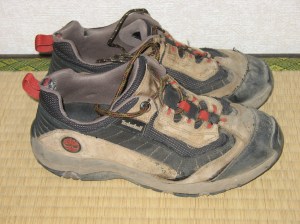
The black oxfords that Richard brought with him to wear to school disintegrated  fairly early on but he had no problem replacing them.  It’s his running shoes that have become a source of merriment.  He came to Japan with two pairs.  One pair was already well worn but the others were brand new.  Shortly after arriving, he bought a third pair, mainly because they were name brand shoes on sale for an price that was irresistible.  So why, I ask myself, is he still wearing the old worn out pair when there are two pairs in the cupboard that have never been on his feet except in the shoe stores?

As we headed out the door on our way to church this morning, I mentioned that perhaps his old favourites were a bit too shabby and he should consider wearing one of the new pairs.  He wouldn’t hear of it, however, so off we went.  As we headed down the street, I realized that with each step, I could see two gaping holes opening and closing in the side of one of his beloved shoes!  I laughed until tears rolled down my cheeks and that’s when I felt this blog coming on!

The old favourites have served him well.  They’ve  walked the streets of five countries and been to the top of Mt. Fuji.  They still have the dust of Vietnam and Cambodia on them.  I really think it’s time to retire them but now he’s threatening to take them back to Canada when we go!  I don’t think so!

the old favourites

the old favourites

Karaoke!

Shortly after arriving in Japan last year, I came across two interesting lists – the top 10 sights to see in Japan and the top 10 ways to get under the skin of the country and the people. Between our first visit to Japan in 2005 and having now lived here for the past ten and a half months, we’ve managed to take in 7 of the top 10 sights. Distance will probably prevent us from getting to the remaining three.

Last night I also reached number 7 on the second list when I went to karaoke with four of my adult students! Though I’ve never been to karaoke in North America, I understand that it’s usually very different from Japan. Here you don’t perform in front of the general public. Instead, a karaoke establishment looks much like a hotel with individual rooms for private groups.

It was a fun and relaxing evening – just five women letting their hair down and having a good time together. There were two huge catalogues of songs to choose from – one English and one Japanese. I sang English songs, they sang Japanese songs and we all sang English ones together. We sang solos, duets and group numbers. I sang everything from Puff the Magic Dragon (a childhood favourite) to Leaving on a Jet Plane and Bridge Over Troubled Water (songs from my youth) to Amazing Grace! I was also the lead singer for a rousing rendition of Jambalaya.

The room was cozy and comfortable with couches surrounding a table that was soon laden with food. We ordered the meal when we arrived and it was delivered to the room. Whenever we needed anything, all we had to do was pick up the phone and ask.

I understand that Edmonton now has a few karaoke establishments that offer private rooms. Hmm… maybe we’ll have to investigate. I can definitely visualize my girlfriends and I whiling away an evening in such a place on our annual Christmas shopping weekend in the city. What do you think, girls?

Seijin no hi

Today is Seijin no hi, Coming of Age Day, in Japan. Until recent years this national holiday fell on January 15 but it’s now celebrated on the second Monday of the month. Twenty is the age of majority in Japan; the age at which a young person can begin smoking, drinking and voting. Though they legally come of age on their birthday, local governments hold special ceremonies on Seijin no hi to honour all those who have turned or will turn twenty during the current school year which runs from April to March. During the ceremony, local officials give speeches and those who are being honoured receive small gifts. This is a very formal occasion. Young men usually wear suits and women often dress in kimono. Parties with friends often follow the ceremony.

We went into Tokyo after church yesterday to have lunch with Matt and Robin’s friend, Kumiko, who is visiting from Kyoto. Though it’s not unusual to see a few women out and about in kimono, we saw many more than usual yesterday. Kumiko told us that families were probably celebrating the coming of age of their children.

For us, today is just another work day. We often work on national holidays and receive other days off in lieu.