Fires, earthquakes and typhoons

September is safety awareness month in Japan so the focus of this week’s staff meeting was school safety. As Richard says, it looks like our best bet in terms of fire or serious earthquake is to pray that we don’t experience either one! Like most buildings in Japan, neither our schools nor our apartment are equipped with smoke detectors. None of the classrooms are at ground level. Most are on the third or fourth floor, often accessed by very narrow stairways, and none have proper fire escapes. There are rope ladders to use in the case of an emergency but I don’t want to be the teacher who has to convince a class of frightened five or six years olds to climb down one of those to the pavement below!

The instructions in case of a fire are much the same as they would be at home. Remain calm, account for all students, leave personal belongings behind, close doors and windows if possible, and relocate to a designated meeting area away from the school. Earthquake instructions are much the same but also include turning off gas and electrical appliances to prevent fire and watching out for falling objects and broken glass. While the building is still shaking, it’s advisable to take cover under a table or to stand inside a door frame. Bathrooms are also sturdier than most other rooms so they are considered good places to wait out a quake. Opening a door or window is recommended as once a building shifts, people are sometimes trapped inside because they can’t get the doors open. Fortunately, Japanese schools conduct earthquake drills, much like the fire drills that we’re familiar with at home, so the students are well acquainted with what to do should one occur.

At this time of year, the biggest safety concern is typhoons. A typhoon is the same thing as a hurricane. These are strong tropical cyclones with winds of up to 180 miles an hour and heavy rainfall. Typhoons that hit Japan are often accompanied by damaging high tides and landslides are also a serious concern. Schools generally close during a typhoon but our general manager doesn’t see fit to close MIL. Of course, teachers cannot always get there because trains often stop running and traffic comes to a standstill. Does this sound familiar to any of you Battle River teachers?

The good thing about typhoons is that they move slowly and there is always plenty of warning when one is on it’s way. When we see our neighbours securing or taking in all the movable objects from their yards and balconies, we’ll know there’s a typhoon coming. Our apartment is equipped with metal shutters to cover our large windows and keep them from shattering and the glass in the smaller windows is reinforced with wire. Some of our classrooms have large windows that don’t have shutters but there are places within each school where we could move the students during a severe storm so that they would be safe from flying glass. Japanese buildings are not well sealed (which helps explain how the insects get in) so leakage around windows and doors is also common during a typhoon.

So, does all this have me shaking with fright?  Not at all.  We knew that Japan was a land of earthquakes and typhoons before we left the relative safety of the Canadian prairie but I believe that this is where we’re meant to be and that we will weather whatever storms may lie ahead.  Just think of the stories we might have to tell!
What’s with the boots?

There are some things about Japan that I will never understand. I think fashion might be one of them. I really like a lot of the styles but why is it that during the colder months it wasn’t unusual to see girls wearing teeny tiny shorts (does anyone else remember hot pants?) and micro mini skirts but now that it’s sweltering hot, just as many are seen in blue jeans? And why is it that at a certain age, women seem to lose their fashion sense and begin to appear in public in the most outlandishly clashing combinations such as the loud flowery pants and animal print top that I saw on the train platform yesterday?

I really shouldn’t comment on skirt lengths as I do remember when I hemmed mine at my fingertips but some of the outfits that are worn in public here would shout “hooker” on any North American street. The most incongruous though, are the high school girls who wear very proper school uniforms complete with knee socks, neckties and skirts so short they’re in danger of showing off their underwear!

It’s the boots that really have me wondering though. As in other parts of the world, the clothing stores have recently put their summer stock on sale and the shelves are filling up with winter wear. I wasn’t surprised to see winter boots appear in Seiyu a few days ago but what amazes me is that as soon as they appeared in the store, they also started appearing on the street! It’s broiling hot out there and girls are wearing knee high winter boots! How does that make any sense at all? I’ve even seen boots being worn with shorts and sun dresses. I try not to laugh out loud.

Revisting Mt. Fuji

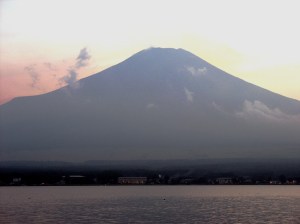
On Wednesday morning we left for an overnight trip to the Fuji Five Lakes area with Matt and Robin. We stayed at an inn on the shore of Yamanakako, one of the five lakes which are scattered around the northern side of the mountain. When we first arrived, the mountain was shrouded in cloud as it often is. Toward evening, though, the clouds began to clear and as we walked along the lake on our way back to the inn after dinner, we watched the sun go down over the mountain. Exactly five weeks after watching the sunrise from the top, this seemed so very fitting. Later, we could see the lights of the mountain huts marking the trail that we had followed up the mountainside.

Yamanakako is a holiday destination for Japanese tourists with many spots along the shore where bicycles, paddle boats and pleasure boats can be rented. An enormous swan-shaped hovercraft does regular tours of the lake but I thought the many live swans were much more beautiful!

In the morning, after enjoying a traditional Japanese breakfast at the inn, we set out to walk to the far end of the lake, a few kilometres away. We ended up walking all the way around the lake! If I’ve read the map information correctly, that’s a distance of about 13.5 kilometres! On our way, we stopped to watch a high school marching band practice, snacked on ice cream, and enjoyed resting in peaceful shady spots. We even saw a campground. After all the time we’ve spent in bustling cities recently, this was a very nice break.

At the end of the day as we waited for our buses, a violent storm blew in. Lightning flashed over the lake, thunder crashed and rain pounded down. I’ve never seen anything quite like it. We took shelter in a second floor restaurant with enormous windows and watched in fascination. Fortunately, the storm subsided somewhat before we had to venture out again.

Rich and I returned to Tokyo by bus then home to our regular daily lives by train. Matt and Robin caught an overnight bus to Kyoto. They’ll be spending the next few days in Kyoto and Osaka visiting good friends and favourite haunts from their two years living in that area. Fortunately, they’ll be back to see us again before they leave the country.

Fish Markets

I really do have some catching up to do here. Korea was a great experience and I’m looking forward to writing more about it but as long as Matt and Robin are around, spending time with them comes first! Robin managed to sprain an ankle yesterday but she’s determined to keep on going so they’re off on a day trip to Kamakura today and we don’t have to leave for work for a while yet.

While we were in Busan, we visited the Jagalachi Market, Korea’s most active fish market. There were fish of every description as well as crabs, squids and other creatures crowded into plastic tubs. Richard found it fascinating but I didn’t much enjoy looking at row upon row of writhing tubs of sea life waiting to meet their demise! If I want to see living sea life, I’d rather wander the tidal pools or visit an aquarium.

Yesterday morning, the alarm woke us at 4:40 a.m. so we could make an early morning trip into Tokyo to visit Tsukiji Fish Market, the world’s biggest. In comparison, it was enormous. Fish weighing a total of about 2140 tons are sold there each day. When your only real contact with tuna has been the little cans on the grocery store shelves, seeing the giant fish being cut up was probably the most interesting sight.

We wandered around the stalls that sell directly to restaurants, retailers and other buyers. I found it much more enjoyable than Jagalachi, mainly because the fish were already dead!  They were frozen or packed on ice. In general, other than the fact that many of the workers were smoking, it also appeared to be much more sanitary. In fact, I’m rather suspect of the food handling standards in Korea.

After wandering through the market, including the agricultural section and the outer market where one can buy a wide variety of cooking utensils, we ate breakfast in one of the tiny restaurants that cater mainly to the traders. Unlike North America, where certain foods are considered suitable for breakfast and others are not, Asian breakfasts seem to consist of the same foods as their other meals. A typical Japanese breakfast would consist of fish, rice and miso soup. While we tend to prefer a western breakfast, we ate sashimi (raw fish served with rice) yesterday! I had crab which I knew I would enjoy and sea urchin which I had never tried before. I also had a bit of Matt’s tuna and tried a few of Rich’s fish eggs. We all ate tiny stuffed squid. It might be a good thing that I didn’t know what those were until after I ate them but they were very tasty!

Amazed by the little things

Sometimes it’s the little things that amaze me. Anyone who lives in a cold climate knows what a nuisance glasses are in the winter. Every time you come in from the cold, they fog up. Yesterday, I had the opposite experience. I walked out of a cool air conditioned building into the steamy heat of Japan in August and my glasses fogged up! How weird!

I also discovered what warm rain feels like. Since Richard and I are both teaching at the school closest to home this week, we’ve been riding our bikes to school. On the way home yesterday, the sky looked dark and ominous. We had some things with us that we didn’t want to get wet so Richard headed for home while I stopped to pick up a few groceries. Sure enough, he got home before the sky opened but I rode home in the rain. I haven’t mastered the Japanese art of riding a bike while carrying an umbrella so I got totally drenched but it felt amazing. The rain was actually warm!

It’s August!

When I was teaching school in Alberta, August 1 meant that the long awaited summer break was already half over and soon the countdown to another school year would begin. When I turned the calendar page this morning, however, it was with great anticipation.  I’ve really been looking forward to August!

First of all, this month means a change in routine. We have no regular classes next week.  All MIL teachers will work Monday to Friday, 11:00 a.m. to 6:00 p.m. with a scheduled one hour break each day.  Like Spring Week, back at the end of March, Summer Week involves teaching three day children’s courses which are marketed as “English Intensive” and are meant to give our regular students a chance to practice their English and prospective students a chance to see what our teachers and classes are like.  The other two days are “Fun Days” with age appropriate activities for children and summer tea parties with light conversation for adults.  One of the main purposes of Summer Week is student recruitment so there will also be trial lessons to teach.  When we aren’t teaching, we’re expected to be working on projects which may include anything from creating flashcards and other teaching resources to cleaning.

On August 9, summer vacation begins and we’re off to Korea!  We’re flying to Seoul and spending three days there then traveling by train to Pusan where we’ll spend another three days before flying back to Japan on August 17.

Hopefully, our return flight from Korea isn’t delayed because about two hours after landing back in Japan, we’re supposed to meet Matt and Robin’s plane!  How exciting!  Three years ago, we visited them in Japan and now they’ll visit us.  We have to teach the first two days of their visit but then we’re using days off and yukyu (personal leave days) to get away for an overnight trip to the Fuji Five Lakes area where I’ve booked us rooms in an inn on the shore of Lake Yamanaka with spectacular views of Mt. Fuji just across the lake.  After that, Matt and Robin are off to travel to other parts of Japan including Osaka, where they lived for two years.  They’ll be back to see us again before leaving Japan though.

Late August will also mark the halfway point in our year here in Japan!  In some ways, the time is going quickly.  On the other hand, we’ve seen and done so much in the first five months that it seems as if we’ve been here for a long time already.

Missing Scrabulous

I learned earlier today that Scrabulous, a popular online version of the Scrabble board game, has been shut down on Facebook in Canada and the United States and I’m not sure what to think. The news didn’t come as a total surprise as I’d heard some time back that Hasbro, the company that owns the rights to Scrabble in Canada and the U.S., was considering legal action against the creators of Scrabulous for copyright infringement. There’s no question in my mind that it is, indeed, copyright infringement as the online game is pretty much identical to the original. Ethically, I realize that Hasbro has every right to bring legal action against Scrabulous but my problem lies in the fact that I’m one of the more than half a million people a day who love playing the game and I’m going to miss it terribly!
Scrabulous is actually still available to we Facebook users who live outside Canada and the U.S. but everyone I play the game with is in one of those two countries. When I think about the fact that I’ve only been using Facebook since January and didn’t even know that Scrabulous existed before that time, it seems silly that I find it’s demise so disturbing but it’s been one of the ways that I’ve maintained contact with some of my friends back home and that’s why I’ll miss it so much.
Mattel, the company that owns the rights to Scrabble outside Canada and the United States, is also pursuing legal action in the Indian courts against the creators of Scrabulous, two brothers who live in that country, so it’s probably only a matter of time until access to the game is shut down worldwide. Apparently both Mattel and Hasbro have official versions of Scrabble on Facebook but my understanding is that they aren’t nearly as good as Scrabulous and when I tried to sign up for Scrabble Beta today, I learned that it isn’t available to players in Japan. It’s the version that Canadian and American players are switching over to so I’m assuming that it’s the one that Hasbro has authorized. In other words, my Scrabulous friends and I probably don’t have access to the same version because we’re on opposite sides of the ocean. Darn! I guess I’ll just have to hope that the games companies and the Scrabulous creators can eventually come to an agreement that will allow the game to resurface. In the meantime, I’ll have to go back to playing Scrabble against the computer. Fortunately, I brought the CD with me!

Obligation gifts

The giving of gifts is a big part of Japanese culture.  For example, whenever a person goes somewhere, even for a few days, it is expected that they will return with gifts for friends and coworkers.  These gifts are usually sweets of some kind.  Consequently, wherever you go, stores are filled with boxes of individually wrapped sweets sold specifically for this purpose.   As teachers, we are often the recipients of these gifts when our adult students have been somewhere.  As a result, we’ve had the opportunity to sample a wide variety of Japanese sweets!

Gifts are also a way of showing appreciation.  For example, at church yesterday we were given two fresh mangoes by Mrs. Sunaga.  This was her way of saying thank you for our prayers and concern on behalf of her husband who is in hospital recovering from a heart attack.  We’ve also enjoyed a jar of her homemade jam given to us as a welcome gift shortly after we started attending the church.

At church yesterday, we learned about another aspect of gift giving.  When our friend, Seiko, gave birth to her wee son, Ayumu, we bought a baby gift.  Knowing that baby showers are not held in Japan, we took the gift to church and gave it to her husband, Atsuo.  We noticed that many other people did the same thing.  Yesterday, Atsuo and Seiko arrived at church with a huge box of gifts to give to all those who had given gifts to Ayumu!  We were presented with a nicely wrapped tin box of very tasty sweets.   The box itself is lovely and will be a treasured keepsake.  More important to me, however, was the handwritten note that accompanied it thanking us for the gift as well as for our prayers and encouragement during Seiko’s pregnancy.

Since we don’t know any engaged couples, it isn’t likely that we’ll have the opportunity to attend a wedding while we’re in Japan but it’s my understanding that they are very costly affairs because the bride and groom are expected to give gifts to all their guests!  They also receive gifts, usually money, but my impression is that the gifts that they give are often quite elaborate.  Adult students have told me about giving not only food, but also dinnerware and other household items.

Summer festival

Several weeks ago I noticed that colourful posters had appeared on fences around our neighbourhood but, of course, they were in Japanese so I had no idea what they were advertising. They were all the same and the drawings included strings of lanterns and little characters in traditional dress who appeared to be dancing. I was able to determine that something was happening on July 26 and 27 and when I considered where the posters were located, I wondered if whatever they were advertising might be occurring at the nearby elementary school.

A little while after the posters appeared, we received a photocopied flier in our mailbox with the same drawings on it. I took it to one of the ladies meetings at the church and asked my friend, Yoko, to translate it for me. She told me that there would be a summer festival in our neighbourhood this weekend and confirmed that it would be happening on the school grounds. The flier included a coupon for a free gift and also promised the first 300 people a free insect, a popular pet amongst Japanese children! It also explained that anyone who wanted an insect would be required to bring an appropriate container to take it home in. The flier also included the information that traditional dancers were needed for the festival and gave a deadline for registering. We immediately decided that the event was something we’d want to check out when the time came and marked it on the calendar.

As I walked home from work early yesterday evening, it was clear that the festival was underway. I could hear the music and when I looked down the street that leads to the school, I could see brightly lit lanterns strung above the entrance to the school ground. We decided to head over there before making supper to see what was going on.

It was definitely a happening place. Crowds of people were milling around, many dressed in yukata (summer kimono). The grounds were brightly lit by strings of lanterns and a stage had been set up in the centre. On the stage and in a circle in front of it, dancers moved to the rhythmic music and the throb of the drums which were located both on a platform high above the stage and on the ground in front of it. Groups of dancers in matching costumes clearly knew the precise steps of the dances while young children joined those on the ground and did their best to imitate them.

Around the perimeter of the school ground, booths had been set up to sell various snacks as well as glow in the dark toys to appeal to the children. We enjoyed some tasty pork pieces grilled on wooden skewers. The people who sold them to us were clearly delighted by the presence of Eigo (English) customers and called out “good bye” and “good night” as we moved on.

After we returned from church this afternoon, we decided to head down to the school ground again to see it in daylight. Though the recorded music was playing, the drumming and dancing hadn’t started yet. There were lots of people, however, and we milled around amongst them enjoying a few more snacks. It was oppressively hot and humid and we weren’t surprised when thunder began to roll and lightning flashed. Suddenly the skies opened! Rain began to pour down and everyone ran for shelter. Our first summer storm in Japan! We took cover with many other people near the entrance to the school and waited for the rain to subside a bit before heading for home. Though we only had a few blocks to go, the skies opened again and we were drenched to the skin before we arrived!

Fortunately, the storm blew on by and awhile ago I could hear the drums throbbing in the distance so the festival was clearly underway again. I’m glad as people had obviously gone to a lot of work to set it up and it would have been such a disappointment if the weather had shut it down early.

Just in case you’re wondering… no, we didn’t come home with an insect. We did turn in our coupon though and our prize was a package of garbage bags!

The earth moved again!

There’s been a lot of earthquake activity this week.  In fact, we’ve felt the ground move beneath us three times since Saturday!

At about 11:40 a.m. on Saturday, I was in teaching a playgroup when the building began to sway.  The children, amongst our youngest students, were in the midst of an action song and didn’t notice anything amiss but the parents who attend class with them were clearly aware of what was going on.  I later learned that an earthquake with a magnitude of 7.0 had occurred off the east coast of the island of Honshu about 300 km northeast of Tokyo.

On Monday evening, I was at home and Richard was still at school when things began to rock again.  It was another earthquake off the east coast, this time about 270 km northeast of Tokyo.  It had a magnitude of 6.0.

Shortly after midnight last night, as we were falling asleep, we felt some fairly significant movement.  We wondered if we ought to get out of bed and open the apartment door as we’ve been told that this is a precaution that we should take in the case of a serious quake.  Apparently, when a building shifts due to an earthquake it’s sometimes impossible to open the doors and escape afterward.  Last night’s shaking didn’t last long enough for us to feel that that was necessary, however, but we did learn this morning that a quake with a magnitude of 6.8 had hit causing numerous injuries and some damage to buildings in and around the city of Hachinohe which is located near the north end of Honshu.  Again, the epicenter was beneath the ocean floor off the coast.  I’m not sure why this one felt so much bumpier to us as it was actually further away than the other two but it certainly was enough to cause us to sit up and take notice.