Hakone

Since Thursday is our regular day off and our school was closed on Friday, we decided to make an overnight trip to Hakone. Located west of Tokyo, Hakone is a very popular tourist area well known for its onsen (hot springs) and its views of Mount Fuji. While on this trip, we learned that Hakone has been a sister city to Jasper, Alberta for the past 36 years. Following the advice of our handy Lonely Planet guidebook, we decided on an interesting loop through the area.

Leaving home at about 8:30 Thursday morning, just late enough to miss the worst of the commuter crush, we headed into Tokyo where we boarded the Romance Car, a quick and comfortable express train that took us to Hakone-Yumoto, the beginning of our loop. There we crossed the platform to the 120 year old Hakone-Tozan line and climbed aboard the tiny narrow gauge train that would zigzag up the mountainside through numerous narrow tunnels and over river gorges to Gora, a very interesting 35 minute ride.

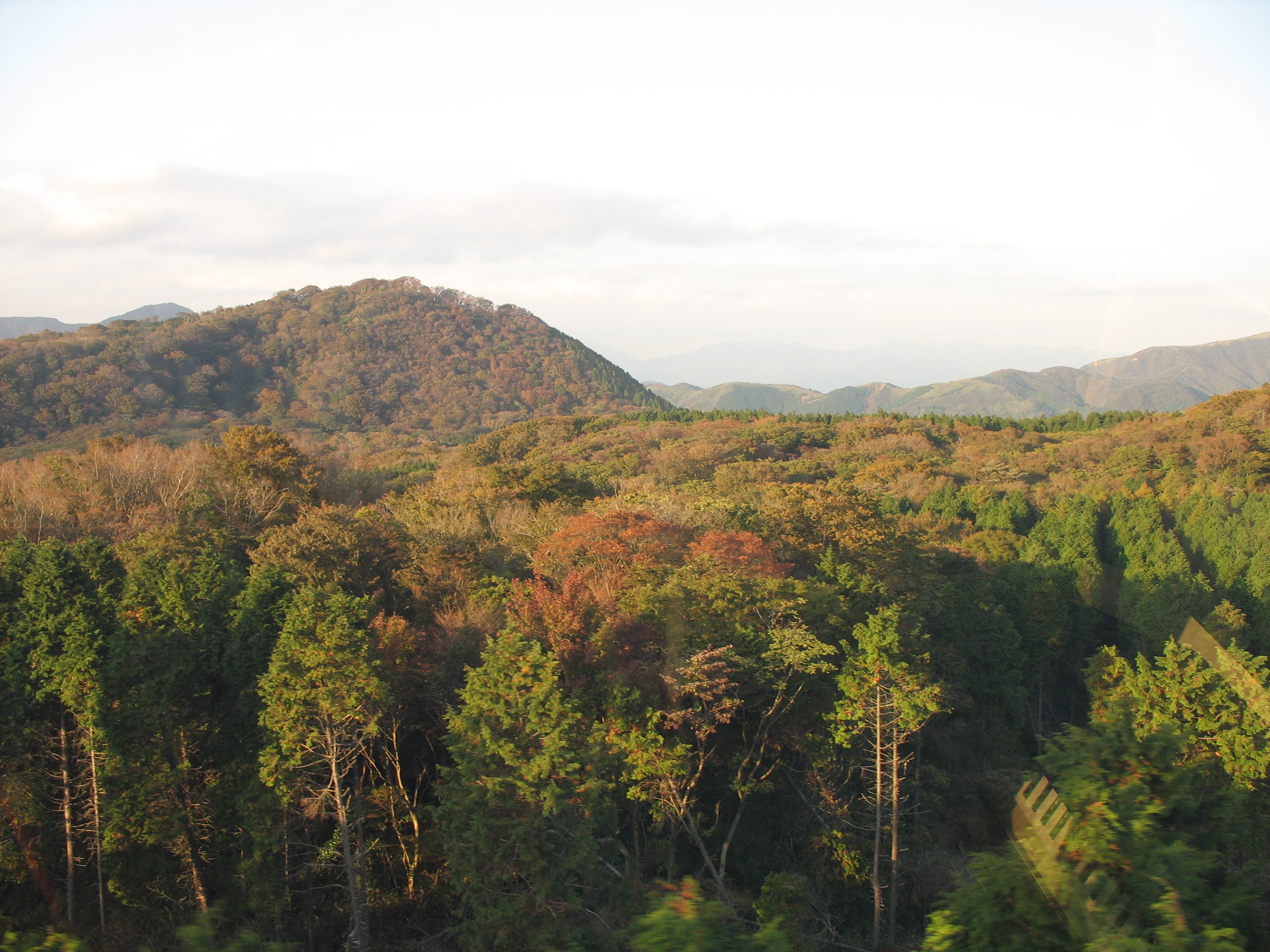
By the time we reached Gora we began to feel as if we were on a tourist treadmill, moving from place to place amongst hordes of other sightseers. Fall, is an especially popular time for Japanese tourists to visit Hakone to see the coloured leaves. The season is a bit late this year so the colours may be more splendid a week or two from now but the hillsides were a beautiful mix of green and coloured foliage. There were many foreign tourists but the vast majority of the travelers seemed to be retired Japanese (we dubbed them the geriatric gang) and school groups.
Over our years of teaching, Richard and I have shepherded countless children on field trips to various interesting sites and we like to think that they were much better behaved than most of the Japanese school groups that we’ve been encountering on recent outings. The biggest difference, I think, is the fact that when we planned field trips, we recruited parent volunteers and usually traveled with one supervisor for every four or five children. Many of the venues that we visited required this. Here, we often see one or two harried looking teachers trying to keep track of a very large group of excited children. I don’t envy them at all! Unfortunately, a lot of the children are loud and unruly which makes the experience less than pleasant for the tourists who share the area with them.

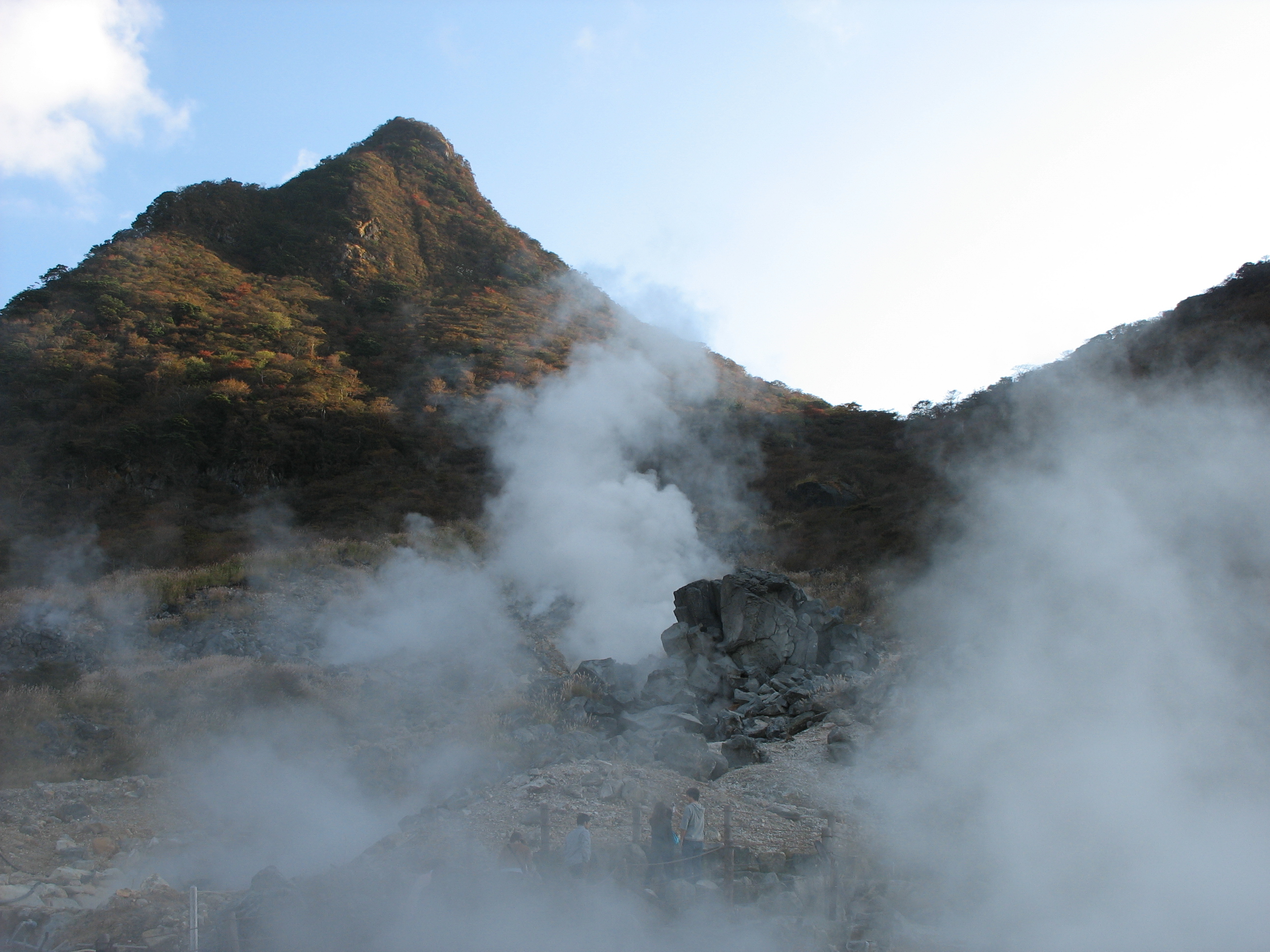
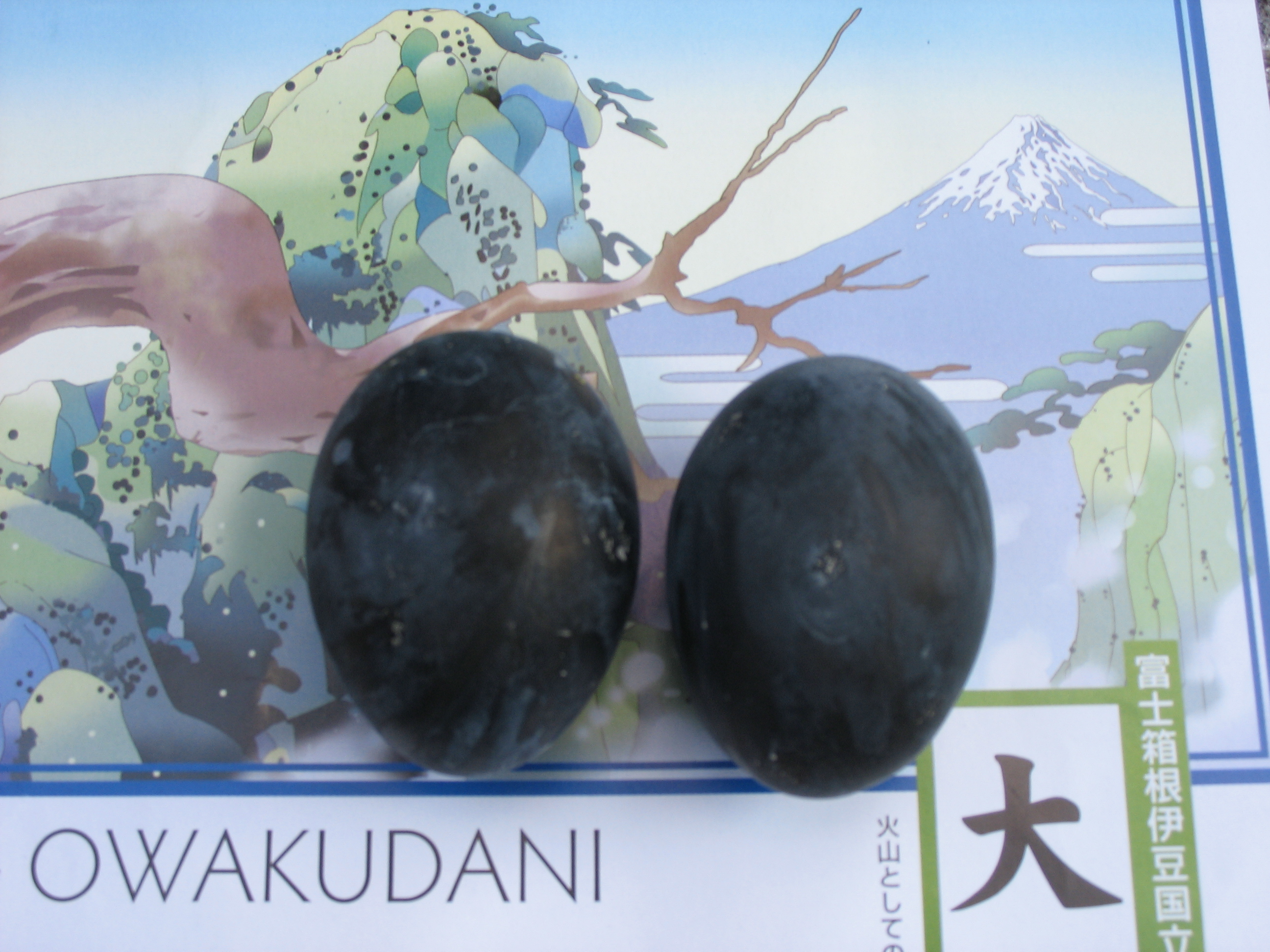
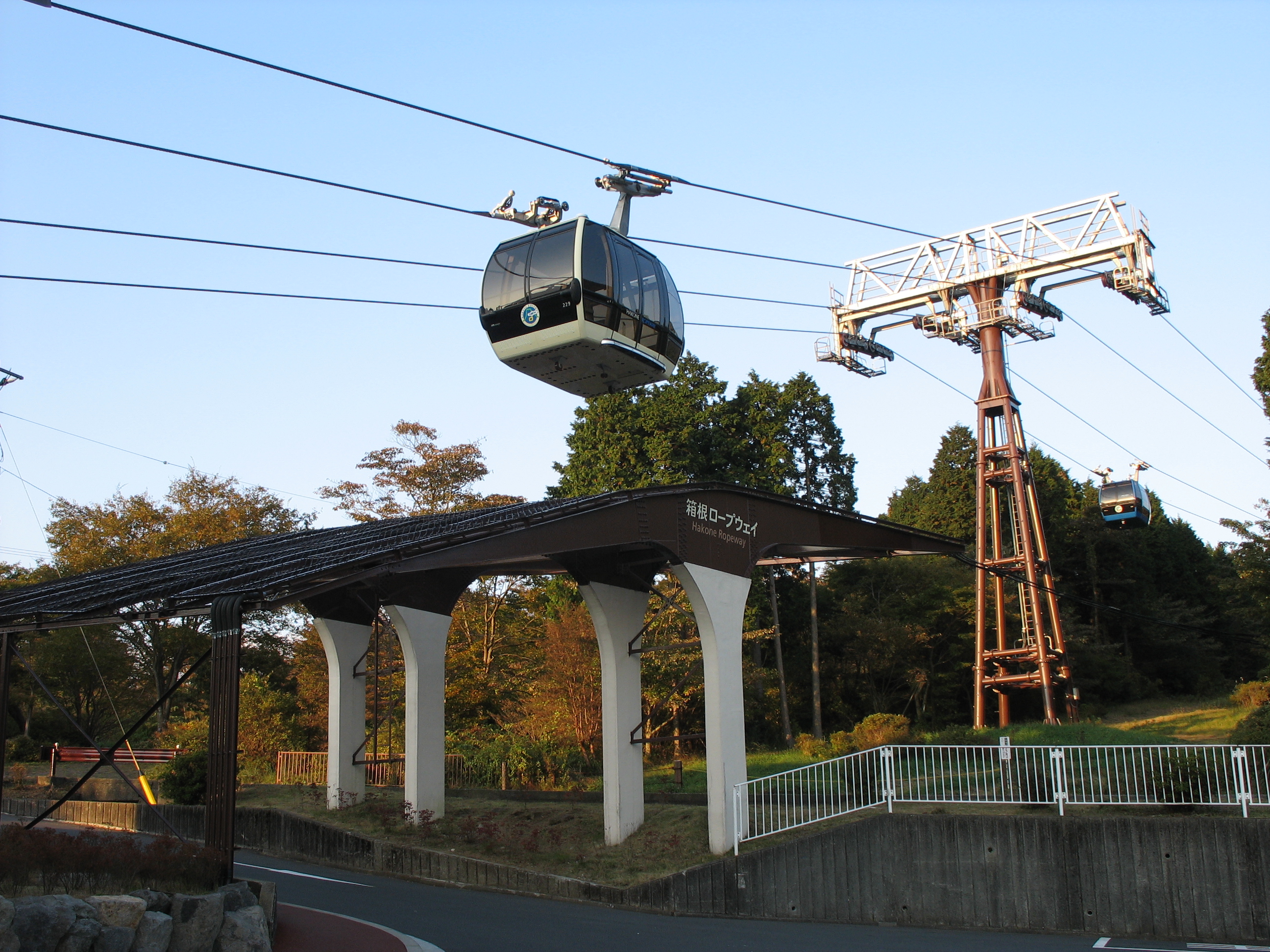
After lunch in Gora, we lined up for the 10 minute funicular, or cable railway, ride up the side of the 1153 metre high mountain, Soun-zan. Soun-zan is the starting point for what the Japanese refer to as a ropeway, a 30 minute, 4 km cable car ride to Tokendai on the shore of Lake Ashi. On the way, the gondola stops at Owakudani. On the advice of our trusty guidebook as well as some of my students, we got out there for a look around. Formed some 3000 years ago, Owakudani is a volcanic cauldron of boiling pools, bubbling mud and steam-spewing vents. What an interesting sight! Of course, we also had to sample the black boiled eggs that are sold here. According to legend, eating one of these eggs, which are cooked in the boiling mud, extends a person’s lifetime by several years. We’ve heard anywhere from four to ten! Since the eggs are sold in groups of five, I ate two and Richard had three. Since women are known to live longer than men, I decided that the extra egg might help him catch up!
After sharing most of the day with so many other travelers, imagine our surprise and delight when we headed back to the cable car and discovered no one waiting in line. We rode the rest of the way down to the lakeside in our own private gondola! From there we took a ten minute bus ride to the nearby village of Sengoku where we had reserved a room at the Fuji-Hakone Guest House, one of the few affordable places to stay in the area. A short walk in the chilly evening air, supper at a small restaurant and a soak in the guest house’s private onsen bath finished off the day.
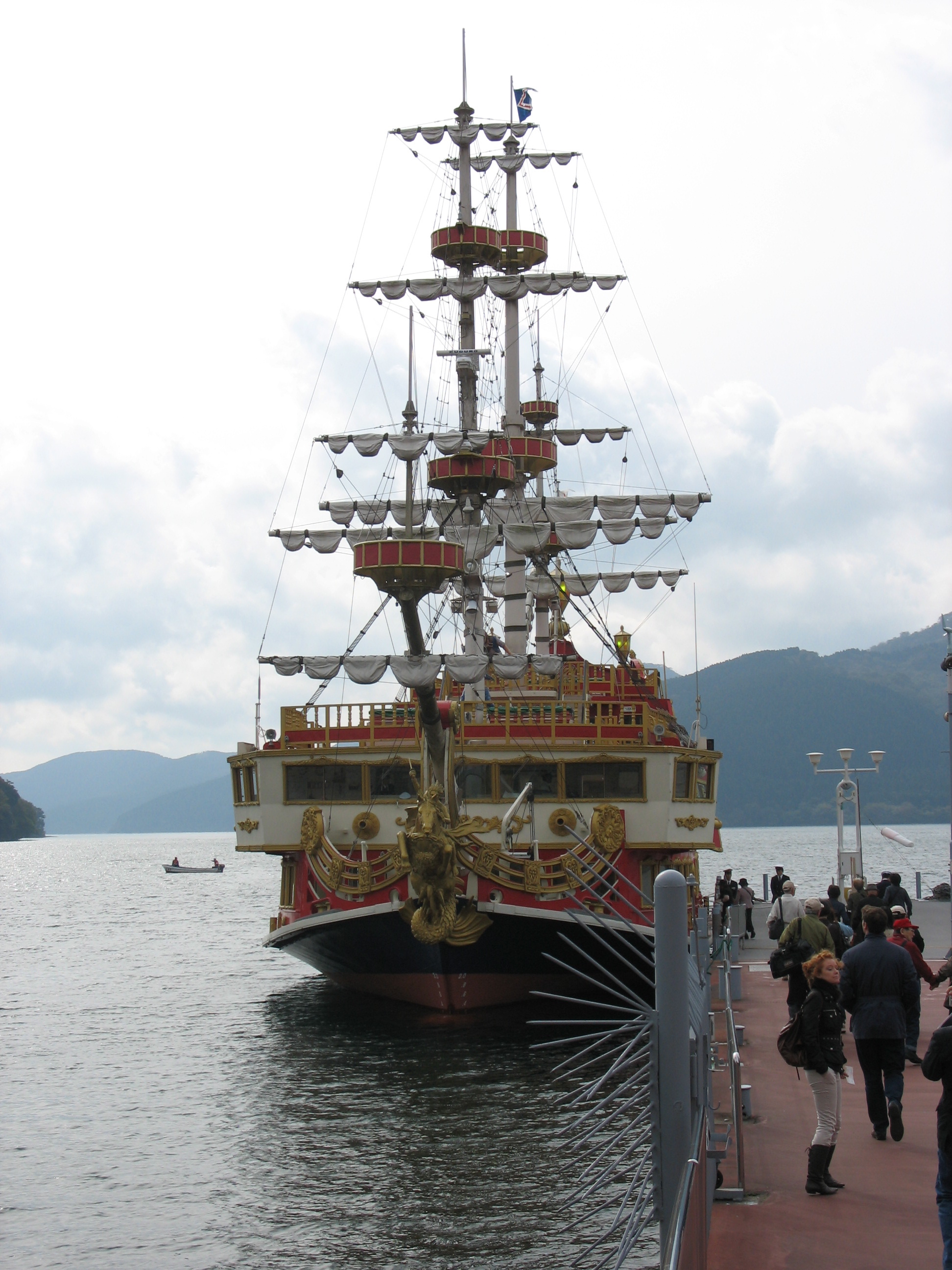
After breakfast at the guest house, we caught the bus back to the lake shore where we lined up for the next cruise to the other end of Lake Ashi. To quote the Lonely Planet, “The ‘Pirate Ship’ has to be seen to be believed – it’s tourist kitsch at it’s worst, but fun all the same.”
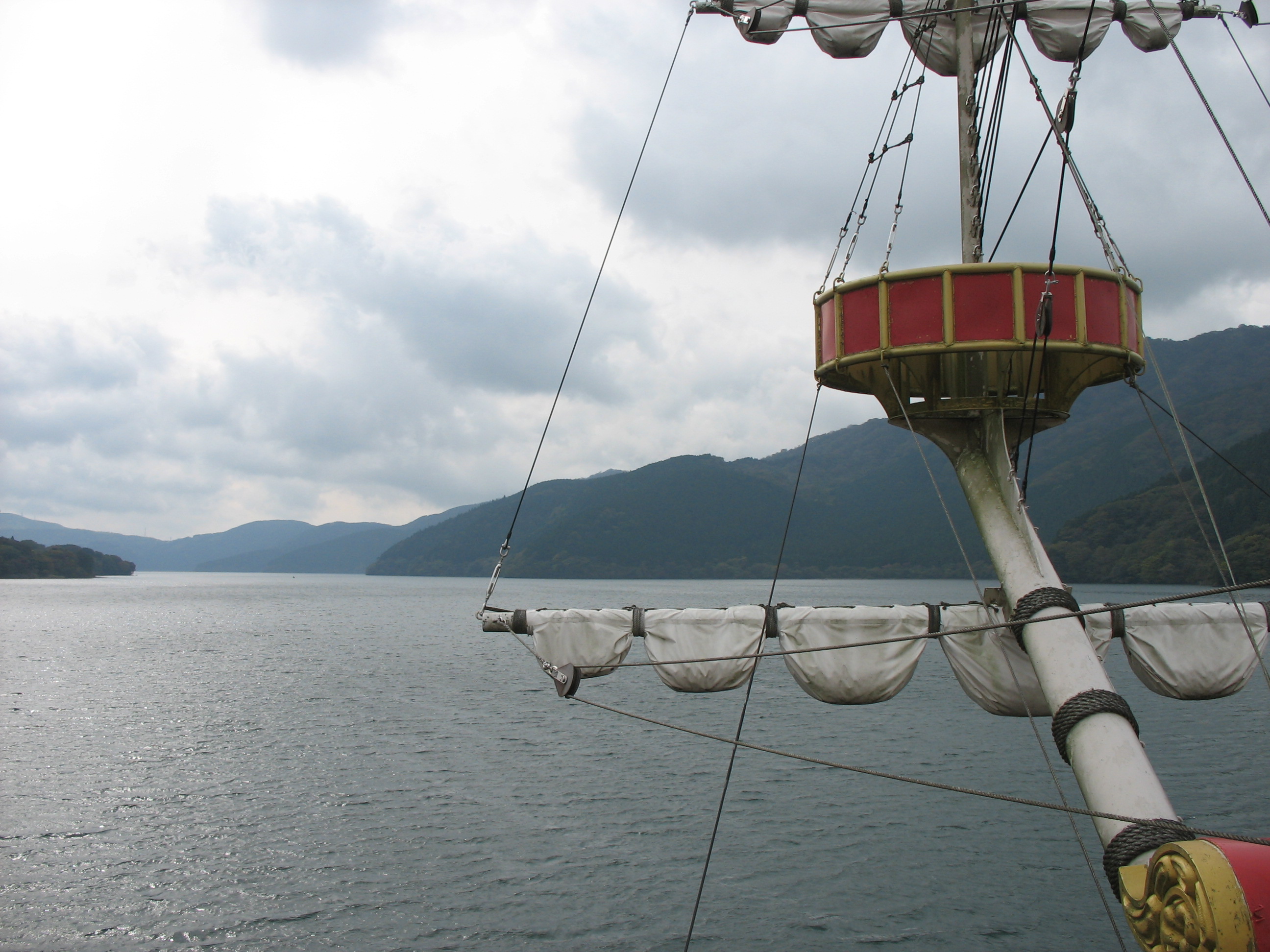
We disembarked at Moto-Hakone and there began what was for me the highlight of our trip, a four hour hike along the old Tokaido highway back to Hakone-Yumoto. Built during the Edo period, this road once linked the ancient capital city of Kyoto, with Edo, present day Tokyo. It was a strenuous hike, largely because for most of the way we were walking on the large uneven rocks that were used to pave the ancient roadway.

About an hour into our trek, we arrived at the Amazake-chaya Tea House where we stopped for a cup of herbal tea and a glass of amazake, a thick warm non-alcoholic drink made from fermented rice. The present roadway between Moto-Hakone and Hakone-Yumoto is separated from the old highway by only a few metres at this point so the tea house serves vehicle traffic as well as hikers but it hasn’t always done so. We met the proprietor, a young man who is the 13th generation of his family to own and operate the tea house! Long before the invention of the car and long before my country was settled, his ancestors were serving weary travelers in whose footsteps we were walking! The young woman who served us spoke fairly good English and, in spite of the fact that there were several other customers to be taken care of, she took the time to visit with us at some length. She took quite a liking to Richard telling us that he reminded her of Robin Williams! She was such a delight.

Continuing on, we encountered the occasional hiker along the way and passed through a couple of small villages. We could often hear traffic on the nearby roadway but for the most part, it was a very peaceful journey. The weather was cloudy and comfortably cool. Our backpacks contained only a change of clothes, the bare necessities for an overnight trip and the food and water we’d need along the trail so our loads weren’t heavy.

When we finally reached our destination, we sought out another onsen where we could soak our weary muscles. Following advice given us at the Yumoto-Hakone tourist information booth, we took a free shuttle bus to a lovely public onsen with both indoor and outdoor pools that was only a few minutes away. We had reserved seats on the 7:00 pm Romance Car back to Tokyo but after stopping for dinner, we were back at the station a little over an hour before that and were able to exchange our seats for ones on an earlier train. That got us home and into bed a little sooner than we’d expected having once again seen and experienced a different aspect of Japan.
Japan goes bananas

The latest craze to hit Japan is known as the Morning Banana Diet. This simple weight loss program involves eating only bananas for breakfast and drinking only room temperature water. With the exception of desserts, the dieter can then eat whatever they choose for lunch and dinner and may also have a snack at three o’clock in the afternoon. Dinner must be eaten before 8:00 pm and the dieter is advised to go to bed before midnight. Exercise is not emphasized as this diet is meant to be stress-free.

Obesity is rare in Japan. It seems to me, however, that Japanese people in general have a rather distorted body image. The majority of them are quite thin. In Canada, I am considered thin, maybe even skinny, but here I’m a giant of a woman! Even the young girls who are as tall as I am are much thinner. They simply have a much more delicate frame. It’s amazing how many of them consider themselves fat, however.

The society as a whole seems to be overly weight conscious. We’ve been told by several businessmen that after a certain age they are required to have an annual medical check-up which is usually performed by their company doctor. If they are found to have a waist measurement greater than 85 cm, they are diagnosed with what is known as a ‘metabolic syndrome’ and are required to go on a weight loss program.

Is it any wonder then that the banana diet has caught on to such an extent that there is actually a banana shortage in Japan? Grocery stores simply can’t keep them on their shelves. In recent weeks, Dole Japan, one of the country’s leading banana importers has increased it’s imports by more than 25% and still cannot keep up with the demand. The phenomenon leaves companies like Dole in a quandary. Fads like the banana diet tend to be short lived. Even if they could find a supplier that is able to handle the present demand, would they want to increase their orders to such an extent that they end up with a huge surplus when the demand dries up?

We have eaten a lot of bananas since coming to Japan. In general, fruit is a lot more expensive here than it is at home in Canada but bananas are one of the few exceptions. Until the diet came on the scene, we were able to buy four or five small bananas for 97 yen, less than a dollar. Interestingly, though, I had stopped eating many bananas just about the time that the diet craze began to catch on. My finicky stomach has been giving me grief again lately so I decided to cut out or down on a few of the foods that I had been eating in large quantities in case any of them were causing me problems. Fortunately, there are many other fruits available at this time of year. Oranges are ripening on the trees all around us and the deliciously sweet mandarins are back in the stores. Since they’re locally grown, they are sold at reasonable prices and with them to satisfy our need for fruit, I don’t think we’ll miss the bananas when we can’t get them.

Sawara

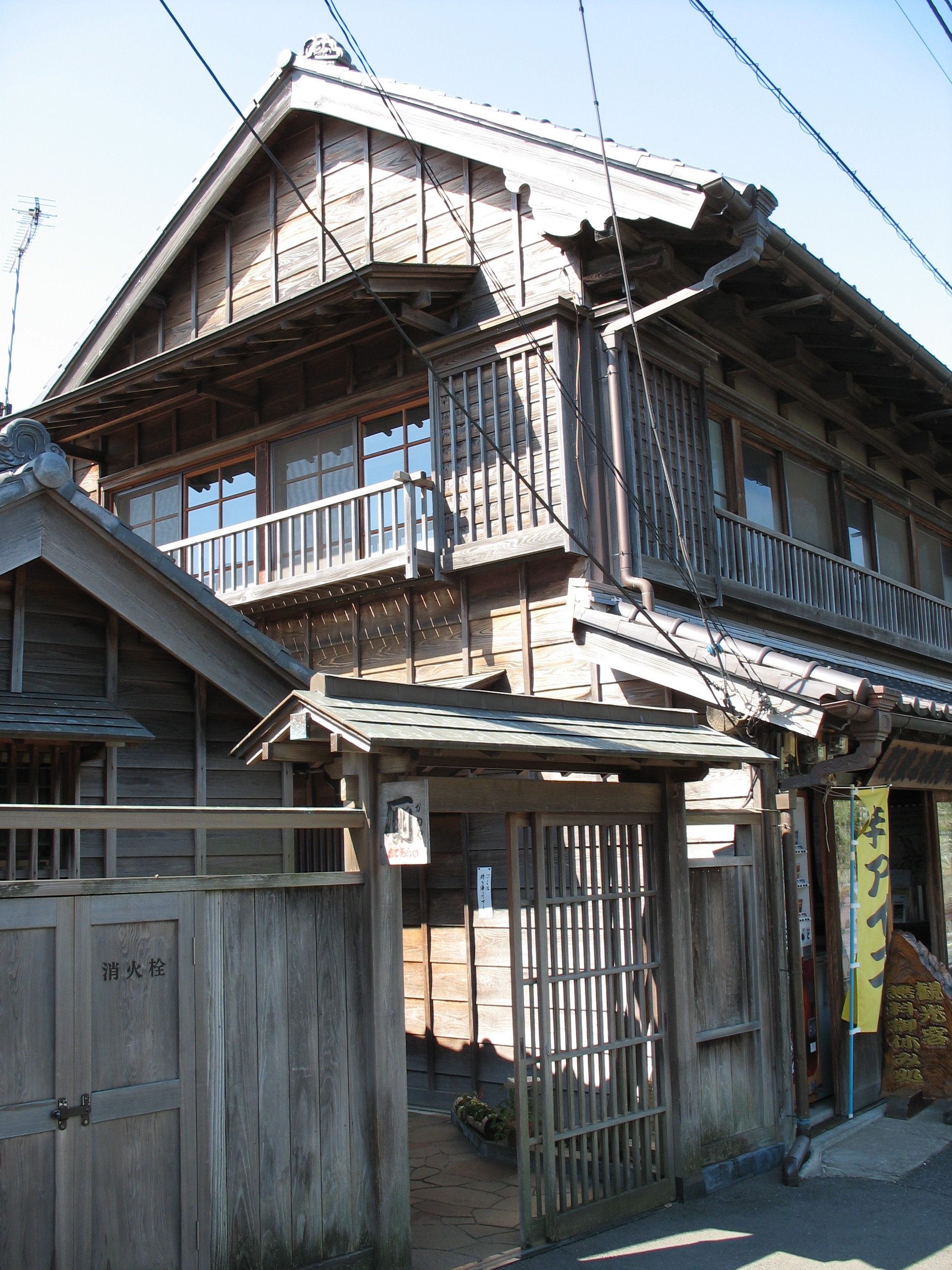
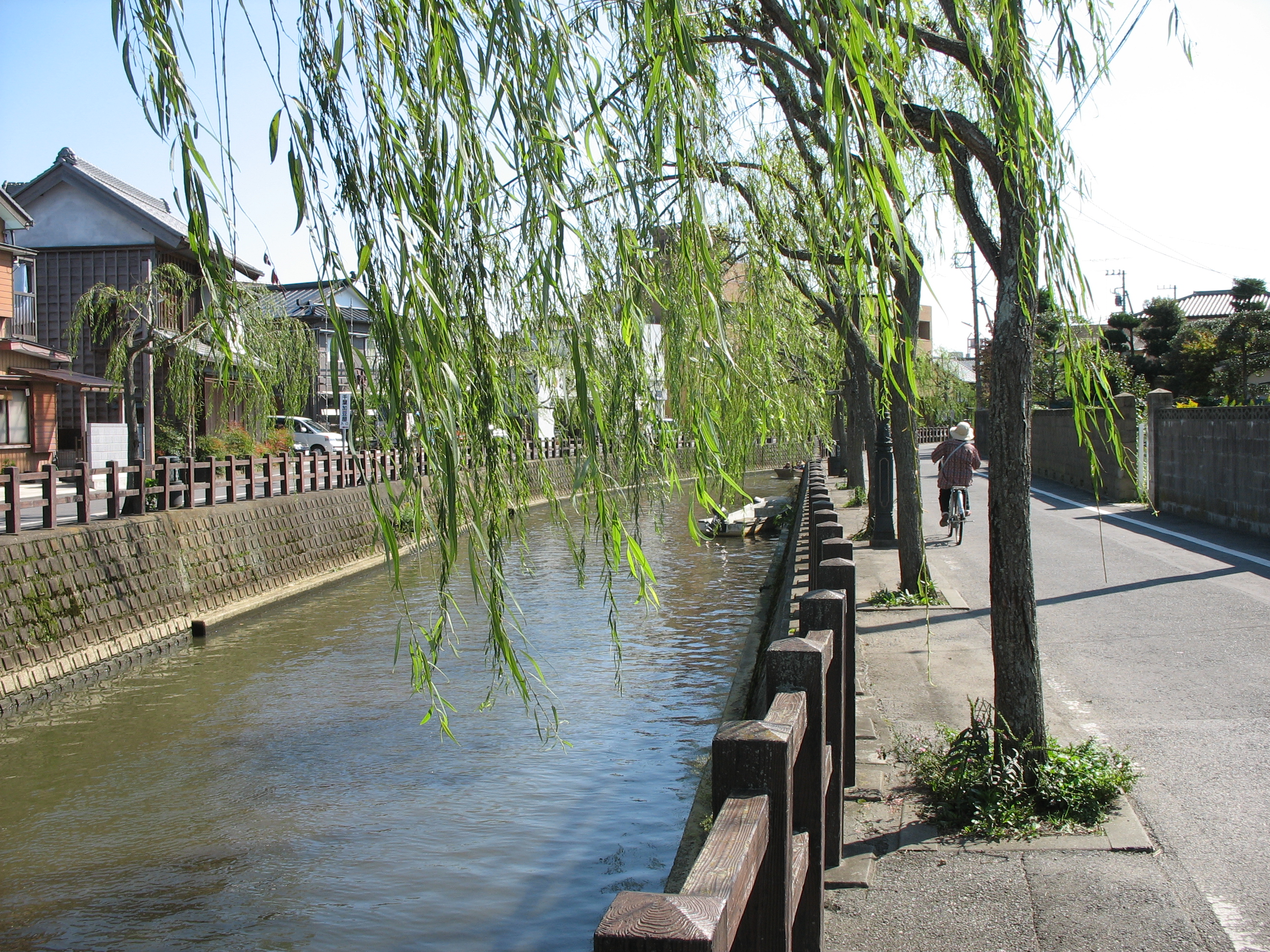
Yesterday was another beautiful October Thursday so we took a day trip to Sawara, a small town located about half an hour north of Narita by train. Sawara is considered one of the most charming towns in the greater Tokyo area. Designated a Historic District by the National Government, the central area of town, located along the Ono River, has many well-preserved merchant houses built between the early 1700’s and the 1940’s. Others that sat in a state of disrepair for many years are now in the process of being restored.

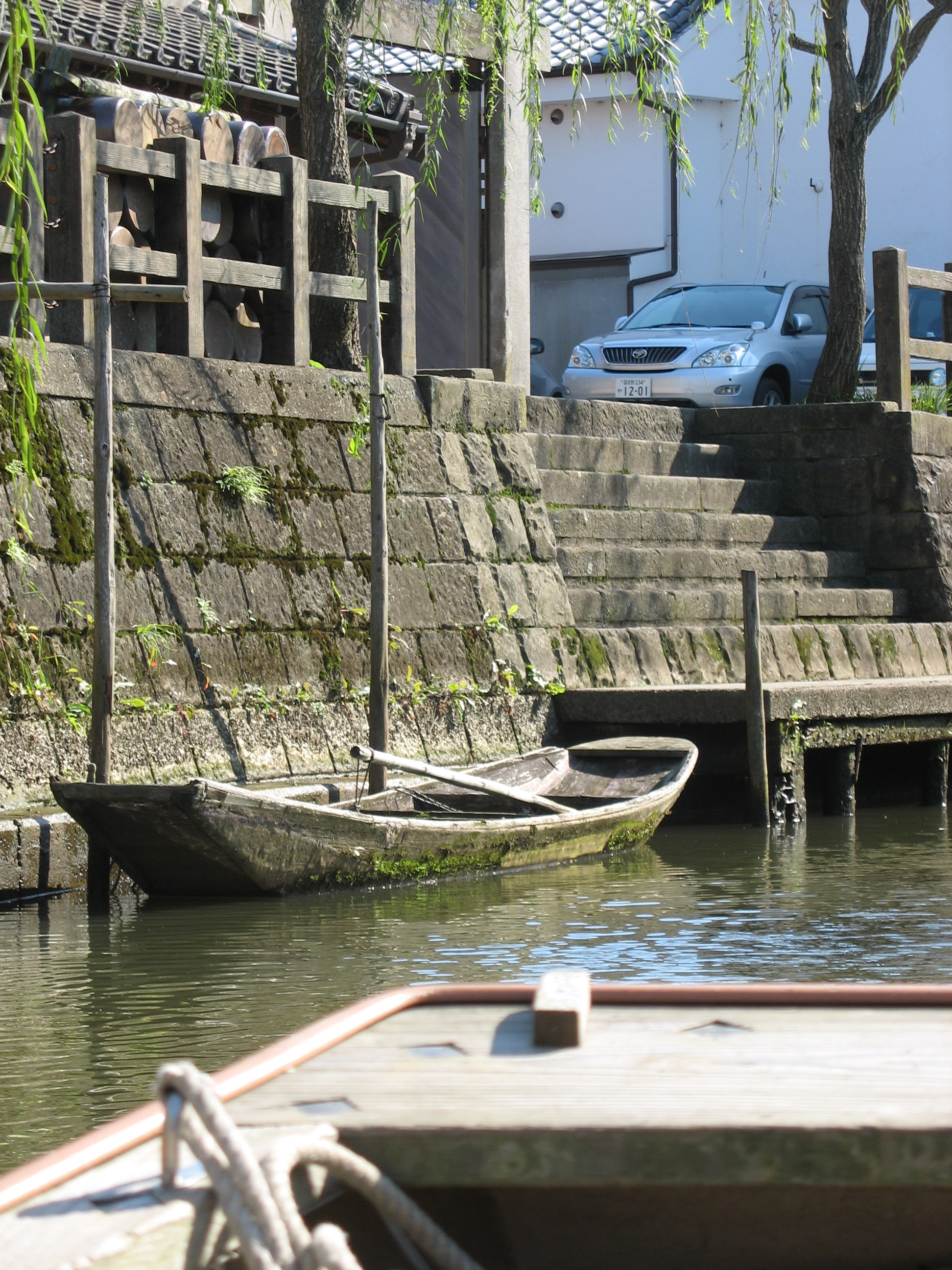
We spent the afternoon exploring this quaint district on foot and also enjoyed a 40 minute boat tour along the river. Just outside town, the Ono River feeds into the much larger Tone River. The tour took us out into the larger river before turning back toward town. From there we were able to look out across the wide open countryside that surrounds Sawara. We also enjoyed the countryside from the train. It was a delight to look out on open fields and to enjoy a big prairie sky on a beautiful sunny day!

Different places in Japan are known for certain foods and Sawara is no exception. Unagi (eel) is it’s specialty so, of course, that’s what we had for lunch. Even had we not tried it last Sunday and discovered how much we liked it, we would have had to try it in Sawara. Fortunately, we enjoyed it just as much the second time around. That still surprises us because, for some reason, we both had the mistaken impression that it would be rubbery and unpleasant. Not true at all! Grilled eel is a rich oily fish but it’s melt in your mouth tender as well as delicious.

Missing the wide open spaces

People here think they live in the countryside because we’re about an hour outside Tokyo but, in actual fact, it’s very urban.  Though I really like it here, by yesterday I was beginning to feel very hemmed in by the city.  It was definitely time to find some open space.

Even though it was our day off, I had to attend a one hour staff meeting at noon.  I could have attended the Wednesday meeting instead but I chose to spend that morning at the twice monthly ladies meeting at church.  Richard spent yesterday morning at the building site helping with the construction of our pastor’s new home.  We met back here for lunch then headed off to Sakura, a smaller town a little ways east of here.  Located fairly close to Narita, where the big international airport is located, Sakura has a number of interesting historical sites to offer but we chose to spend a couple of hours strolling through the Sakura Castle Park.  Very little of the original castle structure remains but the park is quiet and spacious, a good place to get away from the bustle of city living.  I’m very glad that so many areas of this kind have been preserved and once again, I was impressed with how green everything was.  Green will definitely be one of my lasting impressions of Japan.

After leaving the park, we wandered through part of town and as the sun set, we enjoyed the colourful lanterns that lined many of the streets.  We stopped for a relaxing supper then, ready to face the city again, we boarded the train and headed for home.

Asakusa anniversary

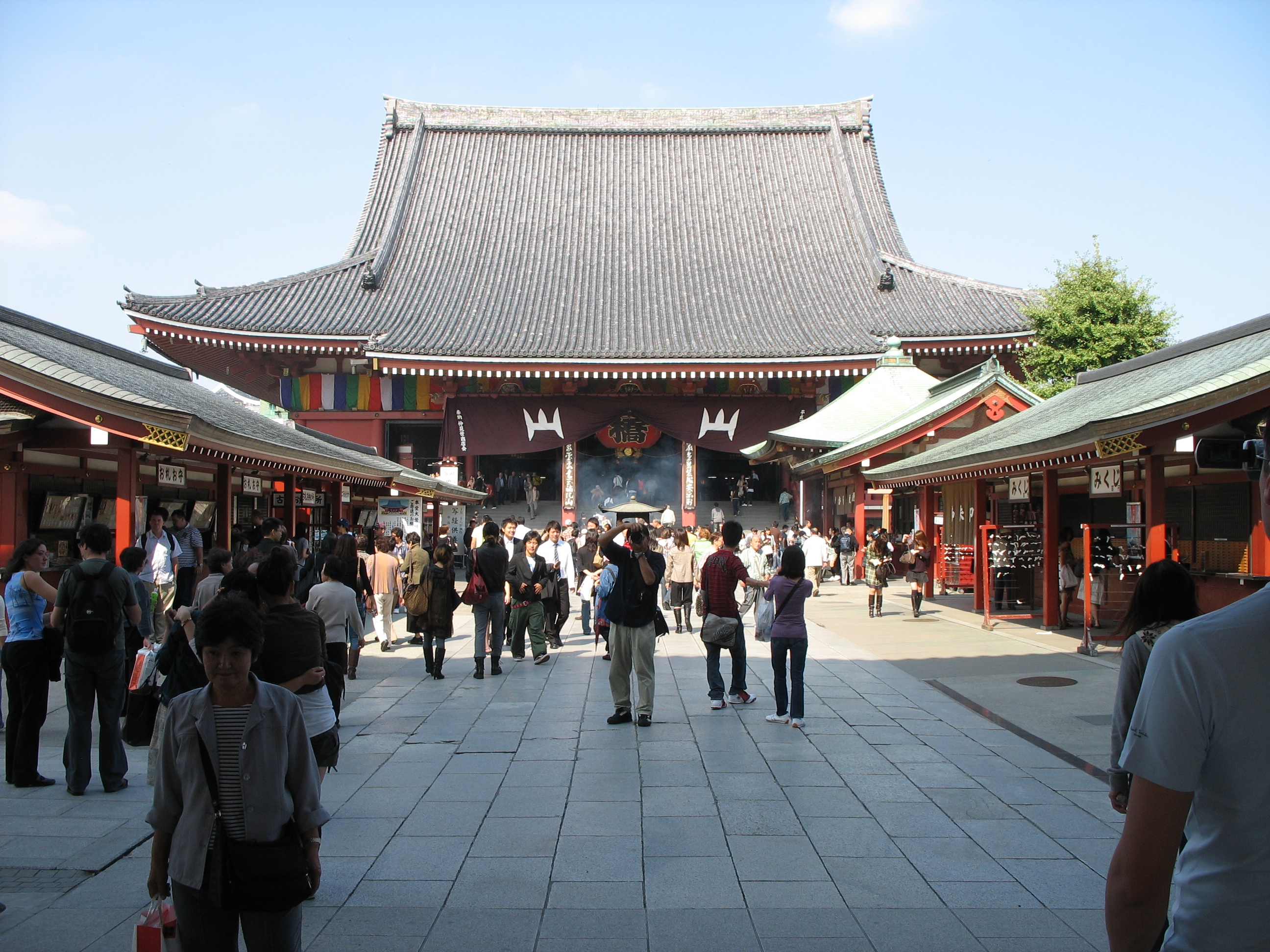
Yesterday was our 32nd wedding anniversary as well as our first weekday off together. After several days of cool rainy weather, we woke to warm sun and bright blue sky. Several of our students had urged us to visit Asakusa, said to be the heart of Tokyo’s old downtown, so after a leisurely breakfast we headed off. The main attraction in Asakusa is Senso-ji, the city’s largest temple. After having seen the temples of Kyoto, Nara and Nikko, I guess it would take an awful lot to impress us now. The temple itself, was no different from many of the others that we’ve seen but the atmosphere of the place definitely was. Clogged with tourists, a fairground spirit prevailed. Leading up to the temple is Nakamise-dori, a narrow and crowded shopping street where everything from tourist trinkets to genuine crafts are sold. Within the temple compound itself, there were more little shops and places to eat as well as a few booths with games of chance! The smell of incense permeates the place. Directly in front of the temple itself, there’s a huge incense cauldron. The smoke is said to bestow good health so visitors, worshippers and tourists alike, crowd around it and rub the smoke into their bodies through their clothes.

The main part of the temple is closed to tourists. Though it would have been nice to take a closer look, I respect that. I wouldn’t want tourists traipsing through my place of worship and in spite of the carnival like atmosphere, there are those for whom the place has great spiritual significance.

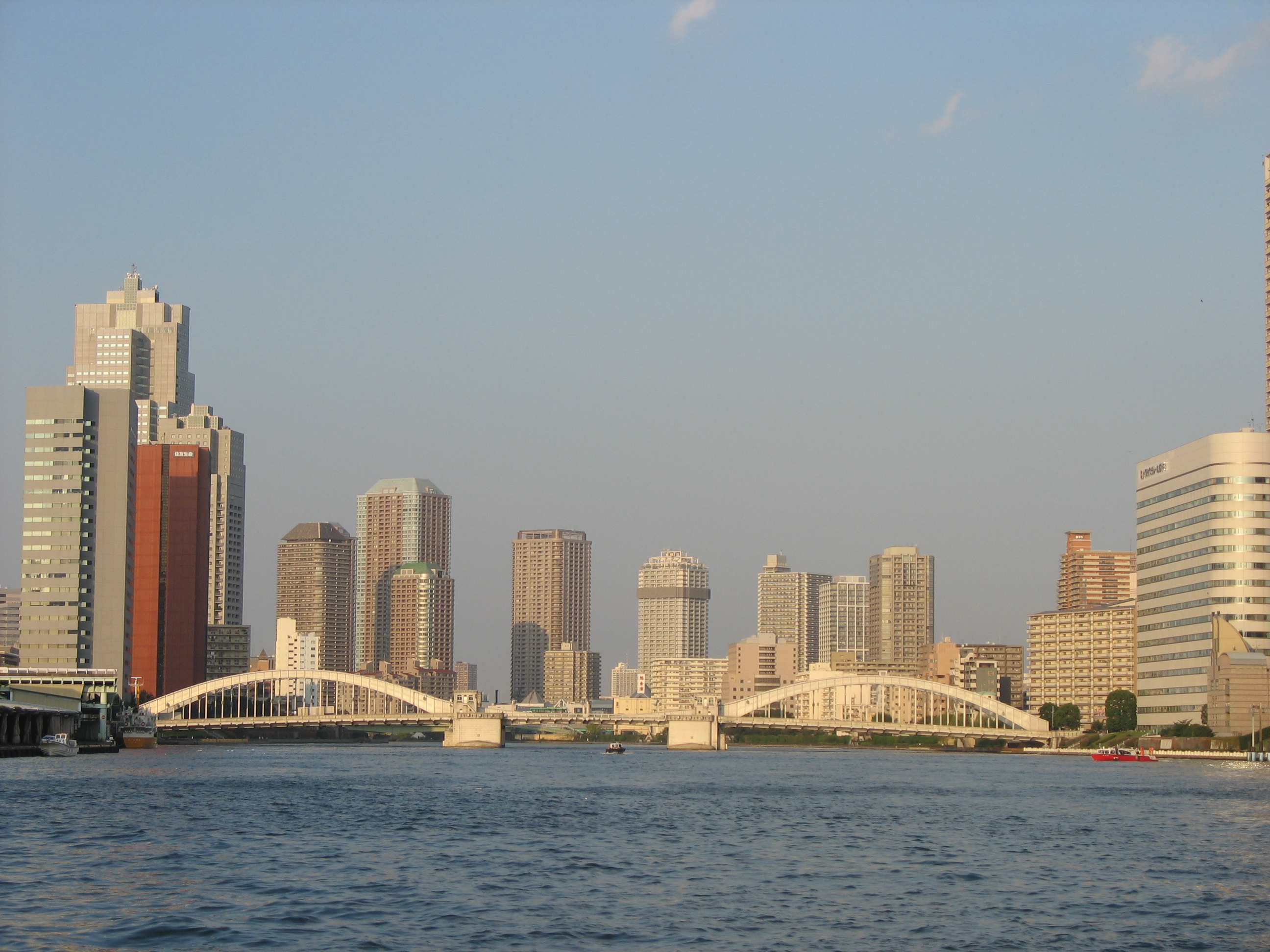
After leaving the temple, we wandered a few of Asakusa’s side streets where we found some interesting little shops and had a delicious lunch. After strolling the promenade along the Sumida River and observing that this is obviously where some of Tokyo’s homeless hang out, we took a water bus to Hamarikyu gardens. The 35 minute boat ride wasn’t the most scenic of cruises but it was a relaxing way to travel from one part of the city to another and it allowed us to enjoy some different views of the city.

We spent the late afternoon strolling through beautiful Hamarikyu-teien, also known as the Detached Palace Garden. Historically it belonged the ruling family. I may have seen enough temples to last me a lifetime, but I don’t think I’ll ever tire of beautiful Japanese gardens!

The garden is about a 10 minute walk from Ginza. Rather than catching a crowded train toward home as the workday came to an end, we decided to spend some time wandering around that area again and hopefully catch a less crowded train a little later. Sounds wise, but it wasn’t! A couple of hours later, the trains were still packed. We had to stand all the way back from Tokyo and were literally packed in like sardines. It didn’t help that we were given wrong directions at the Ginza station and ended up taking a bit of a roundabout way home!

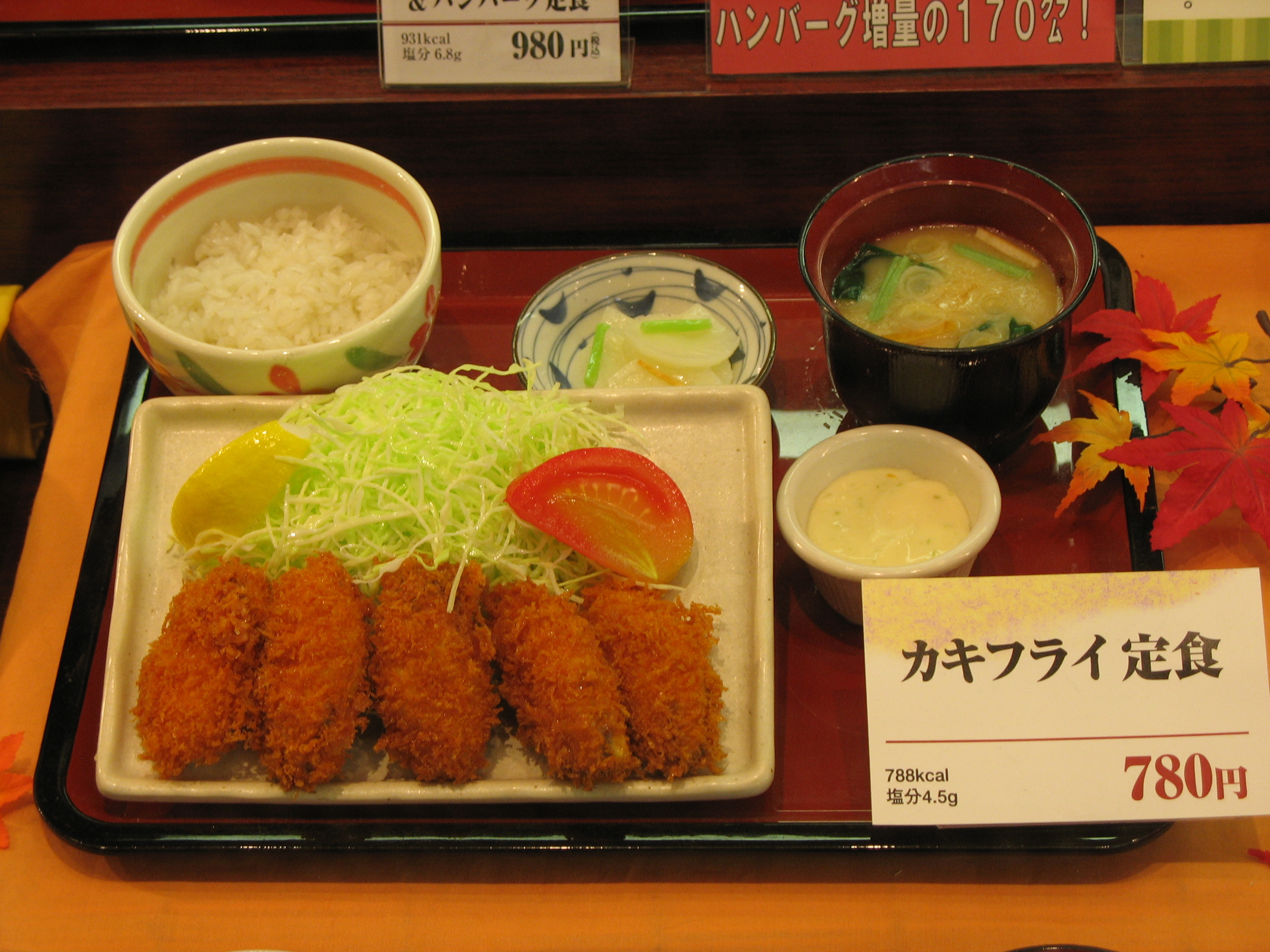
Once we were back in familiar territory, we stopped for dinner. Even though many restaurants have plastic replicas of their dishes on display, there are sometimes surprises when you can’t read the menu. What I thought was fish because I could see that it was served with tartar sauce, turned out to be breaded oysters! I have studiously avoided eating oysters since my father introduced me to eating them raw on the beach in front of our oceanside home some fifty years ago, but I was pleasantly surprised to find that these were delicious!

Lovin’ my toe socks!

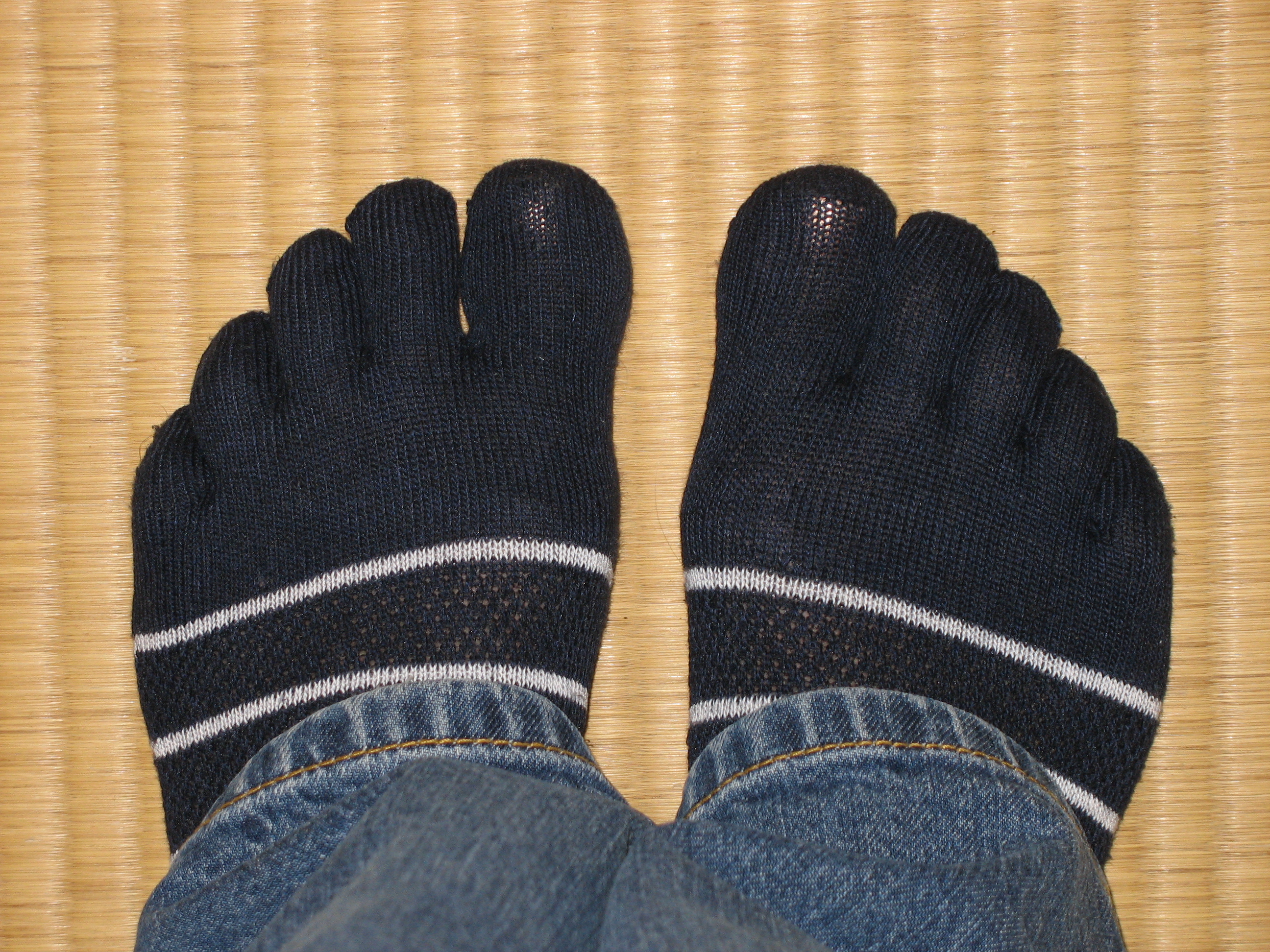
In keeping with my desire to try all things Japanese, it was essential that I buy a pair of toe socks. These are very popular here and I’d been assured by my kids, who were introduced to them when Matt and Robin lived in Japan, that they are very comfortable. I recently found a cute pair in the 100 yen department of one of our local stores and decided that that was a good opportunity to give them a try. If I didn’t like them, I’d only be out a dollar. After wearing them for the past several hours, I can only say that I’ll be shopping for more! They are indeed comfortable as well as warm which will be especially nice as the days get cooler.

I assume that the style is an adaptation of the traditional tabi, ankle socks with a separation between the big toe and the other toes that are worn with the thonged footwear that both men and women wear with kimono and other traditional clothing.

In addition to both types of split toe socks, we often see jika-tabi which are heavy duty rubber soled shoes with a separation between the big toe and the other toes. These are most commonly navy blue and are usually worn by workmen but Matthew was able to buy a colourful designer pair on his recent trip to Japan.

Okonomiyaki

Hours after landing arriving in Japan the first time, back in 2005, we were introduced to okonomiyaki, a delicious Japanese pancake-like meal. Kansai is the geographic region surrounding the cities of Kyoto and Osaka and okonomiyaki is a Kansai area specialty. We were visiting Matt and Robin at the time and ate it in a tiny restaurant in their Osaka neighbourhood. We live in the Kanto region, however, where good okonomiyaki is not easily found. Hence, the need to learn to make it.

Recently, the students in one of Richard’s adult classes had a homework assignment that required them to translate favourite recipes into English and bring them to class. Two ladies brought recipes for okonomiyaki! I also had a cookbook recipe. Using these three recipes, I created one of my own and tried it out yesterday.

The first challenge was shopping for the ingredients. Okonomiyaki calls for flour. Since I don’t have an oven here, I can’t bake and hadn’t looked for flour before. I hoped I wouldn’t have to buy a big bag as the recipe only calls for half a cup. Silly me! I should know by now that nothing, except rice, comes in big packages in Japan! Milk is sold in 1 litre cartons, carrots 3 to a bag, potatoes 4 or 5 to a bag, and the biggest package of cereal on the Seiyu shelves is 435 g. After searching and finally locating the flour, I was delighted to find that it only comes in 1 kg bags!

I was very excited to learn that, while most okonomiyaki recipes call for Chinese yam, a potato makes a good substitute. I could probably get Chinese yam here if I was able to identify it from amongst the many unknown items in the produce department but I definitely want to be able to make okonomiyaki back home in Canada and I can easily get potatoes in the Sedgewick Coop! Whether using yam or potato, the secret is to use a grater that turns it to mush.

I am very happy to report that my first attempt at making okonomiyaki in Japan was a great success! It was simple and delicious. And so, without further ado, here’s my recipe:

Ingredients (serves 2)

  • 1 small potato, peeled and grated
  • 2 eggs
  • 100 g (1/2 Japanese cup or 2/5 American cup) flour
  • 1/4 cabbage, chopped
  • 100 g pork, thinly sliced
  • red pickled ginger to taste, chopped fine

Directions

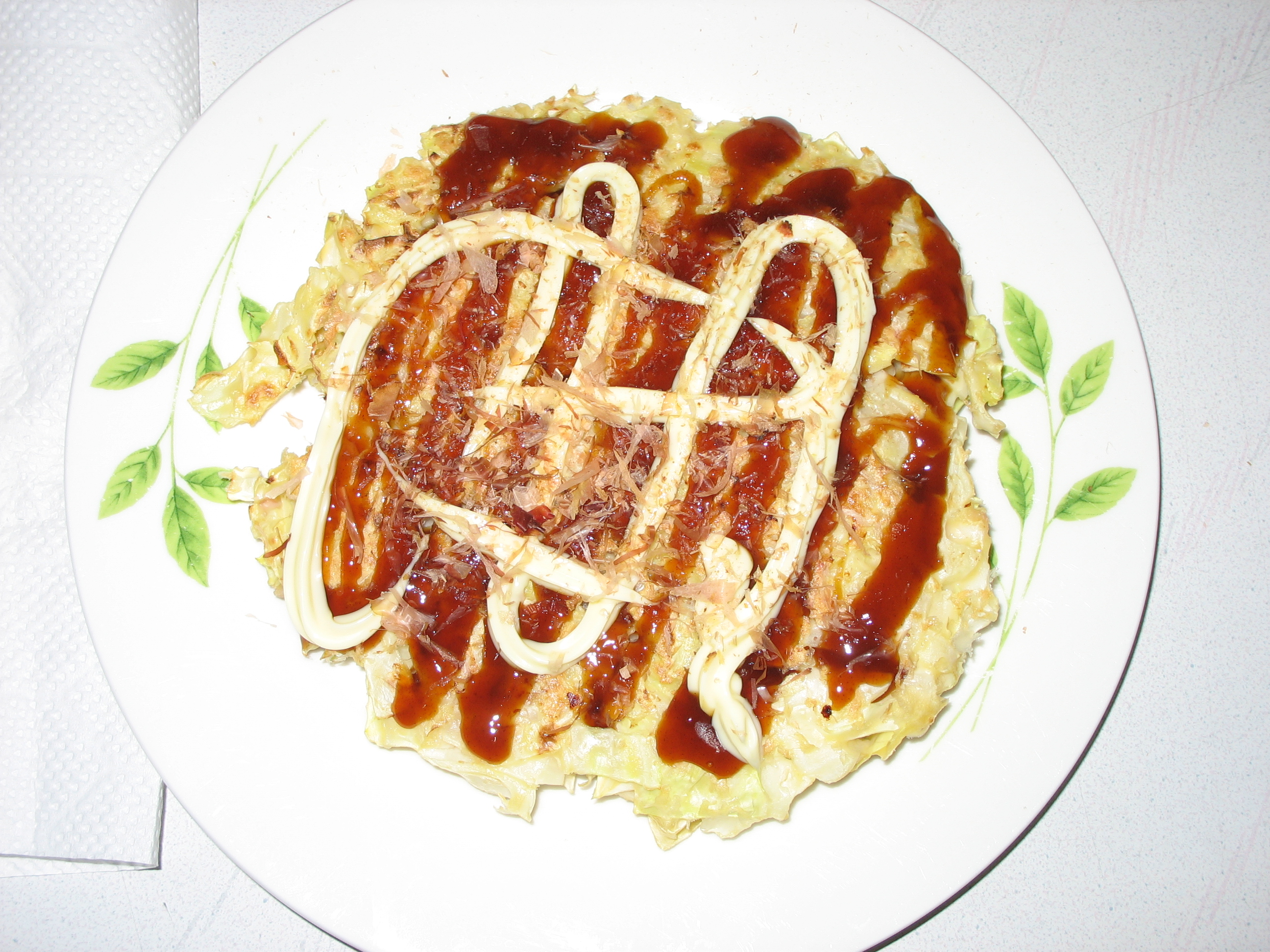
Place the potato, eggs and flour in a large bowl and mix well to form a thick batter. Cut some of the pork into small pieces keeping 4 slices aside. Add the cabbage, cut pork and ginger to the batter. Mix until ingredients are well coated. Form 2 large pancakes. Top each with two slices of pork and cook in a hot pan or on a griddle. Turn over after 3 minutes and cook for 5 minutes. Turn again and cook for 5 more minutes. Turn once more, cooking for 3 minutes. Spread with okonomiyaki sauce (thick Japanese style Worcester sauce) and mayonnaise and sprinkle with dried bonito (fish) flakes.

Variations

Additional fillings such as shrimp or cheese may be added.

Okonomiyaki before toppings

Okonomiyaki before toppings

with toppings

with toppings

Keiro no hi

Today is a national holiday in Japan known as Keiro no hi or Respect for the Aged day. Regular schools and many businesses close but it’s work as usual for us. Because our schedule is designed to ensure that each class meets the same number of times over the course of a year, we’ll have a different day off in lieu.

I suppose I should have done my research sooner and been in touch with our wee grandson to let him know that this is a day when children present their grandparents with gifts! Sometimes they just send them messages, however, wishing them good health and long life. We did receive a message from Drew a few days ago. I had a little difficulty interpreting it but maybe that’s what he meant! It looked like this:

z7dc0orbov ccccccccccccccccccccpksxVvvvvvvvvvvvvvvvvvvvvvpcpoJc09 //.;;;;B VRD5GGGGGGGGGGGGGGG

As you can see below, the little man loves the computer. His training began early.

Schools sometimes host special events in honour of the students’ grandparents for Keiro ni ho. I’m assuming that our local elementary school did something of that nature yesterday as we noticed many neighbours of grandparent age heading in that direction between 9:30 and 10:00 in the morning.

Tatami

I really like the traditional Japanese floor covering known as tatami. There are three parts to each tatami mat; the tightly woven rush cover, a soft core that was traditionally made of rice straw but is often made of synthetic material today, and a decorative cloth edging that is most often a green brocade. Each mat is a standard size, approximately 90 x 180 cm. Except during a period of mourning, tatami mats are never laid in a simple grid pattern. Since it’s considered bad luck to allow three or more mat corners to meet, they’re always laid in interesting patterns.

Tatami provides at least as much cushioning as carpet, making it a comfortable floor to sit on and providing extra padding under the futon mats that we sleep on. I also exercise on the tatami every morning and find that it provides all the padding I need. Tatami is also thought to have a number of health benefits. Apparently, it absorbs both heat and humidity, a definite plus in this climate. The natural smell is said to relax the body and soothe the mind. This smell, which is really quite pleasant, is most noticeable when the tatami is new.

Tatami is amazingly easy to keep clean. It just needs to be vacuumed regularly and if anything does spill on it, it beads up and can be wiped away without leaving a mark.

Given all of the above, what’s not to like about tatami? My only complaint is that it harbours insects! Last spring, when my friend, Seiko, and I went shopping for the various products needed to prevent or do battle with moths, mold and cockroaches, she warned me about this problem and showed me what to buy if we found we needed it. If you start to notice insect bites that you can’t explain, she told me, they’re likely living in your tatami! We’ve managed to live through the rainy season and most of the hot, humid summer without encountering a cockroach but I did begin to notice itchy bites awhile back. We purchased the spray which comes in a can with a pin-like nozzle that is pushed down into the tatami mat to deliver the poison to the inner portion of the mat. We treated the entire tatami room and hoped for the best.

Shortly after our return from Korea, however, I began to notice new bites appearing. Once again, Richard gave the tatami room a thorough spraying. Imagine my disgust a little while later when I noticed that the centre mat was littered with dead and dying insects that had crawled out of the matting to escape the poison! I had heard these insects referred to as fleas or ticks so I had visualized tiny flea-like critters but these were winged insects about the size of a mosquito. Some were considerably bigger and they’d been biting me during the night! How gross! Richard vacuumed them up and decided to treat the centre of the room a second time just in case we hadn’t massacred the entire population yet. That was several days ago. This morning, he’s just finished treating the room once again and we intend to keep this up on a regular basis for a little while just in case there are more nasties hatching out below the surface.

While we’re on the topic of insects, there are plenty of unusual ones here in Japan. Some time back, I blogged about the tiny moths that had taken up residence in our bathroom. Once Richard figured out how to remove the panel in front of the bathtub and cleaned out the buildup of hair and slime under there, we were rid of those.  The sink and tub both drain into that area and the moths must have been breeding in the dampness.  (Have I mentioned how blessed I am to have a husband who does housework?)

We’ve also been entertained all summer by the loud high-pitched sound of the cicadas, gigantic locust-like insects that inhabit the trees all around us.  Not all the insects here are as obnoxious, however.  We also have butterflies that are literally the size of small birds!  How beautiful!

Umi No Hi

Today is a national holiday in Japan. Known as Ocean’s Day or Day of the Sea, the holiday was established in 1995 and first celebrated in 1996 because, until that time, there were no public holidays between May and August and the government felt that workers needed a break. Because Japan is an island nation, it was decided that this would be a day of gratitude for the blessings of the sea and a day to hope for the continued prosperity of the country. It always falls on the third Monday of July.

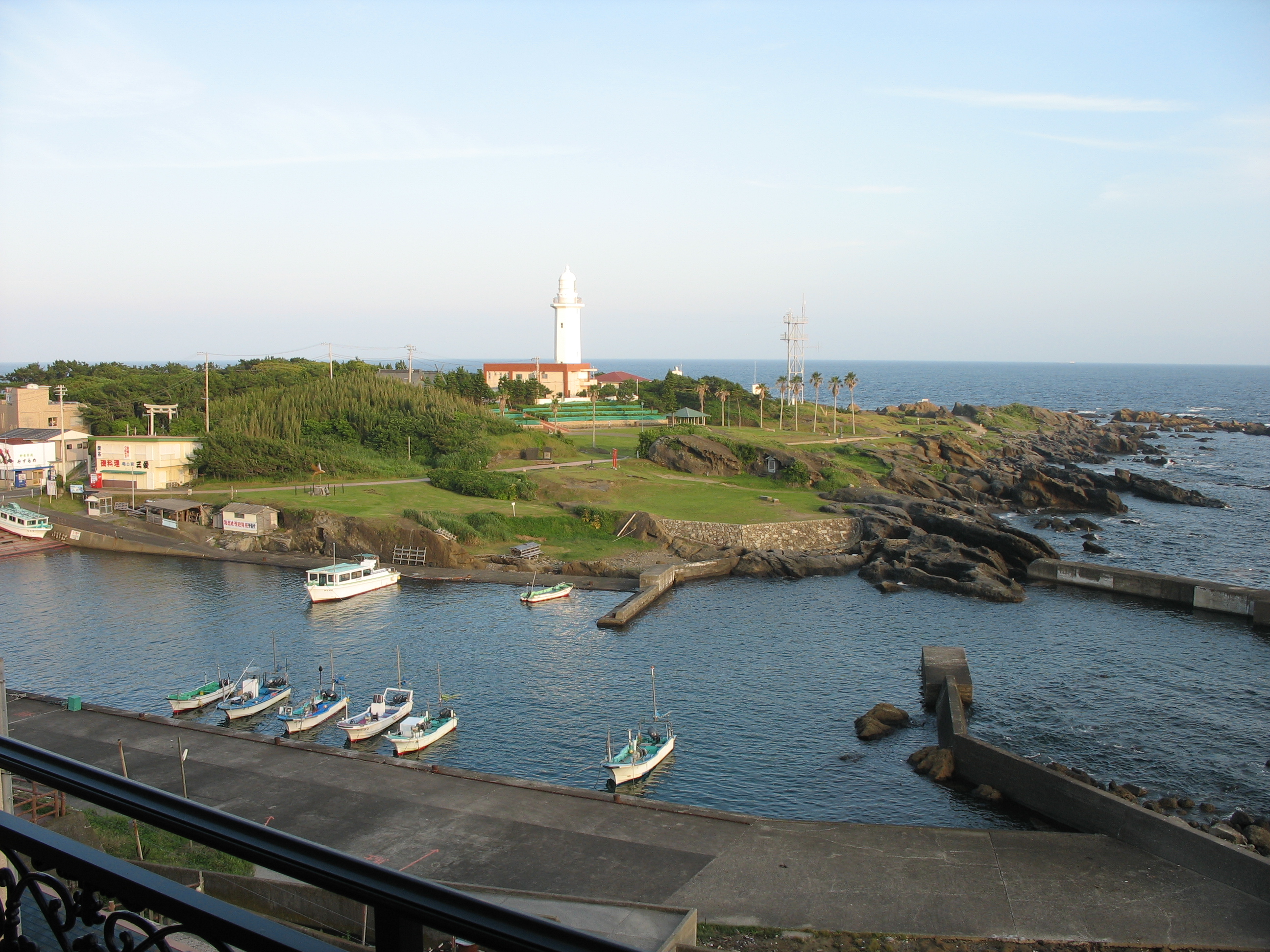
Though many have already taken advantage of the beaches by this time, today is also the day that they officially open for the summer season and many people will spend the day at the beach. Unfortunately, though I would love to be one of them, our schools are open today and I’ll be in the classroom instead. For me, it will have to be a day of remembering the beauty of the ocean and reminiscing about my recent coastal experience at Nojimazaki.