In North America, we talk about going up north and down south, but in Israel people go up to Jerusalem regardless of what direction they’re coming from. With an elevation change of almost 1200 metres between the Dead Sea and Jerusalem, we definitely went up to our final destination! On the way, we stopped at Masada, Herod the Great’s luxurious mountaintop palace and fortress which was declared a UNESCO World Heritage Site in 2001.
Stepping off the cable car that carried us to the top, I was amazed by the sheer magnitude of the place that overlooks the bleak Judean Desert. A sophisticated water system that collected and stored run-off water allowed this barren, isolated hilltop to be transformed into a lavish royal retreat.


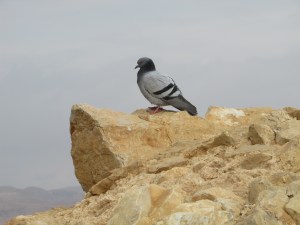
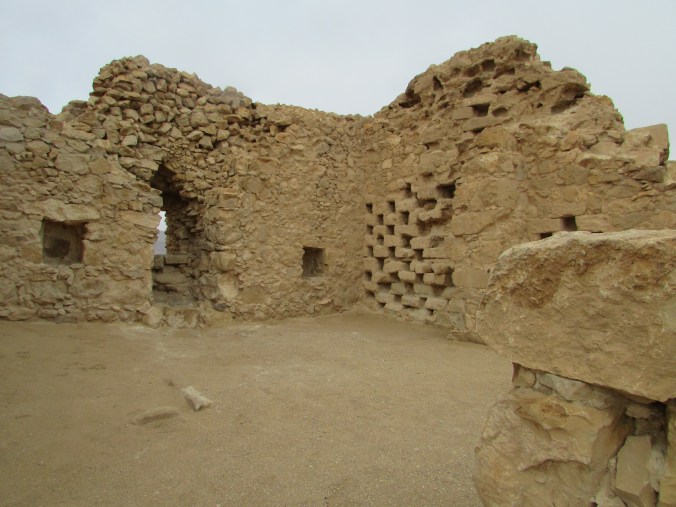
The niches in the wall in the following photo are part of the columbarium which housed hundreds of pigeons raised for their droppings which provided fertilizer for growing food.
The synagogue on Masada is one of the oldest in Israel and is often used for Bar and Bat Mitzvah ceremonies today.

Masada was also the location of the last stand of Jewish rebels against Rome in 73 AD. For three years following the destruction of the holy temple in Jerusalem in 70 AD, 960 men, women and children lived inside the walls and managed to keep the Romans off the mountain. Finally, however, the Romans decided to put an end to this last pocket of resistance. Fifteen long storerooms built by Herod were filled with food and other provisions, however, making it impossible to starve the rebels.
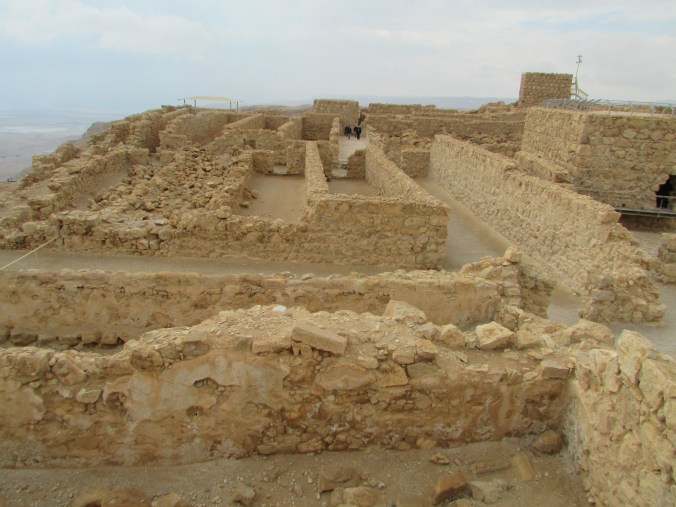
When that didn’t work they built an enormous ramp and moved their war machines into place. Realizing that they could hold out no longer, the brave defenders chose death over capture and slavery. Under the leadership of Eleazar Ben-Yair, the men killed their wives and children. Lots were then drawn and ten men were chosen to execute the rest. At the end, one man killed the other nine and then took his own life. It is thought that this was probably Ben-Yair. This way, only one man was guilty of committing suicide which is forbidden by Jewish law. In a historic find during excavations on the mountain, potsherds were found bearing the names of the ten men.

The siege ramp
The fortress affords spectacular views of the surrounding desert. In the following photo, notice to the left the outline of one of the eight Roman siege camps that surrounded Masada.

The tragic story of Masada was the basis of an epic 1981 mini series. I’m glad that I didn’t see the Hollywood version before our visit to the site, but now I think I would like to.









 Following Augustine