My love/hate relationship with Chinese food

Simply said, Chinese food is delicious! Absolutely delicious! In the past three months, I can only recall one dish that we didn’t enjoy. It looked tasty and there was nothing wrong with the flavour but it consisted mainly of gristle on bone. We didn’t know for sure what it was but we called it knuckles because that’s what it most resembled!

There are a myriad of tiny restaurants within a few blocks of our apartment where we can easily buy a meal for the two of us for significantly less than $10. If we weren’t as health conscious as we are, it would be easy to eat out even more often than we do, especially considering the limited cooking facilities we have here at home.

China is a huge country, of course, and cuisine varies from one region to another but in general, a Chinese diet is heavy on rice and noodles. We do our best to balance the carbs with healthy amounts of meat and vegetables but there’s not a lot we can do about the fact that almost everything seems to be cooked in oil.

I know that there are healthy and not so healthy cooking oils but then there’s Chinese cooking oil! The following is a direct quote from our trusty Lonely Planet guidebook. Be forewarned! If you have a delicate stomach, you may not want to read it!

"In 2010, diners in China were appalled to discover that one in 10 meals cooked in Chinese restaurants was prepared with cooking oil dredged up from sewers and drains. Oil is lavishly employed in Chinese cooking and generates considerable waste.

This waste oil is harvested by night soil collectors who scoop out the solidified oil from drains near restaurants and sell it. The oil is then processed, sold to restaurant owners and it re-enters the food chain…

Once used again, there is nothing to stop the waste oil from being harvested afresh for further recycling. At present, no regulations preventing the recycling of waste oil exist in China."

Yum!

Food scandals abound in China. A couple of them have made headlines in China Daily, the English language newspaper that we read regularly. Several food stores in Shanghai have been temporarily or permanently shut down for selling fake mutton made from fox, mink and rat meat! We’re a long way from Shanghai and I don’t care much for mutton so we’re not likely to be affected by that one.

We watched with great interest when a restaurant below our window underwent a complete makeover recently and we looked forward to stopping in for a meal when it opened for business. Even after one of our students told us that the sign indicated that it served "everything from a sheep" we thought we’d give it a try but they lost me with the severed goat’s head! It was on display on a table out front one morning when I visited the street market and it remained there all day! Though I was tempted to take a picture, I didn’t, so you’re spared that gruesome sight! It seems to have been effective advertising though. The restaurant has been doing such a booming business that they’ve erected some temporary shelters on the sidewalk across the street and serve their overflow customers there. When we go to bed at night, there are still patrons enjoying whatever it is that they serve!

Then there’s the tainted rice scandal that hit Guangdong province recently. An inspection campaign found that the cadmium levels in six batches of rice and two batches of rice noodles produced in two different factories exceeded national standards. Cadmium is a carcinogenic substance often used in fertilizer. Fortunately, no cadmium poisonings have been reported.

Armed with this kind of information, how can we stand to eat at all? It’s easy… as I said, the food is absolutely delicious and miraculously, my somewhat finicky stomach hasn’t bothered me a bit since we arrived in China! If we are what we eat, I guess we’re a little bit gross right now but I keep telling myself that we’re only here short term and that our bodies will clean themselves out when we get home.

Yes, I definitely have a love/hate relationship with Chinese food!

Second wind

A few days ago, I was ready to write a post called Growing Weary but it didn’t happen because I was too tired to write it! It’s probably just as well as I would likely have grumbled and complained unnecessarily.

We don’t, even for a moment, regret coming here. It’s been a fabulous experience and very good for both of us but living in a completely foreign environment where you don’t understand the language or the culture can be exhausting. China is a rapidly developing country where we see change happening all around us but the standard of living is still far below what we’re accustomed to and it’s easy to start finding fault, especially when you’re tired.

I had three goals for this month:

  • Complete and submit the annual reports that are required of me as Missions President for my church back home, a position that I’ve been filling from a distance since coming here in February.
  • Make up the final exams for my university courses.
  • Plan the trip that we want to make through China after our contract expires at the end of June and make arrangements for our return trip to Canada.

The past couple of weeks flew by as I fought with our frustratingly slow and undependable internet to send and receive emails, spent extra hours at the school photocopying, cutting and pasting (the old fashioned way with scissors and glue) and gradually crossed things off my many lists. As a result, the Missions reports have been submitted and the final exams are ready to be handed over to the office staff who will photocopy them for me.

I’m most excited about our travel plans. I usually do all our trip planning myself but this time we’ve decided on a tour. It won’t be the sort of thing where we pile off a bus and follow a flag waving tour guide through all the designated sites however. Instead, someone else is making all the travel arrangements and reservations for us and we’ll have our own driver and/or guide at each location along the way. I’ve been working closely with the travel agent to assure that the tour includes the things we most want to see and do. To date, 32 emails have passed back and forth between us! This a more expensive way to travel, of course, but in a country where there’s so little English and where we’ve discovered that doing things on your own always takes much longer than you expect, this will be a much more relaxing way to end our time here and we’ll actually be able to see and do a lot more than if we were doing it on our own. I won’t go into details at the moment but the tour begins in Beijing, includes a luxury cruise on the Yangtze River and ends in Shanghai where we’ll spend a weekend with Japanese friends who live there before we fly back to Canada. That’s definitely the icing on the cake!

I’ve discovered that even this kind of travel planning isn’t completely stress free. Most of these tours are booked by overseas travellers who pay in American dollars but we wanted to pay in Chinese currency. That meant that our money had to go into a different account than theirs but when the travel agent sent me the information that I’d need to take to our local Bank of China branch to pay our deposit, she inadvertently gave me the wrong account number. With extremely limited English, the bank clerk managed to communicate that there was a problem and that I couldn’t make the deposit. A couple of emails between the travel agent and I sorted that out and it took a second visit to the bank but the deposit has now been made and we’re waiting for final confirmation of all the travel arrangements.

Other than booking the tour, all I had to arrange were our flights from Dalian to Beijing and from Shanghai back to Canada. Even that was stressful though, especially when I discovered how much the prices have gone up since we crossed the ocean in February. Yikes! The completion bonus that we’ll receive at the end of our contract was supposed to cover the cost of our flight home but it definitely won’t. Oh well, going home isn’t optional so the tickets have been purchased anyway.

The beautiful month of May almost slipped away while I was busy with all of these concerns but now that my goals have been met, my weariness has also passed and I seem to have my second wind! Our university classes end in just over two weeks and then our not very heavy teaching schedule will be even lighter. I think the time has come to sit back, relax and coast a little as we enjoy our final weeks here!

Field trip!

Spring… the time of year when teachers often take classes on field trips.

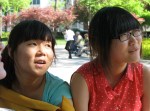
Imagine a field trip where the pupil teacher ratio is 1:1. Now imagine that there are only 4 students, all girls and that they’re in their late teens! I’m sure my Canadian colleagues who are busy herding groups of 20 or more children through museums, historic sites and other educational venues would have seriously envied us today!

This afternoon’s Class A field trip was a "western picnic" partially planned by the girls themselves. We rode the bus to beautiful Children’s Park. I’m not sure why it’s called that. It was occupied mainly by seniors including some in wheelchairs who appeared to be on outings from a nearby care centre, and other than a small playground/amusement park area in one corner, there wasn’t anything specific to appeal to children. It was, however, a lovely spot for a picnic.

In addition to teaching them English, we’re also trying to introduce our students who plan to study abroad to western culture so our menu didn’t include any Chinese food. Instead, we ate sandwiches, potato chips, cookies and miniature chocolate bars. If we could have, we would have introduced them to s’mores but even Carrefour, the French department store that carries some import foods, didn’t have the ingredients nor did we have anywhere to roast the marshmallows.

After lunch, we had a photo scavenger hunt. Each student/teacher partnership had eleven items to find and photograph. The list was, of course, in English. Finding "something fuzzy" is a challenge if you don’t know what the word fuzzy means! I explained to my partner that it meant soft, like an animal’s fur and we set off to see if we could find the cute little puppy that had passed by while we were eating. It was nowhere to be found and I was very proud of Sheila when she spotted the poplar fuzz gathered along the edge of the sidewalk and asked, "Is that fuzzy?" We were the last to return to the starting point with our list completed but we were declared the winners because our pictures were the best! Yay!

Next came a word game. Each of us was shown a word but one person’s was different from everyone else’s. Without giving away it away, we had to take turns saying simple sentences about the word until we could guess whose was different. With word pairs like shampoo and conditioner, bread and cake, and orange and tangerine, it was tricky and the girls had to think hard to come up with good sentences. There was lots of laughter and good-natured bantering and though the senior ladies sitting near us had no idea what we were saying, they clearly enjoyed watching the girls’ enthusiasm.

Yes, this was definitely the most relaxing field trip I’ve ever been on!

The pattern of snack

Have you ever noticed how often we use the word usually? I hadn’t until I came to China to teach English and immediately noticed that the Chinese always say urally! I have no idea how the r sound crept in but apparently that’s the way all Chinese English teachers teach it. Wrong habits are hard to break and our students still need to be reminded once in a while but after lots of practice they do know how to pronounce it correctly now.

Though urally was one of the most common mistakes made by our students, who have never been taught by native English speakers before, we have encountered many other mispronunciations. Vowel sounds are particularly difficult. It isn’t any wonder considering the fact that one little letter like an a or an o can represent so many different sounds. Sometimes these mispronunciations lead to a complete lack of understanding but we also have a lot of fun with them.

Early in the term, one of my students told me that he liked eating snakes! I clearly remember being somewhat startled but this is China, after all! We’ve eaten bullfrog and catfish, restaurants serve silkworms and there’s one not far from here that specializes in donkey meat, so why not snakes? When I attempted to clarify, however, I discovered that he actually meant that he liked eating snacks! As it turns out, the snake/snack confusion is a common one and has led to lots of laughter in our classes!

Is it any wonder then that the headline "Snacks Dominate the Fashion World of This Early Spring" caught my eye when I picked up the April issue of Sichuan Airline’s in-flight magazine on our recent trip to Jinan. The magazine is published in Mandarin but some of the articles are translated into English. Clearly, they could use a more qualified translator but this particular article was hilarious! Here’s just one tidbit:

"It is the year of the snack, patterns of reptile animals have crawled back to the fashion world of women’s wear in spring and summer, among which the pattern of snack turns out to be the most popular. It seems like designers have already foreseen that the pattern of snack would be a fashion trend, this eye-catching animal pattern is now seen in all fashion fields."

The article was accompanied by photos of clothing with a snakeskin motif as well as snakeskin purses and shoes!

I haven’t been following most of my favourite fashion blogs lately because both WordPress and Blogspot are blocked in China. It’s also been several months since I’ve seen a fashion magazine so I don’t know whether or not snakeskin has caught on as a new fashion trend in North America. I haven’t actually seen it being worn here yet but for those who want to know, apparently the pattern of snack is the newest trend!

Looking for peace and quiet

Chinese people tend to be quite loud and there are a LOT of them so this is definitely not a quiet place to live! The streets below our building are usually a beehive of activity. We jokingly call the scene outside our windows our reality show as there’s always something interesting to watch. Because the building has little or no soundproofing, the show comes complete with sound and now that the weather has warmed up and we often have the windows open, the volume has been turned up. Once in awhile, I wake during the night and marvel at the silence but sometimes there are people shouting or horns honking even in the wee hours.

When I was a child, if we asked my father what he wanted for his birthday, Father’s Day or Christmas, his answer was always the same. "Peace and quiet!" I must have inherited my appreciation for quiet places from him. It’s not easy to get away from the hustle, bustle and noise that surrounds us here but we did find a couple of slightly more peaceful places this weekend.

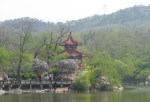
Yesterday afternoon, we visited the Dalian Botanical Garden with one of my university students. Chinese gardens, like Japanese, tend to be landscape style gardens that include one or more ponds, rock works, trees and gazebos or pavilions connected by winding paths. Though there may be flowers, they aren’t the main focus. The Dalian garden is on the outskirts of the city and surrounds a very large pond that is obviously well stocked with fish as there were many people with lines in the water. It was a beautiful Sunday afternoon and also Mother’s Day so there were plenty of families enjoying the park but in spite of that, there was a sense of peace that isn’t easily found here.

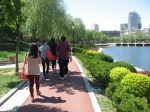
Today, we spent a couple of hours strolling along the boardwalk that skirts the Daxishan Reservoir, not too far from here. Though we were never far from the sound of traffic and there were others also out enjoying the walk, it wasn’t crowded. Again, there was a very welcome feeling of peace.

My name is Guang

Richard and I are still somewhat uncomfortable with the fact that our students are required to use English names at school but I find the stories behind these names fascinating. Many were simply given them by their first foreign English teacher while others chose from a list of names when they first came into the school to register for classes.

Some choose a name that sounds similar to their Chinese name. Bradley’s real name is Li Borou. According to Chinese tradition, his family name comes first but reversed, it would be Borou Li which sounds a bit like Bradley. Now that he’s considering going to Canada to study, however, he’s concerned that Bradley Li (pronounced Lee) will sound odd so he has started signing his name, Brad Li.

Others are influenced by the entertainment world. Grace chose the name of a favourite character in an American television drama and was tickled to discover that I have a fondness for the name because it was also my grandmother’s.

Big Jacky, easily the tallest Chinese person I’ve ever seen, is class monitor for one of my university classes. His duties include stopping by the office when he arrives to pick up the key and unlock the classroom. He also insists on carrying my books up to the sixth floor for me every time! When I asked him how he got his English name, he explained that he’s a fan of Hong Kong actor and martial artist, Jackie Chan, who was actually born Chan Kong-sang.

Sissi (pronounced Cee Cee) was a nickname given to one of Richard’s students by her grandmother when she was just a little girl. Since it’s easy for even we foreigners to pronounce, she decided to use it instead of adopting a different English name. I think it suits her.

One of the most unusual names we’ve encountered is Dragon but his choice made perfect sense once he explained it to me. Apparently his Chinese name means little dragon.

Their English names aren’t particularly important to most our university students who are simply taking an English course because it’s a graduation requirement. When the year is over, many of them will never use the name again. When they wrote their midterm exams, I discovered that Patricia didn’t even know how to spell her English name! It’s a different story for our students who are preparing to study overseas, however. Recognizing that they will be using this name for several years, possibly the rest of their lives for those who dream of making Canada their permanent home, some of them aren’t satisfied with a name that was chosen hastily or thrust upon them by a teacher they’d only just met. Stacie is such a student. Last time I talked to her, she was considering becoming Monique!

Our school isn’t the only one that requires its students to choose an English name. Apparently this is common practice across China. When we met Michael, one of our "angels", in Jinan last week, I asked him how he got his English name and he explained that he’s a fan of both Michael Jordan and Michael Jackson.

After hearing many of these stories, I began to wonder what I would do if I had to choose a Chinese name. I’ve always been fascinated by the meaning of names so I wondered if my name, which means shining light, might have a Chinese counterpart. Over lunch one day, I asked some of our students if they knew of a Chinese girl’s name that meant light. Sure enough, Sissi told me that her mother’s name, Guang (pronounced Gwong), was the one I was looking for. Though no one actually calls me by this name, I’ve decided to adopt it as my Chinese name. I even like the look of its Chinese character. It reminds me of a burning candle or a lighthouse.

Since Chinese women take their husband’s family name when they marry, I guess I’m actually Meng Guang because Richard’s Munchkin class (his 12 year olds) recently decided that he should have a Chinese name too. They dubbed him Meng Fei, naming him after a popular TV anchorman who gained nation-wide fame as host of the popular blind date reality show "If You Are the One"!

Entertaining angels

Do not forget to entertain strangers, for by so doing some people have entertained angels without knowing it. Hebrews 13:2

We’re back in Dalian and though we’ve only been living here since late February, it really did feel like we came home today. As we settle in and get back into routine, I find myself reminiscing about the many "angels" we encountered as we travelled. They may not actually have been heavenly beings but I can’t help thinking that God brought them across our path to make our way easier and more enjoyable. I’ve mentioned some of them in previous posts.

First there was Michael who helped us find our hotel when we arrived in Jinan and later led us to a restaurant and helped us order a delicious dinner. Though he wanted to spend more time being our guide, circumstances didn’t allow it but Michael kept in touch by texting for the remainder of our trip making sure that we were fine and offering to translate or advise if we needed him to.

Then there was the gentleman who volunteered to drive us from the village of Zhujianyu to the bus station in nearby Mingshui so that we could get back to Jinan after exploring the historical site. We didn’t get his name and though we offered, he wouldn’t accept any payment for his trouble. Definitely an "angel"!

Many of the long distance buses here have someone who rides along, collecting tickets or cash from passengers as they board at various pick up stops. She often disembarks somewhere near the outskirts of the city once everyone is on board but when we rode from Jinan to Qufu, the "stewardess" stayed on board all the way. When we pulled into the Qufu bus station, 6 km outside town, she left the bus with us, found us a taxi and made sure he knew where to take us before she boarded the bus again and it continued on to its next destination. We could have managed on our own but it was much easier having an "angel" who knew the language taking care of us.

That evening, when we went out to find some supper, we encountered another one of our "angels". We were thinking about eating at the local night market where food is cooked and sold on the street. We had just started walking through the market area checking out the various things that were being prepared when Daphne, a local college student, walked up to us and asked in excellent English if she could be of any help. She advised us not to eat at the market because it might not be very healthy (exactly the same advice that our own students give us). After asking us what we enjoy eating, she suggested a restaurant, took us there, helped us order and visited with us while we ate.

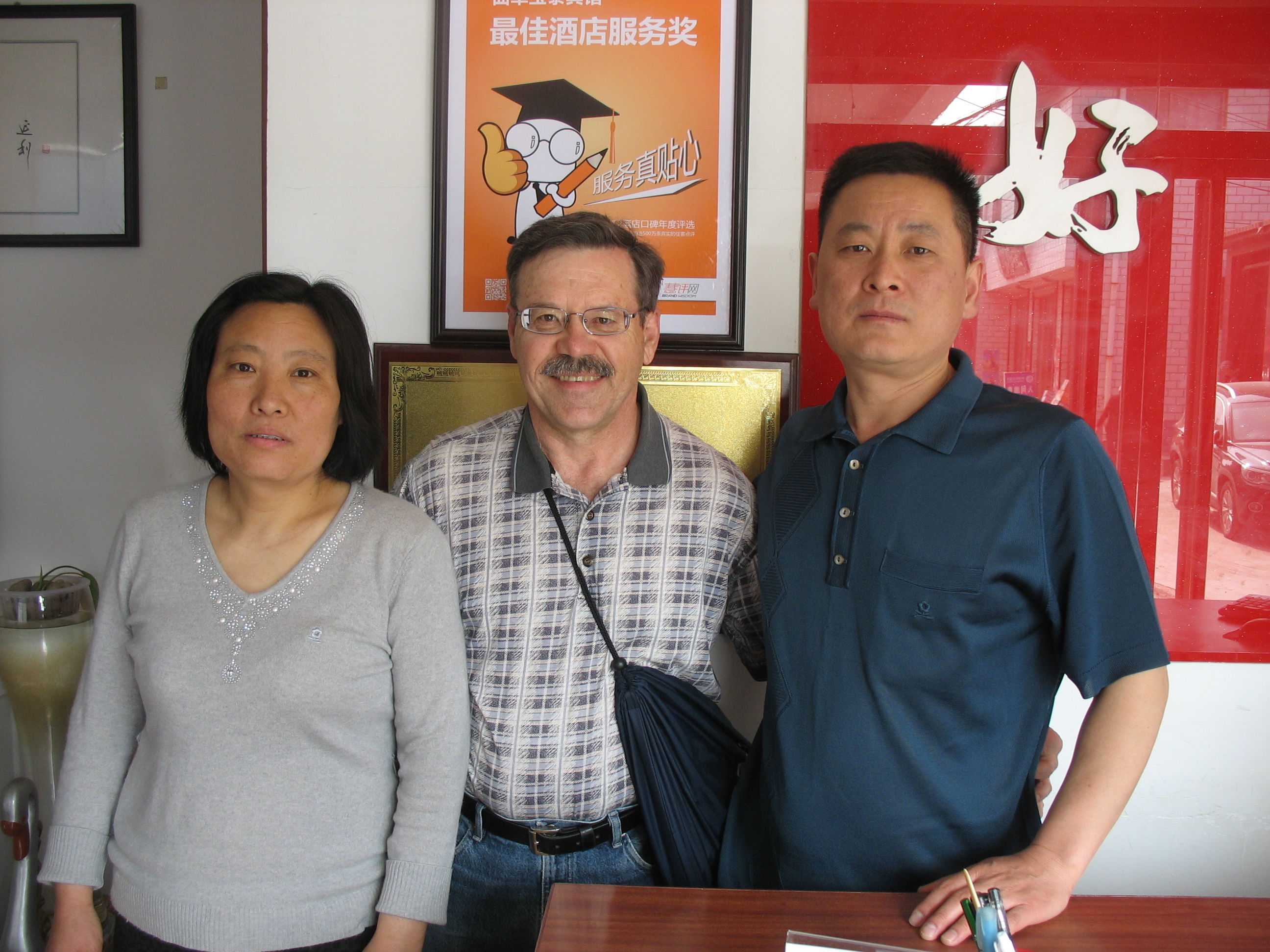
The next day Aku appeared out of nowhere to act as our guide to the Confucius Temple and Mansions but I mustn’t forget to also give credit to one more Qufu "angel", our host at the tiny Bao Tai Hotel. Our room was basic; the mattress was thin, the towels tiny and at $13 a night, we couldn’t complain about the room not being made up each day. What made our stay heavenly was our host. He didn’t speak a word of English but when we arrived, he asked us through gestures if we were hungry and when we said yes, he walked us around the corner to a little restaurant. While we ordered, he headed off on his bicycle to find a map of Qufu and brought it back to the restaurant for us. Later, he was able to communicate through the translator on his computer, that we were the first Canadian guests to ever stay in his establishment and he treated us like royalty. When we came downstairs to check out yesterday morning, he insisted on driving us to the bus station himself instead of allowing us to take a taxi! Though he isn’t smiling in the photo, I think that’s the only time I saw him without one. Yes, that’s definitely the face of an "angel"!

Second day in Qufu

If you had an entire day to do anything you wanted, what would you do? That’s the situation we found ourselves in this morning. We’d allowed ourselves two full days in Qufu thinking that one might not be enough to see all three Confucius sites that we visited yesterday.

Knowing that we had an entire day to fill, we were in no hurry to get up this morning. I haven’t been sleeping well lately largely due to the fact that I’m fighting a nasty cold so a bit of extra rest was very welcome.

Once we were up and had had a late breakfast, we went to visit another ancient temple, this one dedicated to the memory of Yan Hui, a favourite disciple of Confucius. If it were located anywhere other than almost next door to the much larger and more impressive Confucius Temple complex, it would likely draw many visitors but we were almost alone and it was very peaceful. We could actually hear the birds chirping!

The Yan Temple has been undergoing renovations over the past few years. Apparently the cost of this massive facelift prompted a hefty increase to the admission fee which, I’m assuming, resulted in even fewer visitors. We learned, however, that if we could produce our combination tickets from yesterday, we would be admitted free of charge.

In addition to enjoying the tranquility of the temple grounds, we found the renovation project quite fascinating. One of the outer buildings houses a display of photos chronicling the meticulous work that has been done. The buildings that have been completed have received much more than a new paint job. Much dismantling and rebuilding was required to replace wooden parts and roofing that had deteriorated. Many of the intricate panels were taken down, painted and put up again.

After leaving the temple, we headed over to the International Youth Hostel and rented bicycles. Leaving town, we rode out into the countryside to look at the farms where we saw corn, wheat and other crops that we couldn’t identify. Though they appear to have been seeded by machine, we saw many people, mostly women, out in the fields pulling weeds. Imagine doing that by hand on a Canadian farm! I have no idea how far we rode. I’m pretty sure my butt will be telling me about it tomorrow but it was well worth any discomfort I may have to put up with.

After an early supper, we were strolling back toward our hotel when we decided to rest for awhile on a stone bench near the main gate to the city wall, a great spot for people watching. Little did we know that we were in for an unexpected surprise. We were about to leave when someone began banging on the enormous drum atop the wall. It heralded the beginning of a gate closing ceremony complete with elaborately costumed guards, flag and lantern bearers, a herald and others we couldn’t identify. It was a perfect ending to our stay in historic Qufu!

A day with Confucius

Wheresoever you go, go with all your heart.
Confucius

We left Jinan yesterday morning and travelled south by bus to Qufu (pronounce Chu Fu). Small by Chinese standards, with a population of only about 86 000 people, Qufu is famous as the hometown of the great sage, Kong Fuzi, better known to us by the westernized version of his name, Confucius.

The old walled centre of Qufu is small and easy to get around on foot but the three principle sites; the Confucius Temple, the Kong family mansions and the Confucius Forest where the great teacher and his many descendants are buried, are absolutely enormous. We spent all day today exploring them.

When we stopped at the ticket office to purchase the combination tickets that would allow us to visit all three sites, we were also thinking about hiring an English guide but before we could, we were approached by a young college student who called himself Aku, an abbreviated version of his difficult to pronounce Chinese name, who offered to act as our guide for free if we would simply use his camera to take a few pictures of him throughout the day. We agreed and found him to be a delightful and knowledgeable companion.

We started our day at the Confucius Temple, China’s second largest imperial building complex after the Forbidden City in Beijing which we hope to visit in July. The temple started out as a simple memorial hall some 2500 years ago but over the ages, it mushroomed to today’s compound which covers 327.5 acres and is 1.3 km in length from north to south.

Though there is some debate about whether Confucianism should be considered a religion or simply a system of philosophy, the temple was once a site where sacrifices were offered to Confucius. He was a great thinker, a teacher, editor, politician and a philosopher whose teachings emphasized personal and governmental morality, correct social relationships, justice, loyalty and sincerity. He was a strong proponent of ancestor worship which is something we have a hard time getting our heads around but I can’t help wondering if he ever intended that nations of people should worship him. Whether it was his intent or not, many Asian cultures including Chinese, Korean, Japanese and Vietnamese have been strongly influenced by Confucianism.

After spending all morning touring the temple complex we stopped for lunch then moved on to the Confucius mansions, a maze of 450 halls, rooms, buildings and passages where his wealthy and powerful descendants lived like kings. Emperors were known to drop in for visits and a special ceremonial gate near the main entrance was opened only when this happened. The complex included administrative offices and meeting rooms, family residences, kitchens, guest rooms, studies, libraries and a treasury. A peaceful garden of flowers and greenery are found at the rear. Aku told us that his dream would be to build a home like this one in the Chinese countryside but I only coveted the garden and a few unique features like the round doorways! I could also imagine children having endless hours of fun playing hide-and-go-seek in the many passageways!

After relaxing over coffee, it was time for Aku to leave us as he had a bus to catch later in the day. We took a pedicab 2 km north to the Confucius Forest, the oldest and largest family cemetery in the world. There, Confucius and his descendants have been buried for more than 2000 years, a practice that continues up to the present time. The peaceful pine and cypress forest covers an area of more than 200 hectares. Burial mounds and memorial plaques are scattered haphazardly throughout the area. Confucius, himself, lies beneath a grassy mound enclosed by a low wall. Though most of the tourists crowded around the tomb were simply curious, there were those who knelt and others who made offerings of flowers.

After walking back to our tiny, family-run hotel where every room number begins and ends with 8, considered a lucky number by the Chinese, we’re spending a quiet evening resting our very weary feet. Our hosts don’t speak a word of English but they are clearly delighted to have us, their very first Canadian guests, staying with them.

To see what is right and not do it, is want of courage or of principle.
Confucius

Thank you, Dr. Bethune

Over the past few years we’ve stretched our comfort zones to such an extent that we don’t really know where the edges are anymore! I’m pretty sure we stepped outside them this morning, though, when we boarded a bus and headed out into the Chinese countryside with no definite idea how we’d get back to Jinan!

The bus dropped us off beside the highway and we walked two kilometres into the historic village of Zhujiayu. After the noise and pollution of city life in China, a walk in the country was literally a breath of fresh air! The crops on either side of the road were heading out already but it was a bit too soon to tell for sure if they were barley or bearded wheat.

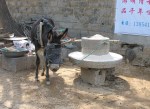
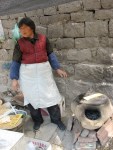
Walking the narrow stone streets of Zhujiayu is a journey back in time. Protected by hills on three sides and dating back to at least the Ming and Qing dynasties, it’s easy to see why it’s been used as a set for a number of movies and television dramas. Though the central street was crowded with vendors selling snacks and tacky tourist souvenirs, we were delighted to see that effort has been made to restore parts of the crumbling village including the wall that enclosed its northern flank and to bring history to life for those who visit. We watched a donkey grinding grain into course flour that was then sifted by hand and used to make the chive stuffed tortillas that we ate for lunch. They were cooked outdoors on a small clay oven.

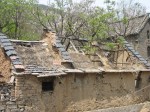
We found the construction of the now crumbling structures fascinating. Most were built of stone from the surrounding hillsides but others were made of brick covered with a layer of some kind of plaster, a building method still in use in this country today. Beneath the tiled roofs was a thick layer of thatch that would have acted as insulation.

After spending a few hours exploring almost every nook and cranny in the village, it was time to figure out how we’d get back to Jinan. According to our trusty Lonely Planet guidebook, there might be a bus that would take us to nearby Mingshui where we could catch another bus back to Jinan. If not, we could walk back to the highway and try flagging down any bus heading back toward Jinan.

As we exited the site, we stopped at the tourist services building to see if anyone there spoke enough English to advise us. Neither of the women on duty did but one of them hustled out to find someone who could. She soon returned with three smiling men. One of them spoke a few words of English but he phoned his wife who was somewhat more fluent and by passing the phone back and forth, we learned that her advice was that we walk back to the highway and flag down a bus. After the gentlemen produced their cameras and had their pictures taken with us, we headed off to do just that.

As we exited the gate, however, we were surrounded by taxi drivers offering to drive us into Mingshui or even the entire 80 km back to Jinan. Of course, they wanted an exorbitant amount in return for their services so we quickly said no and went on our way. I soon noticed that one of the men who’d crowded around us as we talked to the taxi drivers was following us on the opposite side of the road. When we got out of earshot of the others, he crossed the road and told us in broken English that if we would wait for ten minutes while he walked home and got his car, he would drive us to the bus station in Mingshui at no cost! We’ve found over and over again that the Chinese are more than willing to do things like this for us; in fact, they seem to consider it a privilege! As he drove, he explained that one of the reasons that the Chinese love Canadians is because more than fifty years ago, a Canadian doctor helped the Chinese people very much. He was, of course, speaking of Dr. Norman Bethune who died in China in 1939 while serving as a battlefield physician during the Japanese invasion of this country. He is considered a beloved hero to this day.

Though the bus from Mingshui delivered us to an unfamiliar bus station (Jinan has at least three of them) the taxi ride back to our hotel wasn’t much longer than it would have been from the main station where we caught our outgoing bus this morning. Another adventure was complete and our comfort zones, just a little bit bigger! Thank you, Dr. Bethune!