Life’s not fair!

One of the original goals of communism was to create a classless society where everyone would be equal. That might sound great in principle, but in reality, it doesn’t work. Like anywhere else in the world, China has the filthy rich and the very poor.

Most of our students come from well to do families. Our university students pay approximately $500 per semester over and above their regular tuition for 70 hours of instruction with a native English speaker instead of attending the university’s regular English classes with Chinese teachers. In China, that’s a lot of money; more than one month’s salary for many people. Then there are our full time English immersion students who are preparing to study abroad. Only the wealthy can dream of giving their child that opportunity or afford the more than $8000 that this year of preparation cost.

With a mark of 95% on the final exam, Grace ended the year at the top of one of my university English classes but she won’t be back in this program next year. Her family simply can’t afford it. Grace grew up in the countryside where her parents own a small plot of land. In addition to growing rice and oranges, they both work seven days a week in a factory.

Grace’s birth was a disappointment. She wasn’t born a boy. China’s one child law allows rural families to have a second child if the first one is a girl so her parents tried again and Grace has a younger sister! She says that her father has accepted the fact that he’ll never have a son but as the oldest, responsibility for her family falls squarely on Grace’s shoulders.

Though her parents have very little formal education, Grace excelled as a student and graduated at the top of her high school class. Unfortunately, coming from a rural school, she didn’t do well on the university entrance exam that students across the country write during their final month of high school. Once again, she was a disappointment.

Just like the people, universities in China are not all equal. Students can’t freely choose which one to attend or even which major to study. Those who do best on the entrance exam are admitted to the most prestigious universities while those who don’t do as well end up at lower tier institutions like the one where we teach.

Grace dreams of being a primary school teacher but she’s studying accounting. She’s doing extremely well. Well enough, in fact, that she’s been recommended for an upcoming exam that could win her a place at a better school of finance but her heart isn’t in it. She’s only studying accounting because her parents feel that it will lead to a better job; one that will pay a higher wage and enable her to pay off their debts and take care of them in their old age. It’s normal for Chinese parents to make these decisions for their children so she doesn’t feel that she has a choice in the matter.

How do we advise a girl like Grace? She isn’t the only one of our students who isn’t able to follow her dream. David loves the Chinese language and wanted to train to teach it but his mark on the university entrance exam was too high for that! Instead, he’s studying physics. It doesn’t help to tell these kids that life isn’t like this everywhere. It is like this in China!

What we did tell Grace was that education is never a waste and that being fluent in English will open many doors for her. Sadly, it may not open the door that she most wants to walk through. I also told her that life’s not fair but I think she already knew that. After all, if she’d been born into a wealthy family, her parents could simply buy her a good job! Yes, life’s like that in China too.


A day at the zoo

After yesterday’s heavy rain, this morning dawned bright and clear; a perfect day to spend at the zoo. We went with Kevin and Derek, 16-year-old twin students of Richard’s who leave for boarding school in Maryland in early August. We met them at the school early this morning expecting to spend half an hour or more on the bus getting to the zoo. Instead, their father drove us there in his BMW. As we headed for the line up at the ticket booth, four zoo passes mysteriously appeared in Derek’s hand. Though he wouldn’t tell us where they came from, I suspect that they were also a gift from his father!

Covering 180 hectares, Dalian Forest Zoo is the largest city zoo in China and home to more than 150 species of animals. We’d heard that it was worth a visit but it far exceeded our expectations. We were amazed by the number of animals in the zoo; not just one or two of each kind, but in many cases, large groups. I feared that we might find them housed in cramped and dirty quarters like the polar bear exhibit that we saw at the Sun Asia Ocean World aquarium awhile ago but instead, most of them had plenty of room to roam in natural looking surroundings. Of course, the price we paid for that was having to walk long distances to see them all but it was well worth it. In spite of the fact that the animal habitats were large, they were set up in such a way that we were able to see most of the animals easily. I was especially impressed with the viewing platform at the giraffe exhibit. Though I’ve seen giraffes in many zoos over the years, I’ve never been able to look at one eye to eye before!

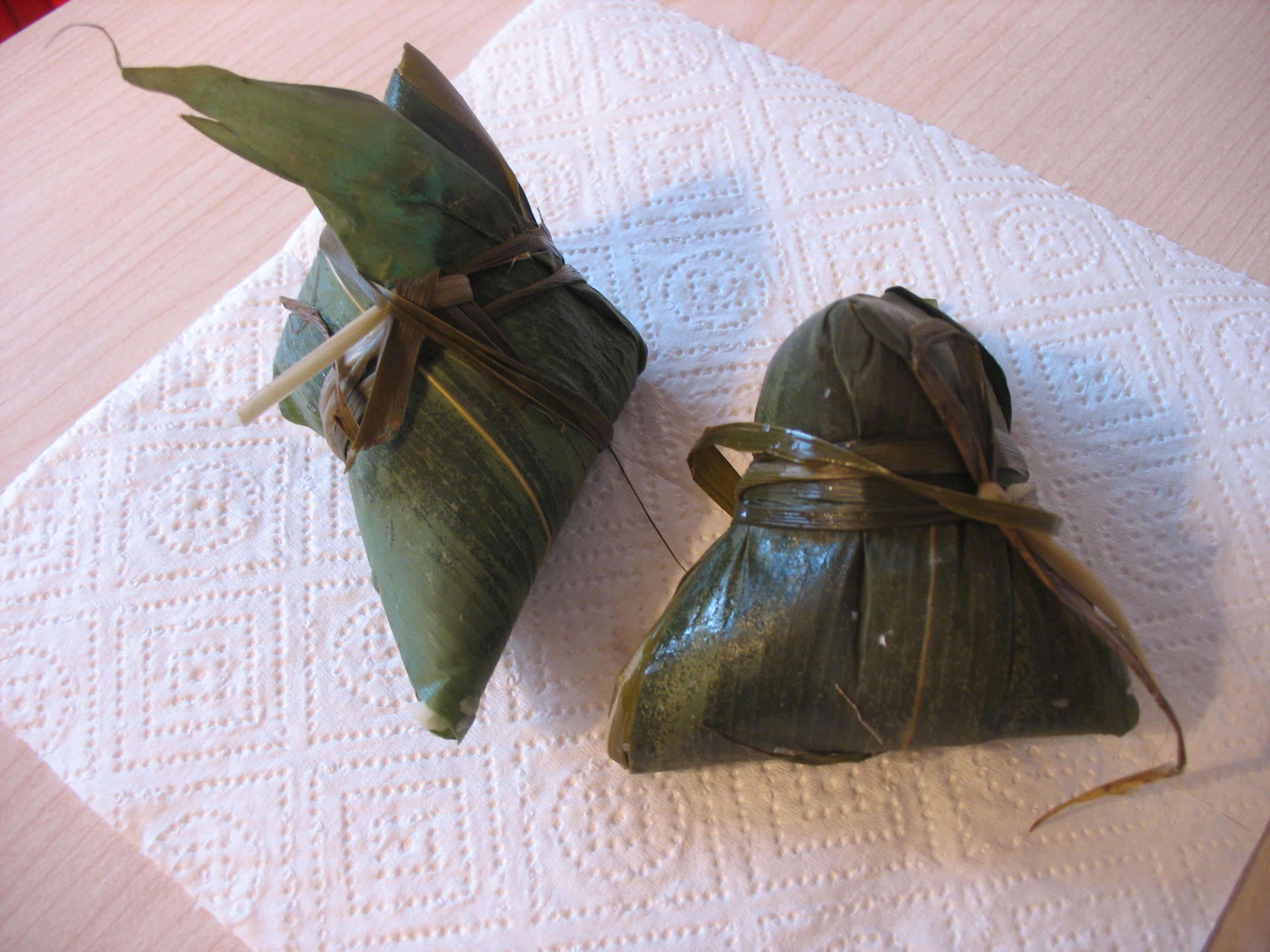
I was able to cross an important item off my unwritten China bucket list early in the day when I came face to face and hand to paw with a giant panda! Of course, there was plexiglass between us but it was an amazing moment! Those of you who know me well know that I love teddy bears and this was a real live one! If that was all I’d seen at the zoo today, I would have gone away happy! Thankfully, we visited the panda exhibit in the morning before the crowds got too thick. The first two pandas that we spotted were relaxing some distance away but the third one was closer. As I stopped to watch him, he walked right up to the glass in front of me, sat up on his haunches and put his paws on the glass! It was love at first sight and I told Richard and the boys that if they wanted to see the rest of the zoo, they might have to drag me away! They waited patiently while I watched my new friend unwrap and eat his Dragon Boat Festival zongzi. Unlike the ones we had for supper on Sunday night, his weren’t filled with glutinous rice though but something more palatable to pandas. We also watched him munch on some bamboo, a panda’s favourite food.

Eventually, I had to leave, of course. There were hundreds of other animals to see including many other kinds of bears. They were housed in the Fierce Beast Area of the zoo but the grizzly pictured below looked anything but fierce!

Springtime has obviously brought many new babies to the zoo. Some of them were on exhibit in the Little Animal Village and Nursery Center but most were with their mothers in the regular exhibits. We saw bear cubs, tiger cubs, and baby monkeys of many varieties just to name a few.

The zoo is divided into two sections. We spent most of the day touring the larger Safari Park on the west side of Bai Yun Mountain. After waiting in line for almost an hour in the middle of the afternoon, we took a cable car 1 200 metres over the mountain to the older Stable Breeding Park area. There was less to see there but the cable car ride was well worth it for the spectacular views of the coastline on the west side and the city on the east.

According to the brochure that guided our steps today, the operation philosophy of Dalian Forest Zoo is to produce happiness. It certainly did that for me today!

Rose gardens and city views

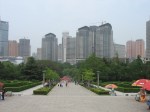
Located just a few blocks from the downtown train station in the shadow of Lushan Mountain, Labor Park is best known for its enormous red and white soccer ball that commemorates Dalian’s glory days as China’s famed football city. Like Dalian’s current football team, however, the park is a bit lacklustre in comparison to some of the more beautiful ones we’ve seen. It does have some pretty spots though as well as an amusement park and acres of space for relaxation. Though I read about “a game farm full of peacocks, deer, and cranes” we saw only a few beautiful cranes strutting around cramped and bare quarters and an empty pool that might have once housed otters or something of that nature.

What the park does have is beautiful flowers, lots of statues and some great views of the city. When we passed it on the bus earlier in the spring, it was festooned with cherry blossoms but now the roses are in full bloom. We saw several bridal couples having photos taken in and around the rose gardens.

Yesterday afternoon, after strolling the broad avenue up the centre of the park, between the statues of the twelve animals of the Chinese zodiac (I’m a dragon) to the giant soccer ball, we took a chair lift up the mountain. As we passed over treetops and even a busy highway, I was glad that I’m no longer afraid of heights. I was even happier about that when we took the glassed in elevator to the observation deck high on the communications tower at the mountain’s peak. Though the day was a bit hazy and the ever present smog hung over the city, the views from the top were definitely worth the ride up. I’m glad we waited to do this until we’d been here for awhile and seen much of the city as it was fun to pick out the various places we recognized. Sadly, the smog and the dirty windows (nothing in China stays clean very long) made it virtually impossible to get good pictures.

Today, the second day of our Dragon Boat Festival holiday, was supposed to be a beach day with one of my students but the sky is grey and it’s pouring rain so that plan has been nixed. Instead, it might just be a relax at home day.

Dragon Boat Festival

Today was the first day of China’s three day Duanwu or Dragon Boat Festival holiday. The festival itself which falls on Wednesday, commemorates ancient China’s patriotic poet, Qu Yuan, who lived from 340 to 278 BC. Though stories vary somewhat, according to legend, Qu was accused of treason and banished from the ancient state of Chu for failing to support the king’s proposed alliance with the increasingly powerful state of Qin. During his years of exile, he wrote many enduring patriotic poems. When the state of Qin later captured the capital of Chu, Qu committed suicide by drowning himself in the Milou River. HIs death occurred on the 5th day of the 5th month of the Chinese lunar calendar which this year falls on June 12. Apparently the festival takes its name from the idea that people rowed their boats out into the river in an unsuccessful attempt to either save their beloved poet or retrieve his body.

At the beginning of the semester, when I saw the Dragon Boat Festival on our school calendar, I had visions of watching colourful boats filled with rowers racing on a local waterway. Sadly, that doesn’t happen in Dalian.

It would seem that the primary way that people here celebrate the festival is by eating zongzi, triangular packets of glutinous rice wrapped in bamboo leaves. The stores and markets have been filled with them for the past few days. It is said that this tradition originated when local people dropped sticky rice packets into the river to feed the fish and keep them from consuming Qu’s body!

We were given several homemade zongzi yesterday. Though the rice tasted okay, having taken on a mild grassy flavour from the bamboo leaves, we weren’t very impressed by its texture. For me, the word glutinous even sounds gluey and that’s exactly what it was!

A second tradition is the wearing of five-coloured silk cords around the wrists. These are being sold everywhere right now by women who have obviously been busy making them by hand. I bought mine for 1 yuan (about 17 cents) each and will wear them on Wednesday. Apparently, when the festival is over, they’re supposed to be cut off and thrown away to get rid of bad luck.

When we went down to the street market to pick up vegetables and meat this morning, we noticed lots of bundles of leaves being sold. We guessed that they too must have something to do with the festival. They didn’t look very edible and we had no idea what their purpose was until I read up on the celebration online and learned that they were mugwort leaves and calamus. Apparently, people put bundles of them over their doors to protect themselves against disease. I wonder if they have any effect on shingles? Perhaps I should have bought some! Actually, the stems and leaves of these plants are said to dispel an aroma that is thought to purify the air and discourage flies and mosquitoes so perhaps there’s something to the tradition.

Although this festival has long been part of Chinese culture, the government of the People’s Republic of China, established in 1949, refused to officially recognize it as a public holiday. It was only reinstated as a national holiday in 2008. Since it falls on a Wednesday this year, many people, including us, worked on Saturday and Sunday so that they could have today and tomorrow off and make it a three day vacation.

Since our tour of China is coming up soon, we decided not to go anywhere this holiday. Instead, we’re staying here in Dalian and being tourists in our own town but I’ll share more about that in future posts.

Shingles… but not the roofing kind!

The itch came first followed by intense pain that had me pacing the floor at night. A quick online search confirmed what I was beginning to suspect; I had shingles! I was almost relieved last Sunday afternoon when the telltale rash finally appeared. Without it, there was nothing to show a doctor; no way to get a definite diagnosis and the medication I needed.

Within minutes of Wendy, one of our helpful office gals, typing the word shingles into her trusty translator on Monday morning, she and I were in a taxi and on our way to the Second Hospital of the Dalian Medical University. One glance at my rash was all the doctor needed to confirm my self diagnosis. He prescribed an anti viral medication as well as a vile smelling lotion to help with the itch and an antibiotic cream to use at night to prevent infection from setting in.

Shingles, or herpes zoster as it’s more formally known, is a reactivation of the virus that originally causes chicken pox. It had been lying dormant in my body for more than five decades waiting to spring into action again! Fortunately, unlike chicken pox, shingles usually affects only one area of the body, in my case a band extending around the left side of my torso at shoulder blade level.

I don’t actually remember having chicken pox. I was very young at the time but I do recall my mother talking about having three children sick with it at once; my older brother, my sister and I. My younger brother missed the first round of all the childhood diseases to hit our home and instead, made a habit of coming down with them when we were on holiday! I remember him having whooping cough in Dawson City, Yukon and mumps at our grandmother’s house. I believe that it was chicken pox that he had while we were camping on Galiano, one of BC’s beautiful gulf islands. I guess I must be following his example by coming down with shingles in China of all places!

Fortunately, I seem to have had a fairly mild case and I think I’m the mend. The blisters have burst and the rash is beginning to heal. The pain, now worst in the morning, eases off after awhile and is easily managed with Ibuprofen.

Though uncomfortable at times, I’ve been able to continue doing everything I needed to do. The blog’s silence this week has had more to do with the fact that I’ve been busy giving and marking final exams than with the fact that I’ve been suffering from shingles. My university classes came to an end this week and for the remainder of the month I’ll have only my students who are preparing to study abroad; just seven hours of teaching a week! No more classes at 8 o’clock on Saturday mornings and no more climbing the stairs to the sixth storey classroom! Even with shingles, life is good!

Football!

I went to a professional football game last night. As in much of the world, football in China is what we North Americans refer to as soccer. I’m not an avid sports fan but in years gone by Dalian’s claim to fame in China was its football team so I really wanted to see them in action. Apparently they haven’t done as well in recent years but they did manage to win last night’s match.

I went to the game with two of our fellow teachers and five of our students. Poor Richard, the real sports fan in the family, had a class to teach so he wasn’t able to join us.

Though the game itself was interesting to watch, being part of a local crowd cheering on their team was exciting. I found myself chanting along with the rest of them and when the one and only goal was scored, I was on my feet and hollering just like everyone else!

It was some of the peripherals that I found most fascinating, however. When we arrived at the stadium, well ahead of game time, the area surrounding it was a beehive of activity. Vendors had food booths and tables set up to serve the crowd and others had stacks of seat cushions to sell. The local custom is to buy a cushion and spend the game sitting on it then send it sailing through the air toward the field at the game’s end! Most of our boys bought the thin 0.5 yuan (about 8 or 9 cent) cushions but Vicky and I decided that our bony butts would prefer the plusher 1 yuan ones! Of course, after the stadium empties, the cushions are collected and resold before the next game.

As is standard at a sporting event, the national anthem was played before the game started. Though we Canadians tend to be rather apathetic when it comes to singing our anthem, I fully expected the Chinese to belt theirs out the way I’ve seen Americans do. I could hear Vicky singing quietly beside me but hers was the only voice I heard! I was quite astonished.

I was also surprised by the presence of soldiers! Though we’re surrounded by crowds of people wherever we go in China, this was the first time I’d been in a situation where a large crowd of people had assembled in one place for a specific purpose. Clearly that’s still something that the Communist government has concerns about. Why else would there be a line of soldiers around the field facing the crowd? They stood at attention until the game started and then sat unmoving on tiny stools always with their back to the action and their eyes on the crowd. They wore dress uniforms including white gloves and weren’t visibly armed but clearly no one was going to tangle with them.

I’ll probably be watching a lot more soccer over the next few years but I don’t expect there to be any soldiers present. I’m going to be watching this little guy, my oldest grandson, play! He’s even wearing Dalian colours and I thought of him when I saw #8 on the field last night.

Duck soup and purple bread

A couple of Sundays ago, we went out for lunch with a colleague of ours, a self-professed foodie, and his wife. In addition to eating at a restaurant that they’d found the week before, we also visited a little takeaway kiosk across the street where we were able to buy a whole roasted duck for under $10. This wasn’t just any old duck though. It was Peking duck and came complete with the paper thin wraps and the soy based hoisin sauce that are part of this most famous of Chinese meals.
After choosing our duck, we watched in fascination as the proprietor used her razor sharp cleaver to cut it up and slice the meat into tiny thin slices. In a matter of minutes, she was done and there was hardly any meat left on the bones. We ate well that night and the next and had enough left over to freeze for a third meal at a later date! It was delicious!

The bones also came home with us and went into the freezer. I boiled them this morning and made broth that left the apartment smelling absolutely wonderful. Some of it went back into the freezer to flavour a future rice dish and I used the rest to make soup for tonight’s supper. I love making home made soups. Every one is a little bit different, depending on what ingredients I have on hand. This time, I didn’t even have to worry about adding any seasonings. There was enough of the skin in this morning’s pot to carry the delicious flavour of the seasoned glaze that the duck was coated with before it was roasted through to the soup pot.

At home in Canada, I would probably have made biscuits or corn bread to go with the soup but here I have neither the ingredients or an oven to cook it in. Bread would have to do but tonight’s wasn’t just any bread. The first time we went to the supermarket here, we were fortunate to find a whole grain bread that’s baked on site. We’ve been enjoying it ever since but when we went shopping yesterday, the store was out of it. The time had come to try something new, something that I’d been eying with curiosity for quite some time, purple bread! At first glance, I thought it had bits of nut in it but on closer inspection I realized that it was sweet red bean which would also explain the bread’s unusual colour. Though we’ll continue to buy the whole grain product most of the time, its slightly sweet flavour was a nice change and went surprisingly well with the duck soup.

Charming Chinglish

Unless the weather changes dramatically in the next little while, this may be the first day in over three months that we don’t leave our little 390 square foot apartment! It’s been pouring rain and the wind has been howling all day long. Since we don’t work on Mondays and had nothing more than a trip to the supermarket to pick up a few groceries planned, it’s been a good day to stay indoors catching up on emails, reading, and playing a few games of Carcassonne. I won three in a row! It’s also a good day to reminisce about all the places we’ve explored since coming to China and to share with you some of the great examples of Engrish that we’ve found along the way!

Engrish, or Chinglish as it’s usually called in China, is what often happens when an Asian language is translated into English. You’ve probably seen some of it when you’ve tried to make heads or tails of the instructions that came with something produced in Asia. As a lover of words, I find Engrish highly amusing. I love to visit www.engrish.com, a website that posts one example of Engrish every day but I’m even more delighted when I find my own examples like the ones pictured below.

"Rain and snow carefully slip" appears beside an escalator in downtown Dalian. Richard waited patiently while I rode up and down several times trying to get the best picture possible!

The "Subsea UFO" sign is found in the aquarium that we visited with some of our students. We had no idea what it was referring to and it made absolutely no sense to any of us! Note that it includes the word harmonious which seems to be a very popular one in China. Even the students in my beginner level university class use this word frequently. The concept of harmony is clearly at the core of Chinese thought and culture. Confucius said, " Let the states of equilibrium and harmony exist in perfection, and a happy order will prevail throughout heaven and earth, and all things will be nourished and flourish."

I don’t know how well you can read the sign that we found at the entrance to Fu Jia Zhuang Park but I especially love #3 and #10. #3 reads "Pre-school age child or psychopath should be accompanied by a guardian." I’m having a hard time typing that one without laughing! #10 is longer. It reads "The tourist who suffers from heart disease, epi lepsy, cold, neuroticism, asthma, diabetes, high (low) blood pressure, rhinopharyngitis, earache or getting drunk are not allowed to dive and swim. If the tourist conceals the above-mention situation, he or she is responsible for the consequence if the accident happens."

One of many signs at the North Korean border warned, "Forbidden to cross border in border area." Um… where else might we try to cross it?

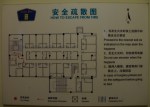
The How to Escape From Fire sign on the back of our hotel room door in Jinan also tickled my funny bone. Fortunately, we didn’t have to proceed to the nesrest exit but we did put on the safeguord before going to bed to prevent burglery from happening.

On our recent walk along the Daxishan Reservoir boardwalk there were many little wooden signs to guide our behaviour. We could figure out the intent of most of them but one was particularly entertaining. We did hold hands but it would have been pretty difficult to walk while holding our feet! The final sign was near the end of our walk. We had to look closely at the little icon to figure out what kind of nuisance people might commit. Believe it or not, though we haven’t actually seen anyone committing that kind of nuisance, we’ve definitely seen evidence of it on some of our walks!

I’m thinking about submitting a couple of these to www.engrish.com. Which ones made you chuckle?

It’s a matter of time

Though China stretches almost as far from east to west as Canada does, it’s exactly the same time in every part of the country!

Canada spans six time zones. When it’s 4:00 o’clock on the BC coast, it’s already 8:30 in Newfoundland. China used to have five time zones but the Communist Party established the country’s present time system shortly after it founded the People’s Republic of China in 1949. Apparently it was supposed to streamline operations and make the country appear more unified.

Personally, I have a problem with this! Dalian is on the east coast where the sun rises earliest. This morning, it came up at 4:36 a.m! I’m not really a morning person but when daylight arrives, I wake up. I’ve done my best to darken our bedroom by taking curtains from the computer room to double the thickness of the ones in the bedroom. It helped a little but not enough and it did nothing to shut out the noise. As soon as it’s light out, vendors begin to set up the morning market below our windows and before long the sound of cars honking and people shouting does away with any chance we might have had of getting a few more moments of sleep.

Of course, the sun also sets earliest here. As Canadians, we’re accustomed to long hours of daylight at this time of year. Back home, the sun isn’t setting until almost 10:00 p.m. but here, it went down at 7:05 this evening.

Apparently China tried Daylight Savings Time from 1986 to 1991 but it was deemed inconvenient and was dropped. Inconvenient for who, I’m not sure. Since the warm weather arrived, we see lots of people out and about enjoying their evenings. Many families from the neighbourhood gather on the plaza in front of the university administration building. Parents and grandparents sit around the perimeter relaxing and visiting while laughing children play. I’m sure that lots of them would happily give up an hour of daylight at 4:30 in the morning in exchange for longer evening light. I know I sure would!

Crossing the road Chinese style

One of the first things we learned when we came to this country was how to “cross the road Chinese style”. Coined by Chinese internet users, the term describes pedestrians who throng together to cross the street where there’s no crosswalk or at marked intersections when the pedestrian lights are against them. There’s safety in numbers was our theory as we attached ourselves to groups of locals to make our way across the busy streets.

Getting to the other side of the street often involves crossing one lane at a time, waiting on the line between lanes until the one in front of you clears. Like the locals, we often cross in the middle of a block rather than at a corner. It’s actually safer and easier than crossing at an intersection where the lights may or may not work and if they do, don’t allow nearly enough time for even an able bodied person to get across before turning red. By far the worst thing about trying to cross at an intersection, though, is the fact that you have to constantly watch for turning vehicles; not just the ones turning right but also those that are turning left! That’s right, the left turn light and the pedestrian light are often on at the same time! We joke that this must be a population control tactic. Send the pedestrians out into the street and then run over them!

Drivers share the road with conveyances of every description including modern buses, bicycles, motorcycles and three wheeled carts that are often so heavily loaded that you can barely see the driver. Some of these are pedal powered and others, fuel driven. These vehicles don’t seem to have any difficulty making room for one another but drivers NEVER give pedestrians the right of way!

Crossing the road Chinese style has been making headlines recently as cities like Beijing and Chengdu have started imposing on the spot jaywalking fines. It hasn’t happened in Dalian yet but we hear rumours that it soon will. Unfortunately, imposing fines doesn’t address the root of the problem.

Until recent years, China was a country of bicycles but automobile sales have soared at a rate of more than 20% per year since 2001 and in 2009, China overtook the United States as the world’s biggest automobile market. Infrastructure simply hasn’t kept up with the ever growing number of vehicles on the road. Here in Dalian, there are pedestrian underpasses in the downtown core
and we’re very fortunate to have a pedestrian overpass joining the north and south campuses of our university which straddles a very busy thoroughfare but many cities lack these pedestrian-friendly conveniences.

Without changes to both driving laws and infrastructure, I don’t see crossing the road Chinese style coming to an end anytime soon.