Role reversal

It’s been quite awhile since my last health update on here, so for those of you who follow our cancer journeys, I thought it was about time for another one. I say journeys because you may remember that, in addition to my cancers, hubby was diagnosed with prostate cancer last summer. Fast forward eight and a half months and as of this week, he no longer has a prostate and as far as we know, he no longer has cancer!

Surgical removal of the prostate, in spite of the fact that it has some negative effects, is thought to be the best choice for long-term survival, but when we saw the urologist in August, he warned us that many specialists consider 70 to be the upper age for performing that surgery. At 73, Richard is otherwise in excellent health and physical condition, so he was referred to a specialist who does robotic prostate surgery, the most advanced treatment option available, with the hope that he would agree to do the procedure. Had he not, there were several other options that we would have had to consider.

On October 31, after the appointment was delayed by a few weeks due to us both having Covid, we finally met with the surgeon. He had clearly reviewed Richard’s case and had absolutely no qualms about performing the surgery on someone in his physical condition. As Dr D said, we could easily look around his waiting room and see men a decade younger than Richard who weren’t in the shape he was in and who would be much higher risk. We were told at that appointment that the wait time for surgery would be five to six months.

Almost five months later, we arrived at the hospital in Edmonton at 5:30 a.m. on Monday and by noon Richard was in the recovery room with no prostate and hopefully no cancer. After one night in hospital, he was released the following day and I suddenly went from patient to caregiver! Total role reversal!

Over the nine and a half years since my first cancer diagnosis, Richard has stood by me and provided excellent care when I’ve needed it. He’s accompanied me to countless specialist appointments and seen me through numerous scans, two major surgeries, 30 radiation treatments, and 14 PRRT treatments. Now it was my turn and I wondered how I would do! Thankfully, he’s been a model patient and things have been going well so far.

The biggest challenge facing us when we got home was the fact that he has a catheter which won’t come out until April 6. The first evening, as we figured out how to change from day bag to night bag (including cleaning the day bag and tubing for the next day’s use), we were both all thumbs. Once we figured everything out though, he’s been able to manage it with minimal assistance from me. A bigger challenge for me might come when our snow finally melts and I’m suddenly in charge of the early spring yard work that Richard usually takes care of! He has very clear instructions not to do any heavy lifting, snow shovelling, or lawn mowing for six weeks. At that point, we’ll also see the surgeon for a follow-up appointment. It’s then that we’ll receive the pathology report and know for sure that he’s cancer free.

And what about my cancer journey? Since early December, I’ve had a CT scan and three different PET scans. Two of those were part of a study. All four scans agreed… no change; no growth or spread. As far as we can tell, my neuroendocrine cancer (NETS) continues to be stable. We’re somewhat puzzled by the fact that a couple of markers in my blood and urine that are specific to NETS have been climbing, but since I’m having absolutely no symptoms, we’ll simply continue to monitor those with more frequent testing. Last week I had my annual check up with the wonderful surgeon who removed both of my other cancers and the good news is that there is no sign of recurrence of either one of those. This is as close as I’ll ever get to a clean bill of health, so I’m in good shape for my present role of caregiver instead of patient!

Stronger Together text with arrow. Corona virus - staying at home print.

Mostly good news

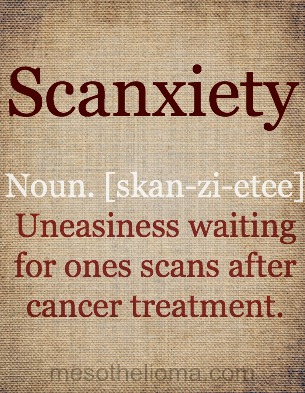
For the past couple of weeks, I’ve been riding a roller coaster that is known in the cancer world as scanxiety (scan + anxiety = scanxiety). 

scanxiety

Over the 9+ years since my stage 4 neuroendocrine cancer (NETS) was diagnosed, I’ve had more scans of various kinds than I want to count. The morning after each of my 12 radioactive PRRT treatments I had an octreotide scan to determine whether or not my tumours had grown or spread since the previous treatment. Any scanxiety that I experienced back then was short-lived because I met with the doctor immediately after the scan to review the results. Not so with the CT scans that I’ve had at 6 month, and more recently 9 month, intervals since completing my treatments in June of 2019. After each of those, I’ve had to wait about a week to find out the results. A week can feel like a very long time if you’re riding the scanxiety roller coaster, but because I’ve been doing so well for so long, that hasn’t usually been a big problem for me. 

This time was different. About three weeks prior to each scan, I have a whole battery of lab tests. The results of those are available to me online, so before I even had the CT scan, I knew that something might be amiss. Two markers that are of particular significance for NETS patients are chromogranin A in the blood and 5-HIAA (5-hydroxyindoleacetic acid) in the urine. Both had been gradually climbing and were now flagged as being higher than the normal range. That’s when the roller coaster ride began! 

360_F_141399140_3bi2tLZvTs4ek3a81nu6aSkeNc8pjsNd

In my lowest moments, I was sure that cancer was rapidly spreading throughout my body, but I did what I’ve done before in times like this. I called on a dozen godly women who share my belief in the power of prayer and asked them to pray. The ride was smoother after that. I still knew that something might be wrong, but I felt more at peace. I’d be a liar if I said that I wasn’t anxious at all, but I didn’t dwell in the low spots any longer. I also focused on one of my favourite passages from scripture, Philippians 4:6-7. 

Do not be anxious about anything, but in every situation, by prayer and petition, with thanksgiving, present your requests to God. And the peace of God, which transcends all understanding, will guard your hearts and your minds in Christ Jesus.

By the time the doctor phoned today for our follow-up appointment (saving us a 5 hour round trip to the city) I truly did feel at peace about whatever it was that she was about to tell me. She gave me the good news first. Nothing of concern appeared on the scans. In fact, a tumour in a lymph node that had been there since diagnosis in 2013 has completely disappeared! That’s amazing news, especially considering how long it’s been since I had my last treatment. I don’t think anyone expected that the PRRT would still be resulting in shrinkage of tumours three and a half years later. The good news was somewhat overshadowed though by the fact that those elevated levels in my blood and urine still indicated that something is happening. So what happens next? 

I’m going to be going for a Gallium-68 dotatate PET scan sometime in January. This newer imaging technique is similar to the octreotide scans that I’ve had in the past, but much more sensitive. It will be able to pick up even the tiniest growths that might have been overlooked on the conventional CT scan. The results of that will dictate what the next steps will be, but for now I’m not going to worry about it. I’m determined not to climb back on that roller coaster. Instead, I’m going to focus on having an enjoyable Christmas!

The scan did reveal something totally unrelated to my cancer. Apparently, I now have a 1.3 cm Thornwaldt cyst lurking in my head! This is a rare, benign growth that develops in the nasopharynx, above the soft palate and behind the nose. If it continues to grow or becomes infected, it has the potential to start causing things like headaches, postnasal drip, blockage of the eustachian tubes, and/or halitosis. If that occurs, it can be drained or removed surgically. I’ll cross that bridge if and when I get there. For now, it’s just one more thing to add to my long list of weird and not so weird diagnoses! 

NET Cancer Day 2022

ncd-logo-newOnce again, today is Worldwide NET Cancer Day, a day set aside to increase awareness of neuroendocrine (NET) cancers and to promote improved diagnostics, treatments, information, care and research. As a patient who has been living with this cancer for the past nine years, this is, of course, very close to my heart.

Once again this year, we are urging people to

Know the symptoms.

Push for diagnosis. 

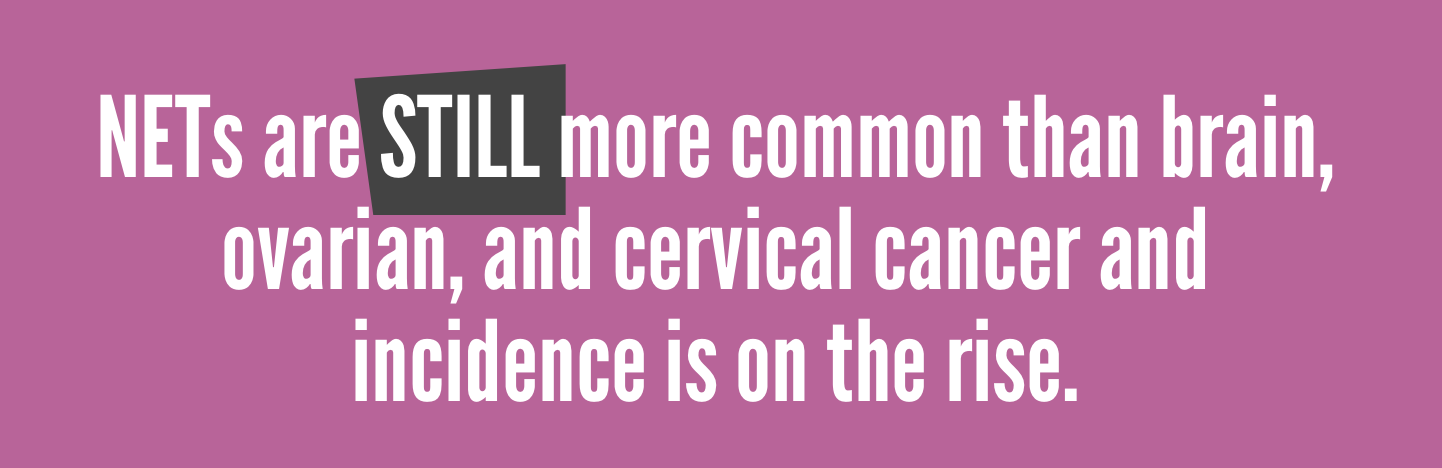
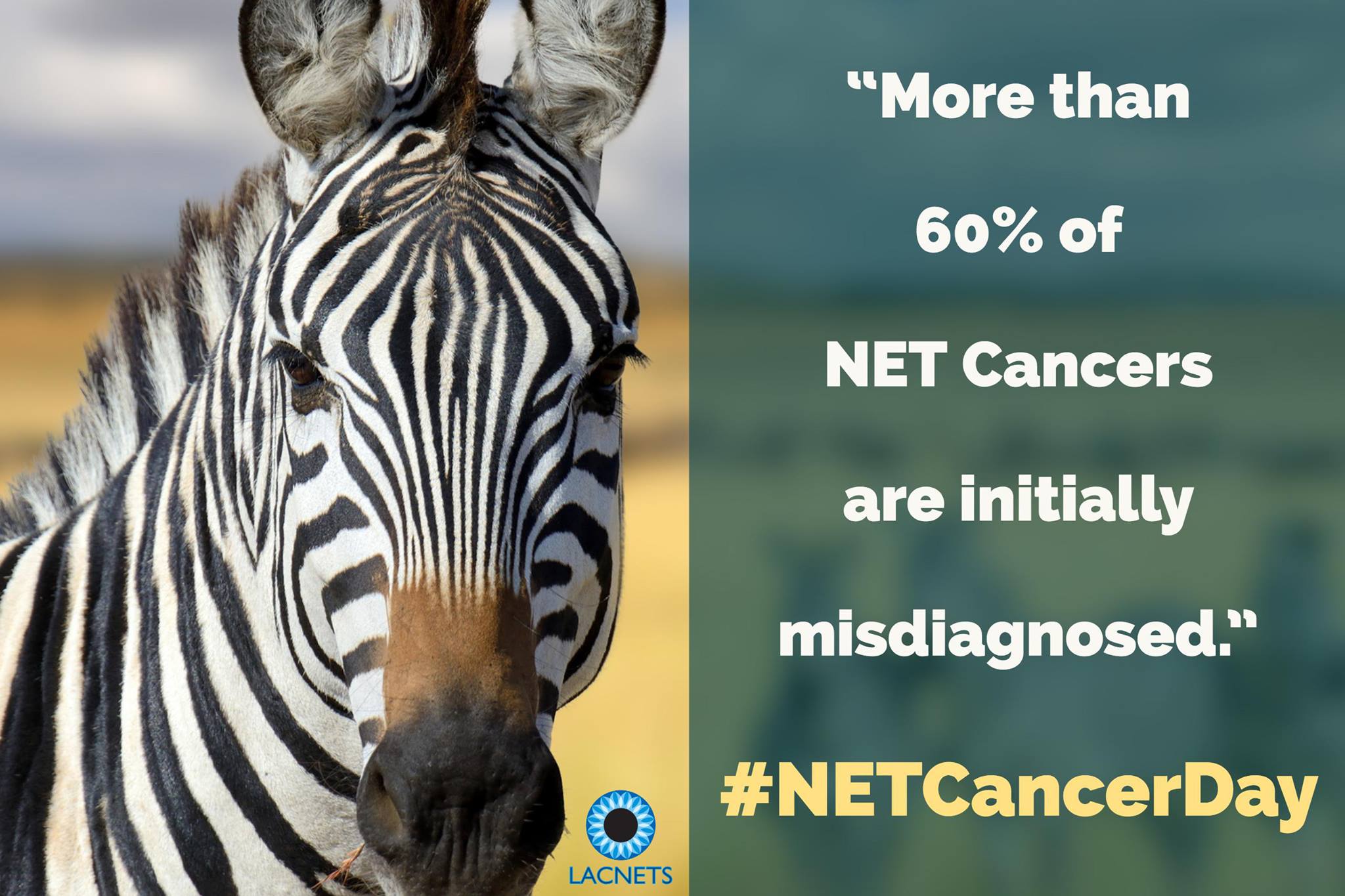
Less than 30% of neuroendocrine cancer patients receive a correct diagnosis the first time they reach out for help. In fact, it often takes five to ten years from onset of symptoms to correct diagnosis. During that time, of course, the cancer quietly spreads.

Screen Shot 2022-11-10 at 9.46.22 AM

Here are some facts about neuroendocrine cancer:

  • NETs are a unique group of cancers that arise from neuroendocrine cells and can be found in many organs of the body.
  • NETs generally affect people over the age of 50, but not always.
  • Symptoms of NETs vary and are often non-specific due to their ability to secrete an excess of different hormones.
  • Symptoms depend on the organ where the tumour is located and may include abdominal pain, diarrhea, nausea and vomiting, weight loss, skin flushing, chest pain, coughing, wheezing, shortness of breath, and/or back pain. 
  • As a distinct class of tumours, NETs require specialized tests and treatments.
  • NETs are often found unexpectedly during unrelated medical procedures or imaging tests.
  • NETs are the second most common cancer of the digestive tract.
  • Gastrointestinal NETs are often found in the appendix, colon, and rectum, but can also affect the stomach and small intestine.
  • Lung NETs comprise 20 to 25% of all invasive lung tumours.
  • The incidence and prevalence of pancreatic NETs (the form of neuroendocrine cancer that claimed the lives of Steve Jobs and Aretha Franklin) have been steadily increasing over time and now comprise about 7% of all pancreatic cancers.
  • Merkel Cell Carcinoma, a rare skin cancer, is a form of neuroendocrine cancer.

One of the most important things I’ve learned since my diagnosis is how important it is to advocate for yourself. Know your body. Know what’s normal for you. Pay attention when something feels off. Take note of unusual symptoms and talk to your doctor as soon as possible. If you don’t get the answers you’re looking for, PUSH! Don’t give up.

Thankfully, at this point, my cancer is stable. Constant surveillance is important though, so I’ll be having CT scans and other tests again next month. In the meantime, since hubby’s diagnosis with prostate cancer this summer, my health has temporarily taken a back seat. Now that his name is on the five to six month waiting list for robotic prostate surgery, we’re breathing a sigh of relief and getting on with life. Though there is no cure for me, I continue to trust that I’m not dying of NETs, I’m living with it! 

Here we go again!

We were camping almost nine years ago when my doctor called to tell me that I had cancer. The news was completely unexpected and, in that moment, our lives changed forever. We were camping again this summer when hubby’s urologist called to tell him that he has two different kinds of prostate cancer, so here we go again!

A recent biopsy took 12 tissue samples from Richard’s prostate. Two of those, taken from one side of the heart shaped gland, showed a low-risk, non-aggressive cancer that is common in older men and usually requires nothing more than surveillance. Unfortunately, one sample from the other side proved to be a somewhat more aggressive form. According to the Gleason score, a scale used to evaluate the grade of prostate cancer cells, it’s a medium-grade cancer meaning that treatment ought to be considered.

There are several possible options. Surgical removal of the prostate, in spite of the fact that it has some negative effects, is thought to be the best choice for long-term survival, but the urologist warned us that the maximum age for a radical prostatectomy has always been a matter of debate and many specialists consider 70 to be the upper limit for performing this surgery. At 72, Richard is otherwise in excellent health and physical condition, so he has been referred to a specialist who does robotic prostate surgery, the most advanced treatment option available. We are praying that he’ll be approved and that the procedure will go ahead. If not, we’ll have to consider other options.

Over the past nine years, we have learned many things. The word cancer, itself, isn’t as scary as it once was. Though not to be taken lightly, it isn’t necessarily a death sentence either. We’ve learned to live life to the fullest and to consider every day a gift. We’ve learned the importance of living in and enjoying the moment. We’ve learned that a positive attitude makes the fight easier and adds to the quality of our days. We’ve learned not to worry about things that haven’t happened yet. As Matthew 34:6 says, “do not worry about tomorrow, for tomorrow will worry about itself. Each day has enough trouble of its own.” We’ve learned to focus on the things that are important in life and to let go of things that drain us for no good purpose. We’ve learned that there can be joy in the midst of challenging times. These are all lessons that we’ll take with us as we embark on this next journey.

Ultimately, we know that we have a God who walks this pathway with us and promises to take care of us. “Do not fear, for I am with you; do not be dismayed, for I am your God. I will strengthen you and help you; I will uphold you with my righteous right hand.” Isaiah 41:10

imagesAs always, the blog will be about more than cancer, but from time to time I will be using it to share progress reports. The only difference from the past will be that now I’ll be reporting on both of us!

One less cancer!

It’s been several months since I wrote an update about my health which is usually a good thing because it means that there’s been nothing new to report. This week saw something very big happen though! Before I get into that, let me begin with a bit of history for those who are new to the blog.

In the early fall of 2013, I was diagnosed with neuroendocrine cancer (NETS) which is incurable, but often treatable. Exactly seven months later, a second completely unrelated cancer was found in a my left parotid (saliva) gland. Treatment on the first cancer was halted while that one was removed surgically and followed up with thirty radiation treatments. Once I’d had time to heal from that, treatment on the first cancer resumed. I entered a clinical trial that involved 12 radioisotope treatments (PRRT) over a period of approximately five years. Each of these treatments left me highly radioactive for a week, but I responded well and there was some shrinkage of my tumours. In the fall of 2018, toward the end of that regimen, scans detected something suspicious in my thyroid gland which eventually proved to be yet another unrelated cancer. Since only a small percentage of papillary thyroid cancers are aggressive in nature, the decision at that time was to watch and wait. My body had been through enough and we could afford to give it time to heal before deciding how to address this latest discovery.

Skipping ahead three years to last fall, my neuroendocrine cancer continued to be stable. In fact, 20 months after my last PRRT treatment, I was still experiencing some decrease in tumour size. I was feeling great and able to live a normal, active life. Though there had been no change to the thyroid cancer, we decided that the time had come to remove it rather than taking a chance on allowing it to begin growing or spreading.

Then began the long wait due to Covid hospitalizations delaying surgeries! Finally, on Thursday morning, the same amazing surgeon who did my previous neck surgery removed my thyroid. I woke up very early that morning with two distinctly different kinds of cancer and a few hours later I had only one again! It’s taking awhile for the reality of that to truly sink in.

After an overnight stay in the hospital, I’m home and feeling remarkably well considering. I’ve needed nothing more than Tylenol for pain which is such a blessing as heavy duty pain killers make me nauseous. My neck feels a bit like someone held me in a headlock for an extended period of time which is probably pretty similar to what happened during the 3.5 hours of surgery! I have a very husky voice as the result of some difficulties with the breathing tube, but that should gradually heal over the next couple of weeks. I had a super good sleep last night and now I’m just going to lean back and take it easy for a few days! During the first week of March, I’ll be back in the city for a follow up appointment with the surgeon as well as CT scans to check on the neuroendocrine cancer. In the meantime, I’m just rejoicing over having one less cancer!

1479468594421-V9D5BEZF2RTMCO558E0E

NET Cancer Day 2021

ncd-logo-new

Once again, today is Worldwide NET Cancer Day, a day set aside to increase awareness of neuroendocrine (NET) cancers and to promote improved diagnostics, treatments, information, care and research.

The theme of this year’s campaign is

Know the symptoms.

Push for diagnosis. 

Less than 30% of neuroendocrine cancer patients receive a correct diagnosis the first time they reach out for help. In fact, it often takes five to ten years from onset of symptoms to correct diagnosis. During that time, of course, the cancer quietly spreads. Thankfully, compared to many other cancers, NETS is slow growing, but like many of my fellow patients, I was Stage 4 at diagnosis. This means that my cancer had already spread from its origin to distant parts of my body. At this point, 8 years after diagnosis, treatment has halted it’s progress and resulted in some shrinkage, but there is no cure.

Know the symptoms. 

23213264_715559725308228_7678779028864335896_o

Once considered rare, neuroendocrine cancer is actually the fastest growing class of cancers worldwide. Unfortunately, many health care professionals have never seen a case and know little or nothing about this complex disease. In order to achieve early, correct diagnosis for every patient, we need every primary care physician to know and recognize the symptoms. When they are presented with stomach pain, it makes sense for them to suspect gastritis (inflammation of the stomach lining), but we also need them to wonder if it could be neuroendocrine cancer. When the stomach pain is accompanied by severe diarrhea, irritable bowel syndrome is a definite possibility, but we also need the doctor to be aware that it could be NET cancer. When a woman complains of facial flushing, rather than simply assuming that it’s due to menopause, we need her doctor to ask himself if it could be NETS. Depending on the location of the primary tumour, other symptoms may include nausea and vomiting, rapid heartbeat, anxiety, skin rash, shortness of breath or wheezing, lack of appetite, unexplained weight loss and/or lack of energy.

Push for diagnosis. 

Message-5-16_9-Key-Messaging-Infographic

Diagnosing neuroendocrine cancer is complex. In addition to recognizing the symptoms, we need doctors to order the correct laboratory tests and scans. It’s also important for patients to push for correct diagnosis. One of the most important things I’ve learned since my diagnosis is how important it is to advocate for yourself. Know your body. Know what’s normal for you. Pay attention when something feels off. Take note of unusual symptoms and talk to your doctor as soon as possible. If you don’t get the answers you’re looking for, PUSH! Don’t give up. Years before I was finally diagnosed, I remember thinking “at least it’s not cancer” but I was wrong! If I’d pushed for answers then, perhaps it would have been caught much sooner and the outcome might have been very different!

Know the symptoms.

Push for diagnosis. 

Blogging woes and cancer news

My beloved MacBook Air is getting old; old enough that I’m not able to update to a newer browser. Recently, whenever I opened WordPress to check my stats or work on a post, I received a message telling me that I was using an unsupported browser. Until earlier this week, however, I was able to click through to the appropriate page and work as usual. Then came the fateful day when all that I could open was a blank page with the WordPress logo in the centre!

As I usually do when something goes wrong in my blogging world, I fired off a cry for help to WordPress support and hoped for the best. They’ve never let me down yet, but while I wait to find out what they can or can’t do for me, I’m typing this on my husband’s computer. Not easy! Mine is a Mac, but his is not. The keyboard is a different size and my fingers don’t know what to do. Things jump around when I’m not expecting them to and then there’s the issue of all my photos being on my computer and not knowing how to transfer them to his. With practice, I’m sure these things will get easier, but this is, at best, a very temporary solution! I’m hoping that I don’t have to invest in a new computer right now as mine still does everything else I want it to do, but I have to be able to blog!   

Now, for the other news… 

In mid August, I went through a series of tests and scans, as I do every six months, to determine whether or not there were any changes to my cancers. When the results became available online, I was concerned about a spike in one marker that is particularly significant to neuroendocrine cancer (NETS). Not only had the level increased dramatically, but it was now slightly above the normal range. Knowing that I had to wait several weeks to see the doctor for an explanation, my response was similar to when WordPress quit working. I called for support. I sent out a cry for help to eight godly women asking each of them to pray, not only that my cancer had not grown or spread, but also that I wouldn’t be anxious as I waited for answers. Almost immediately, an unnatural peace descended on me and I was able to go on without undue stress or anxiety. 

“Do not be anxious about anything, but in everything, by prayer and petition, with thanksgiving, present your requests to God. And the peace of God, which transcends all understanding, will guard your hearts and your minds in Christ Jesus.”  Philippians 4:6-7

And now for the really good news… my cancer continues to be stable and the doctor has no concerns! Though the spike in that one marker looked concerning to me, she assured me that it would have to be much higher before it was anything to worry about. Praise the Lord!

100 butt darts!

Every 28 days, without fail, a visiting nurse pulls up in front of our house and comes in to give me an injection of Sandostatin LAR. Today was the 100th of those butt darts!

185522421_4133815289994653_3767392803849794568_n

Sandostatin LAR is a long-acting treatment meant to reduce or eliminate the symptoms associated with neuroendocrine cancer (NETS) and for me it has been an absolute life changer! No longer do I live with the stomach pains and diarrhea that plagued me off and on for several years prior to diagnosis. Though the effect of Sandostatin on tumour size, rate of growth, and development of metastases has not yet been determined, it is thought that it might also be of benefit in those areas.

Sandostatin comes as a powder and a diluent solution that must be mixed and administered according to very precise instructions which is why I haven’t been taught to inject it myself. Once the diluent is added to the powder, it must be allowed to stand for a minimum of 2 minutes and not more than 5 to ensure that the powder is fully saturated. Then, after gently shaking the syringe for about 30 seconds to ensure that the powder is completely suspended, the nurse has to administer it without delay to avoid sedimentation. Even following these guidelines carefully and using a fairly large needle (19 gauge), it sometimes plugs. On those occasions, she has to quickly change the needle and try again. On a couple of occasions it has taken 4 jabs to get the medication into me! My 100 butt darts has actually involved about 130 pokes altogether.

In addition to the benefits that the drug offers, getting it into me and not wasting it is of vital importance because every one of those butt darts costs $2358.52 CAD! In other words, over the past almost 8 years, we have pumped more than $235,000 into my posterior! You could buy a nice house in our small town for that much.

This is where I’m really glad to be Canadian. I pick up the Sandostatin at my local pharmacy every 4 weeks and don’t pay a cent! The cost is fully covered by the government and that includes the cost of having the nurse come to my home. A Mobile Administration Program even enables me to have my injection administered by a trained nurse anywhere else in Canada. A simple phone call is all it takes to make the arrangements. I have to take the medication, which has to be refrigerated, with me but I’ve found that an insulated lunch bag and a mini freezer pack do the job as long as I can put it in a fridge overnight. So far, I’ve had butt darts administered at all 3 of my children’s homes. Arranging to have it done outside the country would be more complicated and isn’t something I’ve tried at this point.

So, is getting my monthly Sandostatin a pain in the butt? Not really. As a child, I was terrified of needles, but I lost that fear a long time ago. Only once in awhile does really hurt going in. Today was one of those occasions, but it went in on the first try, so I’m not complaining! The injection site often feels bruised for a couple of days and a lump often forms that gradually dissipates over the next few weeks, but these minor inconveniences are well worth it when I consider the benefits. So, 100 butt darts down and here’s hoping that I can have 100 more! Or 200. Or more!

It happened!

I had my second Covid-19 vaccine injection today! It was an uphill battle getting here, but it happened!

IMG_2362

Continuing from where I left off when I wrote the post Am I expendable? on April 18th, I called my MLA’s office and the Ministry of Health. By that time, the cry for cancer patients to receive their second vaccine within the recommended time frame had hit the media and was definitely on the government’s radar. Though I wasn’t given any details, I was told that a decision would be announced soon.

Finally, late on the afternoon of April 22, the Chief Medical Officer of Alberta announced that cancer patients and others who were severely immunocompromised could begin booking their second appointments by phone the following day. Actually getting the appointment was quite a gong show though. I started calling first thing the next morning, but the lines were clogged. I was absolutely elated when I got through later that morning and was able to book my appointment for the morning of April 30, just two days beyond the 21 day interval recommended for the Pfizer vaccine. My excitement was short-lived, however. Within a couple of hours, I received an email, with no explanation, telling me that my appointment had been cancelled!

I immediately phoned again and made a second appointment, only to have that one cancelled the following day! At that point, I started to think that somehow the information that I was a cancer patient must not be getting into the system. I admit to being pretty hot under the collar by the time I called a third time to make the same appointment! I mentioned my suspicion and the gal who did the booking agreed with me. She told me that there was a new button to click to indicate that a caller was part of the patient group who could now book their second injections. Apparently those who took my first two calls either didn’t know that or forgot. Fortunately, while all of this was going on, today didn’t completely fill up and I was still able to get in.  

I’m glad that no one checked my blood pressure during the two days that it took to finally get an appointment that stuck! The whole rigamarole certainly added to my stress level and I almost feared checking my email for the next few days in case I once again saw a “Covid-19 Immunization Cancellation” message waiting for me! After fighting so hard to see this happen, I didn’t feel 100% certain that it would until the needle was actually in my arm! 

The fight isn’t over yet though. The majority of cancer patients across Canada still don’t have access to their second vaccine within the timeline proven most effective by clinical trials. CONECTed, a national network of oncology groups supported by over 17 national patient organizations, has launched a campaign asking the federal government to revise the National Advisory Committee on Immunization (NACI) recommendation for cancer patients so that they would receive 2 doses of Covid vaccine within 21 to 28 days of each other. They are also asking provincial and territorial governments as well as local administrators to ensure that adequate directives and resources are provided to achieve this goal. 

image002(1) (1)

Being fully vaccinated isn’t actually going to make any difference to how I live my life at least in the short term. It typically takes two weeks after a person is fully vaccinated for the body to produce enough antibodies to provide protection from the virus and even then, with the Covid-19 situation here in Alberta the worst it’s ever been, life won’t be getting back to “normal” anytime soon.  

Am I expendable?

Cancer has been trying to defeat me for almost 8 years. Now it looks like it’s trying to recruit Covid-19 to help it out. No, I don’t have Covid and I’m trying to do everything I can to keep from getting it, but I’ve run into a dangerous roadblock that is affecting cancer patients across our country. 

Vaccines have been touted as our way out of this pandemic and I believe that they probably are IF they’re given correctly. That’s where the problem lies. According to the product monographs and based on the trials that were performed before the vaccines were approved, the second Pfizer dose should be given 21 days after the first, Moderna 28 days, and AstraZeneca 4 to 12 weeks. Here in Canada, however, the National Advisory Committee on Immunization (NACI) has recommended that in order to maximize the number of individuals benefiting from the first dose of vaccine, the interval between doses be extended to four months or 16 weeks.

While there is no evidence to show that this is an effective way of administering these vaccines, the extended period between doses may not make a big difference to the general population, but that is not true for those of us with cancer. Research conducted in the UK has shown that while an antibody response was found in 97% of the healthy volunteers tested after their first injection, the response was less than 40% in patients with cancer. That number increased dramatically to 95% if they received their second shot at the recommended time, but only 43% if that time was extended. 

I had my first injection of the Pfizer vaccine on April 7. That means that I have 10 days until I should be getting the second one, but I feel like I’ve been beating my head against a wall trying to make that happen. I’ve called Alberta Health Services to no avail. The clinic where I received my cancer treatments was unable to help. I’ve attended a webinar with members of various patient advocacy groups across the country and I’ve contacted the media. A petition has collected more than 20,000 signatures over the past few days and news sources are coming onside, but will the government listen? Ontario and Manitoba are moving forward with the second dose for cancer patients, but here in Alberta not one word of hope has been heard from our government. It would seem that they have decided that those of us who are already fighting for our lives are expendable! 

photo-1618093877862-3630a08f737f

Photo: Spencer Davis