Downtown Montreal

I’m back from a whirlwind trip to Montreal where I attended a three day Canadian Neuroendocrine Tumour Society (CNETS) conference. More about that in Friday’s post, but today I want to share a bit of that beautiful city with you. 

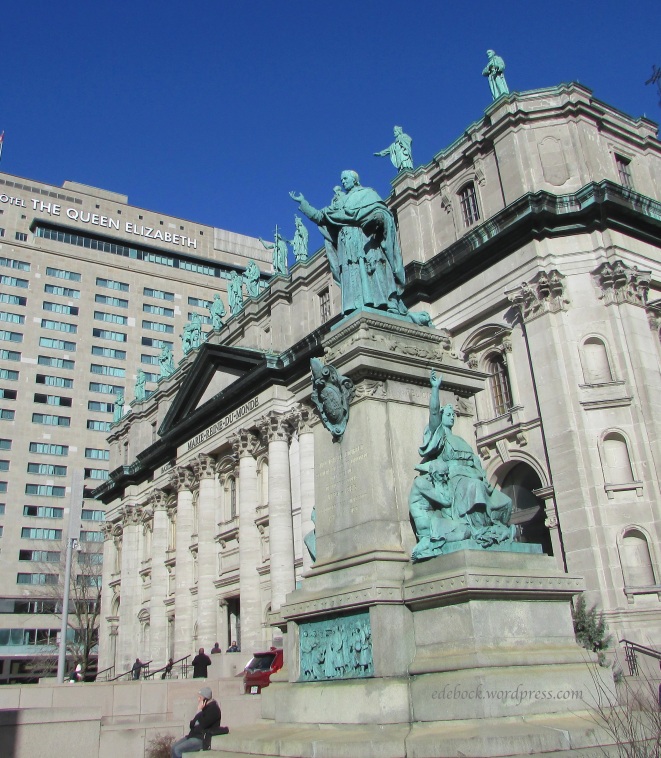
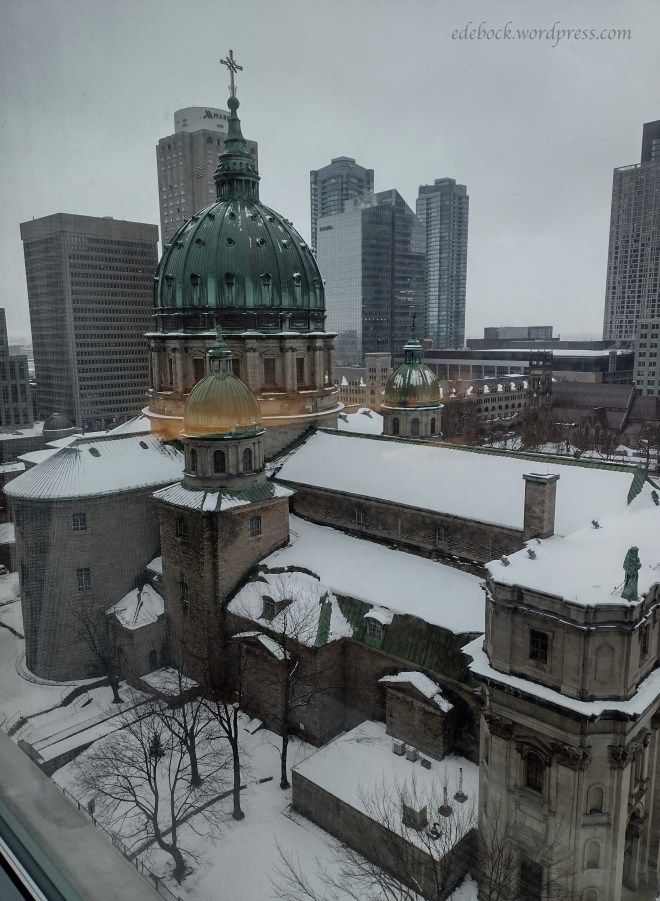
After my plane was delayed for four hours by a major snowstorm, I finally arrived late in the evening and checked into the downtown Fairmont Queen Elizabeth Hotel where the conference was being held. Entering my hotel room, I was awestruck by the view from my window overlooking the ornate Basilique Marie-Reine-du-Monde (Mary Queen of the World Basilica), a smaller replica of St. Peter’s Basilica in Vatican City. 

IMG_20240405_073719691_HDR

The following pictures of the basilica were taken on one of my walks after the weather cleared. 

IMG_6721 2

While the statues on the facade of St. Peter’s depict the twelve apostles, at Mary Queen of the World thirteen statues represent the patron saints of the parishes that form the diocese of Montreal.  Carved of wood and clad with copper, each statue is 9 feet tall. They were completed between October 1892 and October 1900 by Quebec native, Joseph Olindo-Gratton.

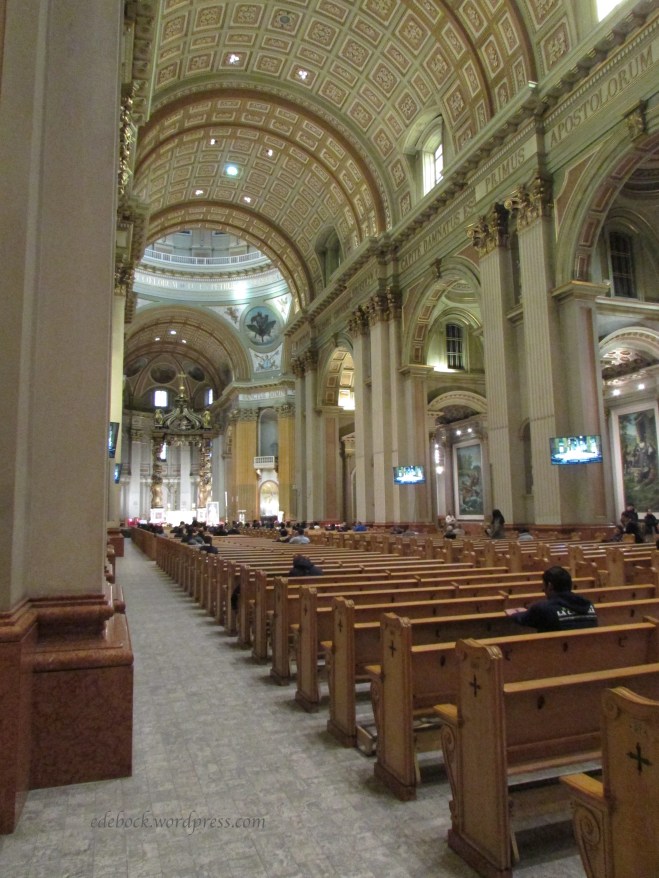
I was thankful to able to slip inside the basilica for a quick photo of the interior. 

IMG_6723

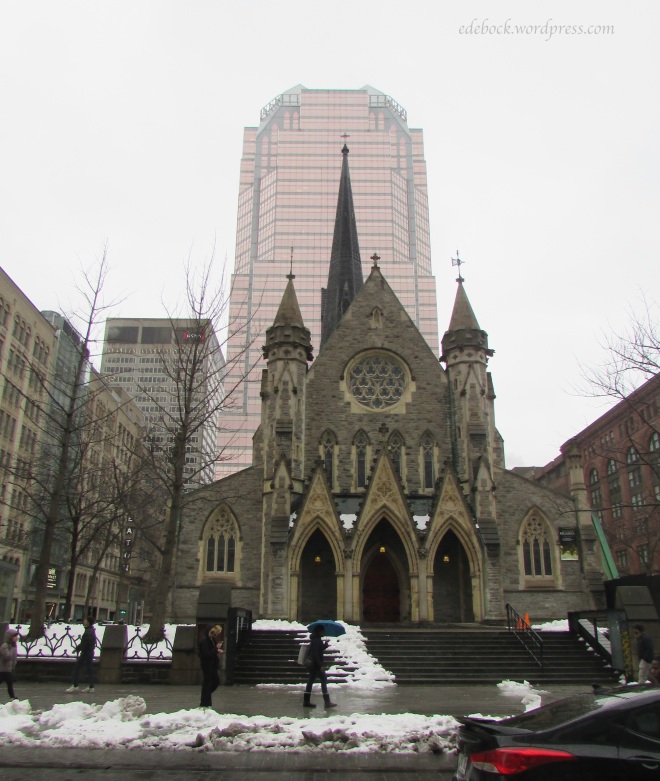
Downtown Montreal is home to many old stone churches. This one is Christ Church Cathedral and has been designated a National Historic Site of Canada.

IMG_6697

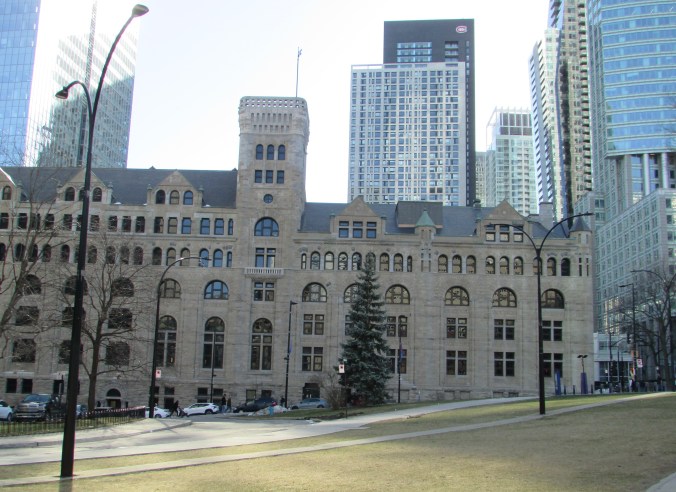
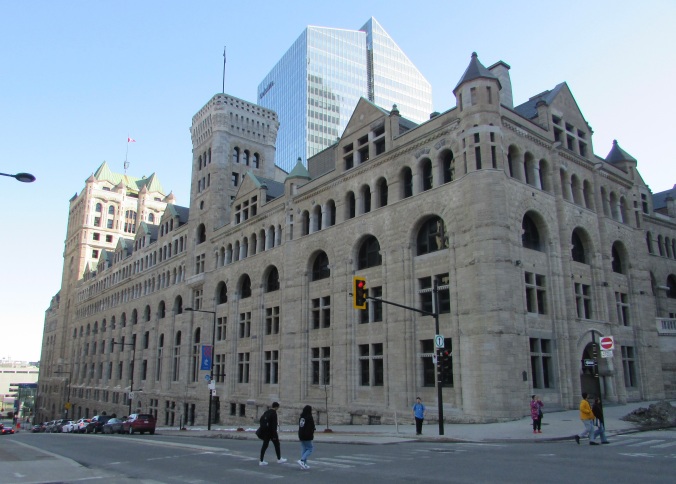
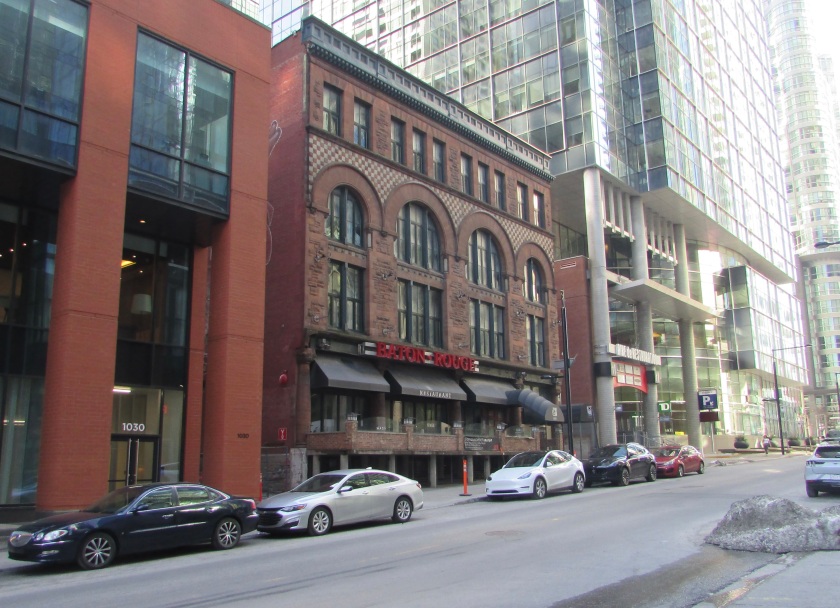
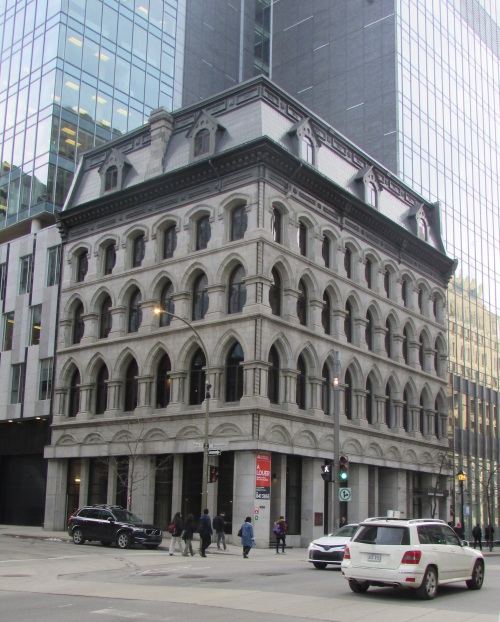
As always, I love the juxtaposition of old architecture and new. Here are a few other structures that caught my eye as I walked. The first is Windsor Station. Formerly the city’s Canadian Pacific Railway station and headquarters of the CPR from 1889 to 1996, it has been redeveloped into an office complex that also houses some restaurants and cafés. I can’t tell you anything about the others. 

IMG_6714

IMG_6708

IMG_6712

IMG_6716

IMG_6804

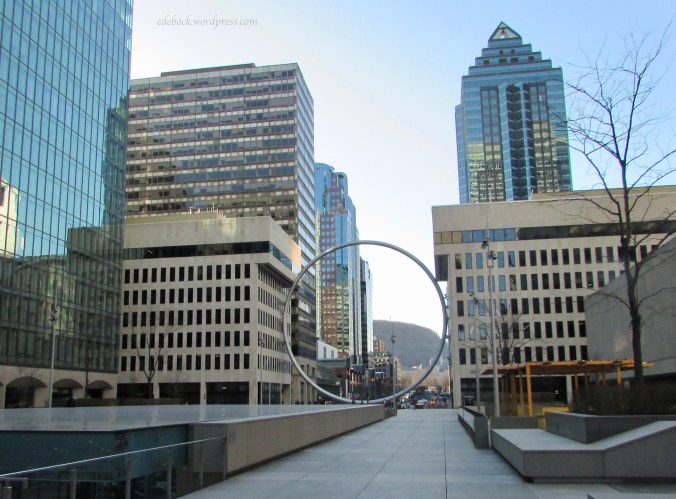
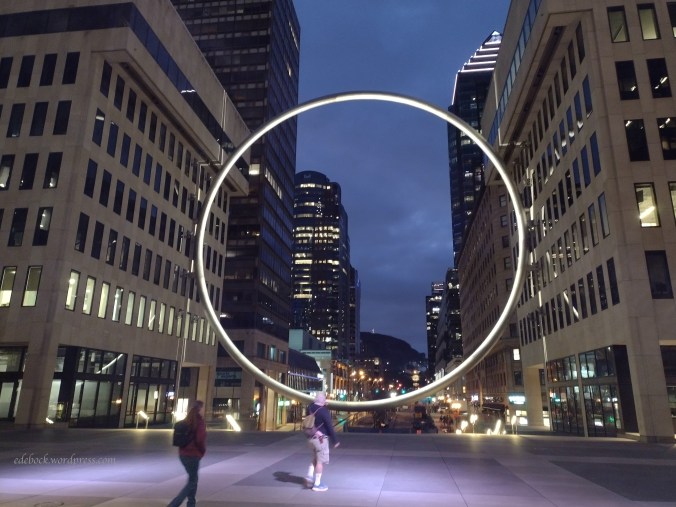
Though there is no end of old architecture to enjoy in Montreal’s downtown area, there’s also something new to see. Suspended between two buildings, 30 metres in diameter and weighing some 23,000 kilograms, The Ring hovers over the staircase of Place Ville Marie’s Esplanade directly across Rene Levesque Boulevard from the Queen Elizabeth Hotel. Installed in June 2022, The Ring serves as a window to more than 200 years of history, establishing a direct line of view from the hotel and Place Ville Marie to McGill University, the former Royal Victoria Hospital, and the illuminated cross on Mount Royal.

IMG_6744

IMG_20240406_195749629

Baby, it’s cold outside!

Screenshot 2024-01-14 at 7.40.50 PM

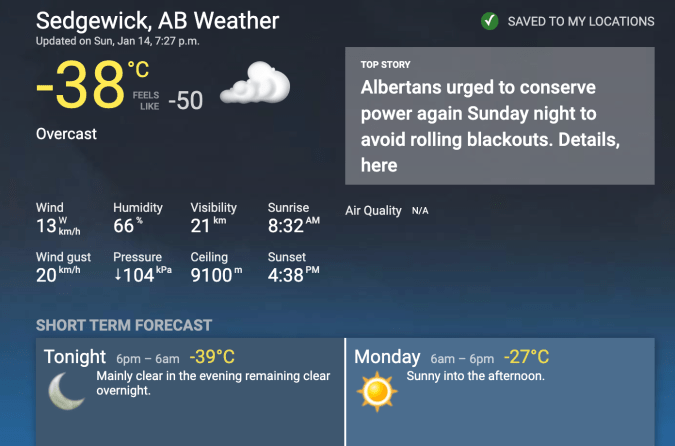
That’s the weather report as I write and it’s 8ºC warmer than it was when we got up this morning! (-46ºC is equal to -50.8ºF) I’ve seen many comments on social media today asking how we live at these temperatures, so for those of you who can’t imagine surviving such extreme cold, here’s how we do it.

First of all, we stay indoors as much as possible. Many businesses closed this weekend and many churches cancelled their services. Though schools usually remain open, school buses, especially in rural areas, often don’t run. Central heating systems (forced air furnaces), often fuelled by natural gas, keep our houses warm regardless of what’s happening outside.

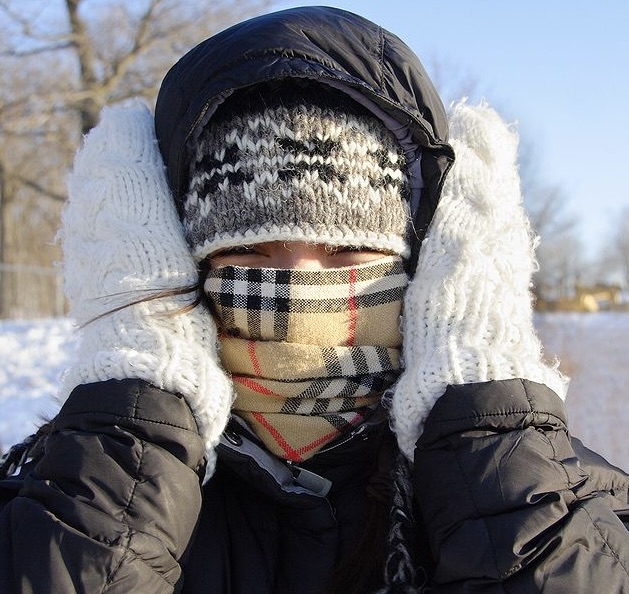
When we have to spend any time outdoors, we dress for the cold in layers that trap body heat and help keep us warm. In extreme cold, exposed skin will develop frostbite in a matter of minutes, so if we’re going to be outside for very long, we cover all but our eyes.

extreme-cold 2

Image: kawarthaNOW.com

Vehicles in this climate are equipped with block heaters. Most will start down to about -15ºC (5ºF), but below that, unless the vehicle is kept in a heated garage, the block heater needs to be plugged into a regular 110-volt outlet to warm the engine block and internal fluids like the oil and coolant. Wise drivers ensure that their vehicles are equipped with well-stocked emergency kits, extra clothes, blankets, and candles in case they’re stranded on the side of the road and have to wait for help.

This present cold snap seems especially harsh because, until now, thanks to El Niño, we’ve been enjoying an unusually mild winter. When I hear people saying that they’ve never experienced cold like this before, I’m reminded how old I am. While we haven’t seen daytime temperatures like these for 20 years, I distinctly remember waking up to -50ºC (-58ºF) one morning in late 1976 or early 1977. Hubby and I, both school teachers at the time, had only been married a for few months. After warming up the car, we attempted to leave for school. As soon as the vehicle moved, one of the tires, frozen solid, separated from the rim. We bundled up and walked to school! Thankfully, it was less than a kilometre away (about half a mile)!

One last thing that Albertans love to do to make winter more bearable is to get away to somewhere warm for a mid winter break. Hubby and I will be doing that soon, so more about that in future posts!

Another Miquelon September

We spent several days this week camping at Miquelon Lake Provincial Park, less than an hour and a half from home. We’ve camped there several times in the past, always in September.

It’s definitely not the lake that keeps us going back. Shallow, saline, and shrinking rapidly, it’s a small fraction of the size that it was a century ago. In fact, we’ve seen the water level drop significantly over the past few years. No, it’s the well-maintained hiking trails that keep us returning to Miquelon.. 

IMG_6039

IMG_6040

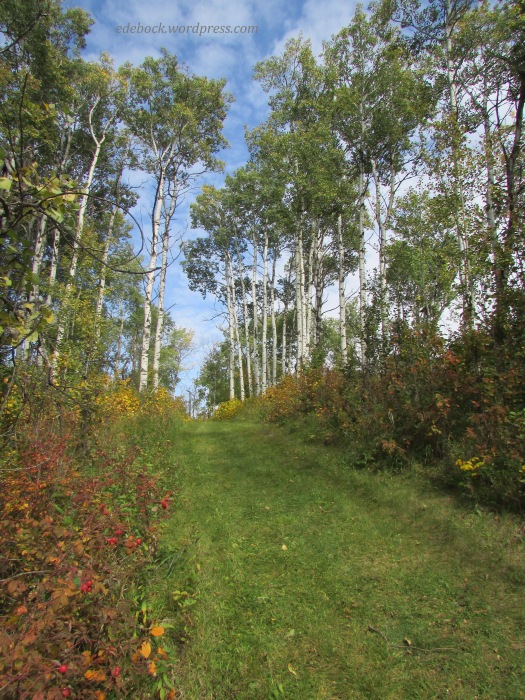
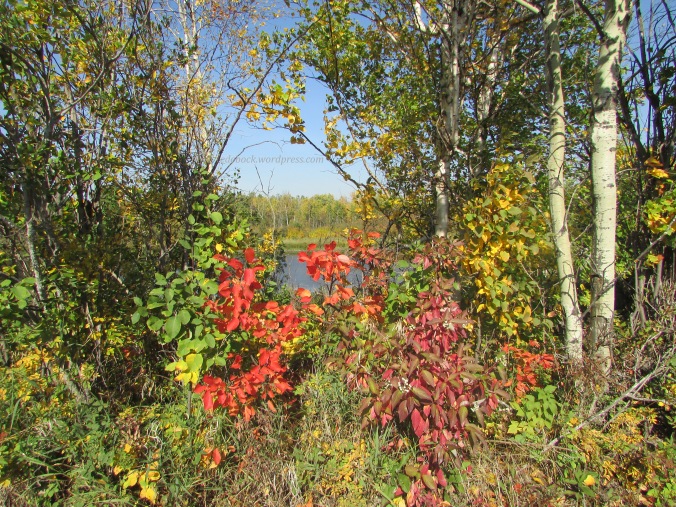
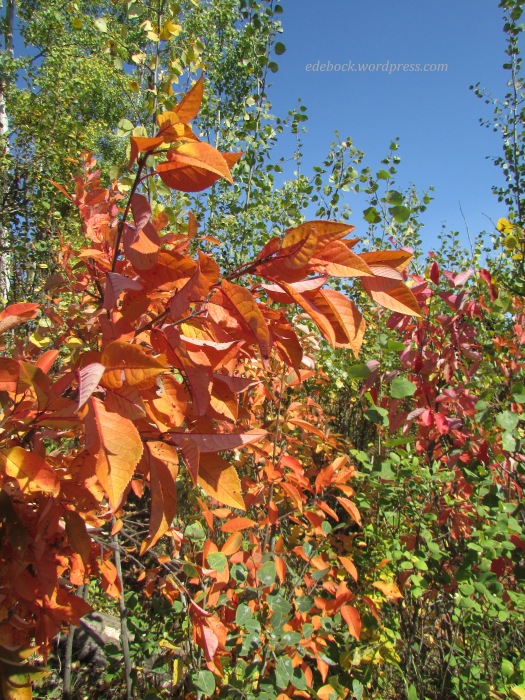
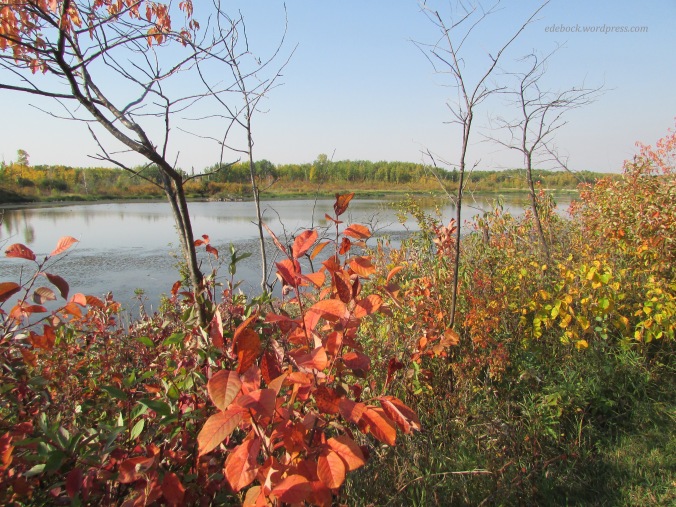
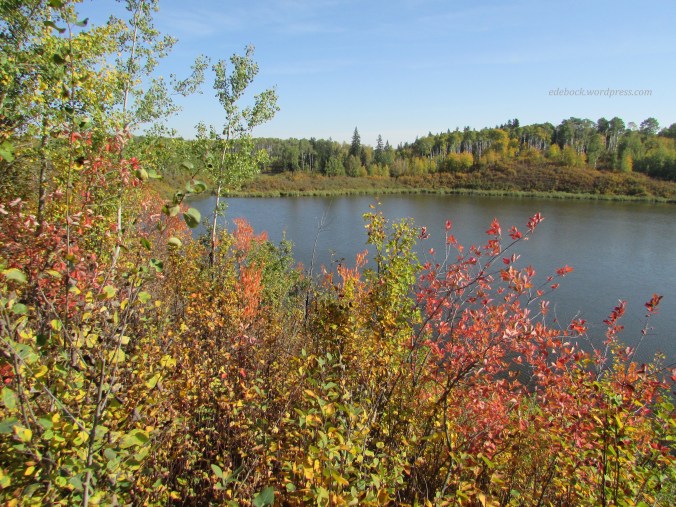
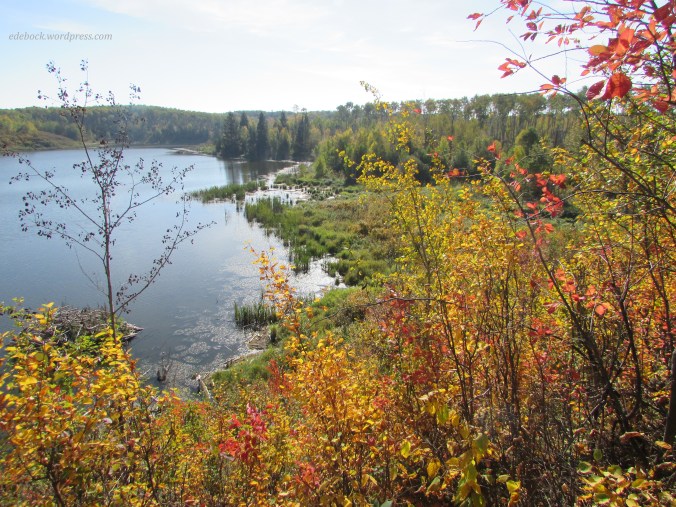
The “knob and kettle” terrain consists of hummocky mounds (the knobs) and water-filled depressions (the kettles). Hiking trails wind up and down, around and between the ponds and at this time of year, colourful foliage adds to park’s natural beauty. Here in Alberta, we don’t get the wide variety of fall colours that are found in eastern Canada, but Miquelon seems to be an exception! Is it any wonder that we love to go there in September?  

IMG_6046

IMG_6064

Over the past few days, we hiked a total of 26.5 kilometres (16.5 miles). As we made our way up and down the “knobs”, we definitely felt muscles that don’t come into play as much when we walk the level ground around home! Thankfully, our legs are in pretty good shape though. With just over 6 weeks to go, I’m only 32 km short of my goal of walking and/or hiking 350 km between May 1 and Oct 31! 

With our bear bell ringing, we didn’t see any of the larger wildlife, including deer, moose and elk, that live within the park, but there was clear evidence of their presence along the trails. Plenty of fresh hoof prints and droppings, including bear scat, told us that they weren’t too far off. We did see rabbits, squirrels, one garter snake, several grouse, and numerous other birds including an abundance of waterfowl. It was also clear that industrious beaver have been hard at work. 

The campground was very quiet during the week, but we were surprised to see how many rigs pulled in on Friday. Obviously, we aren’t the only ones who enjoy fall camping! 

IMG_6053

There were even a few hardy souls sleeping in tents. It must have been pretty chilly with nighttime temperatures dipping close to 0ºC (32ºF). We were toasty warm in our trailer bed though, except for the one night when the propane ran out and the furnace stopped running! Thankfully, fixing that problem was as simple as switching over to the second propane tank. 

IMG_6056

We’re hoping to fit in one more short camping trip before winter and I have no doubt that we’ll be back to Miquelon again another September. 

IMG_6062


Rowley, an Alberta ghost town

We spent several days camping this week and as a result, I don’t have a Fashion Friday post ready for you today. Instead, I’ll share one of the highlights of our short time away from home. After a horrendous storm Monday night, we woke to sunshine on Tuesday morning, but the wind was still much too strong to go golfing or kayaking and we’d already hiked the 6.5 km nature trail around a nearby lake. We didn’t want to spend the day sitting in the trailer though, so what should we do?

Hubby suggested a road trip to Rowley. In its heyday, Rowley, Alberta was an agricultural town of approximately 500 people, but at last count the population was 9. Yes, that’s right, 9 people and perhaps a few stray cats! Apparently, some of the residents don’t really like their hometown being referred to as a ghost town though that’s what it’s usually called. They take pride in the place and have worked hard to preserve the few remaining buildings and to turn it into a tourist destination. Once a month, the community association, made up of residents and people from the surrounding area, host a well-attended pizza and pub night to raise funds to help with the cost of maintenance.

As the ROWLEYWOOD sign at the turnoff on nearby Highway 56 suggests, the movies Legends of the Fall, The Magic of Ordinary Days, and Bye Bye Blues were filmed in the hamlet.

So, come walk with me and I’ll show you around Rowley, Alberta.

The Lion’s Oil Garage, complete with its old style gas pump, is a reconstruction of the building that originally stood on this site.

IMG_5901

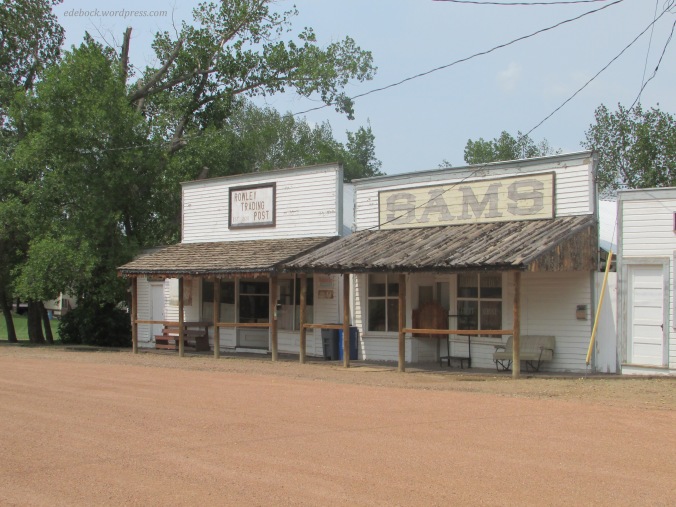
Walking down Main Street past Sams Saloon and the Rowley Trading Post, it’s easy to imagine ourselves transported back in time to the wild west. I could easily picture a couple of horses hitched to the rails and women strolling the boardwalk in old fashioned dresses. Built in 1920, the trading post was where Rowley residents purchased their dry goods and groceries until 1973 when it was the last business in town to close its doors.

IMG_5875

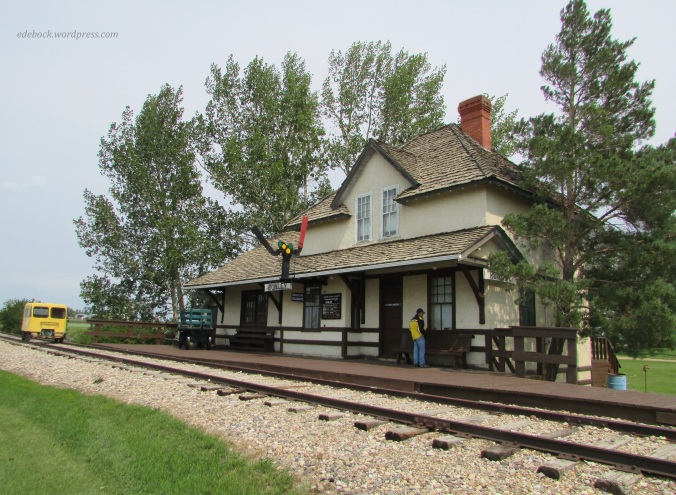
At the end of the street stands the beautifully preserved CNR train station. The station master and his family likely lived upstairs.

IMG_5878

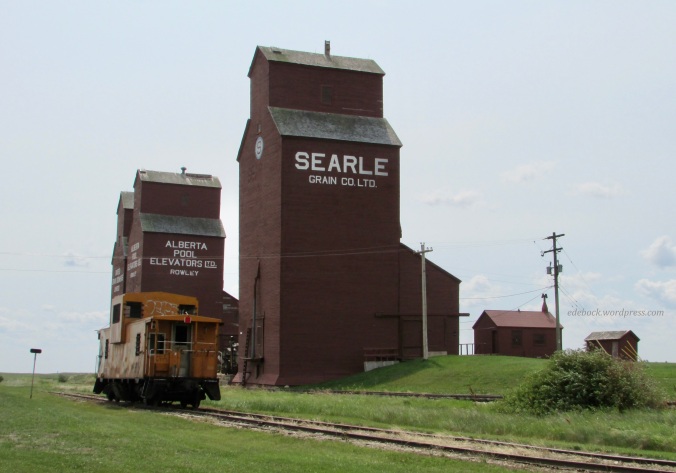
At one time, every little town on the Canadian prairie had its wooden grain elevators, but very few of these stately sentinels remain today.

IMG_5885

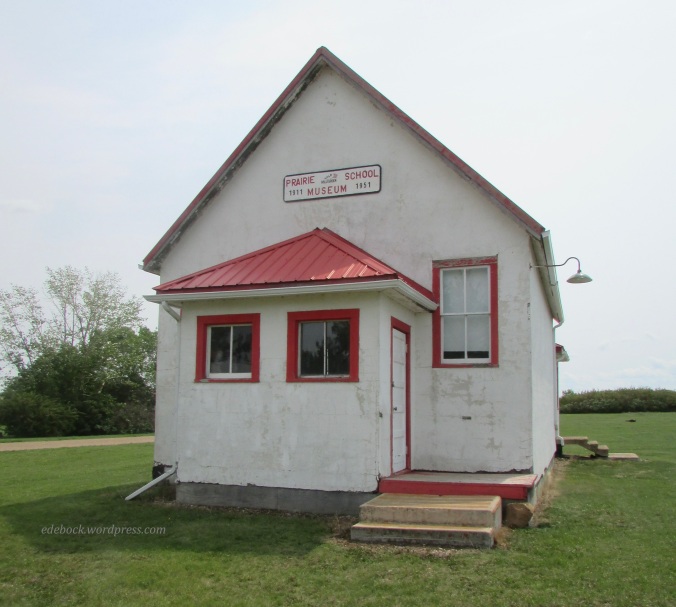
The Prairie School Museum is typical of the one room schoolhouses that dotted the prairie in days gone by. 

IMG_5891

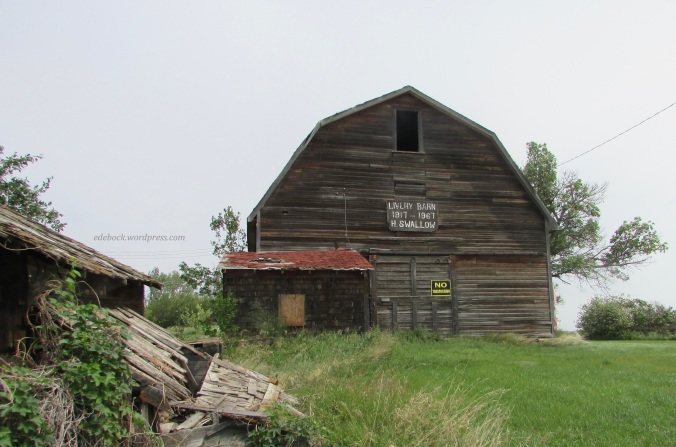
If you came to visit Rowley in the early days, you might have boarded your horse at H. Swallow’s livery barn. While some of the smaller structures around it are falling down, the barn still looks pretty sturdy.

IMG_5894

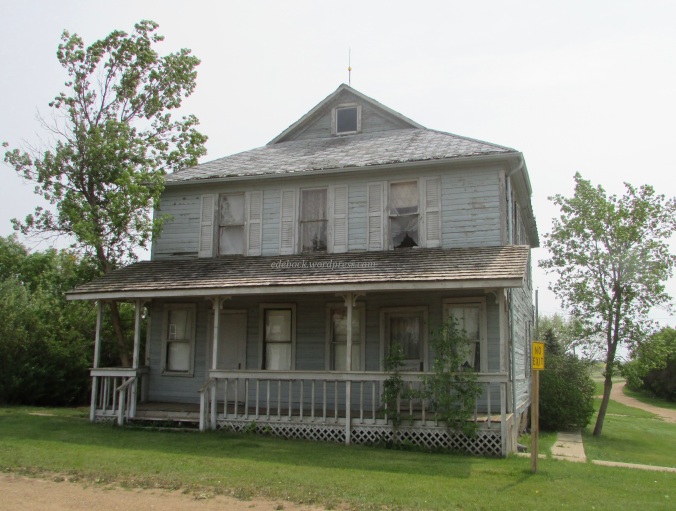
Circling back to the upper end of Main Street, we find this stately old house, weathered by time but still beautiful. Hubby and I thought that perhaps it had once been the town’s hotel, but after doing a bit of research I discovered that it was originally used as a hospital.

IMG_5897

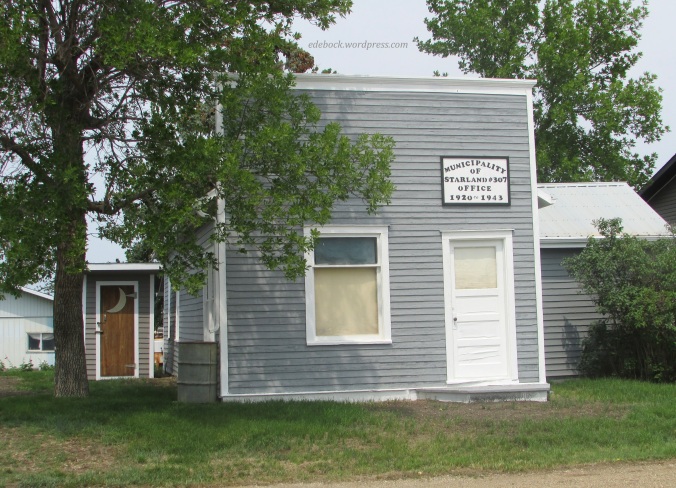
Across the street, the old municipal building has obviously undergone some fairly recent renovation. Though I’m happy to live in the day of indoor plumbing, we thought the backyard biffy was cute.

IMG_5898

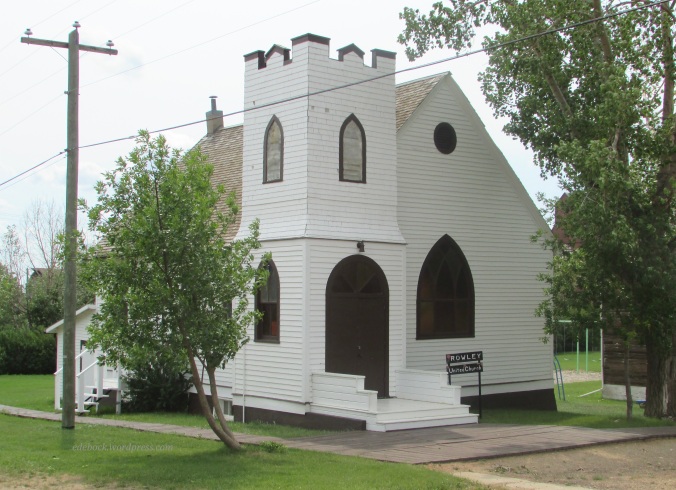
The Rowley United Church remained active until 1969 and continues to be used for the occasional wedding. 

IMG_5899

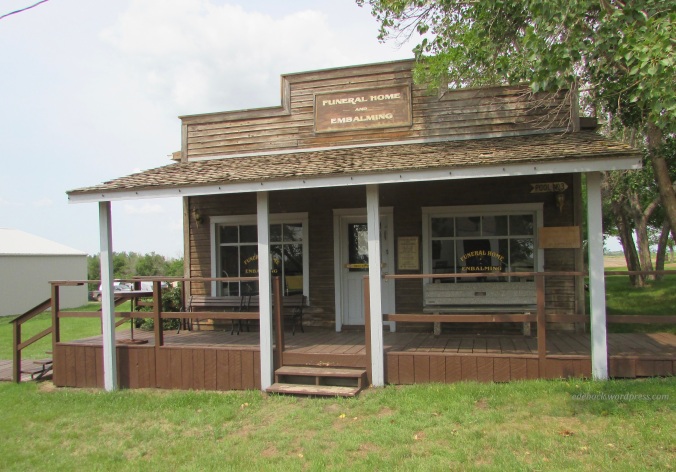
Like at least one other building in Rowley, not shown here, the funeral home across the street from the church was constructed specifically for the filming of the movie, Bye Bye Blues. Afterwards, the residents decided to turn it into a pool hall for their own enjoyment, but kept the front and signage intact. 

When we were there, we had Rowley almost entirely to ourselves and were content to peer through the windows at the artifacts housed inside the buildings, but should you wish to take a closer look, the Rowley community association hires local summer students to give free guided tours inside the buildings Thursday to Monday during July and August. 

Museum of Aboriginal Peoples’ Art & Artifacts

We spent a few days this week camping, hiking, and kayaking in Sir Winston Churchill Provincial Park near the small town of Lac la Biche, about two and a half hours northeast of Edmonton, Alberta. When I read that the Portage College campus in Lac la Biche is home to the Museum of Aboriginal Peoples’ Art & Artifacts, I knew that we had to go into town to see it. I recognized the names of well-known artists like Bill Reid, Alex Janvier, and Norval Morrisseau and was eager to see their work.

Arriving at the college, I expected to find a gallery showcasing the works of these and other Indigenous artists. Instead, the extensive collection of traditional and contemporary works lines the hallways of the school and we were free to wander and enjoy them. With only one class in session while we were there, it was as quiet and serene as any traditional gallery would have been.

IMG_5793

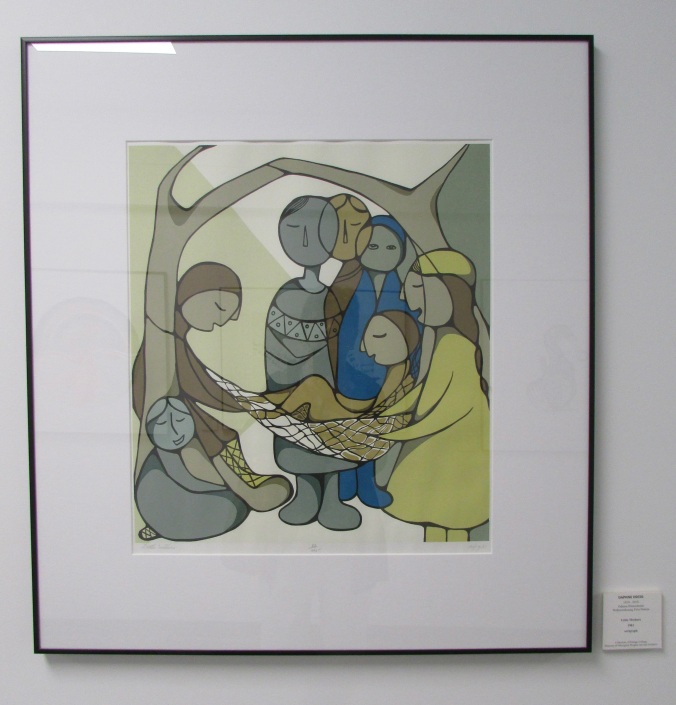
Little Mothers – Daphne Odjig

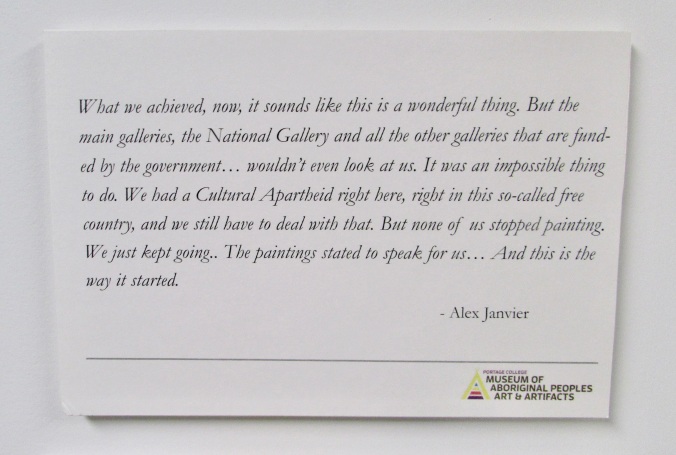
The Portage College museum features the world’s only permanent collection of works by the Professional Native Indian Artists Inc., also informally known as the Indian Group of Seven. The group was formed in 1972 after a series of gatherings in Daphne Odjig’s craft store and gallery in Manitoba and later incorporated as an attempt to be taken seriously as professional artists and to advocate for Indigenous art to viewed as fine art and to be included in galleries across the nation. The museum on the Portage College campus began in 1978 as a teaching collection for the college’s Native Arts and Culture programs and grew from there.

IMG_5783

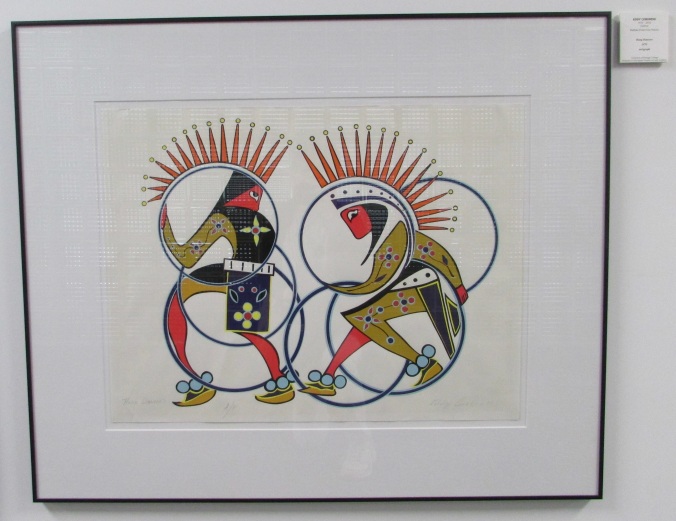
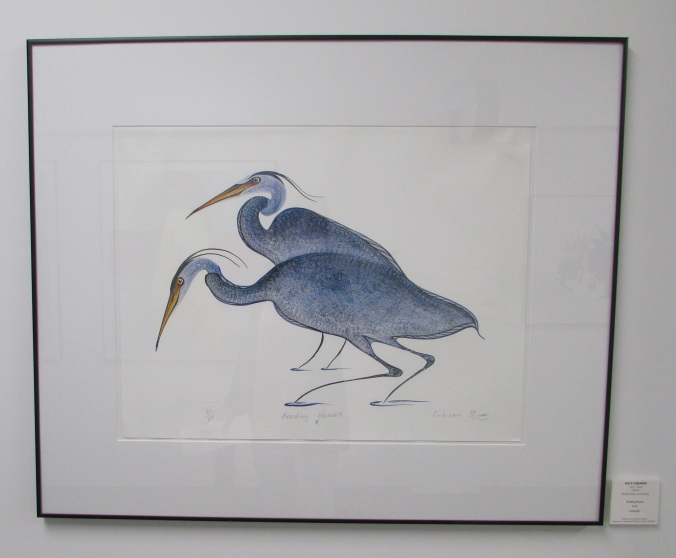
While I was impressed by most of what we saw, amongst the Group of Seven it was the work of Eddy Cobiness (1933-1996) that really stood out to me. Cobiness, of Ojibway descent, was born in Minnesota and raised on a reserve in Manitoba. Though I had not heard of him before, his art is held in many prominent private and public collections.

IMG_5777

Hoop Dancers – Eddy Cobiness

IMG_5805

Feeding Herons – Eddy Cobiness

IMG_5795

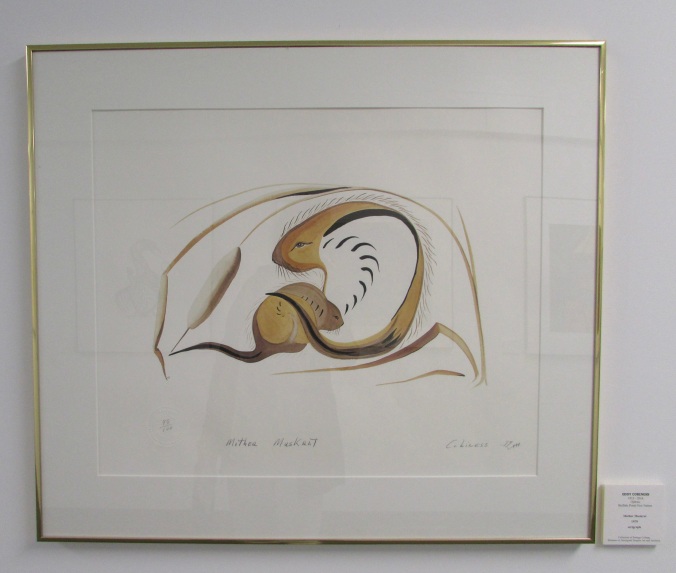
Mother Muskrat – Eddy Cobiness

IMG_5797

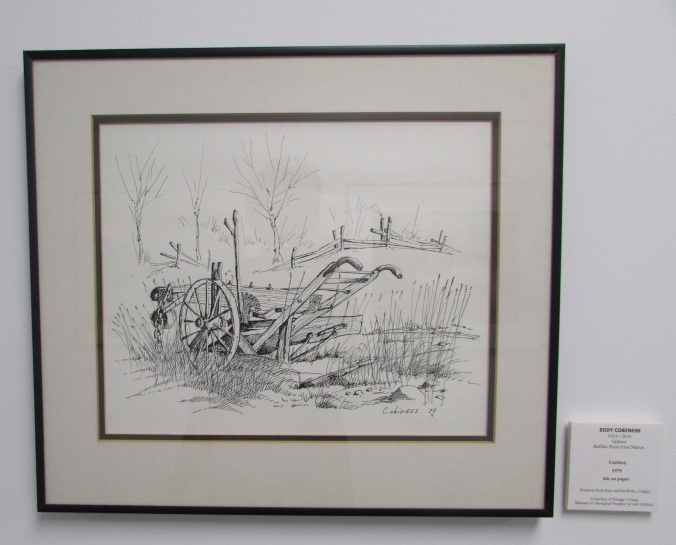
Untitled – Eddy Cobiness

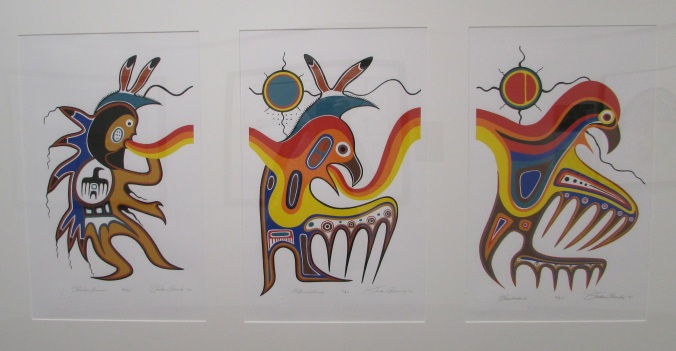
These three colourful designs by Jackson Beardy also caught my attention, probably because their style is somewhat similar to that of the Indigenous artists of the Northwest Coast that I love so much.

IMG_5788

Thunder Dancer / Metamorphosis / Thunderbird – Jackson Beardy

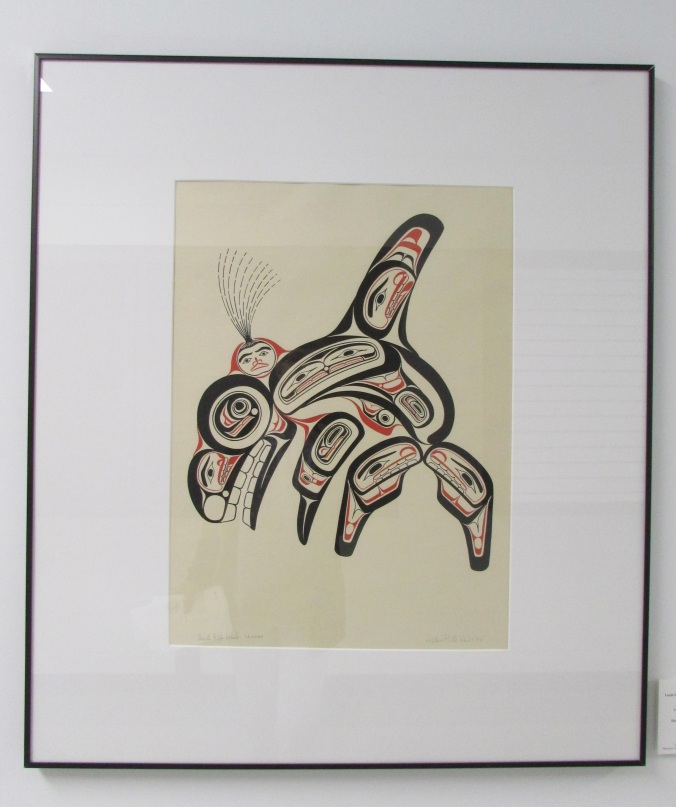
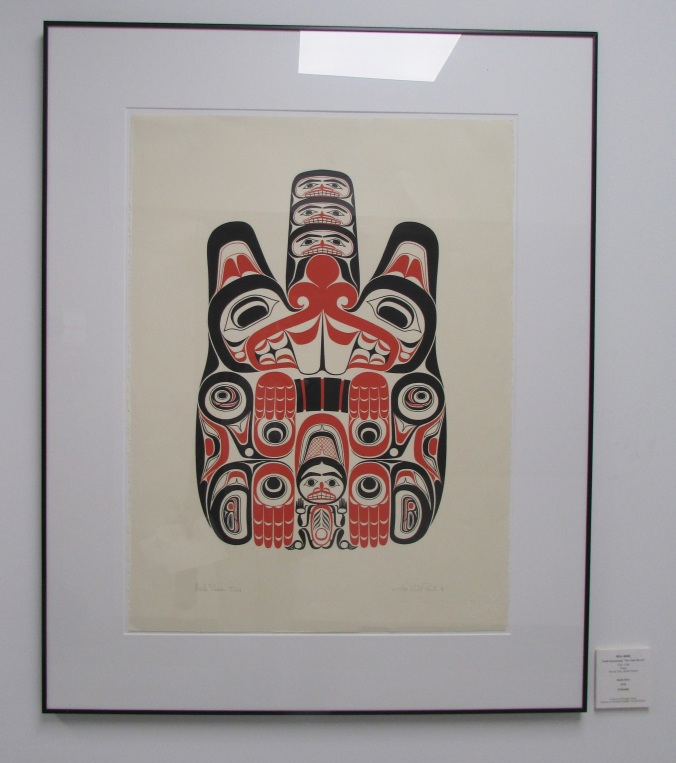
In addition to showcasing the work of the Professional Native Indian Artists Inc., the museum also features Northwest Coast and Inuit art. Bill Reid (1920-1998), was a prolific Haida artist, perhaps best known by many for his giant sculpture “Spirit of Haida Gwaii” on display in the international departures area of the Vancouver airport.

IMG_5821

Haida Killer Whale – Bill Reid

IMG_5819

Haida Bear – Bill Reid

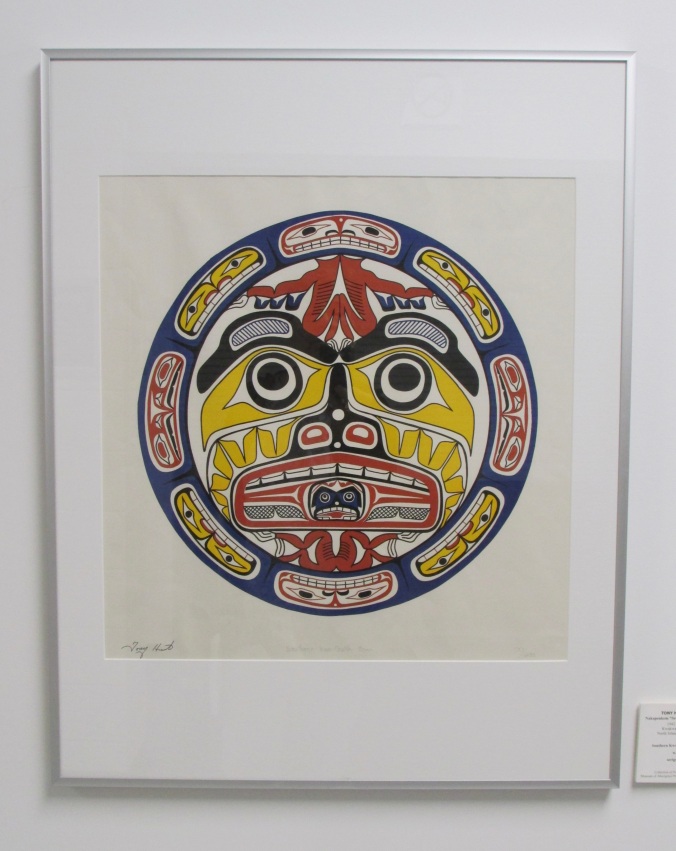
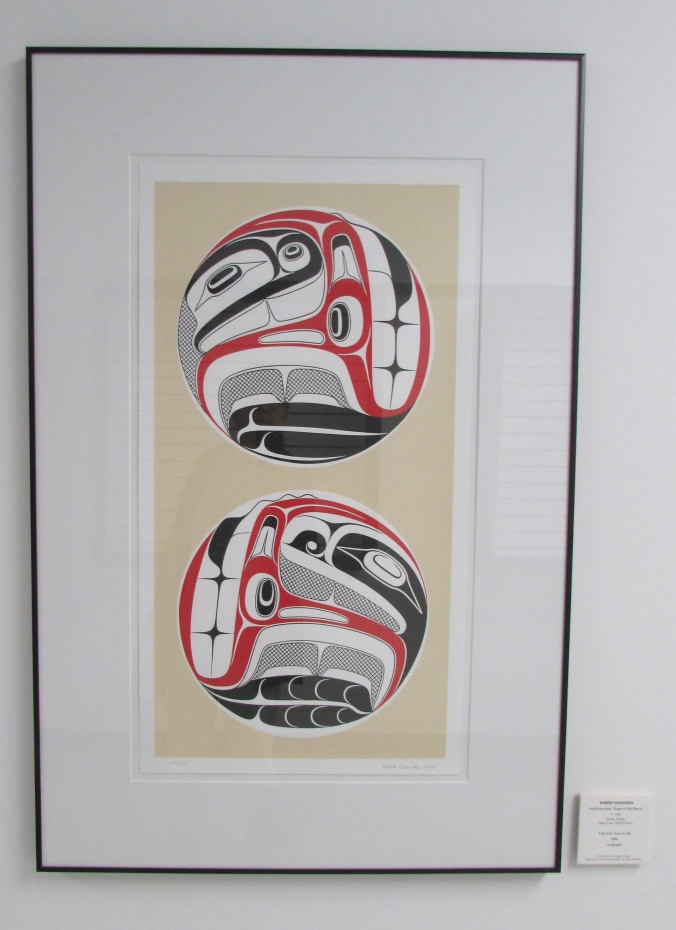
Other coastal artists whose work is on display in Lac la Biche include Tony Hunt Sr. (1942-2017) who was the hereditary chief of the Kwa-Gluth people and Robert Davidson who is of Haida and Tlingit descent.

IMG_5830

Southern Kwa-Gulth Moon – Tony Hunt Sr

IMG_5824

I am You, You are Me – Robert Davidson

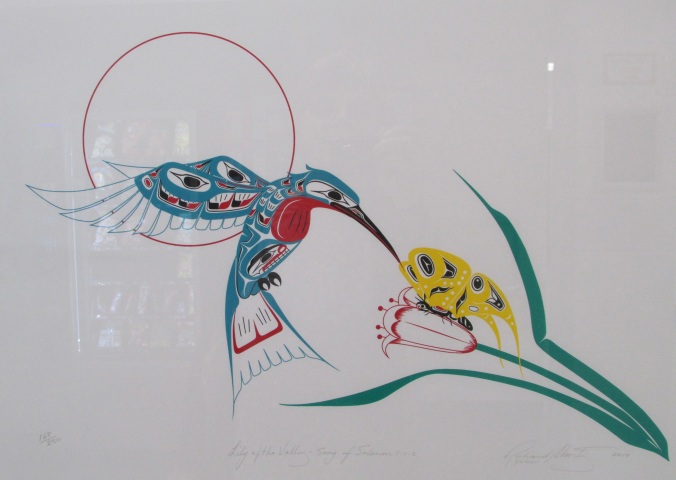
I thought this piece by Richard Shorty of the Tuchone Kwanlin Dun First Nation in the Yukon was absolutely exquisite. According to Northwest Coast tradition, the hummingbird represents love and beauty.

IMG_5833

Lily of the Valley / Song of Solomon – Richard Shorty

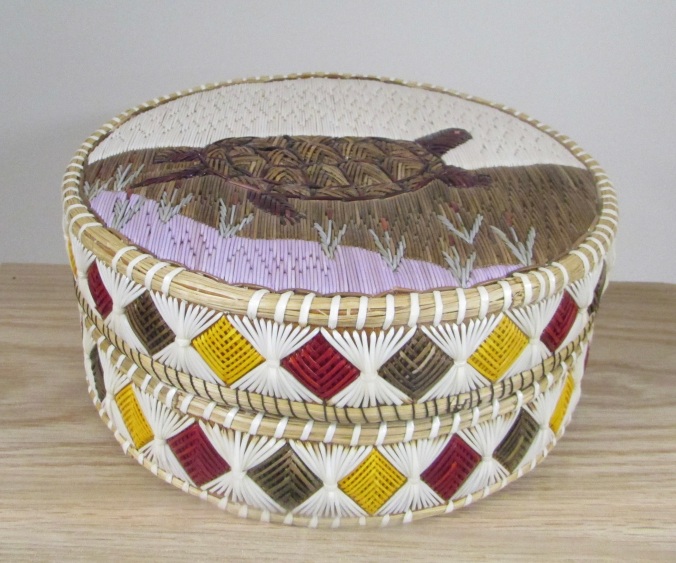
In addition to the framed work lining the corridors of Portage College, there are numerous glass cases containing carvings, baskets, beadwork, ceremonial clothing, moccasins and mukluks, headdresses, masks and more. Due to the reflective quality of the glass, it was difficult to get good photos, but I did manage to get one of this perfectly preserved Mi’kmaq porcupine quilled basket from the late 1700s or early 1800s.

IMG_5813

While I was thrilled to be able to spend a couple of hours enjoying this amazing collection of Indigenous art and artifacts, it saddens me that it’s hidden away in a remote location where few Canadians or visitors to our country will ever have the opportunity to see it.

Family hike at Bunchberry Meadows

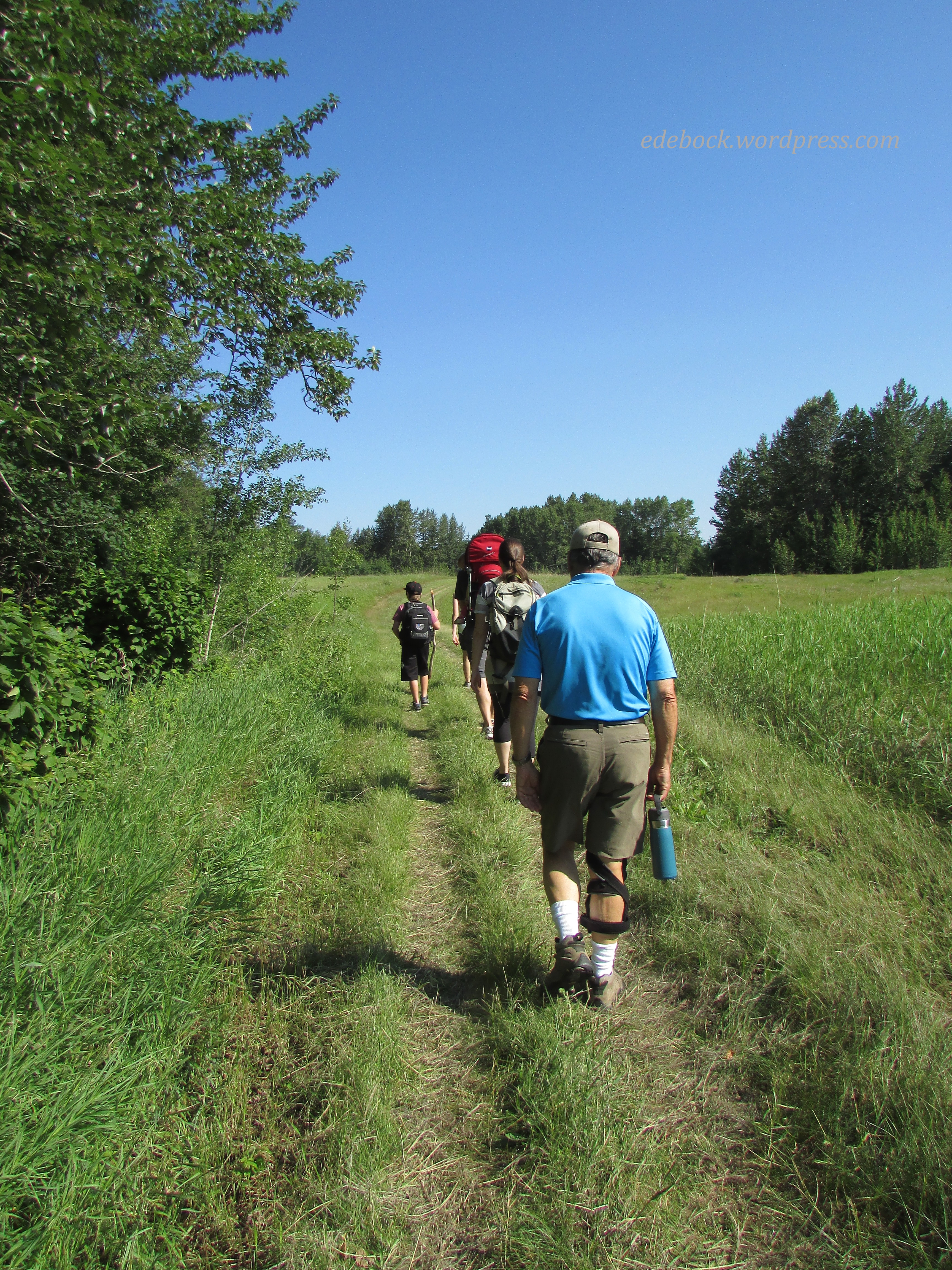
Trips to Edmonton for medical appointments often include overnight or weekend visits with our youngest son and his family. This morning, we all headed out to Bunchberry Meadows, a Nature Conservancy Canada site just outside the city for a family hike. The 260 hectare (640 acre) conservation site is made up of open meadows, old-growth forest and wetlands and was a great place to spend a couple of hours enjoying nature.

IMG_5752

This was our first hike with 20-month-old granddaughter, Mikayla. Daddy found a sturdy baby carrier backpack on an online buy and sell site last night, so she started the hike riding high and enjoying the sights. 

IMG_5754

Before long, however, she wanted down and was soon leading the way running along the trail! 

IMG_5758

The park has 8.68 km of groomed trails. We took the 4.43 km Aspen Trail which was perfect for a family outing. Though the area is habitat for a variety of wildlife including salamanders, weasels, porcupines, and moose, all we saw was one squirrel, a few fuzzy caterpillars, a frog, and some insects. There were also several varieties of wildflowers including Alberta’s provincial flower, the wild rose that blooms at this time of year. 

Sharp-eyed Nate also spotted this wreck hidden deep in the bush, so we had to check it out. In earlier days, it was common practice on the prairie for old vehicles and machinery to be abandoned in the bush. I suspect that this one was there long before the conservation area was set aside for hikers, cross-country skiers, and snowshoers to connect with nature. 

IMG_5769

If you’re in the Edmonton area and want to leave the city behind for a little while, Bunchberry Meadows might be the place you’re looking for. There’s a parking lot, picnic tables and outhouses located at the trailhead. It’s definitely a place that we’d like to go back to and explore further.

Downtown Calgary walking tour

Over the years, we’ve been to Calgary about a bazillion times. That’s because our daughter moved there immediately after graduating from high school 22 years ago to go to college and ended up staying. It had been many, many years, however, since we’d spent any time in the downtown core. Yesterday, however, we had a few hours to kill before picking up a friend who was traveling with us. We took a self-guided walking tour to see some of the weird and wonderful outdoor sculptures that add to the vibrant life of the city’s downtown. It was a cool, blustery morning, but thankfully, it rained very little. 

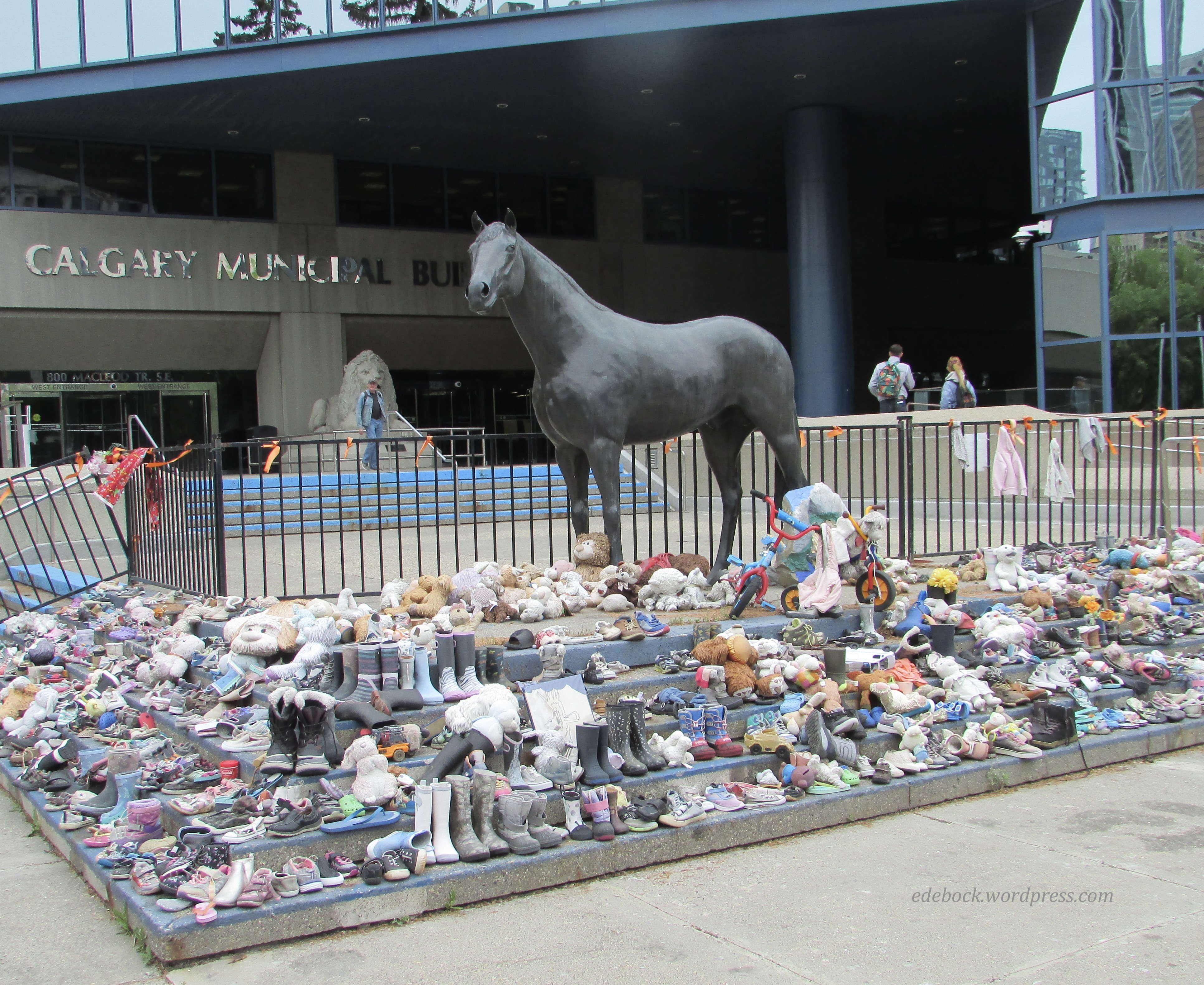
Our morning started at the somewhat pricey, but conveniently located City Hall Parkade and our first stop was just around the corner of the building. The Family of Horses, consisting of three statues, was donated to the City of Calgary by Spruce Meadows, a multi-purpose equestrian facility located near the city. The stallion shown in my photo is positioned in such a manner that he overlooks the foal and mare (not shown). At present, however, he stands guard over a temporary memorial to honour Indian Residential School survivors. The city intends to create a permanent memorial elsewhere once a location and design have been chosen. 
IMG_5682

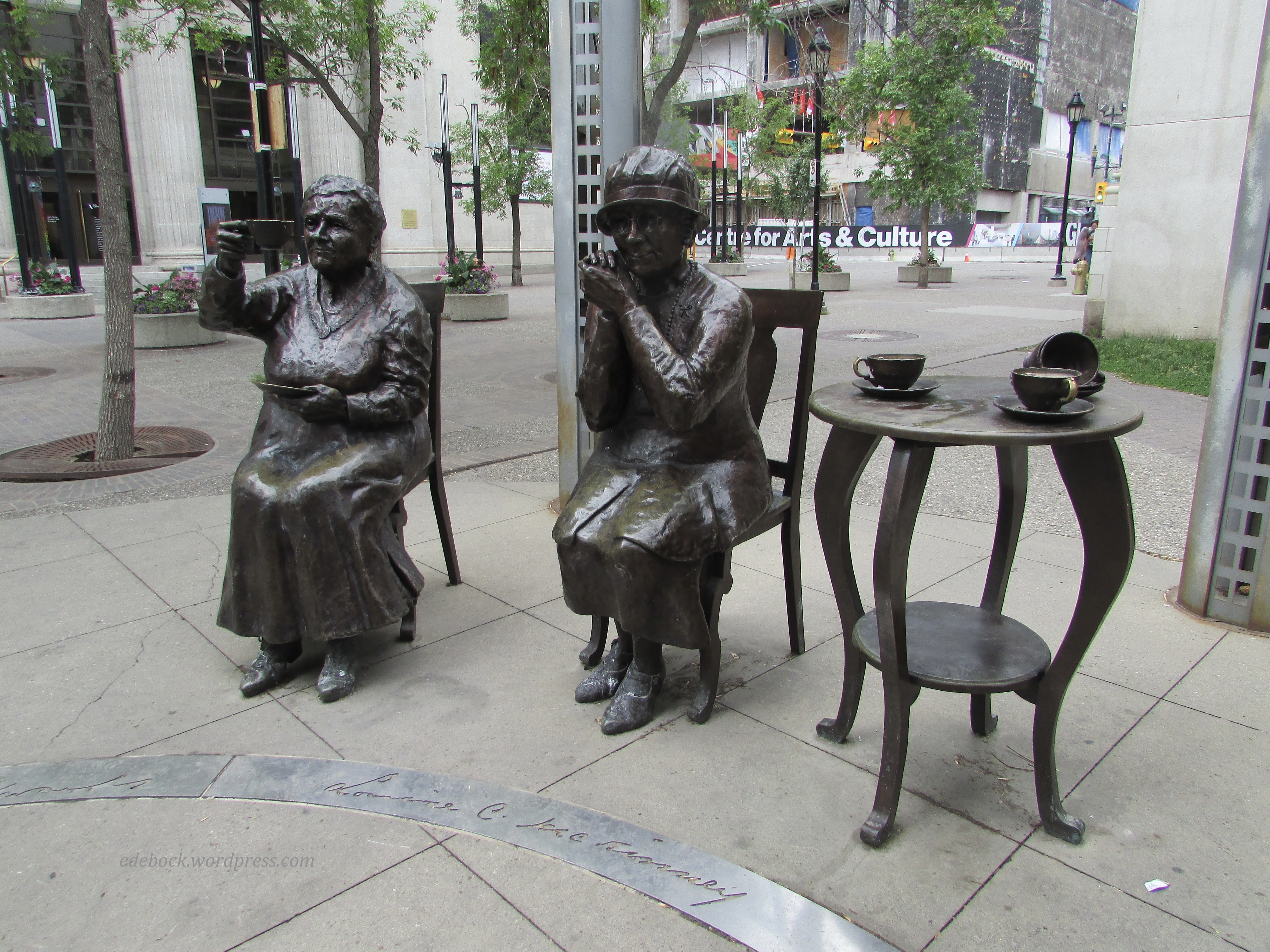
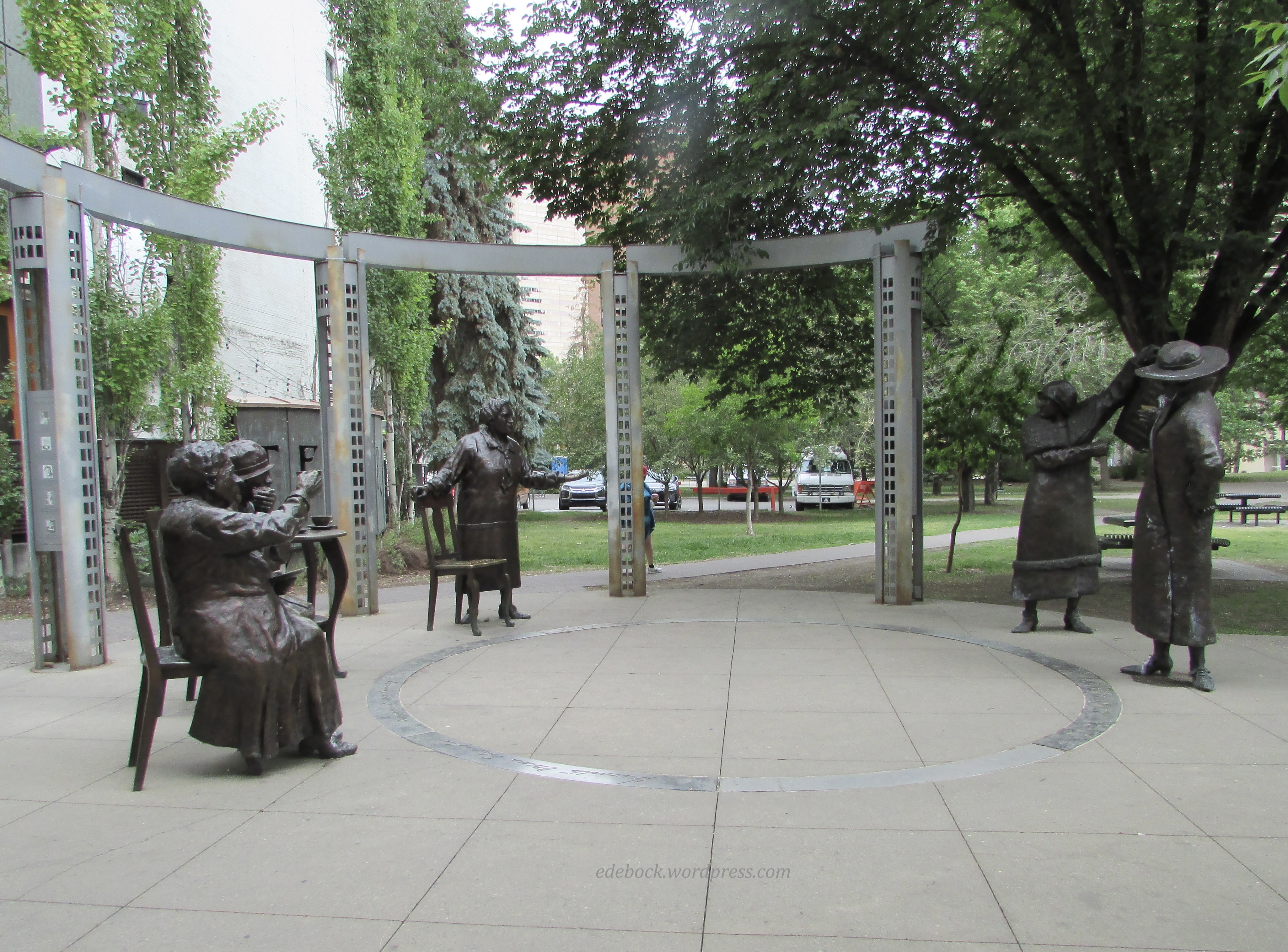
Next, the Women are Persons statues are located at the corner of Olympic Park. The monument recognizes the role played by Canadian women in the growth of the country and specifically honours the Famous Five, five persistent Alberta women — Emily Murphy, Nellie McClung, Irene Parlby, Louise McKinney and Henrietta Muir Edwards. Through their efforts, Canadian women were legally declared persons and given the right to vote on October 18, 1929. Seventy years later, the Calgary monument was unveiled on October 18, 1999 by then Governor General Adrienne Clarkson. Exactly one year later, a similar monument was unveiled on Parliament Hill in Ottawa. 
IMG_5686

IMG_5689

Of course I had to stop and sit with the famous ladies for a bit! 

I remembered the 21-foot-tall Family of Man sculptures from my university days in Calgary in the early 1970s. Designed by Mario Armengol to be displayed at the British Pavilions at Expo 67, they were bought on behalf of Maxwell Cummings and Sons by Robert Cummings and later donated to the City of Calgary. The sculptures depict naked and faceless men and women, devoid of expression, but extending their hands in gestures of goodwill and fellowship. I’m sorry about the streak of rain across the first photo! The weather was at its most blustery at this point in our morning.
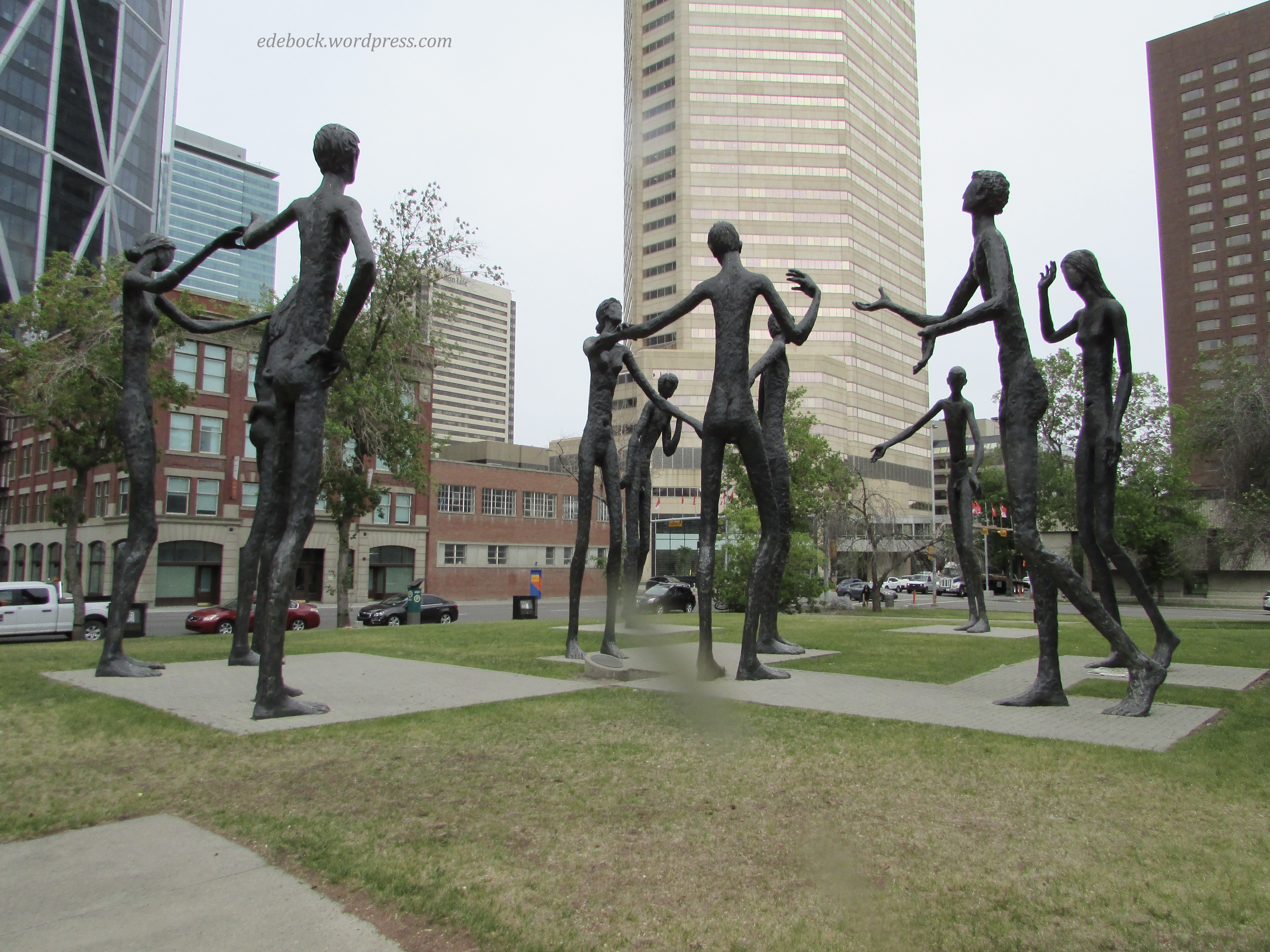
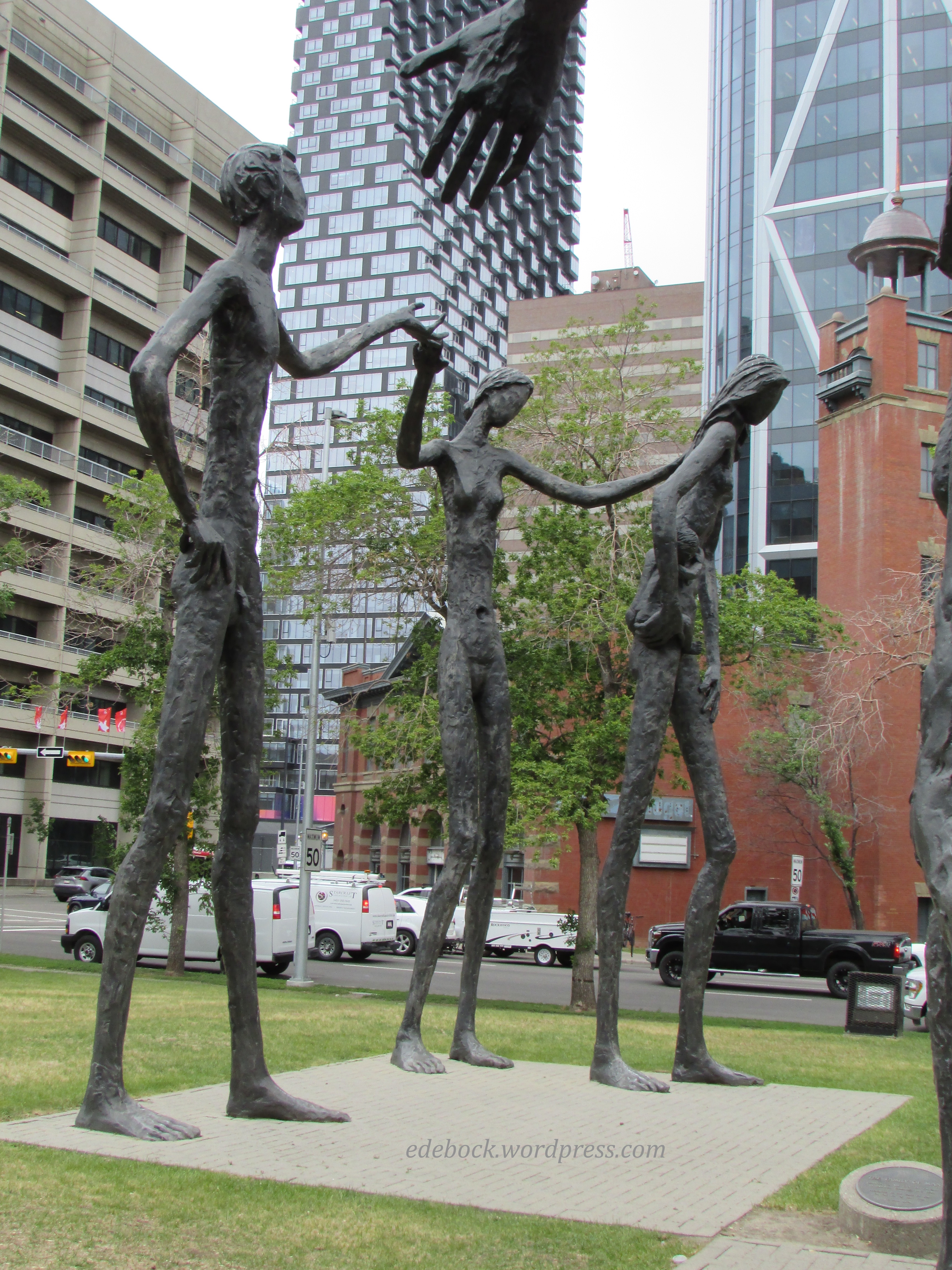
IMG_5695 

IMG_5697

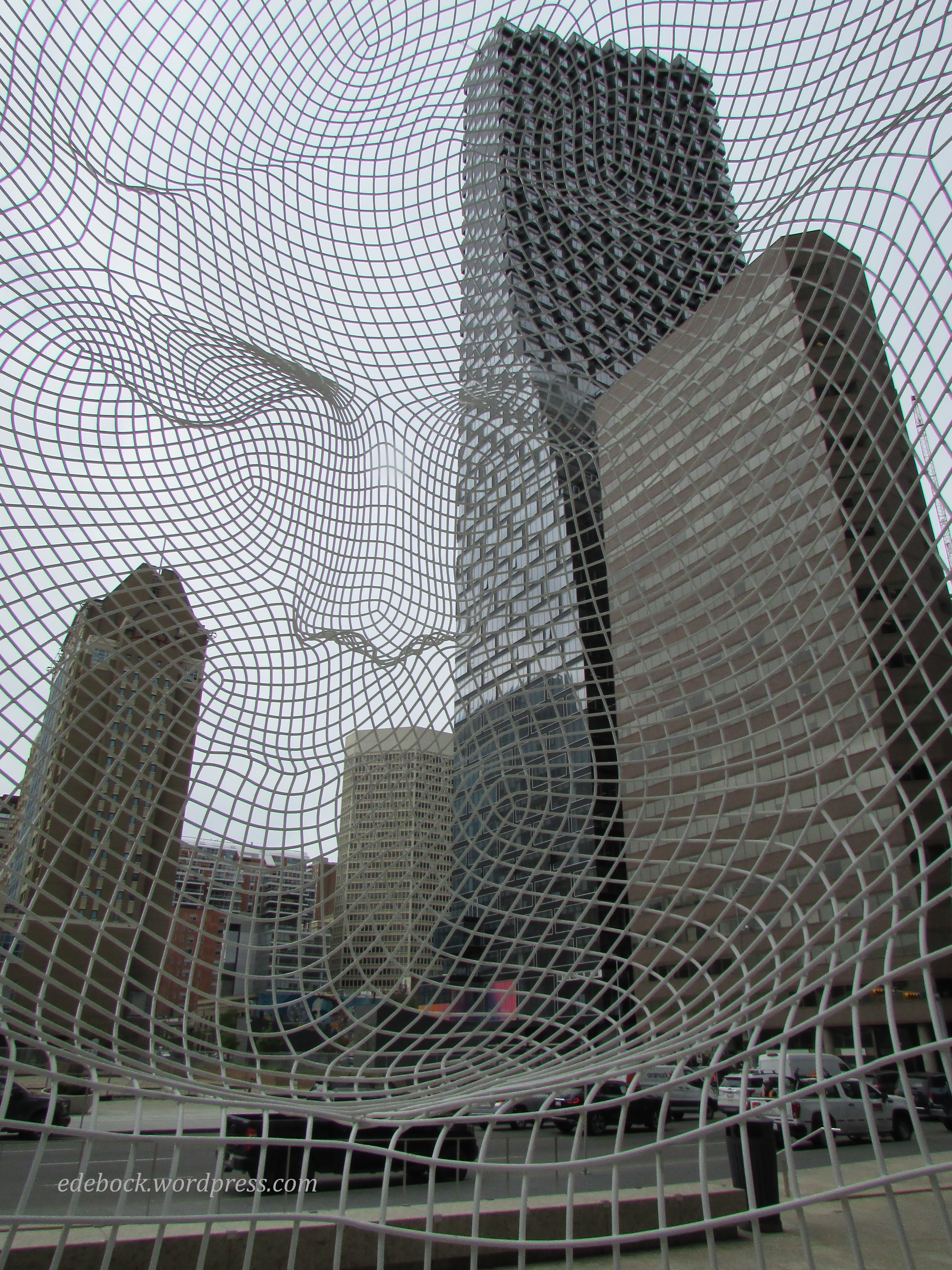
When Wonderland, a 39-foot-tall bent wire sculpture of a young girl’s head came into view, hubby’s comment was, “Look! It’s a giant radiation mask!” It did bear an uncanny resemblance to the fitted mask that I wore for every one of the 30 radiation treatments to my neck and jaw back in the summer of 2015. Thankfully, the statue has a much happier meaning. Located in front of the Bow, a crescent shaped skyscraper, it’s meant to represent the dreams of the young people of the province.
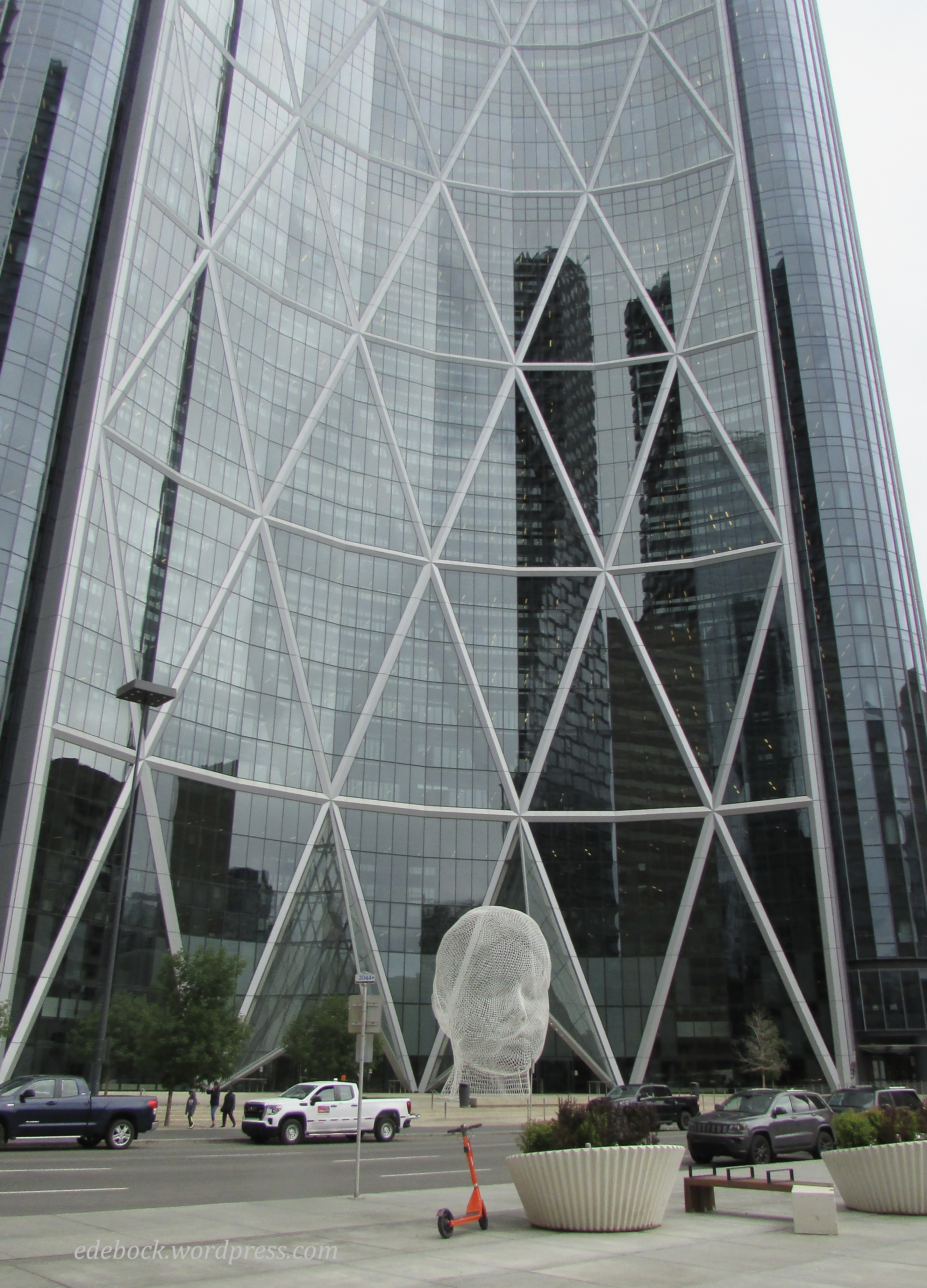
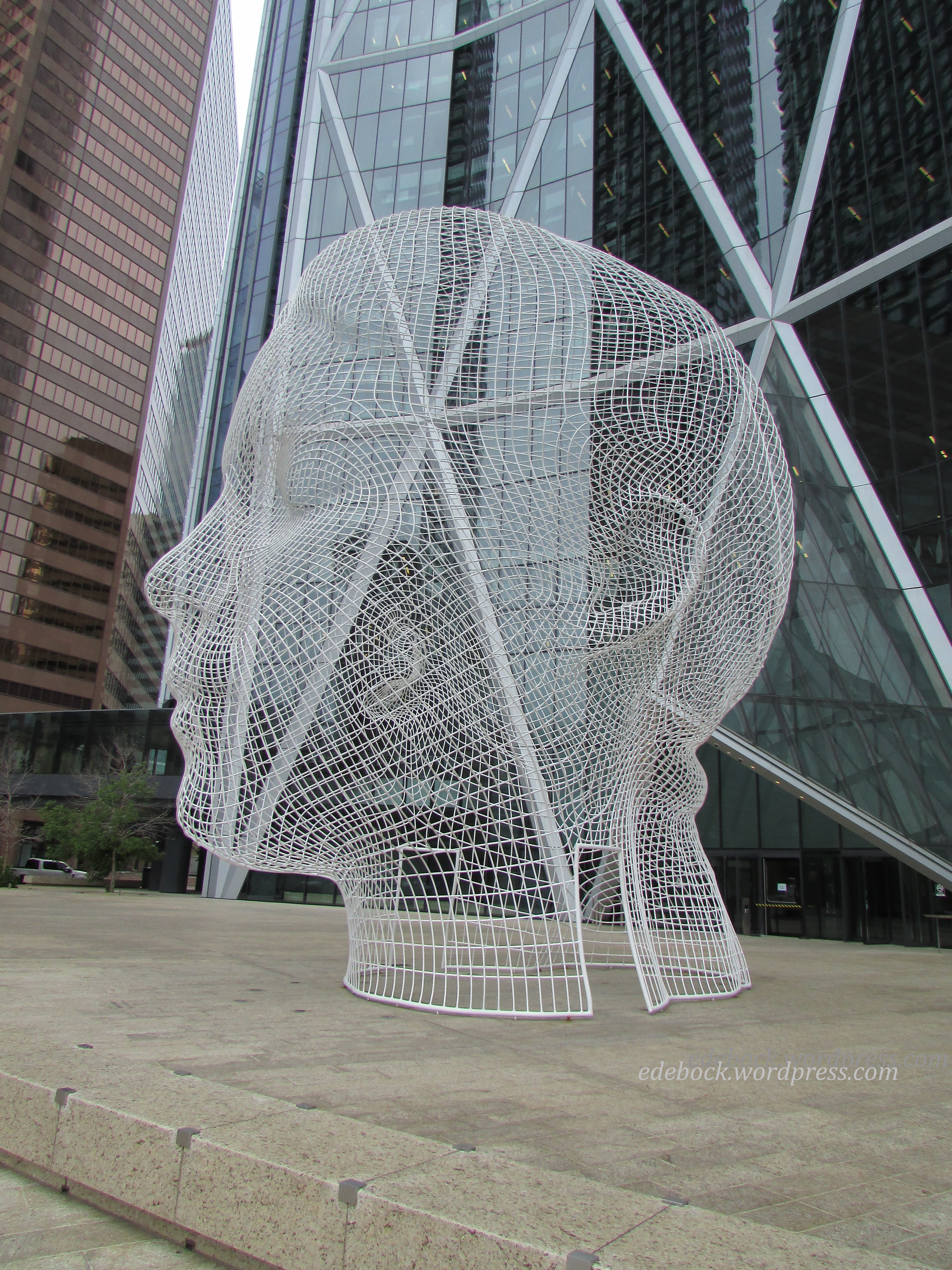
IMG_5704

IMG_5698

Unlike most sculptures, Wonderland allows visitors to view the artwork from the inside as well as out. This is definitely one of the most interesting looking photos I’ve ever taken! 
IMG_5702

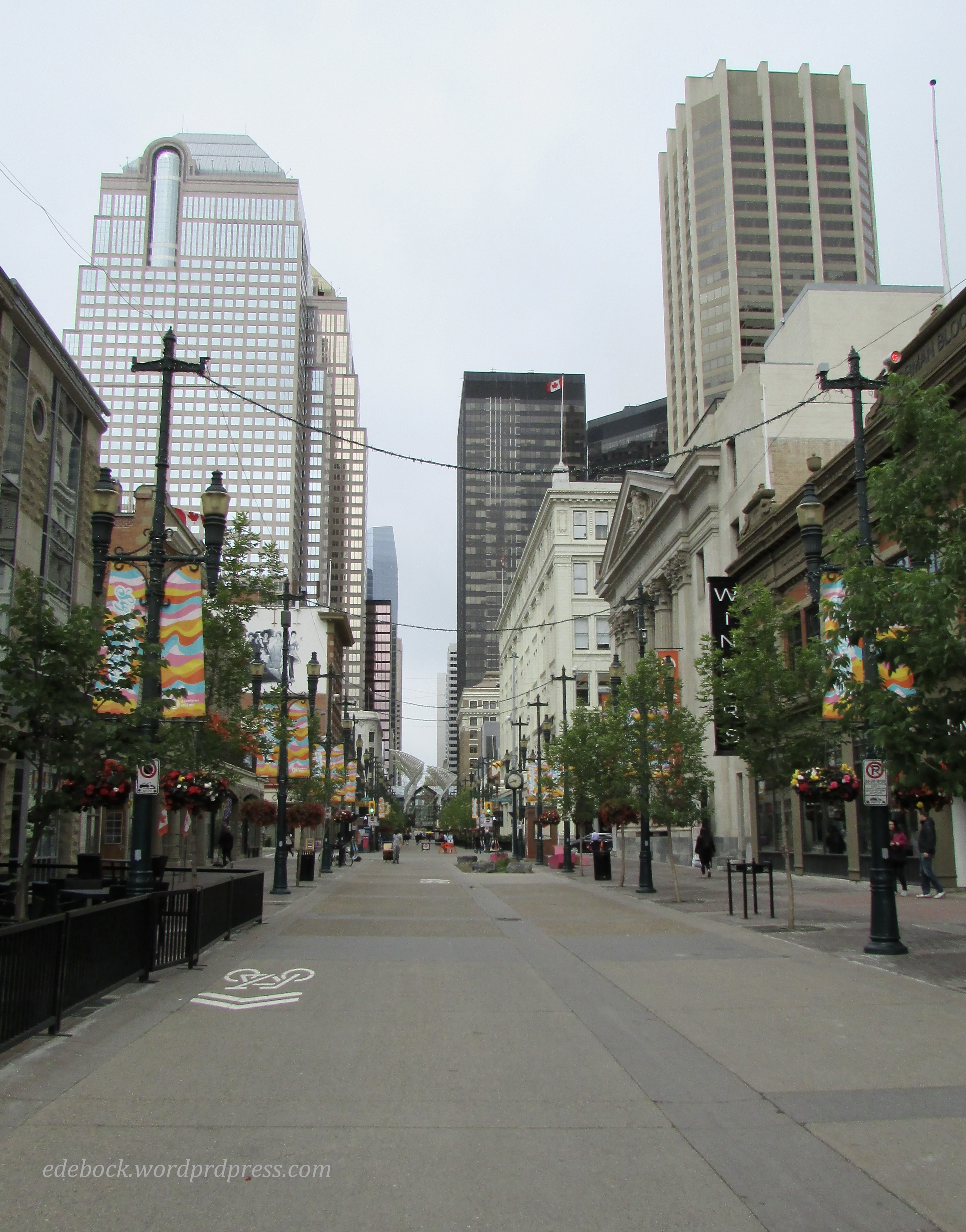
Lined with an eclectic mix of boutiques, high-end retailers, restaurants, cafés, pubs, and bars, as well as two hotels and the Telus Convention Centre, Stephen Avenue is a major pedestrian street stretching along 8th Avenue SW from 4th Street SW to 1st Street SE. 
IMG_5705

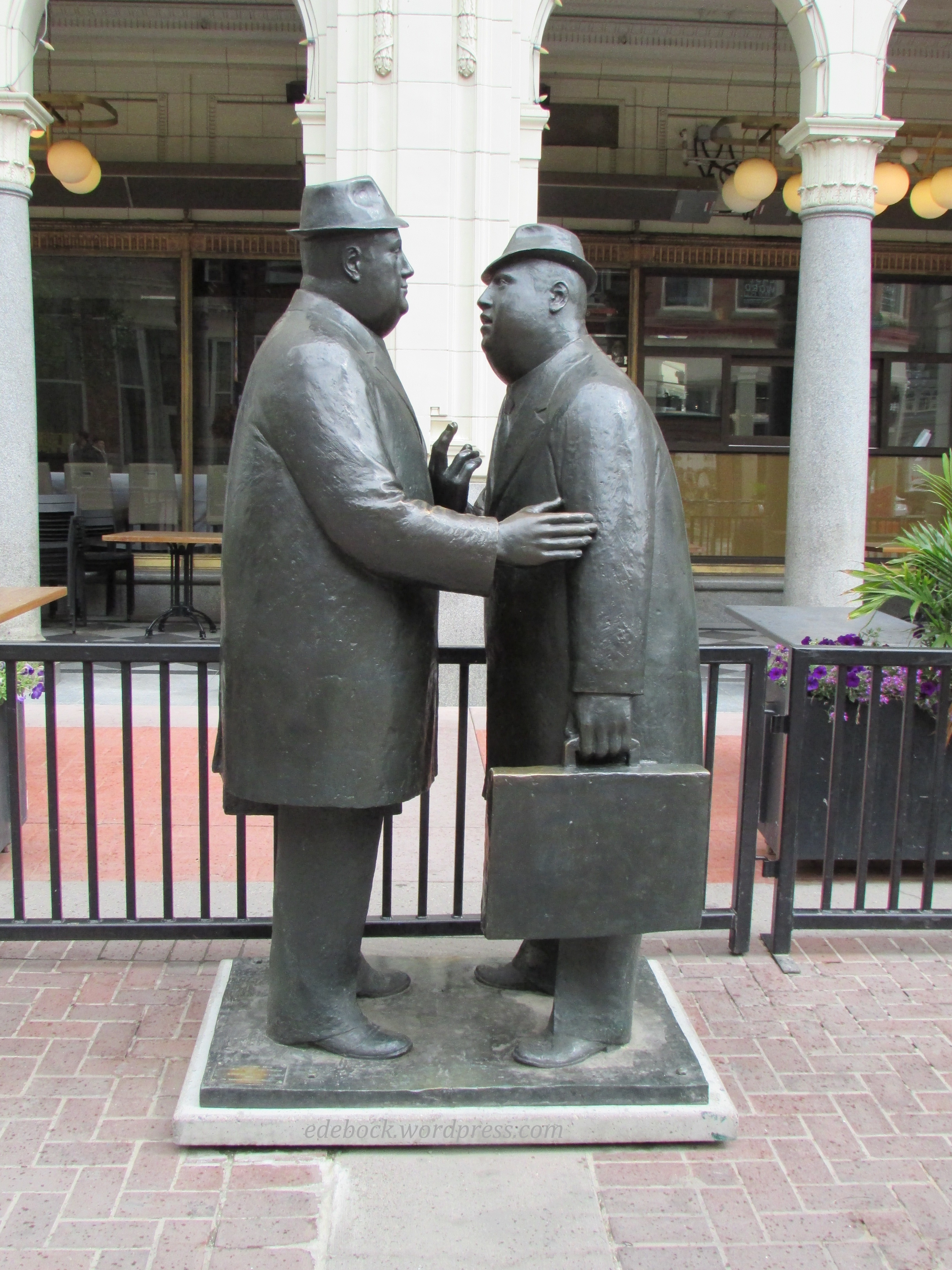
Usually a happening place, the avenue was quiet on a cool morning, but busier close to lunch time when we were headed back to the vehicle. It was along Stephen Avenue that we stopped to see The Conversation, a life-sized bronze statue of two businessmen deep in conversation. Created by William Hodd McElcheran, the popular sculpture originally belonged to Norcen Energy Resources who donated it to the City of Calgary in 1981. It has stood on Stephen Avenue ever since. 
IMG_5708

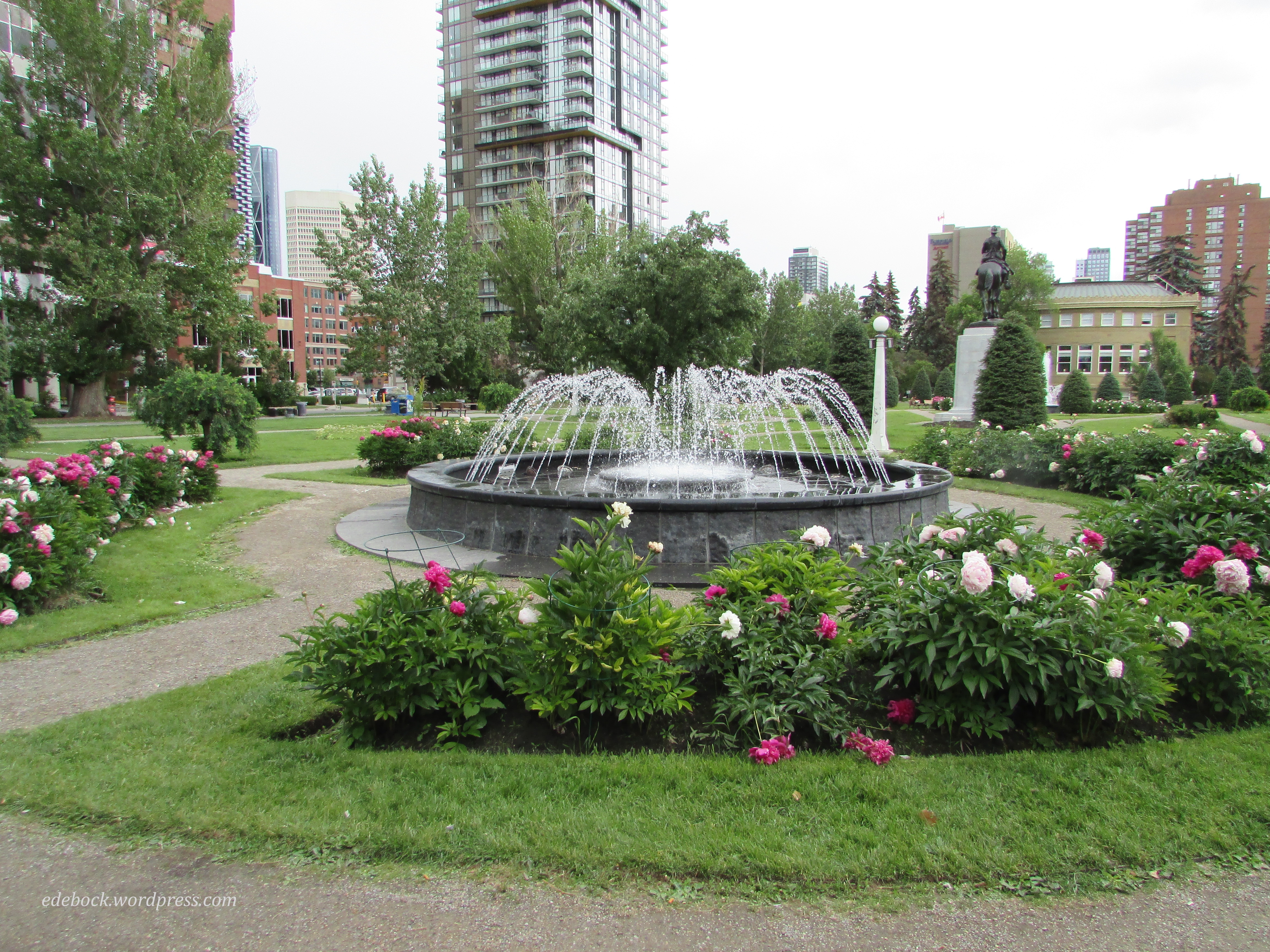
A little further in our walk, we came to Central Memorial Park. With the peonies in full bloom, it was a beautiful and peaceful spot.
IMG_5716

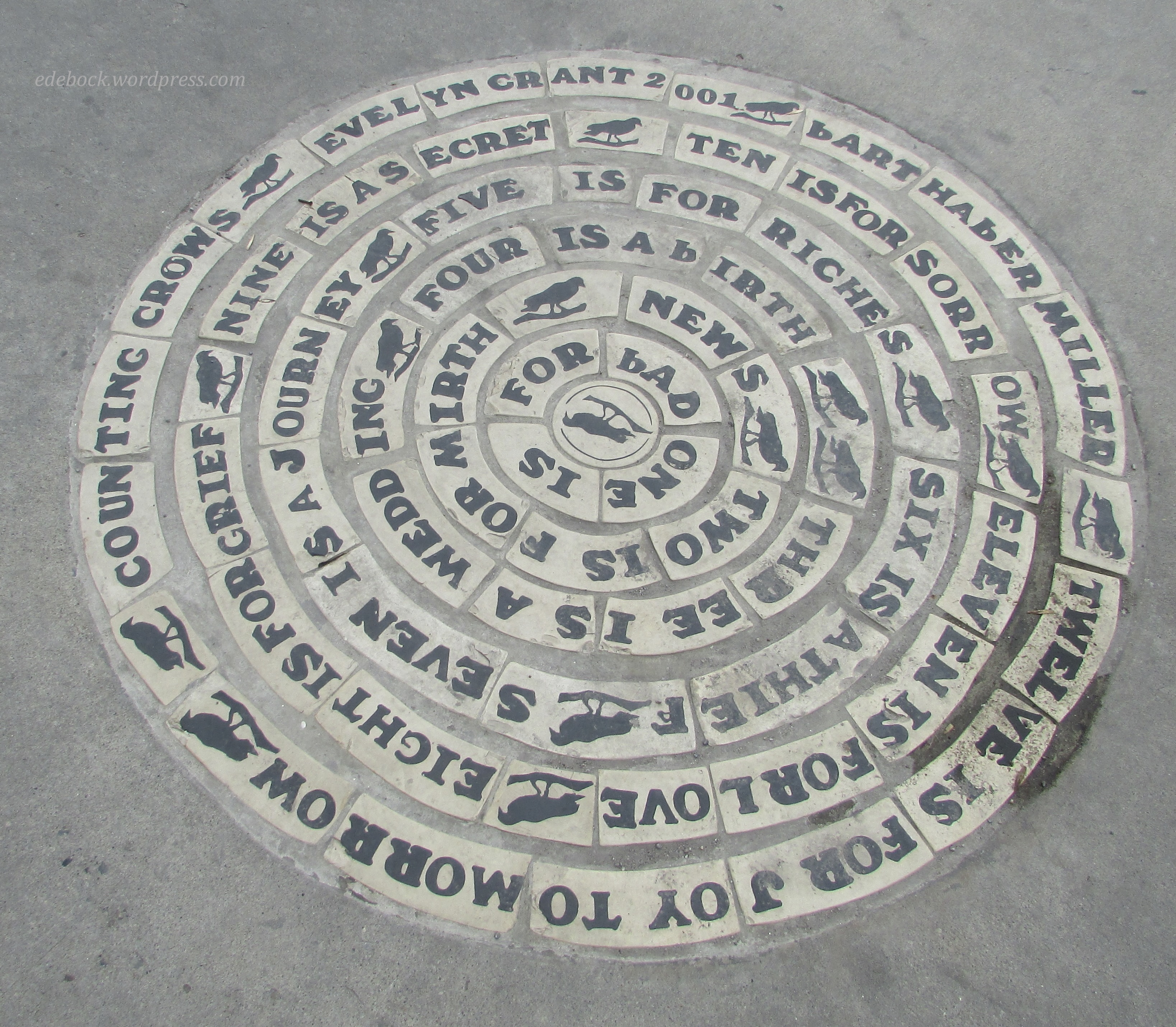
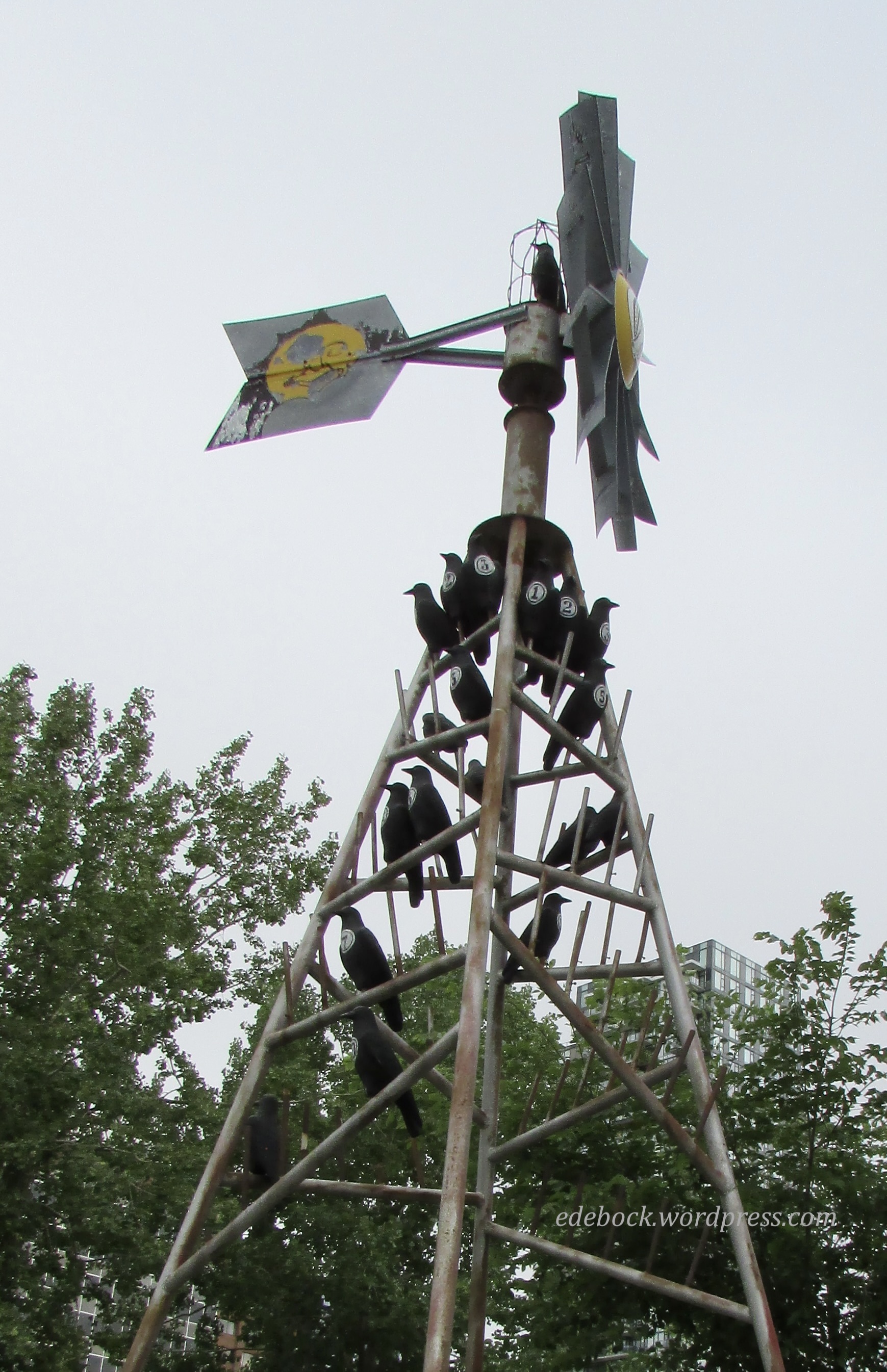
Across the street from the park at the corner of 4th Street SW and 13th Avenue SW stood what was definitely one of the strangest sculptures that we saw. Counting Crows was created by Calgary artist Evelyn Grant who handed it over to the city in 2001. Inspired by a traditional English rhyme that appears on the sidewalk below it, the sculpture resembles a windmill such as those that were once seen across the prairie. If you look closely, you’ll see that each realistic looking crow bears a number on its chest. 
IMG_5720

IMG_5723 2

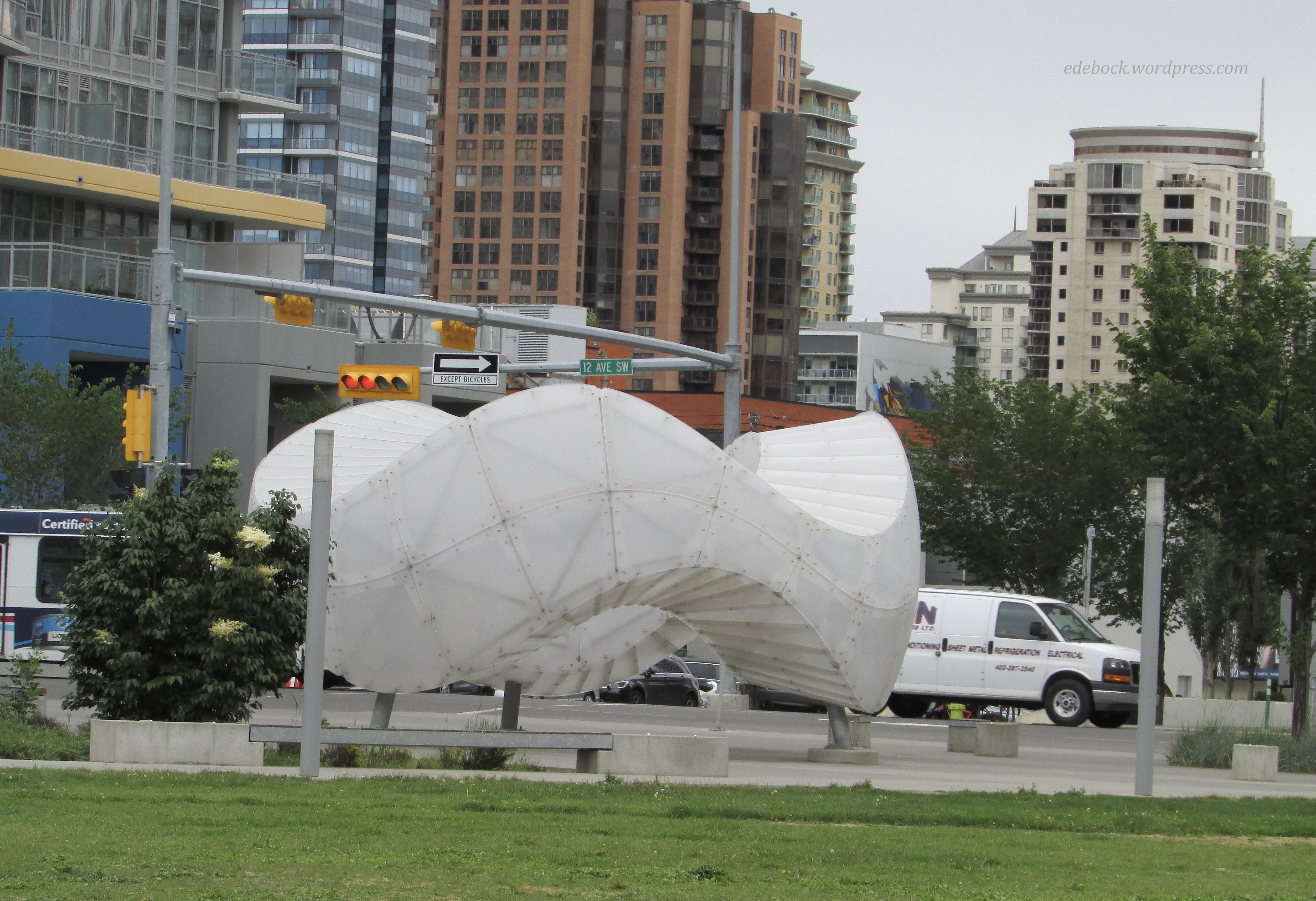
By this time we realized that we weren’t far from the Calgary Board of Education building where our daughter works, so we stopped in for a very quick visit before beginning the long trek back to our vehicle. Across the Barb Scott Park, next to her building, I spotted the last piece of public art that we’d see. The shape of Chinook Arc drew it’s inspiration from the historic Beltline Streetcar loop that once encircled the neighbourhood, as well as the Chinook arch, a unique cloud formation that occurs along the eastern slopes of the Rocky Mountains. Though we didn’t get close enough to investigate, I’ve since learned that it’s an interactive and illuminated installation that would likely be quite something to see lit up after dark. 
IMG_5731

As it was, we had to hoof it to meet our friend and get back to the parkade before our three hour time limit expired. We walked a total of 8.72 km (5.42 miles) and proved to ourselves once again that walking is the best way to see a city! 
What I wore to travel

Logo by SamIt was unseasonably warm when we boarded a plane in Calgary on Sunday morning, but even -1ºC (30ºF) is chilly. When we left the airport in Mexico City at almost midnight it was +19ºC (66ºF). How do you dress for a day with that kind of temperature variation?

The answer, of course, is layers.

IMG_5092

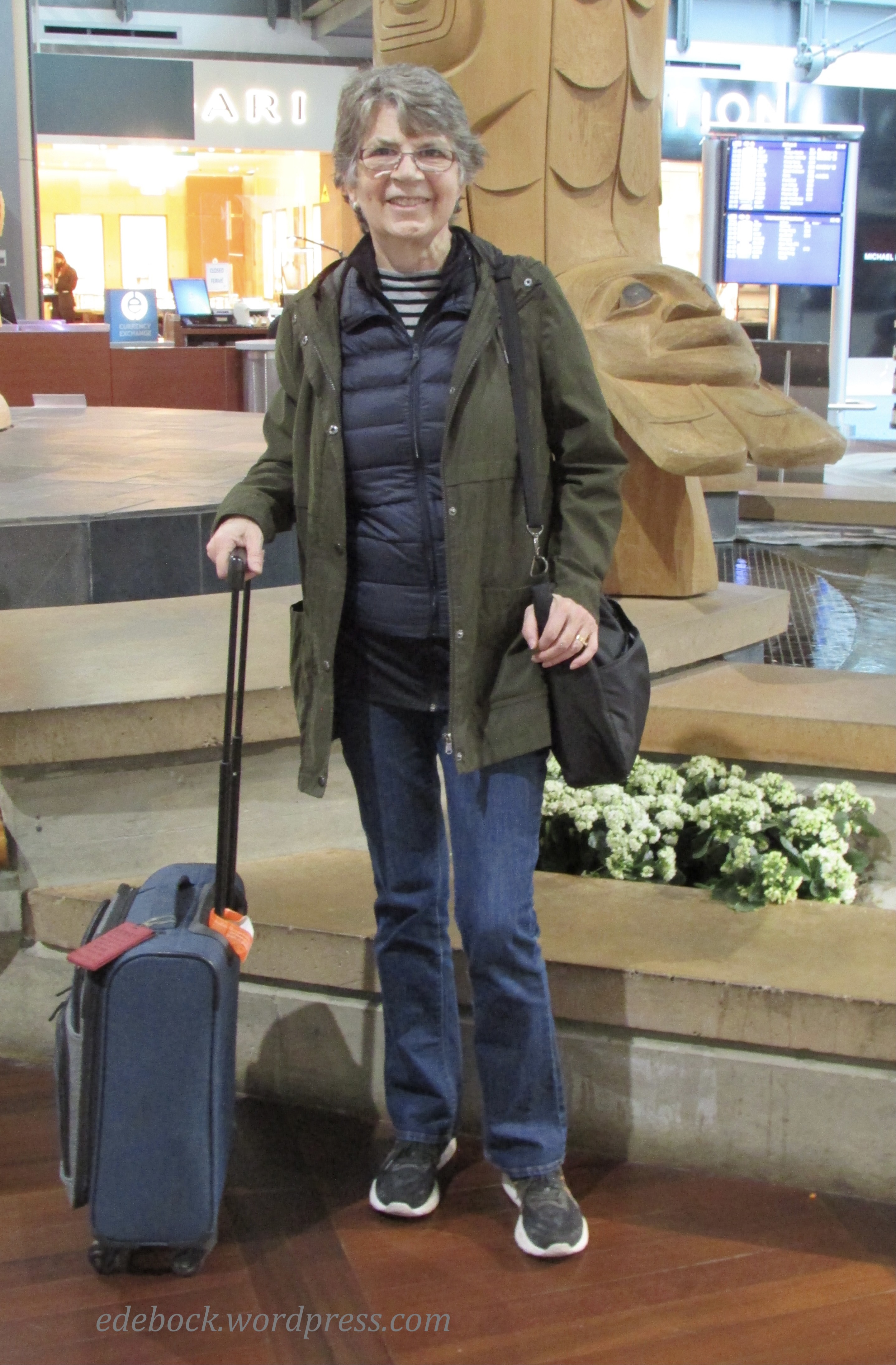
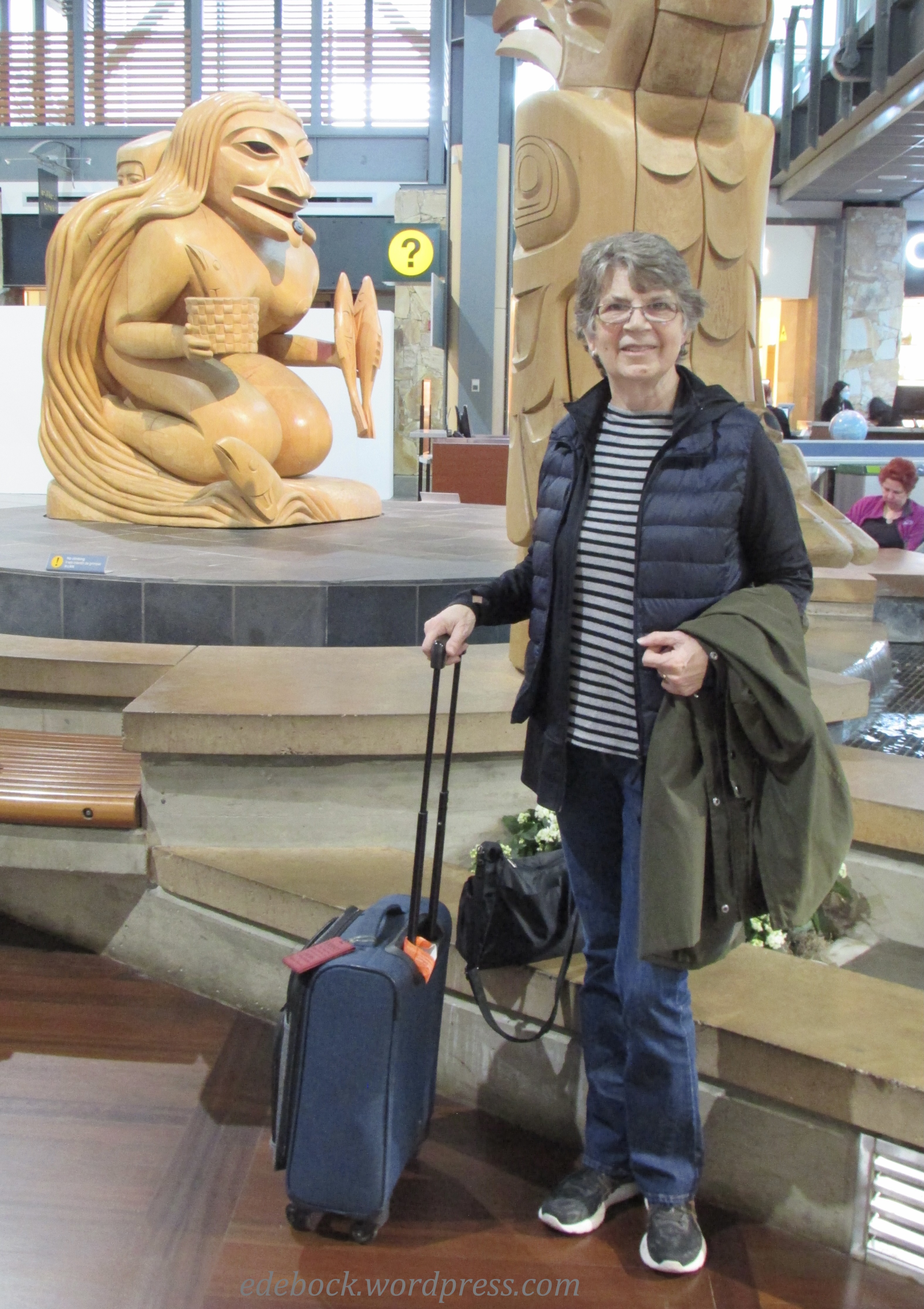
My base layer was a long-sleeved, striped sweater. Next came a hoodie and then my ultralight down vest from Uniqlo. The final layer was a spring jacket that is both wind and waterproof. While each layer was very lightweight, together they provided ample warmth on a chilly Alberta morning. After the photos were taken during a layover at the Vancouver airport, the vest came off and was tucked into an outer pocket of my tiny suitcase. Some people find jeans uncomfortable for long days sitting on a plane, but I practically live in them and find them very comfortable. A pair of good walking shoes completed my ensemble.

IMG_5095

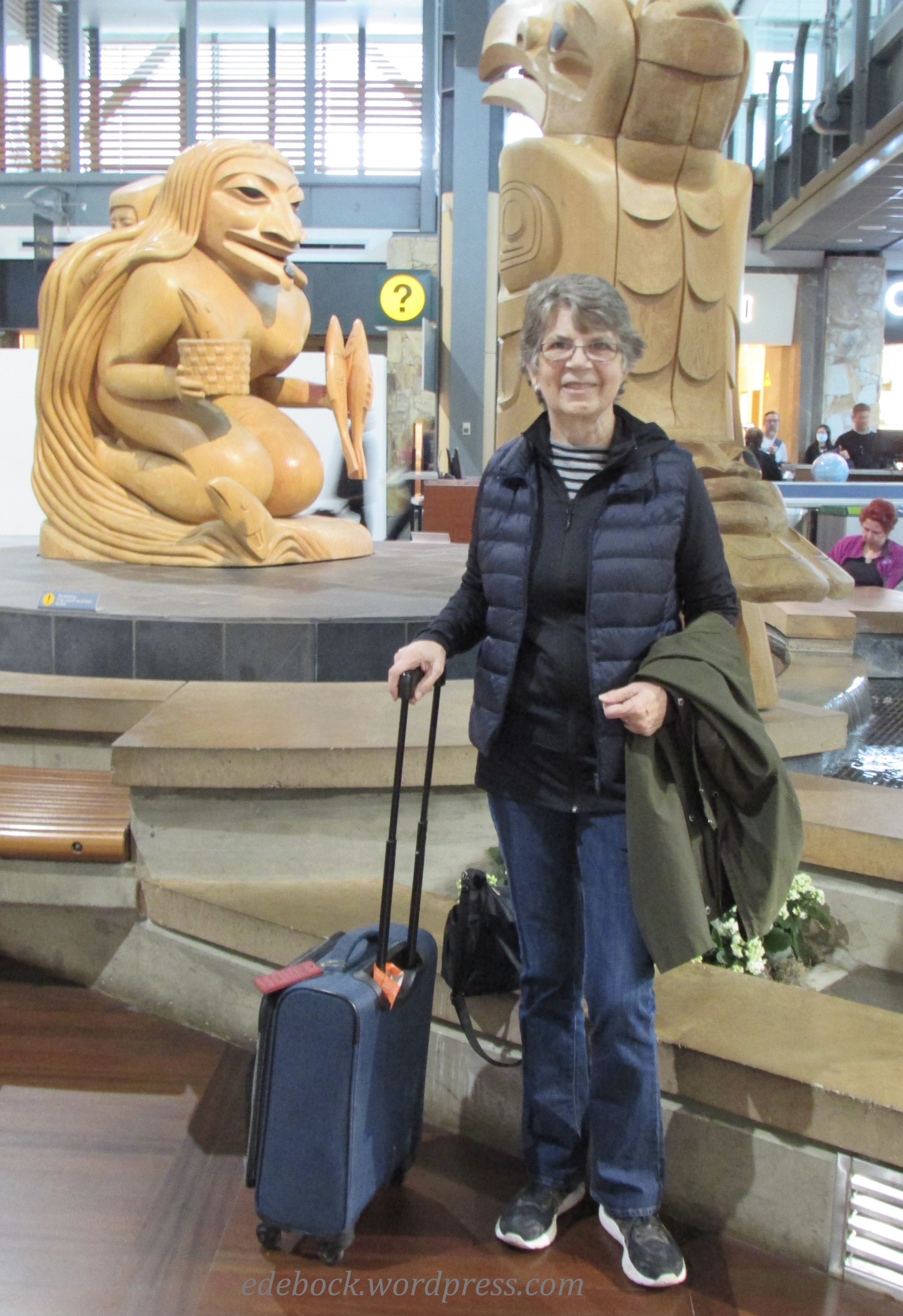
Not only is YVR Vancouver’s international airport, but it’s also home to a permanent collection of more than 210 pieces of art, much of it work of British Columbia’s indigenous artists. The pieces behind me represent The Story of Fog Woman and Raven. Carved of cedar wood in 2007 by Dempsey Bob, they tell the story of how the annual salmon run originated to benefit the people of the northern coast of BC and the southern coast of Alaska. Immediately behind me, Raven perches on the side of a pool, beak uplifted, smiling and well fed, while to the side, Fog Woman kneels at the head of a stream.

IMG_5099

Once we reached our destination, the clothing that I wore to travel in was set aside and won’t be worn again until our return trip unless we have a really chilly day while we’re here.

The last camping trip

Every year, as summer winds down and the camping season comes to an end, I yearn for one more outing with the trailer. This year, that last camping trip took us just a little over an hour from home to Black Nugget Lake, so named because the park and the adjacent Coal Creek Golf Resort were built on the site of a former coal mine.

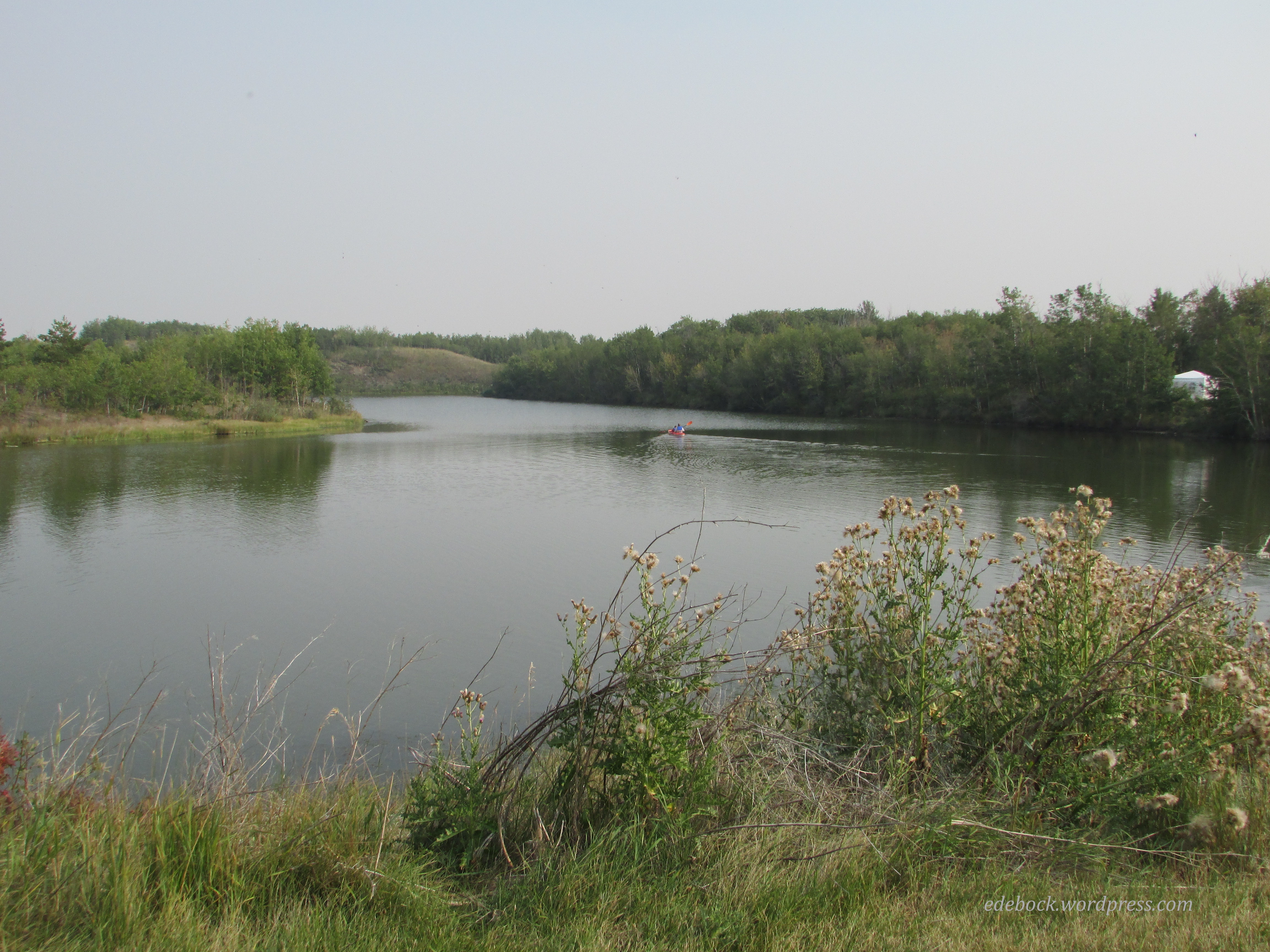
Our youngest son and his family joined us for the weekend and together we enjoyed games of ladder ball, bocce, and tether ball. Nate also got both of his older kids out on the lake in our kayak. If you look closely, you can see him and our grandson, Yari, in this photo.

IMG_4522

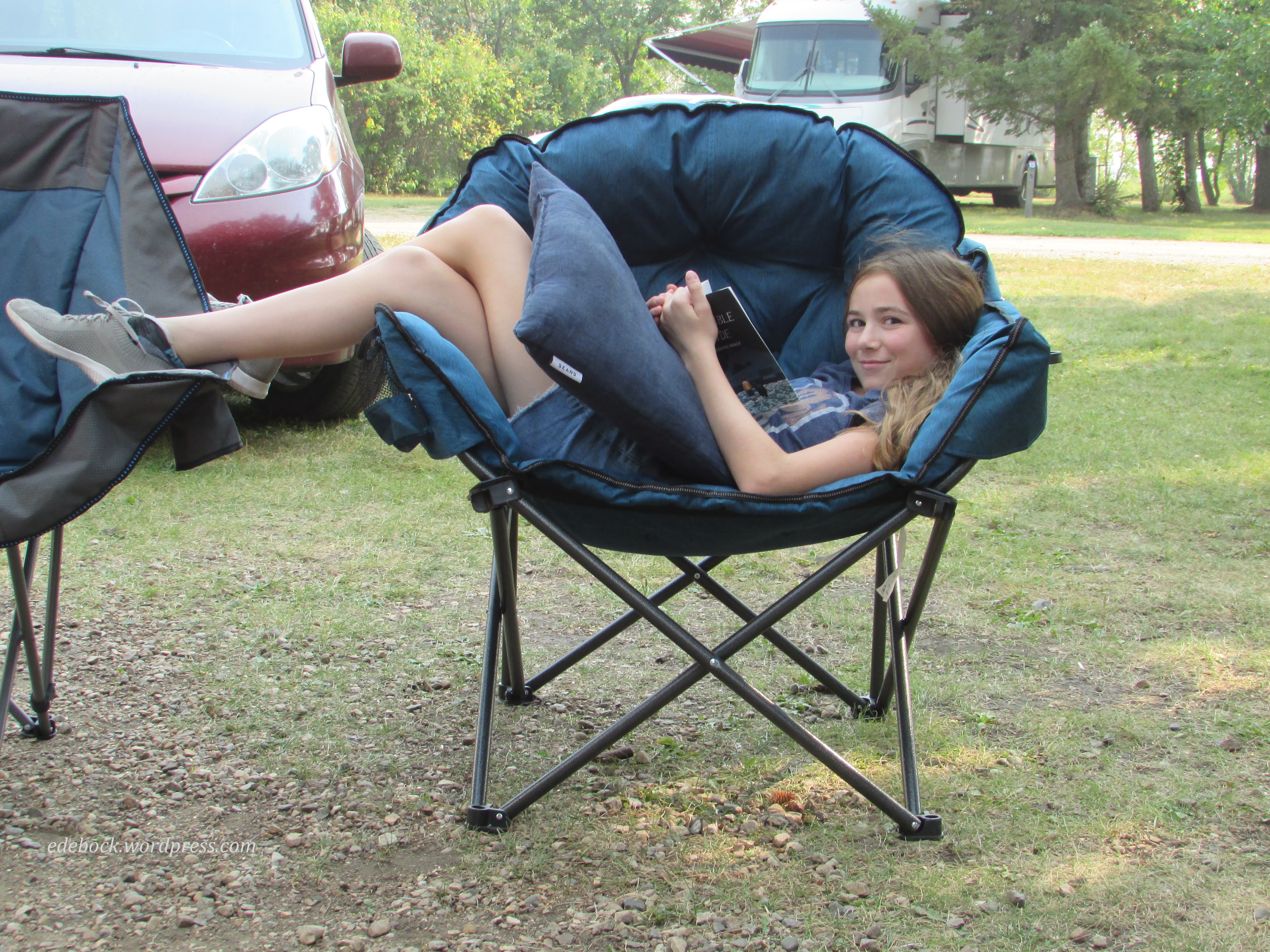
Lots of time was also spent relaxing as demonstrated so well by our granddaughter, Harlow!
IMG_4523

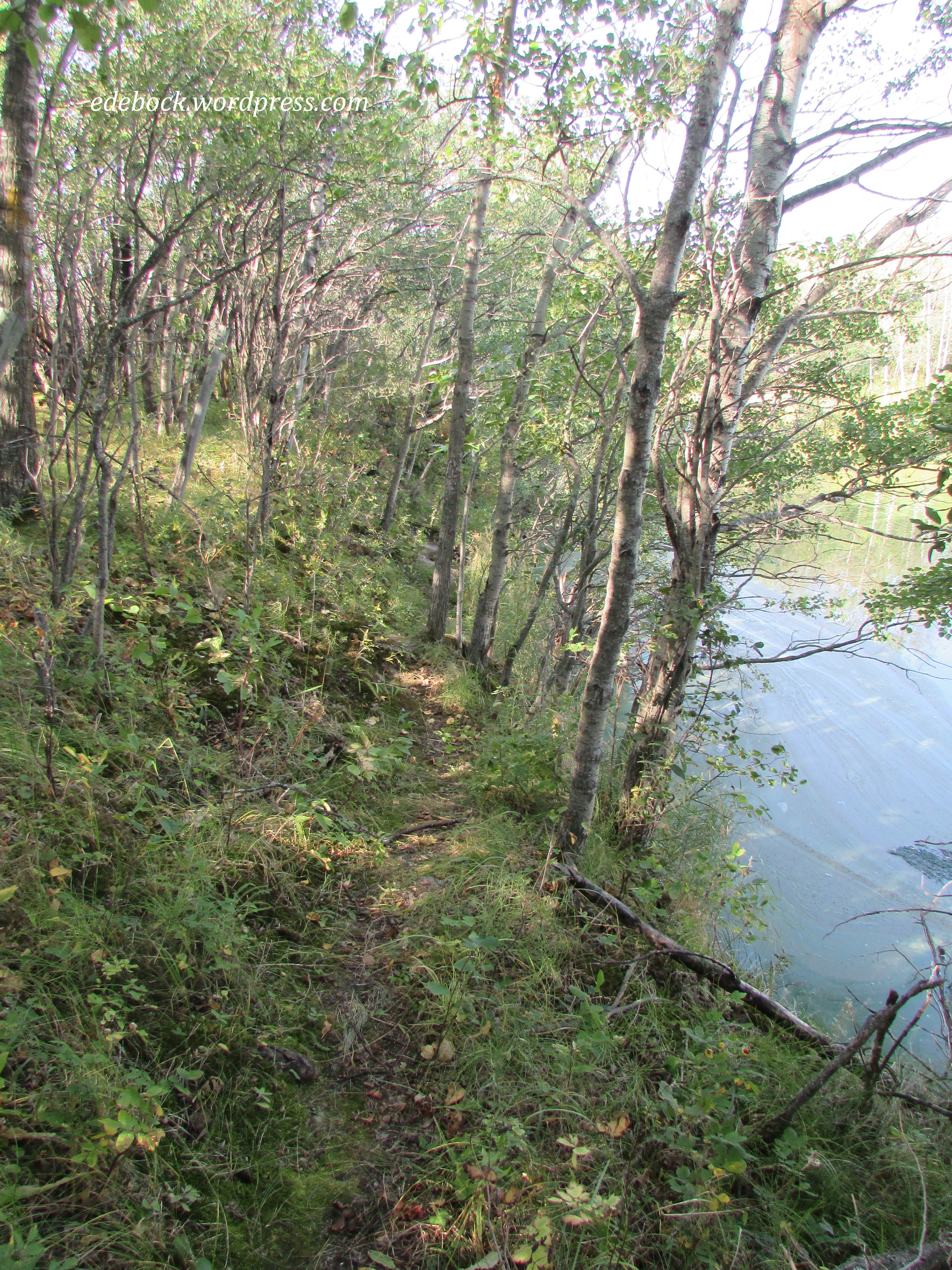
After the family left to return to the city for work and school, hubby and I stayed on for an extra day to do some hiking and kayaking. Unfortunately, the trails that were promised on the campground map were unmarked and badly overgrown. We followed one of them as best we could for about twenty minutes before it petered out entirely and we returned to camp.

IMG_4553

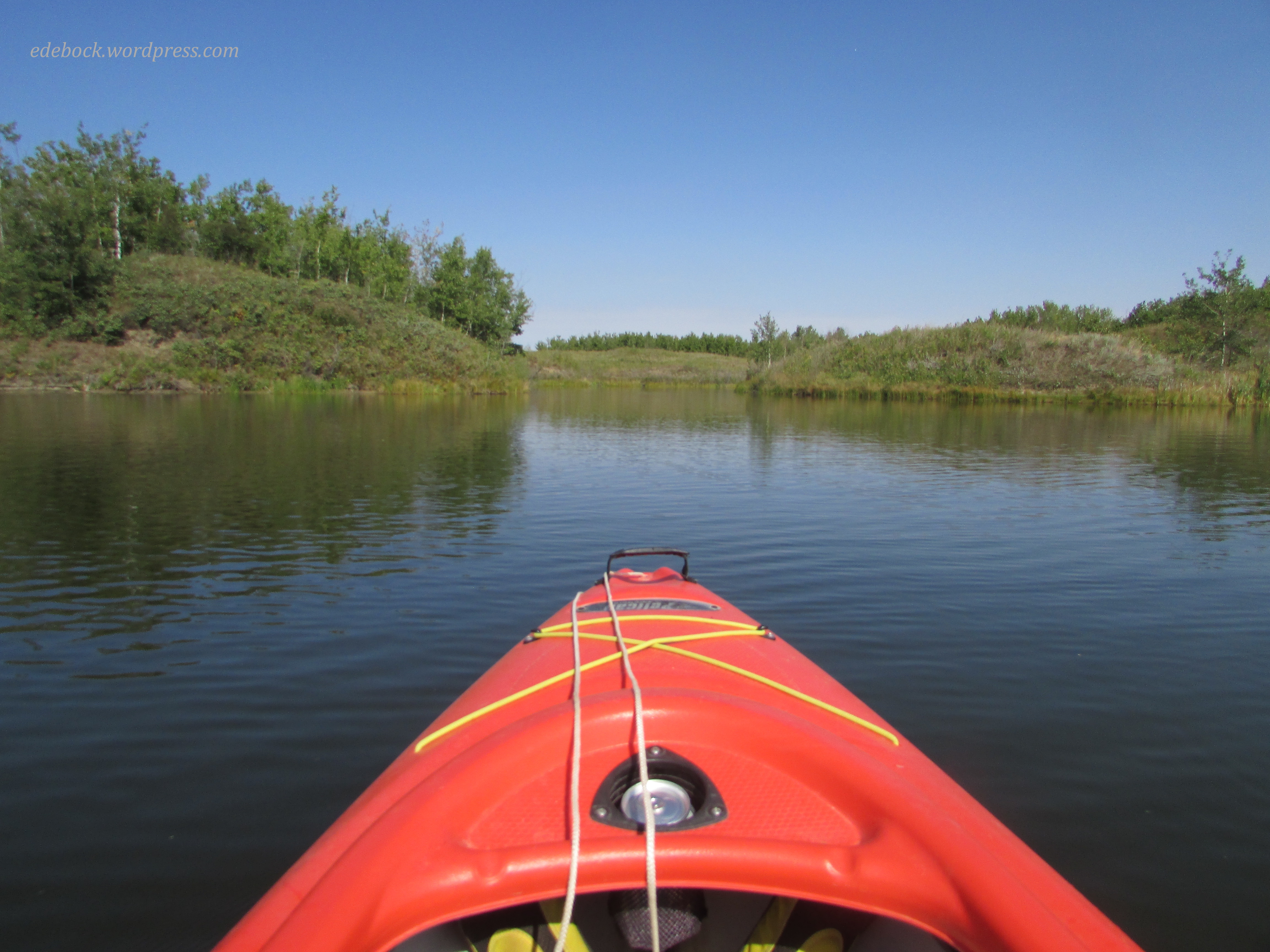
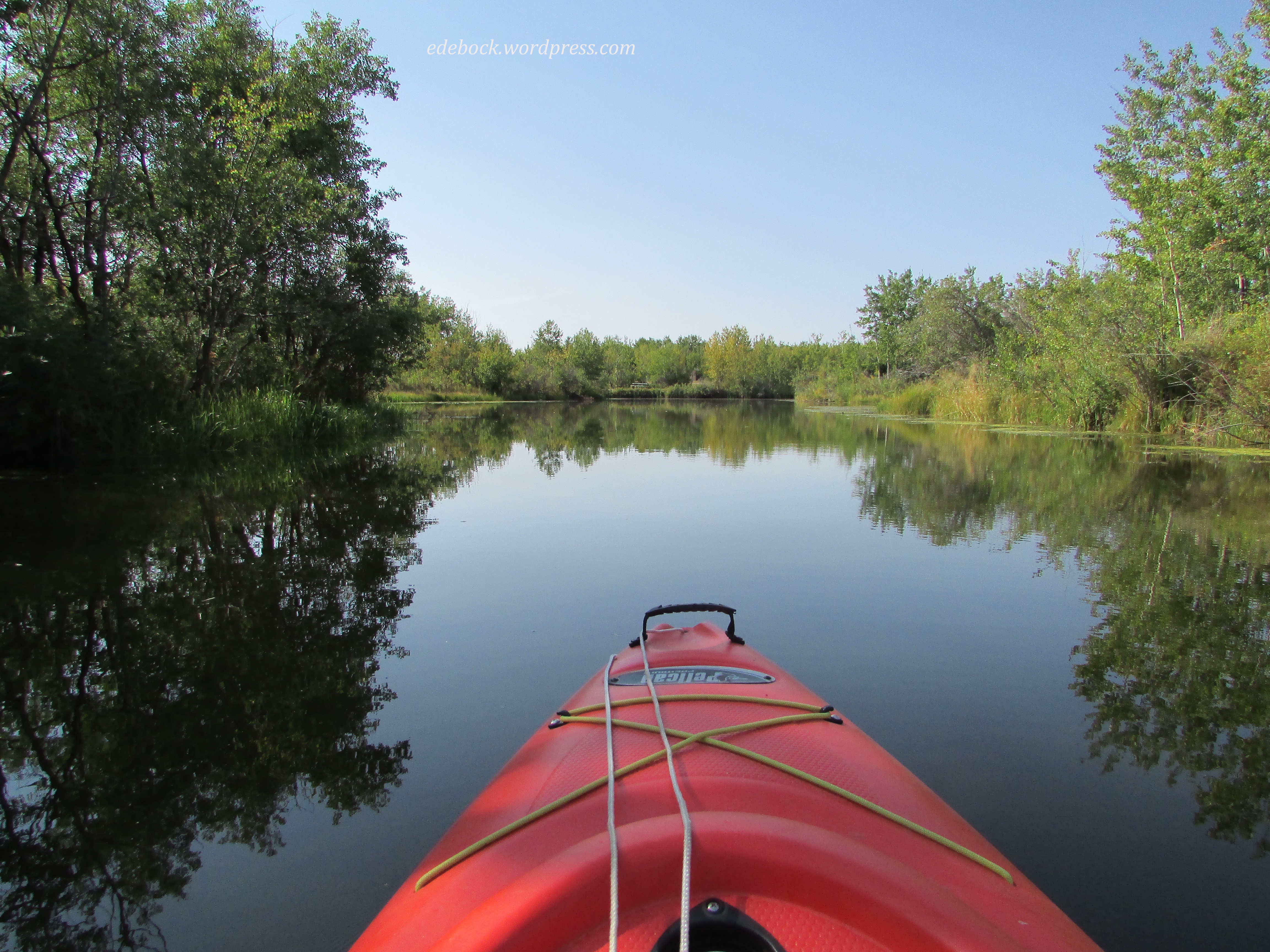
Kayaking was much more successful. The long winding lake, a haven for waterfowl, was fun to explore.

IMG_4558

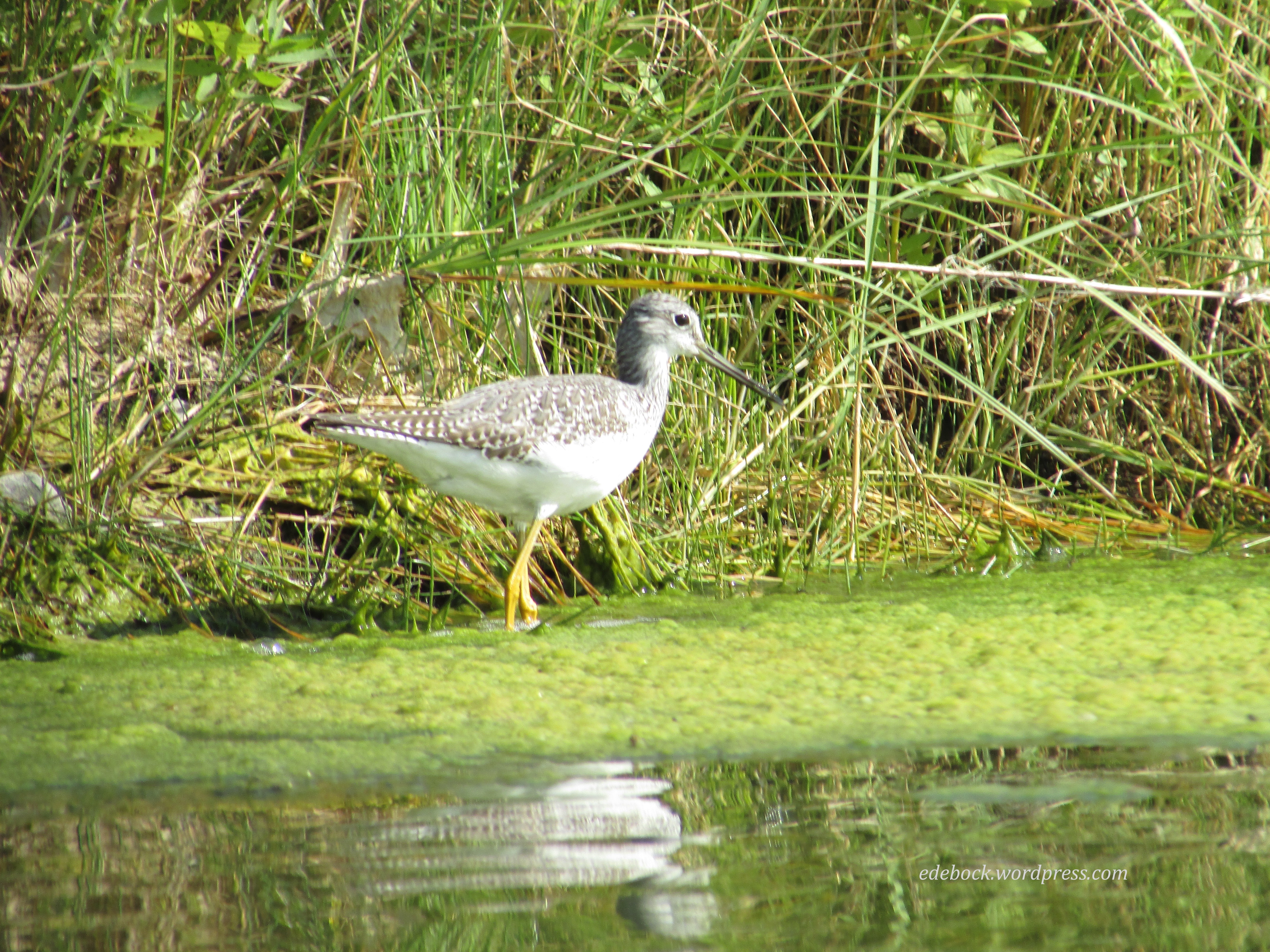
In addition to Canada geese and a variety of ducks, we saw numerous Greater Yellowlegs, a fairly large shorebird, as well as a stately Great Blue Heron. “Hank the Heron”, as Harlow dubbed him when she and Nate spotted him from the kayak, was standing guard on a tiny gravelly island when we first saw him. When we got too close for comfort, he flew off, but landed on the lakeshore where I was able to get close enough for a few more photos.

IMG_4555

Greater Yellowlegs

Great Blue Heron (with a Greater Yellowlegs in the foreground of the first photo) 

We managed to spend a total of thirty-five nights in the trailer since the first week of June this year. Although we don’t expect to take it out again this season, we do hope to do some day trips that will include more hiking and kayaking. Fall is definitely in the air and nights are getting chilly, but I’m hanging onto summer as long as I can!

IMG_4560

Ukrainian Cultural Heritage Village

IMG_4420

Prior to the recent influx of refugees from Ukraine, Canada was already home to 1.4 million people of Ukrainian descent, the world’s second largest Ukrainian diaspora after Russia. The Ukrainian Cultural Heritage Village, an open-air museum located approximately 50 km east of Edmonton, Alberta uses costumed interpreters to recreate a pioneer settlement and commemorate the lives of Ukrainian Canadian settlers from the years 1899 to 1930.

Like everywhere else, it seems, the Village is short-staffed this summer, but there were still plenty of interactive activities for us to enjoy when we visited with two of our grandchildren earlier this week.

The one room schoolhouse was a favourite. The teacher gave sample lessons in arithmetic, spelling, and grammar. She also checked to make sure our fingernails were clean and suggested that some of us weren’t dressed appropriately for school!

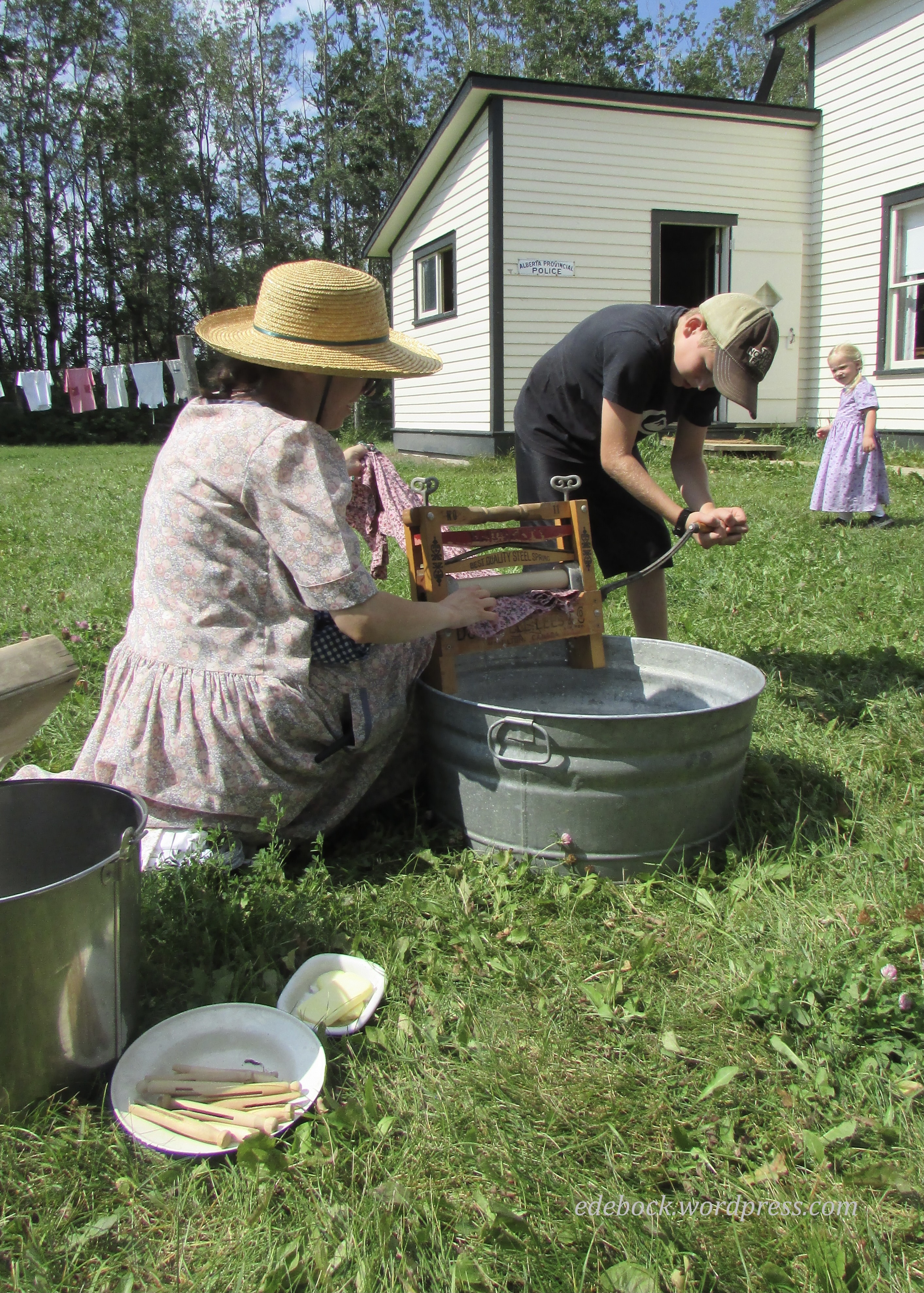
Learning to do laundry the old-fashioned way was also fun for Harlow and Yari.

IMG_4399

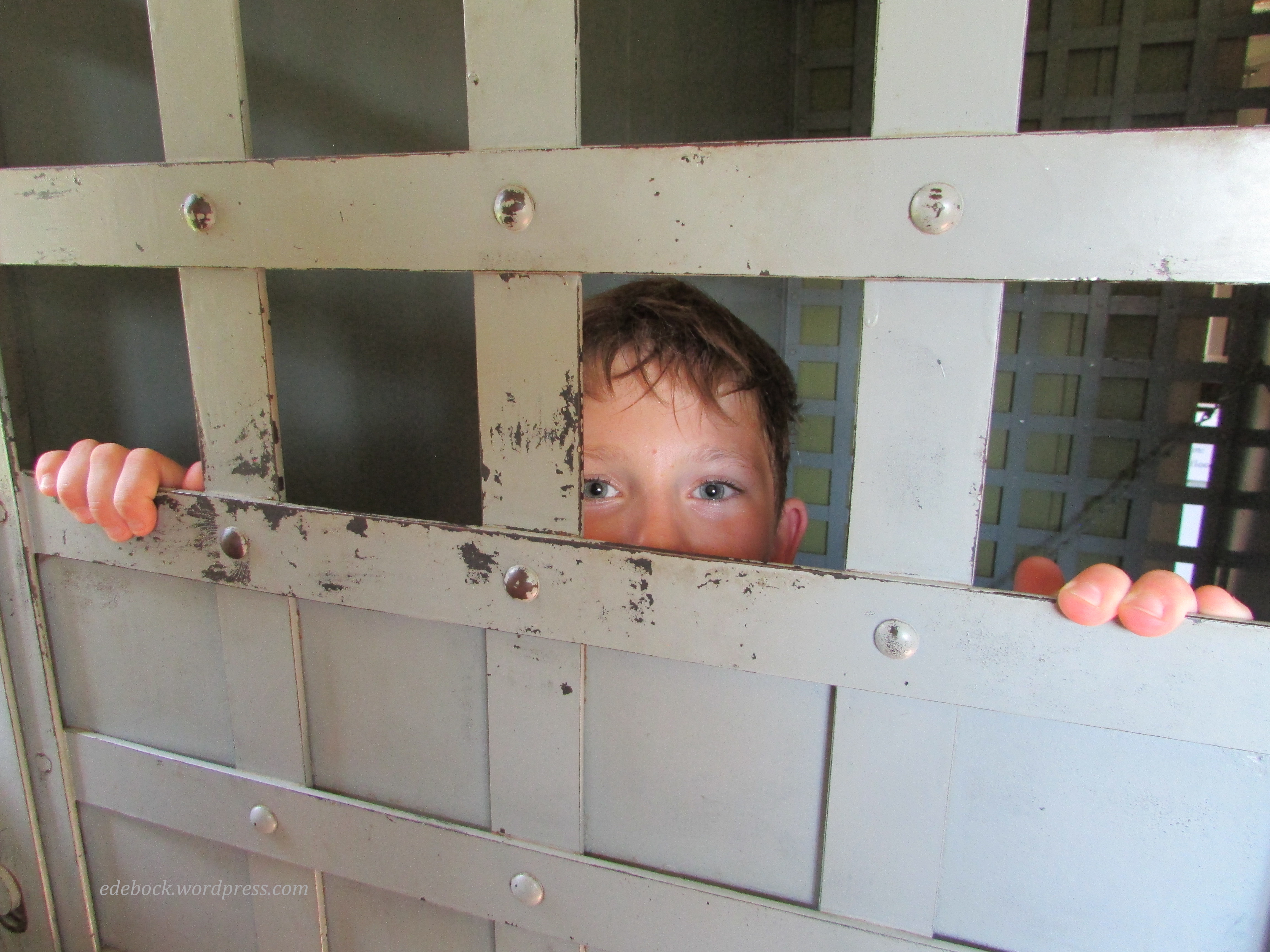
At the Provincial Police Post, we put Yari in jail!

IMG_4403

IMG_4404

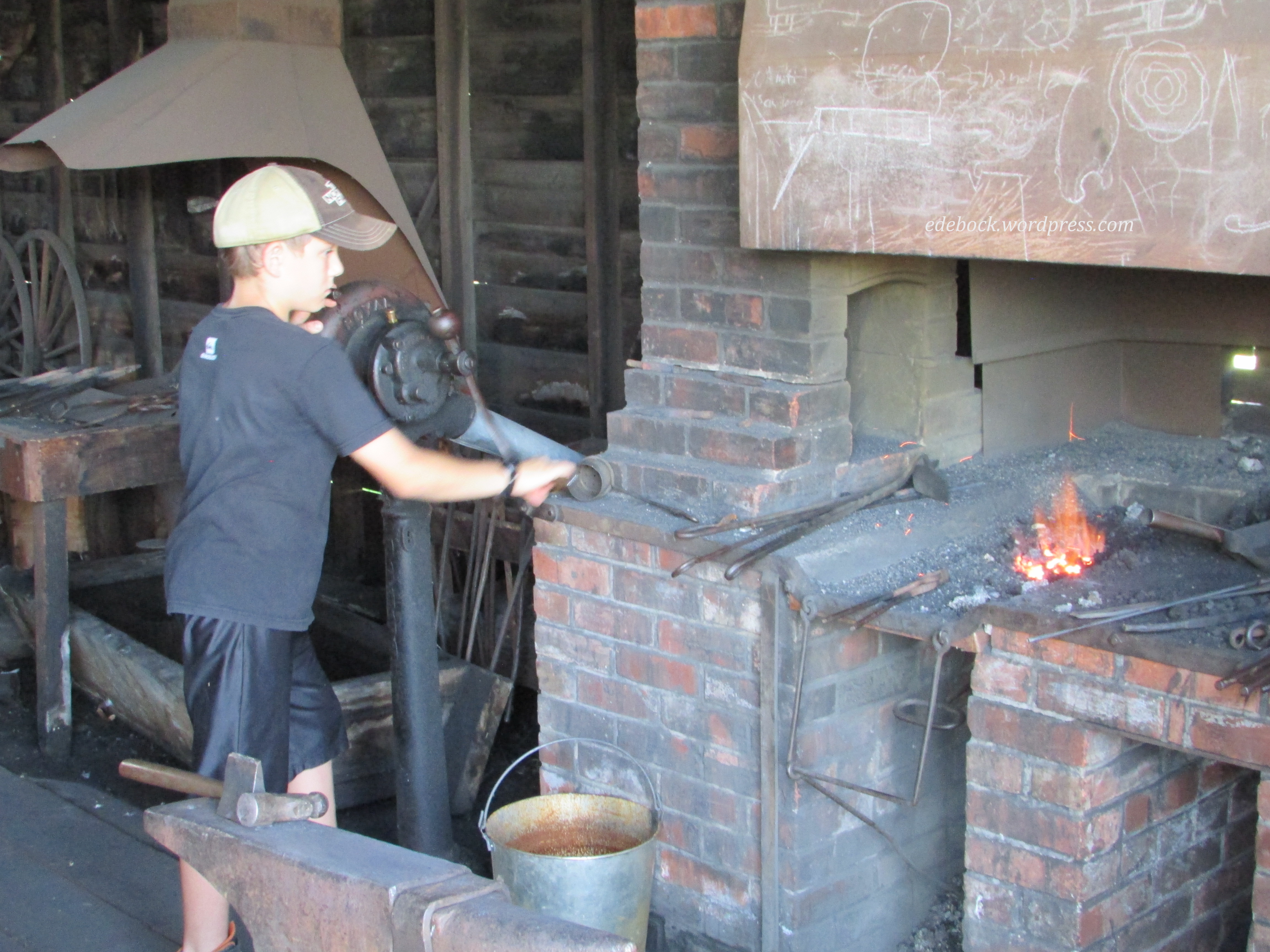
He also got to help the blacksmith.

IMG_4421

For lunch, we sampled a variety of authentic Ukrainian foods including pyrohy (perogies), holubtsi (cabbage rolls), sausage, borshch (beet soup), and somewhat less authentic, but absolutely delicious, pyrohy poutine!

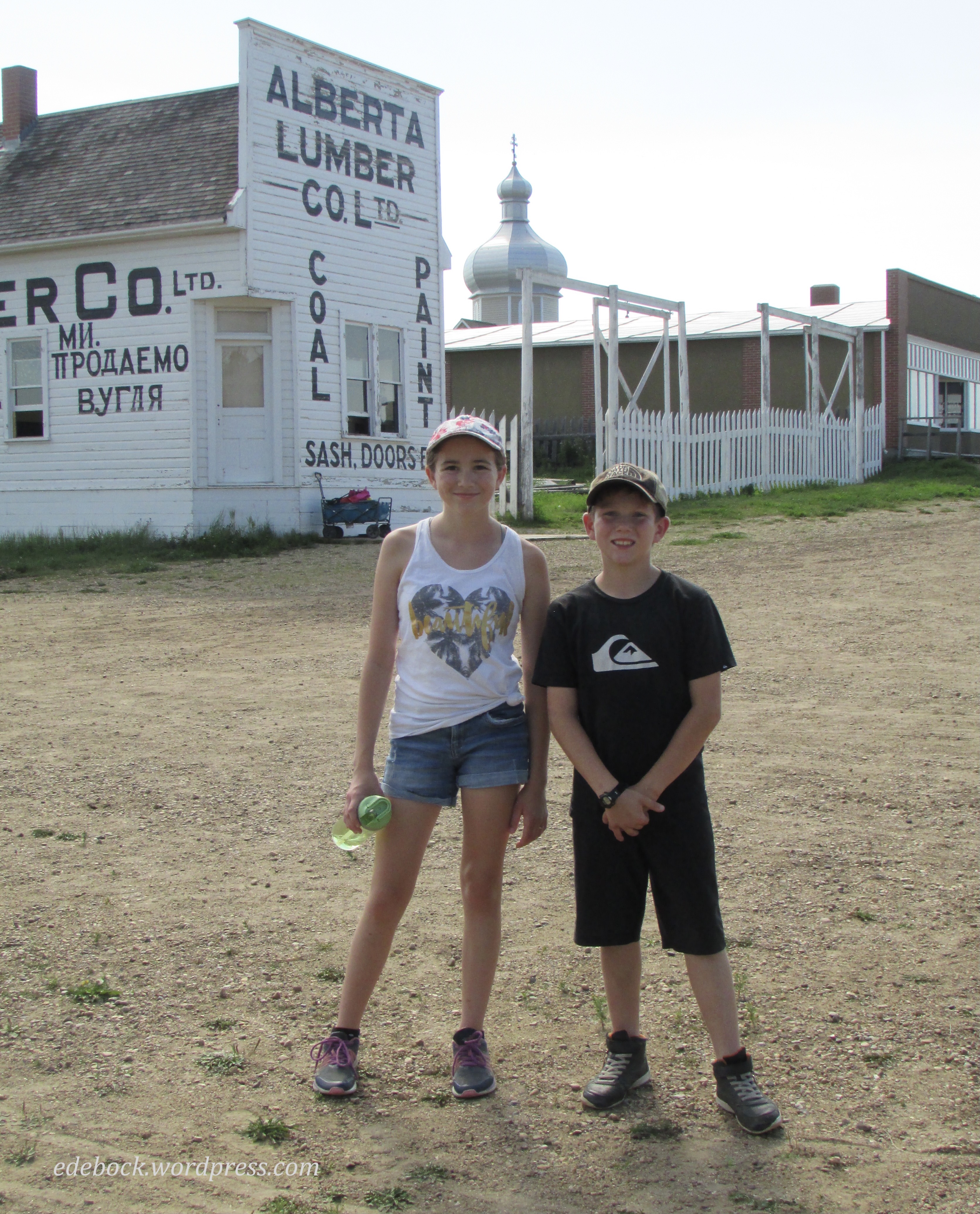
It wasn’t until later when I looked at my pictures that I realized that I’d taken lots of photos of the kids and almost none of the village’s many buildings!

IMG_4425

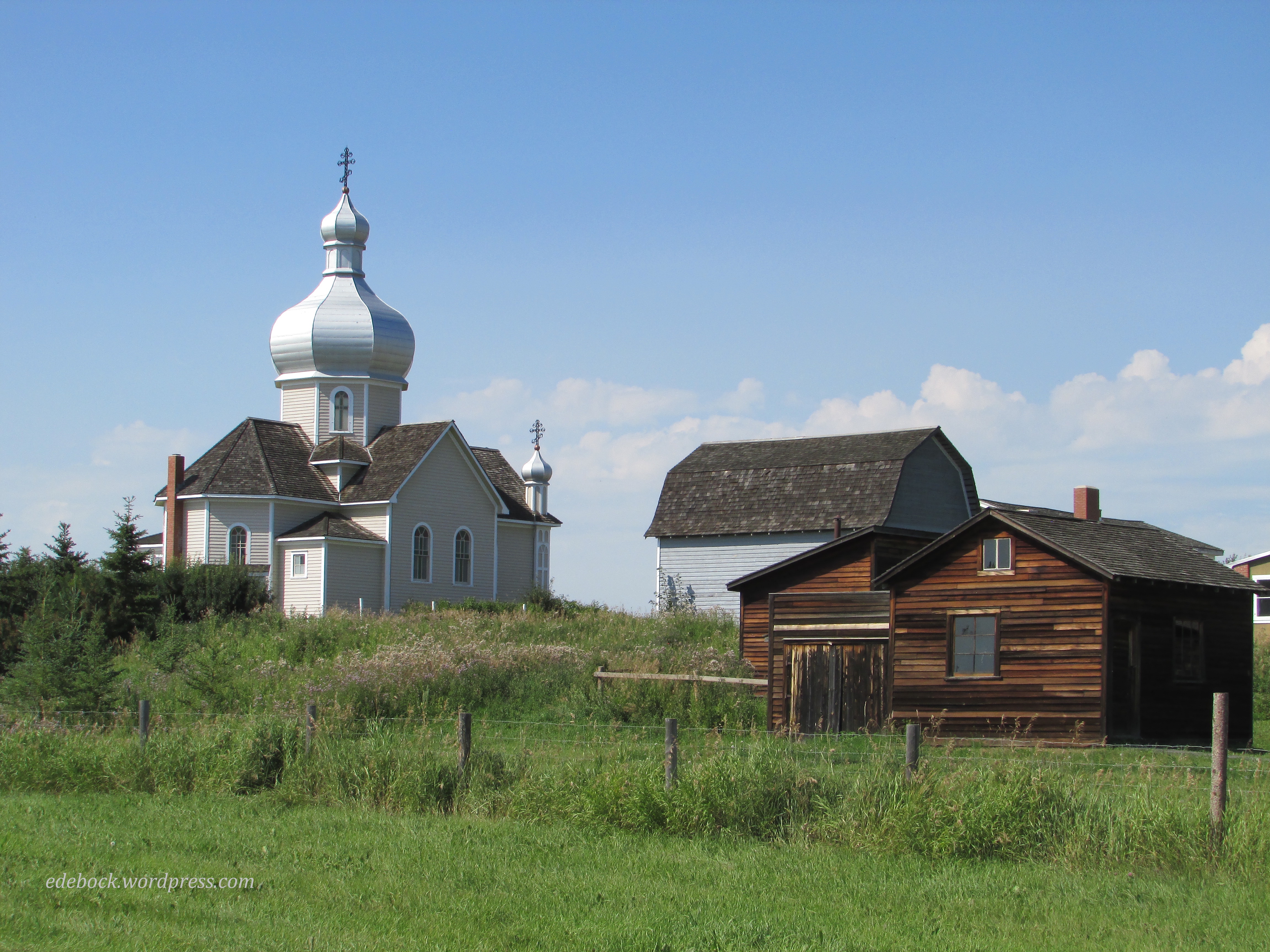
In addition to houses, barns, schools, and various places of business that have been moved to the site from communities across central Alberta, there are three churches that are still active places of worship. As such, they aren’t open to the public.

IMG_4406

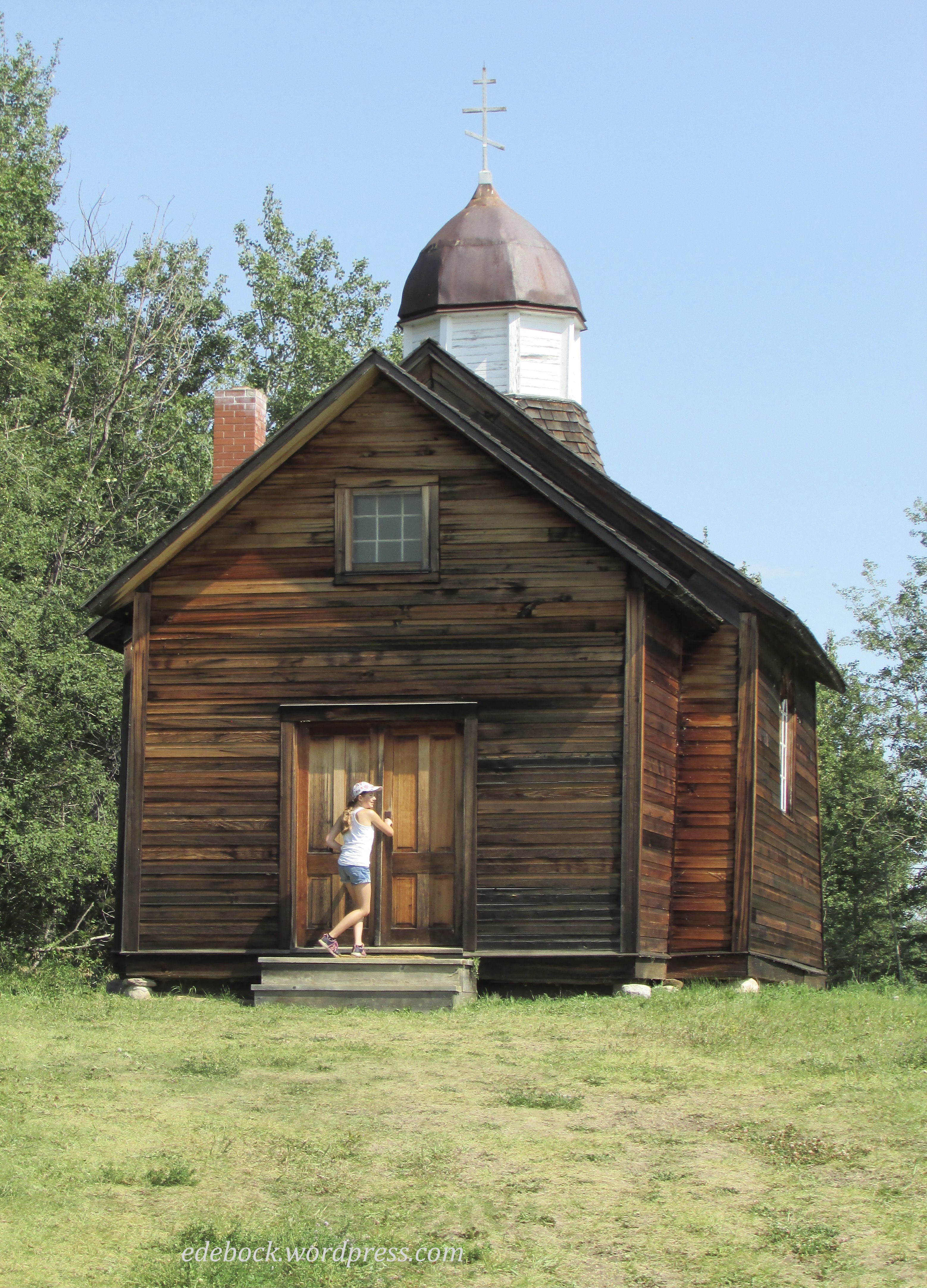
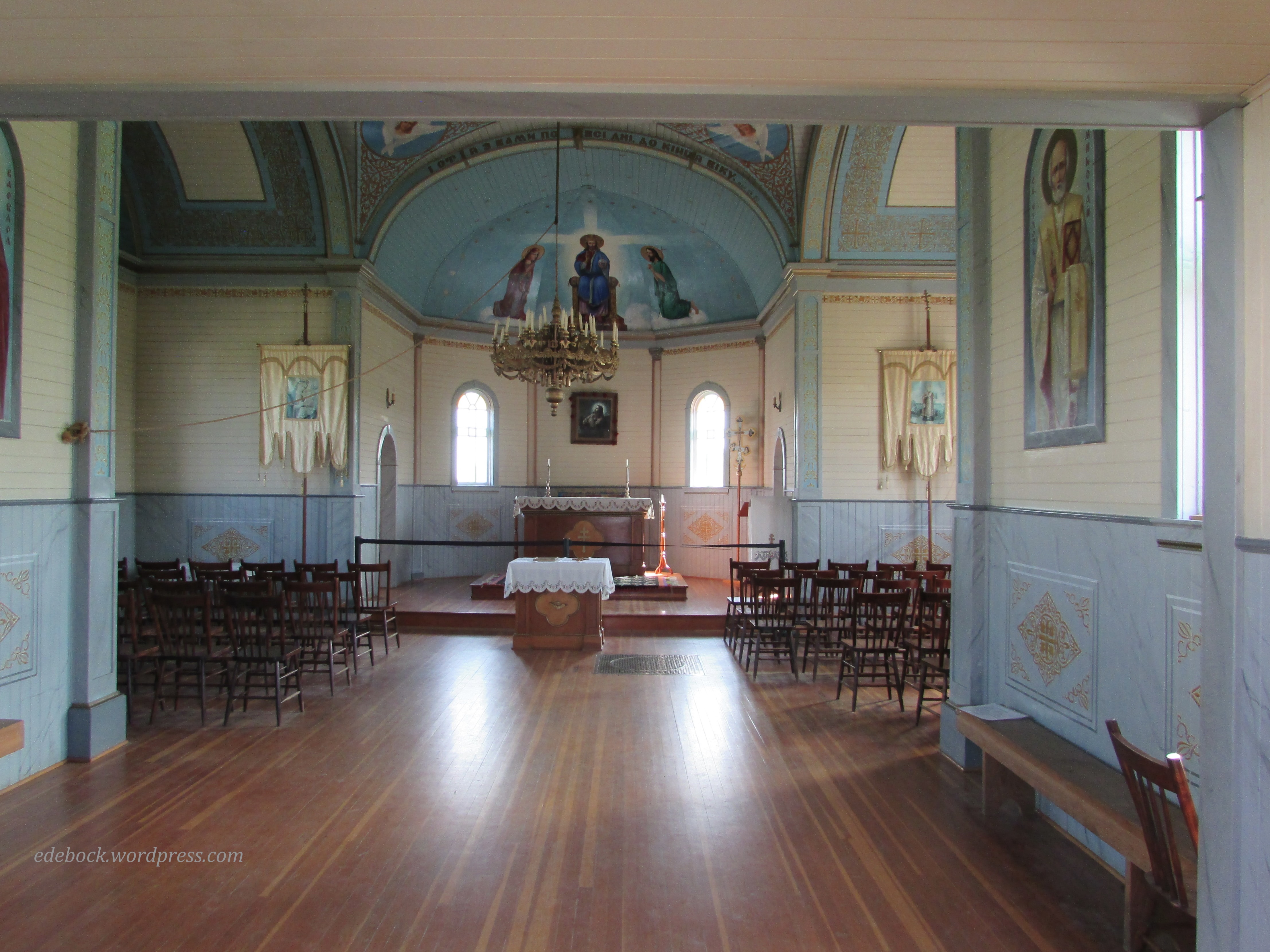
St. Nicholas Russo-Greek Orthodox Church was built in the rural community of Kiew, Alberta, by Ukrainian settlers from Galicia. The more elaborate St. Vladimir’s Ukrainian Greek Orthodox Church, shown in the first photo above, originally stood in Vegreville. Though we weren’t allowed to enter, we were able to view the very traditional interior, with it’s cross-shaped floor plan, from the open doorway. 

IMG_4423

Although the website suggests 2-3 hours to tour the village, we took significantly longer walking the dusty streets and pathways and exploring virtually every nook and cranny that was open to us. We finished our day with a ride around the village in a horse drawn wagon.