International Women’s Day 2016

Yesterday, March 8th, was International Women’s Day. My search for something relevant to write about led me to a headline that caught my interest:

Ditch the sexualized dress codes, Ontario employers told

Compared to many of the issues and abuses such as poverty, female genital mutilation, and child marriage, that women in other parts of the world face,  being required to wear sexy, cleavage-baring outfits or heels to work is definitely a first world problem, but one that I’m happy to see being addressed.

The Ontario Human Rights Commission has told that province’s employers to stop demanding that their workers dress provocatively as a condition of employment. Requiring female staff, most often restaurant and night club servers, to adhere to a sexualized dress code that frequently includes tight skirts, low-cut tops and high heels is discriminatory and, according to US research, leaves them vulnerable to a higher than normal rate of sexual harassment.

Those in the industry claim that dressing in a sexualized manner garners greater tips. That may be true, but isn’t that a rather sad statement about our culture? Should a restaurant server have to sell her body to make a living? Personally, I would rather eat at an establishment that builds its reputation on quality food and excellent service and I tip accordingly.

Hooters is, of course, the first to come to mind. It built an empire on its young, attractive and scantily clad waitresses. With their tank tops, short shorts, tights and socks, at least they get to wear comfortable shoes!

hootersgirls-1024x682

photo:  http://www.hooters.ca

Some employers insist that servers, who are on their feet all day, must wear heels. According to the Earls communication manager, that company recommends wearing heels “to reduce safety hazards.” A heel or wedge is preferred because apparently ballet flats don’t offer enough protection against stepping on glass. That’s a feeble excuse if I ever heard one! She also claims that heels provide more support, but the American Osteopathic Association would disagree. According to their website, “statistics show that high heels are one of the biggest factors leading to foot problems in women, with up to a third suffering permanent problems as a result of prolonged wear. Over time, wearing high heels can shorten the muscles in your calves and in your back, leading to pain and muscle spasms.” I have nothing against women choosing to wear heels, but to require it of someone who is on her feet day in day out puts her long term health in jeopardy.

It was the comments on the articles about this issue that disturbed me most, however. Over and over again, I read responses like this one:

” If women go to Moxie’s or Hooters to work they know they will have to flaunt their equipment. Unbelievable how women would complain knowing full-well going into the job what it’s all about.”

and

“This is a free country, Women have the choice to  accept or decline employment at businesses that require revealing uniforms.”

Tell that to the many young women who are working in these places to put themselves through school or feed their children. How many options do many of them have, especially in today’s economy?

Obviously objectifying and exploiting women is still alive and well in our culture.


No longer a joke

At first, Donald Trump for president seemed like a joke, but it really isn’t funny anymore!

This isn’t a political blog. In fact, I’ve written over 700 posts and this is the first one to tackle anything truly political, but I simply cannot keep quiet over this one! How is it possible that a xenophobic, chauvinistic and bigoted reality TV star with a track record of multiple business and personal failures has become a serious contender for the presidency of one of the most powerful countries in the world? It would be laughable if it wasn’t so downright scary.

I’ve been told by a family member that comparing Donald Trump to Adolf Hitler is “extremely over the top”, but I’m far from alone in making such a comparison. When Holocaust survivors including 86-year-old Eva Schloss, step-sister of Anne Frank and survivor of Auschwitz, are saying the same thing, maybe someone should sit up and pay attention.

“If Donald Trump became the next president of the US it would be a complete disaster,” Ms Schloss told Newsweek magazine during an interview marking Holocaust Memorial Day on January 27.

Perhaps Yad Veshem, Jerusalem’s Holocaust memorial museum, is still too fresh in my mind, but when I hear the voice of Donald Trump declaring that he will rid America of Muslims, it seems to echo the anti-Jewish sentiments expressed by Hitler and other Nazi leaders long before they achieved the position of power that enabled them to carry out the slaughter of millions of innocent people. With Trump in the White House, is it really inconceivable that something that evil might happen again? Sadly, I don’t think so.

Then there are his absolutely ludicrous claims. Making campaign promises that are easier said than carried out is par for the course at election time, but Trump’s are definitely over the top. For example, he’s going to push China into making North Korea’s leader, Kim Jong Un, disappear!

“I would get China to make that guy disappear in one form or another very quickly,” said Trump in an interview on CBS’s This Morning show on February 10. Really? And just how, exactly, is he going to do that? Has he forgotten, perhaps, that China is the largest foreign holder of US debt? We’re talking 1.2 trillion dollars here, so if push comes to shove, who is going to have the upper hand? If Donald Trump thinks he’s going to force China do anything, he’d better think again!

As a Christian, I find Trump’s public conduct appalling. His vulgar and often demeaning comments are absolutely deplorable, not to mention his flip flopping on issues such as abortion. The fact that he, who once graced the cover of Playboy magazine and who participates in what he has flippantly referred to as “my little wine” and “my little cracker”, but who also states that he does not ask God for forgiveness for his sins, has a growing number of evangelicals amongst his supporters absolutely baffles me.

I’ve heard it said that people are supporting Trump because they don’t have a better option. What an incredibly sad statement. If, amongst the approximately 319 million Americans, they have not been able to come up with any better candidates than this one, that country truly is in a sorry state! Sadly, so is the rest of the world which is why I give a damn. I am not an American. I will not be voting in this election, but if I was, and Trump was truly the best option available, I’d be packing my bags and going somewhere else!

no-trump-e1437232248968

I invite respectful dialogue in the comments section as I would very much like to know what you think.

Naming Lavita

Perhaps it’s just an extension of my love of words, but I find the meaning and origin of names fascinating. Long before we had our first child, Richard and I had two boys names picked out, Matthew and Nathan. Interestingly, they both mean “gift of God” and since God blessed us with two sons, we were able to use them both. We had a much harder time choosing names for our daughters. I’ve always been partial to girl’s names that end in A and, after much deliberation, we settled on Janina for our first daughter. A derivative of Jane, it too means “gift of God”! Though the spelling of our second daughter’s name is very similar to mine, Elaine means “light” and Melaina means “dark”! Like our other three, however, she is also a “gift of God” and that’s the meaning of her middle name, Jean!

In addition to naming our children, I’ve helped name a few pets along the way, but I never thought that I’d name a gastrostomy tube; a tube inserted through a patient’s abdomen to deliver nutrition directly to her stomach! Over the past few months, I’ve made contact with two other bloggers who are also neuroendocrine cancer patients and one of them, Lizbeth, recently wrote a post asking readers to help her choose a name for the tube that provides her with vital nutrition. She was tired of simply referring to it as “tube”.

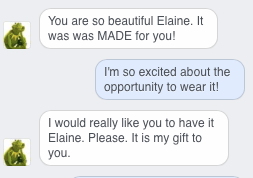
I immediately began to search for girls names that meant “giver of life”, but I didn’t find one that I liked, so I changed my search slightly and began to look for names that simply meant “life”. I quickly came up with three of them and they even ended in A; Olivia, Livia and Lavita. I sent them off to Lizbeth and waited to see what would happen. Here’s what her next blog post said:

A fellow blogger, Elaine, has gave me a name that I’m rather struck on.  The name Elaine has suggested means life.  Rather apt.  For me the tube gives me a better quality of life…  It provides me with my essential nutrients and vitamins – my daily steak and chips or fresh fruit salad if you get my meaning.  For many people with a tube it is an essential lifeline and the only source of nourishment.  

The name I have chosen is Lavita.

image4

Having the last word

I love to engage in online discussions, but when they deteriorate into pointless arguments or worse yet, absolute rudeness, I bow out. One of my pet peeves is people who always have to have the last word. Don’t they realize that having the last word isn’t the same as winning?

I have seen great discussions on Facebook and other social media end in hurt feelings and broken friendships and I’ve seen people try so hard to prove how right they are that they end up making themselves look stupid. It’s just not worth it!

As Kenny Rogers sings in his hit song, The Gambler,

You’ve got to know when to hold ’em
Know when to fold ’em
Know when to walk away
And know when to run!

I admit that I like to be right too, but I’m deliberately practicing the discipline of not having to have the last word.

As a Christian, part of my mission is to be Christ-like in what I say and do, so I’ve been looking at His example. Jesus didn’t have to deal with social media, where people often say things that they might not say face-to-face, but the principle is the same. He often said things that were controversial or misunderstood, but when He was confronted, He didn’t engage in long-winded debates. He often spoke the truth and then simply walked away. Even when He stood before Pontius Pilate and his life was on the line, He made no reply to the accusations of the chief priests and the elders. (Matthew 27:12-14)

last word

Mezuzah

If you come to visit us, you’ll notice something on the doorpost at the entrance to our home that wasn’t there before our trip to Israel.

IMG_1363

Four inches long and made of brass, it is a mezuzah container. Hidden inside are two tiny slips of paper, one in Hebrew and the other in English.

scan-1


Scan

Mezuzahs are fastened to the door frames of Jewish homes to fulfill the Biblical commandment to write the words of the Shema, the command that is central to the Jewish faith, on the door frames of their houses. (Deuteronomy 6:5-9)

“Love the Lord your God with all your heart and with all your soul and with all your strength.” 

If ours were a true Jewish mezuzah, there would be just one scroll inside. It would have been handwritten by a certified scribe with specially prepared ink on kosher parchment made of thinly shaved hide. If we were a Jewish family, we would have several mezuzahs, not just the one on the outside doorpost. Every doorway that leads into a proper room, except for the bathroom, would have its own mezuzah. Each of our hotel rooms in Israel had one.

A mezuzah is permanently affixed to the right doorpost, on the lower part of the upper third. It is traditionally hung on a slant, as shown in the photo above, with the top pointing inward. A special blessing is usually read or recited prior to affixing each mezuzah.

Mezuzah cases come in a variety of sizes and materials. Ours is a Messianic mezuzah made specifically for a Christian home. The symbol at the top is the Hebrew letter “Shin”, the first letter of Shaddai (Almighty), one of the Biblical names of God. Below it is the Messianic Seal of the Church of Jerusalem which incorporates a menorah (seven branched candelabra), a distinctly Jewish symbol, and a fish, which has been used as a symbol of Christianity since its very early days. The triangular base of the candelabra and the tail of the fish tie the two symbols together and form the Star of David, the national symbol of Israel.

The mezuzah at the entrance to our home will long be a reminder of our amazing pilgrimage to Israel, but also an expression of our faith in God.

“As for me and my household, we will serve the Lord.”  Joshua 24:15

The colours of Israel

The Sunday before we left on our pilgrimage, a little girl in our church asked us if everything in Israel was in black and white! I don’t know where she got such an idea, but her question caused me to look for colour everywhere we went. In my mind’s eye, Israel had always been the neutral colours of rock, sand and desert. A lot of it is, but there were many pops of colour to be found.

I was thankful for the bright colours on our bus, making it easy to spot wherever we went.

IMG_0822 - Version 2

There were green fields in the fertile valleys of Galilee.

IMG_0264

And green on the street in Bethlehem that made us laugh!

IMG_0731 - Version 2

There were beautiful stained glass windows and paintings in churches.

IMG_0782

There were flowers in February, always a marvel to someone from Canada!

IMG_0345

There were bright coloured fabrics.

IMG_1235

IMG_1266

And everywhere, the olive colour of military uniforms.

IMG_1267

IMG_1298

There was, of course, the glistening gold of the Dome of the Rock.

IMG_1102

But also bright yellow signs in many places warning of land mines.

IMG_0383

When I think of the colours of Israel, however, I will always remember the rainbows. Yes, in a usually dry and dusty land, God blessed us with three rainbows; one over the Mediterranean Sea, one over the Sea of Galilee, and one over the Dead Sea! My photos of the first two, taken through the bus window in the rain, didn’t turn out very well, but here’s the one over the Dead Sea. An employee in the hotel told us that it was the first rainbow he’d seen in at least three years!

IMG_0600

No, Victoria, Israel isn’t all in black and white!

Eating Kosher

I knew that I would be asked what the food was like in Israel, so this time I was prepared and even took pictures! We ate all of our breakfasts and suppers at our hotels while lunches were enjoyed in restaurants wherever we happened to be at the time. I can say without hesitation that the food was delicious, nutritious and kosher!

So what does it mean to eat kosher? Essentially, it means eating according to the dietary laws given in the Old Testament, or Torah. I was already aware that this meant only eating meat from animals that both have cloven hooves and chew their cud, avoiding all seafood except fish with fins and scales, and avoiding eating meat and dairy together. I’ve learned, however, that eating kosher is much more complicated than that and that even amongst Jews, there are many different ways of interpreting and following the dietary rules.

For example, when it comes to meat, it isn’t only a matter of which animals are eaten, but also how the animal is slaughtered and how the carcass is prepared for butchering. Some birds are kosher, while others are not. The eggs of kosher birds may be eaten, but only if they contain no blood which means that each egg should be examined individually. All dairy products must be derived from the milk of kosher animals. Hard cheeses pose a problem because an essential ingredient in their production is an enzyme called rennet, which is normally derived from the stomach of an animal. Some rabbinic authorities maintain that the enzyme is so separated from its original source, that it should not even be considered a meat product. Therefore, these authorities believe that it is permissible to eat cheese that was made with rennet. Others, however, believe that rennet still constitutes a part of an animal, and thus cannot be mixed with milk. Eating processed food is particularly troublesome because one must be sure that every ingredient, no matter how much or how little the product contains, is kosher.

Generally, all fruits and vegetables are kosher, but again, we learned, in Israel, that it isn’t quite that simple. There, these products are only considered kosher if 10% of the crop is left on the plants, bushes or trees around the perimeter of the field or orchard at harvest time for the use of the poor in the community and if the land is left to rest every 7th year. Fruits and vegetables must also be very carefully checked for insects as they are not kosher. Drinking wine or grape juice that has been produced by non-Jews is also forbidden.

There are those who claim that God established the dietary laws to protect the health of His people and that, for this reason, we would be wise to follow them. I don’t believe this to be true. Though there may have been some health advantages to some of the laws in the days before refrigeration, there is nothing less healthy about eating camel or rabbit than eating beef or chicken. I believe that it was simply God’s intent to distinguish His people from those around them and to teach them obedience. I am, therefore, in agreement with those Jews who say that they eat kosher simply because God told them to and for no other reason. How thankful I am that as New Testament believers, we are not subject to the Old Testament dietary laws. God made that very clear to the apostle Peter in a vision while he was staying at the house of Simon the Tanner in Joppa. (Acts 10:9-16)

All meals served in the hotels where we stayed were kosher. Each hotel is under the supervision of its local rabbinical council and should they ever be caught serving anything non-kosher, the penalty would be severe.

So, what did we eat? The meals were similar at all four of our hotels. Breakfasts and dinners were sumptuous buffets with a myriad of wonderful choices. It’s only in the west that breakfast is an entirely different meal from lunch and supper. For example, when we lived in Japan, if we asked our students what they ate for breakfast, the answer would most often be fish and rice. If we asked what they ate for dinner, the answer would usually be the same. This appeared to be true in Israel as well. Though cereal and toast were available at breakfast time and our last hotel had a station where yummy looking omelettes were made to order, breakfast also included a complete salad bar! Cottage cheese, yogurt, various cheeses, buns and breads were also part of the breakfast menu, but so were fish, olives and a variety of hot dishes. Coffee and a variety of teas were also available.

I think I could have lived off the salad bars alone. I started each day with a plate filled with salad, a dollop of cottage cheese, a few slices of cheese and a bun or a slice of hearty bread. When that was done, I finished off with a taste of a one or two of the hot dishes.

We were thankful for the hearty breakfasts as our days were full and we did lots of walking and climbing. Lunch was most often a pita filled with either falafel (spiced mashed chickpeas formed into balls and deep-fried) or schawarma (roasted, shaved meat) and vegetables. Simple, but tasty and filling.

Dinner was usually fairly late. After a busy day, we were ready to load up our plates again!

Again, I filled a plate at the salad bar and then went back for a smaller serving from the many hot food choices. Meats most often included fish, chicken and beef. The dessert selections looked absolutely amazing, but I didn’t take any pictures as I didn’t want to linger over them too long! I managed to stick to my low sugar diet most of the trip. Three of our four hotels offered sugar free dessert options which was nice. When I didn’t see any on offer at our last hotel, I asked, and after a long wait, I was brought a piece of very dry, plain cake that was still slightly frozen in the centre. After that, I didn’t ask! I did break my diet twice, once when we celebrated our youngest group member’s 16th birthday with a lovely cake and once when I tried a teeny, tiny chocolate eclair because everyone else was raving about them. It was well worth it!

Though the reason for my diet is the fact that I’m pre-diabetic, I was pleased to discover that in spite of eating so well, I didn’t gain any weight while we were away!


Shabbat Shalom!

We were in Israel for two Shabbats, the Jewish Sabbath that begins at sundown on Friday and lasts until sundown Saturday. Most schools, businesses, shops and even tourist sites close at 3:00 pm on Friday and don’t reopen until Sunday morning.

According to Old Testament law, work is forbidden on Shabbat. The 4th commandment says, “Remember the Sabbath day by keeping it holy. Six days you shall labour and do all your work, but the seventh day is a Sabbath to the Lord your God. On it you shall not do any work, neither you, nor your son or daughter, nor your manservant or maidservant, nor your animals, nor the alien within your gates. For in six days the Lord made the heavens and the earth, the sea, and all that is in them, but he rested on the seventh day. Therefore the Lord blessed the Sabbath day and made it holy.” (Exodus 20:8-11)

Over the centuries, Judaism has attempted to interpreted what is work and what isn’t, what is forbidden on Shabbat and what is allowed, ending up with a complex and somewhat overwhelming list of rules to be followed. Here’s a basic list of activities that ought to be avoided on Shabbat:

  • writing, erasing, and tearing
  • business transactions
  • driving or riding in cars or other vehicles
  • shopping
  • using the telephone
  • turning on or off anything which uses electricity, including lights, radios, televisions, computers, air-conditioners and alarm clocks
  • cooking, baking or kindling a fire
  • gardening and grass-mowing
  • doing laundry
  • carrying anything outdoors or transferring objects between an enclosed domain, such as the house, and a public domain, such as the street

There are detailed rules pertaining to each of these. For example, the refrigerator can be used because it is on all the time, but to ensure that it’s use doesn’t involve turning something on or off, the fridge light should be disconnected before Shabbat by unscrewing the bulb slightly. The rule about carrying things outdoors would include carrying anything in your pocket or even having gum in your mouth! Of course, as in any culture or religion, there are those who follow the Shabbat rules to the nth degree and those who don’t.

Clearly our Lord took exception to the interpretations of the 4th commandment that were in vogue in His day as He was criticized by the religious leaders for healing the sick on the Sabbath (John 5:1-15) and for allowing His disciples to pick heads of grain and eat them when they passed through the fields on that day of the week. (Matthew 12:1-2)

In one of our hotels, we had the choice of three door hangers to notify the staff of our various needs or intentions.

IMG_0185

Many hotels in Israel allow a late checkout on Saturday for Shabbat observers, enabling them to stay in the hotel until after sundown. Attending synagogue on Shabbat is considered essential by most Jews, so many hotels also have a synagogue within the building.

We were warned to avoid using the specially designated Shabbat elevators in our hotels unless we had lots of time to spare. Set to go up and down continuously, stopping and opening at every floor for the entire 24 hour Shabbat period, these elevators ensure that Shabbat observers don’t have to push any buttons which would be construed as work.

Friday dinners in our hotels were festive affairs with many Jewish families there to celebrate Shabbat. Going out for dinner ensured that they kept the no cooking rule and they didn’t seem to object to the fact that someone else had to work to prepare and serve the meal! The already sumptuous buffets were even more elaborate on those days and it definitely wasn’t all food that was prepared in advance. Saturday breakfasts, however, were more basic than the other days and involved very little hot food.

Of course, the people we saw at dinner in the hotels were not the ultra-Orthodox Jews. They would have been at home observing Shabbat in a much more traditional way. We drove through an ultra-Orthodox neighbourhood on our way back to our hotel in Jerusalem on a Friday afternoon and observed them scuttling about making their last minute purchases and preparations before retiring to their homes.

Our guide pointed out that the various ways that the men were dressed indicated membership in different sects. Height or style of hat, coat length, whether his socks are black or white, and whether or not his pants are tucked into his socks are all indicators of which group a man is part of. The women’s clothing is much less distinctive, but very conservative. For example, they would never be seen in public wearing pants. A large overhead billboard as we entered the neighbourhood advised us how we ought to dress while we were there.

billboard

Photo:  Lisa Mathon – https://commons.wikimedia.org/w/index.php?curid=2024503


So who are these ultra-Orthodox people? Though they consider themselves the most religiously authentic Jews, they don’t seem to be very productive members of Israeli society and are seen by many as a drain on the economy. Less than 50% of the men are employed. Instead, many spend long hours every day praying and studying scripture while the family lives off Israel’s generous social welfare system. Like many other Israelis, our guide, Shimon, resents how much he pays in taxes to support these people. Apparently, this is a huge political issue at election time. Another source of resentment for many is the fact that, upon the establishment of the State of Israel in 1948, ultra-Orthodox males of military age were exempted from universal conscription into the Israel Defense Forces. Officially, those who were enrolled in yeshiva, an institution focusing on the study of traditional religious texts, were granted deferred entry into the IDF, but in practice few serve at all. At the time when this agreement was made, only about 400 individuals were affected, but due to their extremely high birth rate, the ultra-Orthodox are now estimated to make up approximately 10% of the Israeli population!

Well, even though the days are getting longer it’s now past sundown on a Friday afternoon in my part of the world so I wish you Shabbat Shalom or, in English, Sabbath Peace!

Final day

Reflecting on and writing about our final day in Jerusalem seems like a perfect way to enter the Lenten season as we spent the day immersed in the final moments of Jesus’ life here on earth, visiting the sites surrounding his arrest, crucifixion, burial and resurrection!

Our morning started on the Mount of Olives overlooking the Kidron Valley. The sun gleamed off the golden Dome of the Rock, the Muslim mosque that now stands atop Mount Moriah where the Jewish temple once stood. Before us lay the route that He took on His triumphal entry into Jerusalem on the day that has become known as Palm Sunday. (Matthew 21:1-11)

IMG_1107 - Version 2

As we stood atop the Mount, we were reminded that, according to prophecy, that is where He will return someday! (Zechariah 14:4) Come, Lord Jesus!

Walking down the Mount, we came to the Garden of Gethsemane where Jesus spent the final moments before His arrest. Even with the sound of traffic in the background, the garden was a place of great peace. In our devotional time there, we were reminded so clearly of the great burden that our Lord bore that night as He prayed alone, feeling the weight of the sin of the entire world on His shoulders. Kirk, our devotional leader, compared it to the deepest of depressions. For me, our time of reflection in the garden was spiritually profound. As I thought about the extreme anguish that I once felt when I was betrayed by someone I loved and then tried to multiply that by the sin and betrayal of every person who has ever lived, it was beyond my ability to comprehend. Is it any wonder that He sweat drops of blood and prayed, “Father, if you are willing, take take this cup from me.” How thankful I am that He followed this up with “yet not my will, but yours be done.” (Luke 22:39-45) Without that willingness to carry the weight of our sins to the cross, we would be forever lost with no hope of salvation and eternal life.

We stopped for a quick look at the Gethsemane Basilica of Agony with it’s beautiful mosaics above the portico.

IMG_1189

Continuing down the hill and up the other side of the valley, we entered the walled city through the Lions’ Gate, which is also known as St. Stephen’s Gate or the Sheep Gate.

IMG_1200

IMG_1203 - Version 2

Inside the wall, we visited St. Anne’s Church where, when we sang Amazing Grace together, the acoustics were so amazing that each note hung in the air for a good four seconds! Though she isn’t mentioned in scripture, St. Anne was, according to tradition, the mother of Mary and the grandmother of Jesus. I was especially taken with the beautiful alabaster statue of a mother teaching her young daughter from scripture. The scroll in her hand has Deuteronomy 6:5 written on it in Hebrew. “Love the Lord your God with all your heart and with all your soul and with all your strength.” The delightful French Canadian priest told us that the church is often referred to as the “grandparents’ church” and reminded us of our Lord’s instruction to pass on His teachings to our children and grandchildren. (Deuteronomy 6:6-7)

IMG_1214

In the area, we also saw where the pools of Bethesda were once located. It was here that Jesus healed a man who had been crippled for 38 years. (John 5:1-15)

IMG_1218 - Version 2

A quick trip around the Temple Mount by bus took us to the Jaffa Gate where we entered Old Jerusalem and walked the narrow market streets to a tiny restaurant where we had lunch.

Our next stop was the Church of the Holy Sepulchre, a cavernous structure standing on the bedrock at a site said to encompass both Golgotha, or Calvary, the spot where Jesus was crucified, and the tomb (sepulchre) where His body lay. Filled with icons and incense, we could only think of what we saw as idolatry and, to me, it didn’t seem very different from what we’d seen in numerous Buddhist temples in Asia. Most disturbing to me was the Stone of Unction, or Stone of Anointing, a flat red stone some six metres in length and decorated with candlesticks and lamps that is located in the entrance of the church. It is purported to be the place where Jesus’ body was laid and prepared for burial after being taken down from the cross. It was surrounded by devoted pilgrims bowing before it, kissing it and rubbing their possessions on it in hope of receiving some sort of blessing. Personally, I was more than happy to leave. Apparently, people sometimes wait hours to enter the Edicule, an ornate cubicle that supposedly houses the empty tomb, but we had another tomb to visit!

IMG_1253 - Version 2

IMG_1255

Some 2000 years after the fact, there is, of course, no way of knowing exactly where the cross of Christ stood or where the tomb that held his body was located, but the Garden Tomb seemed much more authentic to me. The guide who met us there, gave us many pieces of evidence pointing to the likelihood that this could be the place. If nothing else, there was a great sense of peace there that I didn’t feel in the Church. He first showed us the hillside that would appear to be Golgotha, meaning “the place of the skull”. Though the nose crumbled several years ago and a bus station has somewhat obliterated the lower portion, it’s easy to see a skull in the rocky hillside.

IMG_1272

Although I’ve always visualized the crosses standing at the top of a lonely barren hill, the guide explained that they were more likely positioned near the bottom beside a busy road and in the face of the throngs of passersby making their way into Jerusalem for Passover. That’s the way the Romans did things. He also pointed out the irony of thousands of lambs being brought into the city for the Passover sacrifices passing right by the true lamb of God hanging on the cross, but missed by the multitudes.

Next, he walked us through the garden to the empty tomb. Actually being able to enter and see the spot where Christ’s body may have lain was another very moving experience. The doorway has been enlarged and steps added to allow easier access.

IMG_1278

IMG_1284

This is a similar tomb beside a road in Galilee that shows what the stone would have looked like.

IMG_0247

After we’d all had a chance to enter the tomb, we gathered in a tiny well-lit chapel in the garden for a service of communion. We drank our wine from tiny olive wood communion cups which we were then given to bring home with us. Celebrating our risen Lord with a group of people that we’d quickly grown close to and experienced so much with was very meaningful! Though that would have been a suitable finale to our pilgrimage, we made three more quick stops before our busy day was over!

On Mount Zion, we first visited the place that is traditionally held to be the location of the Upper Room where Jesus and His disciples shared their Last Supper. (Matthew 26:17-30) The building is actually a 12th century Crusader structure, but archaeological evidence of Roman construction on the lower level supports the possibility that this area was indeed the location where our Lord shared a final meal with his disciples. Like so many others, the building has changed hands many times throughout history.

On the lower level, we visited one of the most holy Jewish sites, the traditional location of the tomb of King David. The men were required to don yarmulke, the skullcap traditionally worn by Jewish males, and entered one room while we women went into a smaller adjoining room. In our room, a few women quietly read their Hebrew scriptures, but we could hear quite a din from the other side of the partition. Our men exited shaking their heads and describing a crowded room full of ultra-Orthodox men shouting, wailing and banging on a central table as they bowed and bobbed. There is obviously much that we don’t understand about their religious practices!

Our final stop was the house of Caiaphas, the high priest, where Jesus was taken after his arrest. There is clear evidence that this time we were, indeed, standing in an authentic spot. The stone stairs leading up to the house are the very ones that Jesus would have climbed on His way to trial.

IMG_1307

Inside the house, we went down into the dungeon where Jesus likely spent His final night on earth. It was nothing more a large hole dug into the rock beneath the house. Somewhat overcome by all that we had seen and experienced, we sang our final hymn together.

Yad Veshem

I think a person could easily spend a whole day in Jerusalem’s Yad Veshem Holocaust History Museum, Israel’s national memorial to the victims and the heroes of that horrible time in history, and not have time to take in every detail. We had an hour and a half! While some of us would probably have liked longer, I don’t know how much more we could have handled. After awhile, I think the horror would have been too much.

From beginning to end, the museum tells the story of those terrible years from a uniquely Jewish perspective. As visitors move from one gallery to the next, the displays, filled with artifacts, documents, survivor testimonies, diaries, letters, personal possessions and works of art, emphasize the experiences of individual victims. Beginning with Nazi Germany and its anti-Jewish policies prior to the outbreak of World War II and carrying through to post-war days when survivors sought to return to some sort of normal life again, it is a dramatic reminder of man’s inhumanity to man.

The circular Hall of Names at Yad Vashem is the Jewish people’s memorial to each and every Jew who perished in the Holocaust, a place where they may be commemorated for generations to come. Shelves around the outer edge of the cavernous hall hold the Pages of Testimony containing short biographies of each Holocaust victim. Over two million Pages are stored in the repository and there is room for six million in all, the number of men, women and children who were murdered by the Nazis and their accomplices.

Photo taking is not allowed inside the galleries, but I will seek to share a few of my strongest impressions:

  • Reading some of the details and quotations expressing anti-Jewish sentiment from the years prior to the Holocaust was especially disturbing because they sounded so familiar, so reminiscent of anti-Muslim and anti-refugee sentiments that we’ve been hearing in recent days. Is our world not ripe for something this evil to happen again?
  • Learning that at least one ship full of Jewish refugees headed to Cuba was turned away angered me. Refused refuge by both Canada and the US, it was forced to return to Europe. While some passengers were allowed to stay in Britain, others were forced to return to the mainland. I’ve seldom felt ashamed to be Canadian, but in the moment when I read that, I did.
  • Being reminded that in a situation like the Holocaust, everyone is involved either as victim, perpetrator, hero or part of the apathetic masses who fail to get involved or who follow corrupt leaders out of fear, I had to ask myself, which category I would fall into. Would I have the courage to stand by my convictions against such forces of evil?
  • Watching numerous video clips of survivors bravely telling their stories had a powerful impact on me. How thankful I am that these recordings were made. As the number of victims rapidly dwindles due to the passage of time, their stories will continue to be heard.

Our guide, Shimon, didn’t go into the museum with us. We assumed that he had probably been many times before, but he told us afterward that he has never been inside. He doesn’t need a museum to remind him of the effects of the Holocaust. Leaving their families behind, his parents came to Israel from eastern Europe as teenagers prior to World War II. It wasn’t until after the war that they learned that their entire families had perished. Shimon grew up with no extended family; no grandparents, aunts, uncles or cousins. Apparently this wasn’t uncommon for his generation in Israel. He also told us the story of his father-in-law who lost his first wife and their two children in the Holocaust, a secret that he told no one until moments before his death.

Outside the museum is the Garden of the Righteous. Trees, a symbol of the renewal of life, were planted here in honour of those non-Jews who risked their lives to save Jews during the war.