Preparing for the rainy season

In the two months that we’ve been in Japan we’ve probably seen as much rain as we normally get in a year in Alberta and the rainy season hasn’t even started yet!  In our school mailboxes yesterday we received two pages of hints and tips for coping with this annual occurrence.  Apparently, we need to prepare ahead in order to minimize mold, mildew, moths and yes, cockroaches!

Our first task will be a trip to the store in search of anti-moth products, desiccants which are used for dehumidifying, and roach traps.  Next, we’re advised to make sure that winter clothing, particularly anything wool, is thoroughly cleaned and stored in bags with anti-moth stuff and desiccant.  I’ve already packed our winter coats away but will have to add the products to protect them once we purchase them.  We’re also advised to put anti-moth product and desiccant in all our drawers and in the corners of our closet.  Apparently, if we don’t, we run the risk of finding mold on pretty much anything.

Apparently, even if we run our fans and use the dehumidifying feature on the air conditioner, everything will become damp during rainy season.  As often as possible, assuming that the sun does shine occasionally during the rainy season, we should sun dry our futons to keep them from becoming musty.   I don’t have any difficulty believing that this will become necessary as I already took the towels from the bathroom and hung them outside for awhile this morning because they simply wouldn’t dry in there.

In order to avoid run ins with the “little livestock”, as our handout calls the cockroaches, we must NEVER leave any food out for them, should wash all dishes immediately, should wipe our sink and counters (what counters?) with bleach and should keep all garbage bags closed and sealed.  Also, I now know why there’s a trap in the kitchen sink.  It’s not to keep food stuff from going down the drain.  It’s to keep roaches from coming up!  Eew!

We can do all of the above but I’m not sure how much it will help.  There’s an open space under our bathtub where the water from the sink and tub drain.  I hate to think how gross and wet it probably is under there and I don’t know of anything we can do to close it off or prevent it from attracting nasties.  It’s been suggested that we pour some bleach in there to try to kill off anything that might be growing there so we’ll probably do that and hope for the best.  We’ll also decorate the apartment with roach traps.  Apparently, these are much like the little ant traps that we use in the basement back home.  The insect carries the poison back to the nest to share with it’s roommates, thus killing them off.  Gross, but hopefully effective!

The final suggestion on our handout is to always look for the beauty in the season!  Apparently Japanese iris and hydrangea are at their prime at that time of year.  I’ll try to remember that when I encounter my first cockroach!

Waiting for Peanut

The one downside of our Japan adventure is the fact that we’ll be so far away when our first grandchild is born and we’ll miss out on being nearby during most of his first year of life.  Our kids have always known of our desire to teach overseas after retirement so, even though she was pregnant when we left, Melaina encouraged us to continue with our plans.  We so appreciate that.

Peanut, as he was fondly dubbed by Melaina’s dear friend, Tanya, when she saw the first ultrasound pictures, was due to be born in the middle of May.  It doesn’t look like he’s planning to wait that long, however.  In fact, he’s been threatening to arrive for the past 48 hours!  That’s when the contractions first began.  Poor Melaina’s been experiencing what her doctor calls the longest latent stage of labour in history!   Unfortunately for her, the doctors are unable to do anything to hasten the process because she’s still technically pre-term.

Thanks to modern technology and the fact that yesterday was my day off, Melaina and I have been in pretty constant contact throughout the past two days of waiting.  Due to the 15 hour time difference between Alberta and Japan, her nighttime hours are my day and vice versa.  Throughout yesterday afternoon, I checked Facebook every hour or so and when she didn’t post any messages for several hours, I knew she was getting some much needed sleep.  I’ve been leaving the computer on at night the past two nights and when I’ve had to get up for one of those inevitable bathroom visits that happen at this age, I’ve checked in to see how she’s doing.  The phone has been waiting at the foot of our bed in case there’s a call in the wee hours to tell us that Peanut has indeed put in his appearance.  Richard and I are amongst the few people in Japan who don’t carry cell phones, however, so we can only be reached at home.  Fortunately, today is Rich’s day off so he’ll be around much of the time.

Please don’t keep us waiting too much longer, baby boy!  Even at a distance, Gram and Grandpa are anxiously waiting to know you!

Living in a flower garden

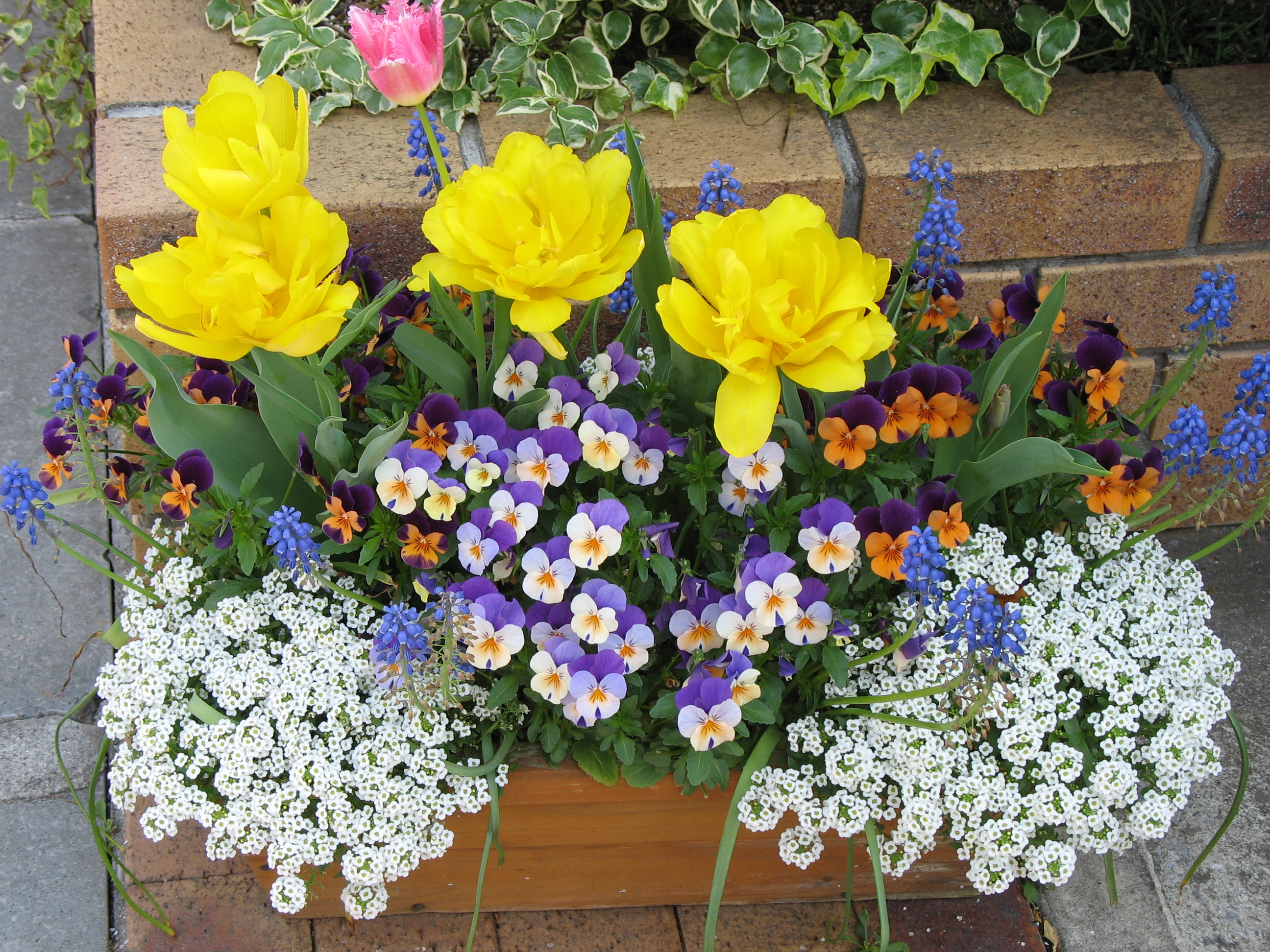
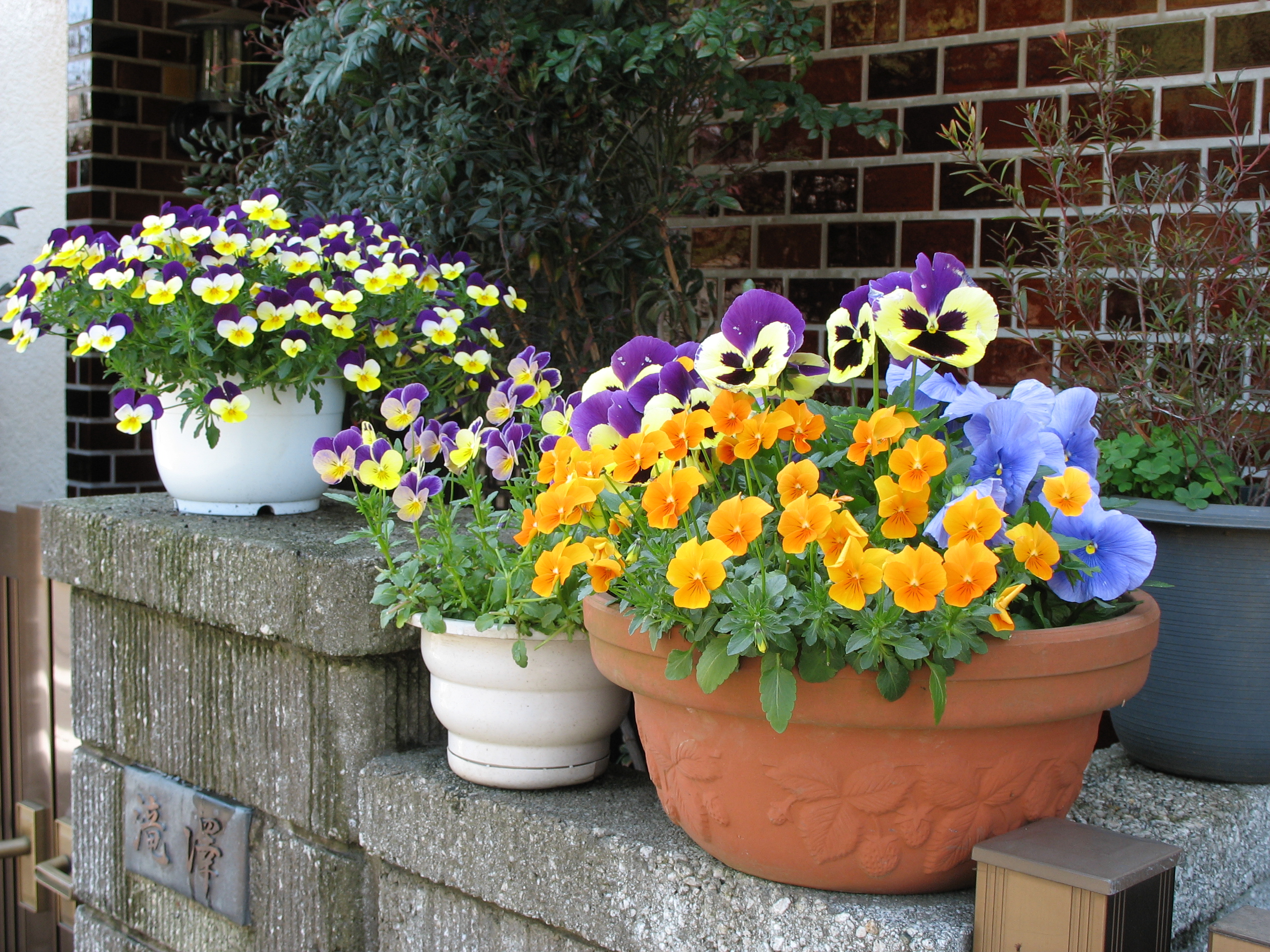
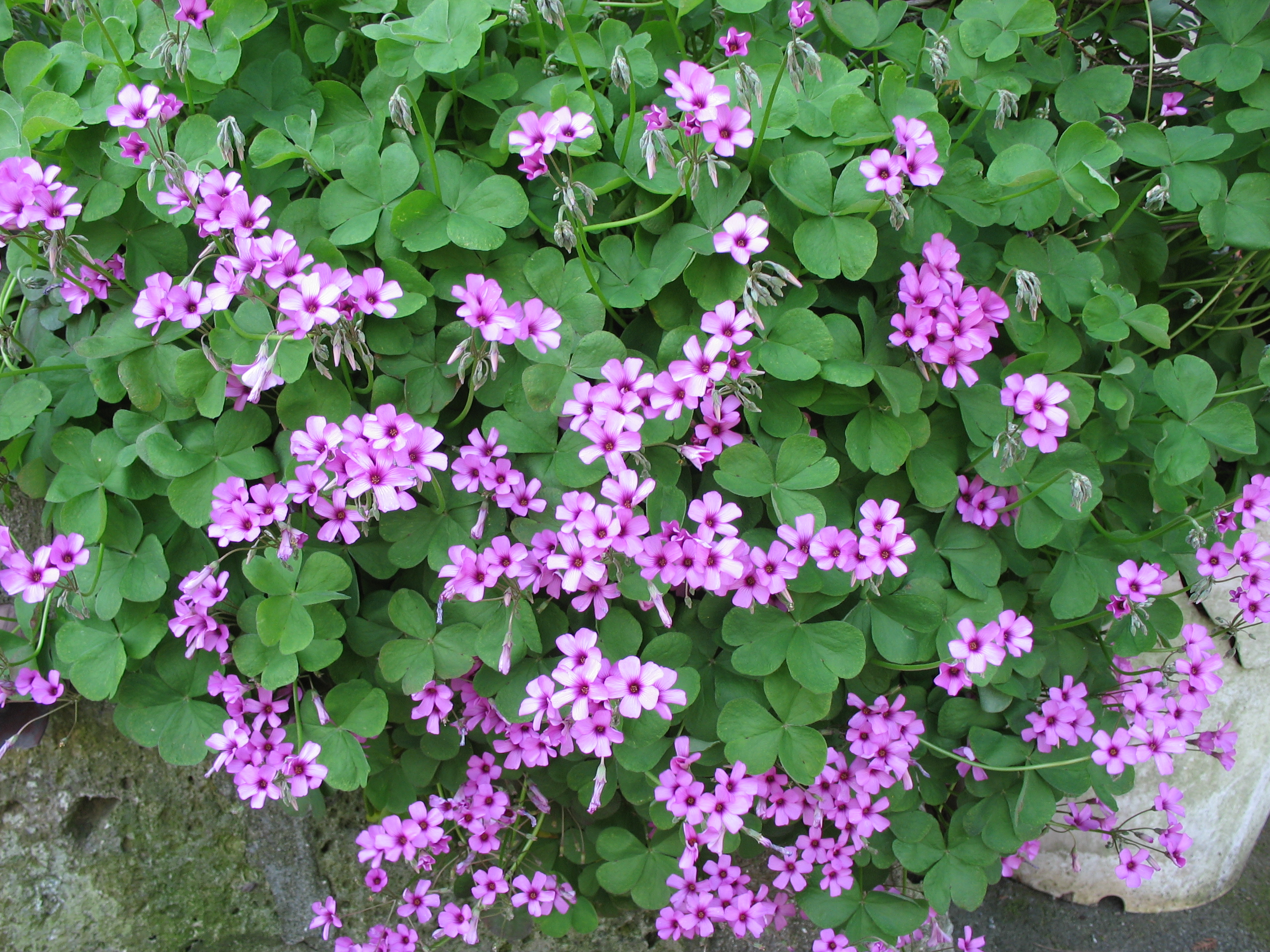
As my Alberta friends dig themselves out after a late spring snowstorm, I feel like I’m living in a flower garden!  The cherry blossoms are long gone but every day new trees and plants seem to burst into bloom.  Space is at a premium here but people manage to tuck beauty into every little nook and cranny.   Of course, the climate is right for such things.  All the rain we’ve had lately has to be good for something!

Since we don’t have a garden, my sweet husband visited the 100 yen store and bought me a vase which he has been keeping filled with flowers.  Right now it contains beautiful light pink lilies.  Yesterday one of my students brought me bright red tulips from her garden so our one tall drinking glass was put into service as a second vase!

Familiar in the midst of the unfamiliar

We continue to be surprised when we come across something familiar in the midst of the unfamiliar.  For example, after we left church this afternoon, we decided to walk around Nishi Funabashi, the area where the church is located.  Just up the street from the church, we discovered a Denny’s restaurant!

McDonald’s is everywhere, of course.  In fact, there’s one within easy walking distance of our apartment.  We pass it on our way to school each day.  We haven’t eaten there but we do occasionally stop into a McDonald’s when we’re out and about on a day off because they’ve recently been promoting their premium roast coffee and we can get a good sized cup there much cheaper than anywhere else.

In addition to McDonald’s, food courts in the malls include Subway and Baskin Robbins.  Starbucks is also found in all the better shopping areas and apparently there are Tona Roma’s restaurants in Tokyo.  Kentucky Fried Chicken and 7-Eleven are both seen in a variety of locations and we’ve passed both Esso and Shell gas stations.  I still remember my extreme surprise at passing a Century 21 real estate office on our way to school the first time!

Many of the vending machines, which are found absolutely everywhere in Japan, sell Coke.  Pepsi is less common but we have seen it.

The grocery store also contains surprises.  Most of the labels are completely foreign to me.  In fact, through grocery shopping I’ve been given a glimpse of what it must be like to be illiterate because I can read so few of the labels and am constantly searching for a familiar English word to give me a clue as to what the product might be.  We do have Ritz crackers in the cupboard, however, and Kraft Parmesan Cheese in the fridge and I eat Kellogg’s Bran Flakes for breakfast quite often!  Some such items are imported and quite pricey while others are made specifically for the Japanese market.  For example,  the Bran Flakes are quite different from those sold at home.  Richard doesn’t like them at all as he likes cereals that soak up the milk and get mushy while these maintain their crunch.  I love them because, unlike Bran Flakes at home which are pretty bland, these are slightly sweetened.  With a bit of fruit on top, I find them quite delicious.

Perhaps the biggest surprise to us was the obvious fact that there was a connection between Wal-Mart and the Seiyu department store where we do most of our grocery shopping.  The familiar Rollback signs and the fact that the clothing departments sell the George brand were clear giveaways.  A little research online showed that Wal-Mart bought a majority interest in the chain in 2005.  Those of you who know Richard’s anti Wal-Mart leanings will understand that he was somewhat reluctant to shop there at first!

There are many familiar items that aren’t available here, however.  Those who also know Richard’s fondness for Kraft dinner might sympathize with his regret that we haven’t seen it anywhere!

Tulip fields

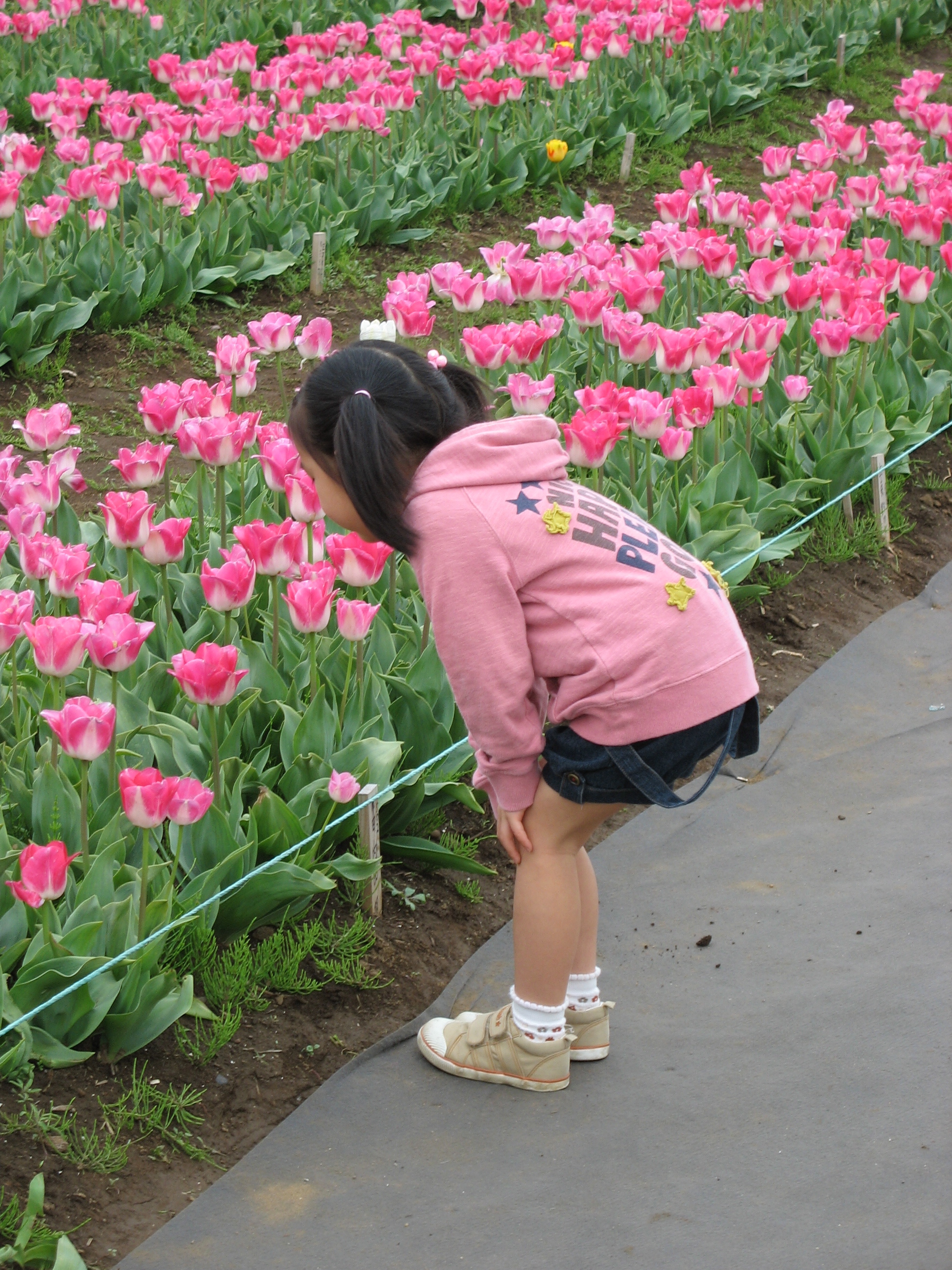
Today I went to the 20th annual Sakura Tulip Matsuri (festival) where I strolled through fields of beautiful blooms – some 550 000 in all!   Sakura is a community to the east between here and Narita.   The first tulips were planted there in 1989 to celebrate goodwill between the Netherlands and Japan.  They were followed by the building of the landmark Netherlands windmill in 1994.  It was made in Holland, shipped to Japan in pieces and assembled on site and is the first wind driven water pump in Japan.

In addition to enjoying the beauty of the tulips, it was great to get out into some wide open space!  Sakura Furusato Hiroba (square), where the windmill and the tulips are located, is surrounded by a marsh on one side and fields on the others.  I took the train to Sakura, then caught a free shuttle bus from the station.  To reach the tulips from the drop off point, I walked a gravel pathway between the fields and alongside the marsh.   Even though there were people everywhere, it was a very nice change for this girl from the country!

As I wandered through the tulips, I could hear street organ and accordion performances taking place and alongside the tulip fields vendors had set up stalls selling all sorts of foods and souvenirs.   I treated myself to a picnic lunch of okonomi-yaki from one of the stalls.  Okonomi-yaki might best be described as being somewhat like an omelet containing cabbage and various other fillings.   We were first introduced to it when we visited Matt and Robin in Osaka three years ago.  It’s really a Kansai specialty so we haven’t found much of it in this area.   While I enjoyed today’s, it wasn’t as good as Matt makes.

In addition to the foods and other products being sold by the vendors, tulips are also for sale.  In fact, those who want to buy them are given a trowel and a bag and head out to the outer fields where they can choose the plants they want and dig them up themselves.  Perhaps it’s a good thing that I don’t have a garden here.  I would have had a difficult time choosing from amongst the approximately 166 different varieties!

Mornings

I’ve never been a morning person. I like my days to begin gradually. Perhaps that’s why our present work schedule agrees so well with me. Not having to leave for work until noon or later most days is great! I guess it’s good that I feel this way as another class was added to my schedule yesterday and from now on I’ll be working until 9:00 p.m. on Mondays instead of 7:00. I now have the dubious honour of being the MIL teacher with the highest number of regularly scheduled teaching minutes per week.

I’m also a person who loves light. Getting up in the morning is so much easier if it’s light outside. On the other hand, I hate knowing that daylight hours are wasting away while I’m asleep. For this reason, I really think that Japan should adopt Daylight Savings Time! Right now, the sun is coming up a couple of minutes after 5:00 a.m. What a waste, especially since I don’t intend to get up for another three hours! It would seem that many of my neighbours wouldn’t agree, however. They appear to be early risers. Some of them had their first load of laundry hanging out to dry before mine made it into the washing machine this morning and since today is pick up day for cans and bottles, they started depositing those in the sacks below our window shortly after 6:00 this morning! Believe me, this is not a quiet activity!

Of course, it might be easier to get up with the neighbours if we went to bed earlier but we’re often eating dinner at 10:00 p.m. and somehow, going to bed as soon as the dishes are done just doesn’t work for me! I need some down time to relax after the day’s work. If I happen to be reading a compelling book, putting it down and going to bed is even more difficult. At the moment, on the good advice of my friend Tess, I’m reading The Time Traveller’s Wife by Audrey Niffenegger. It took awhile to get into but now I’m having trouble putting it down!

School days

I teach a total of 25 classes a week at 4 different schools. Most classes are 45 to 55 minutes long though there are a few as short as 25 minutes or as long as 85. My largest class has 8 students!

My adult classes include 5 group lessons and 5 private students. Their interests and ability levels vary widely. Some are studying English because their employers require it while for others, it’s simply a hobby. My students include school teachers, a librarian, a computer programmer, an accountant, retired people and several housewives.

My 15 children’s classes include my Saturday morning playgroup with 4 preschoolers. They learn basic English vocabulary through games, songs and stories. Our first lessons have been focused on learning the colours. I’ve learned red (akai), green (midori) and white (shiroi) in Japanese through listening to them! Fortunately, their absorbent little minds are picking up more than that from me! Another interesting children’s class is my returnees. Returnees are students who have lived in an English speaking country for a period of time and who are trying to maintain the English that they’ve already learned. My class is made up of 3 eight and nine year old girls. It includes one student who technically isn’t a returnee. Arisa is a new student at MIL and is perhaps our most unusual. She was taught English at home by her mother who has also never lived outside Japan. At eight years old, this little girl speaks the language fluently and has read all the Harry Potter books! Her English is better than either of her classmates and she wouldn’t fit into any other children’s class at our school. Some of those kids are still learning the alphabet while others are learning basic reading and conversational skills.

A typical school day begins with a 15 minute walk to Kita Narashino school, the main school closest to our home. The school has a reception area, a teachers’ work area and 4 small classrooms. It’s located on the 3rd floor of a building in a busy commercial area and accessing the school involves climbing an incredibly steep set of stairs. I can judge my improving fitness level by how much easier it’s getting to climb those stairs!

Once at Kita, we sign in, check our mailboxes, check to see if there’s anything that needs to be delivered to whichever school we’re going to that day and check the schedule to see if there have been any changes. Changes usually involve the addition of a trial lesson or a ticket private student. Trial lessons are short sample lessons given to prospective students who want to know more about our school before deciding whether or not to sign up and ticket privates are students who pay for a certain number of lessons then schedule them whenever works best for them. This means that they don’t have a regularly scheduled lesson at the same time each week and aren’t guaranteed the same teacher for each lesson. I won’t have many trial lessons or ticket privates this term as my schedule is already quite full. Rich’s schedule is a little lighter so he’ll probably have several of these.

We each stay and teach at Kita once a week. On the other four days, after our quick check-in at Kita, we head off to the train station about a block away and depart for whichever school we’re at that day. Rich and I teach at the same school on Tuesdays but the rest of the week we’re off in different directions. Our days don’t necessarily begin or end at the same time either so keeping track of our schedules can be quite a challenge!

My earliest class is the Saturday morning playgroup at 11:30 but most days, I don’t start teaching until between 2:00 and 3:30 p.m. My days end between 7:00 and 8:30 p.m. Breaks between classes can vary from 5 minutes to a couple of hours though mine are pretty tightly scheduled this term. My longest break is about an hour. Breaks are generally used for lesson planning. Unlike at home in Canada, we don’t do any homework. Lesson planning is all done before, between and after classes. Saturday is my most grueling day with 7 classes between 11:30 a.m. and 7:00 p.m. so I try to fit in planning for that day earlier in the week. Now that we’ve become more familiar with the various textbooks and teaching resources that are available to us, planning is generally fairly quick. Of course, that’s never been our favourite part of teaching. For both of us, when we enter the classroom and are face to face with the students, the teacher in us comes alive and the fun really begins!

Lalaport

We were supposed to go on a church picnic this afternoon but it was canceled because it poured rain overnight and was still very chilly and wet this morning.   Since many people had packed picnic lunches, even more than usual stayed and ate together after this morning’s service.  Once again, we took advantage of this opportunity to spend time getting to know people.

Afterward, we headed off to Lalaport.  We’ve been told that it’s Asia’s largest mall and it’s right here in Funabashi!  Though it has over 500 stores, it isn’t as big as West Edmonton Mall and doesn’t have all the entertainment facilities found there.  I found the layout much more confusing, however.  Of course, I’ve been shopping West Ed since Phase One opened over 25 years ago so I’ve kind of grown with it.  Even so, I tend to prefer smaller malls and, if I ever have any serious shopping to do, I’ll probably return to one of the two smaller ones that we’ve already explored.  Of course, a cool wet Sunday afternoon might not have been the best time to visit a major mall!  Everyone in the Greater Tokyo area seemed to have the same idea and the crowds probably rivaled West Ed at Christmas time!  Since we were only browsing, however, the large number of people and the line ups at the tills didn’t really bother us.

We’ve sort of fallen into the habit of going out for supper on Sunday evenings.  After a day of exploring, it beats coming home and making a meal!  Since there are many restaurants to choose from within walking distance of home, we usually come back to our area to eat.  Tonight we decided to try an Indian restaurant that had been recommended by one of our fellow teachers.  I was a little worried about how the spicy food would affect my stomach, which has been bothering me again lately, but I think I must have shocked it into submission!  The curry was definitely hot but that was several hours ago now and I haven’t suffered any ill effects so far.  Touch wood!

Yukata

A yukata is a light cotton kimono.  Unlike the traditional kimono, which is a complicated and very expensive garment, the yukata is inexpensive and easy to wear.  Though they are apparently a common sight on summer evenings, they are more often used for relaxing at home.  Before we came to Japan, I had decided that I wanted one to use mainly as a dressing gown.   I bought it at Hayashi Kimono when we went to Ginza on Sunday.  It’s a tiny shop tucked into a narrow and crowded shopping arcade but is advertised as Tokyo’s largest kimono boutique for foreigners.   The staff speak English and the gentleman who waited on me was incredibly helpful.  In spite of the fact that it was obvious that I didn’t intend to spend a great deal, he encouraged me to try on as many garments as I liked before making a choice.  He graciously showed me a variety of colour choices and tied each one carefully so it would look it’s best on me.  My yukata is brighter and more colourful than many but the more subdued colours made me look completely washed out.

Each yukata comes with a narrow belt made of the same fabric but when the salesman showed me how much better they look with the wider silk sash in a contrasting colour, I decided to buy one of those as well.  The entire ensemble cost me only 5400 yen (about $54).  The fabric is a very fine cotton and is completely washable.

Before we came to Japan, our employer sent us a handy little book entitled “Living  Japanese Style”.  It gives a couple of important tips for wearing the yukata correctly.  Apparently, I need to remember to cross the left side over the right when dressing.  Crossing the right side over the left would be a terrible faux pas as this is done only when dressing a corpse!  Apparently, I would also be laughed at if I wore my yukata with shoes.  Since it would look completely ridiculous with most of my shoes, this won’t likely be a problem.  Special sandals and socks for wearing with kimono are sold here but I doubt I’d ever find any to fit.  If I ever do decide to go out in my yukata, I could probably get away with wearing it with my flip flops.

This one’s for Katie

Today was my day off and I’d decided that finding somewhere to get my hair cut was a priority. I usually have it cut every six weeks and it had been over eight. Thick and unruly at the best of times, it becomes even more curly and unmanageable in humid conditions such as we’re experiencing here. I was desperate!

Finding a salon was no problem at all. There are several within easy walking distance. Choosing one and making an appointment when I don’t speak the language was another matter. I was determined, however. Obviously, I couldn’t live here for a year without having my hair cut so I pulled out my trusty Japanese phrasebook and wrote down “yoyaku o shitai no desu ga” (I’d like to make an appointment) and “heya-kat-to” (haircut). Armed with my note and the phrasebook, which also lists handy things like the days of the week, I set out to conquer the problem.

The only salon that had been recommended to me was Earth Hair. It was also the first salon I saw when I arrived here and I walk by it almost every day. I had pretty much ruled it out, however. Earth Hair is big and it’s all windows, mirrors and stainless steel. Like most Japanese salons, the prices are listed outside and they are significantly higher than the other shops in the area. A cut and blow dry is 3900 yen (approximately $39) and that’s if it’s done by a lowly stylist rather than a managing stylist or one of the many other higher ups such as the artistic director. I had come to the conclusion that it was just a little too posh for the likes of me.

As I was walking walking by some of the other salons this morning, checking their prices and trying to decide which one to venture into, I passed by a girl handing out advertising fliers. This is not at all unusual in Japan. Often, I refuse the offering knowing that it will likely be printed entirely in Japanese and that it will be of absolutely no use to me. For some reason, this morning, however, I reached out and took what was offered and what do you suppose it was? An advertisement for a promotion at Earth Hair! Amongst the Japanese, there were four English words offering a cut and blow dry for 2500 yen, approximately the same price it would be at any of the other shops! Must be a sign, I thought, and headed back to Earth Hair!

As soon as I entered, I was greeted by a girl behind the front counter. I asked if she spoke English but she didn’t. Neither did either of the other two girls behind the counter. I pulled out the flier and pointed to the cut and blow dry ad. The girl asked me something and I must have looked blank so she pointed toward the stylists at work. I nodded not knowing for sure what I was agreeing to and she indicated that I should give her my coat. I didn’t have to make an appointment, I was being offered a haircut on the spot! Bonus! One of the other girls came around the counter and took my purse, hat and umbrella then gestured to the chairs in the waiting area.

As I sat down to wait, I knew that I still had one more hurdle to overcome. I had to communicate to the stylist that I wanted my hair thinned. The phrasebook was no help at all but I quickly grabbed one of the hairstyle books and found a picture of a fairly short textured looking cut. When I showed it to the stylist, he looked a bit dubious but got to work. Noticing that I was holding my glasses, he rushed off and came back with a glasses case for me to put them in. He worked meticulously, cutting my hair dry then wetting it and blowing it dry. When he finished, he handed me my glasses and held up the mirror for me to check the back. A look of great relief crossed his face when I smiled and gave him a thumbs up indicating that I was happy with the results. He handed me a key with the number 12 on it and headed to the front counter. Following him, I wondered what the key was for until I spotted the lockers and realized that my purse and other belongings were safely stowed in locker #12! One of the girls brought me my coat and helped me into it. As soon as I paid the stylist he rushed to the front door, held it open for me while I exited and, in true Japanese style, bowed to me as I left!

For those readers for whom today’s title makes no sense, Katie is my hairdresser back home in Sedgewick.  And no, this isn’t how I dress on a regular basis!  I’ll tell you about the outfit another day.