What does it cost?

The official currency of China is the renminbi or RMB. The primary unit of RMB is the yuan and the terms are used interchangeably. In addition, CNY sometimes appears on price tags instead of either of the other two terms. It simply means Chinese yuan.

The value of the yuan fluctuates, of course. This morning 6.16 yuan equal one Canadian dollar which seems to be about average in recent weeks. To make calculating easier, we tend to divide prices by 6 to get an idea how much things would cost in Canadian dollars. It’s not exact but it gives us a ballpark figure and is much easier to figure out in our heads. I’ll use 6.16 (and a calculator!) for the prices I post here.

Let’s begin with our recent trip to Dandong and the Great Wall:

  • 4.5 hour bus trip from Dalian to Dandong – $31.82 per person return
  • budget hotel room with private bathroom – $21.10 per night including a sumptuous buffet breakfast for 2 – we couldn’t help joking that it was like buying breakfast and having a hotel room thrown in for free!
  • 12 km bus ride to the Great Wall – $0.97 per person
  • entrance to the Great Wall – $9.74 per person
  • taxi back to Dandong, shared by 4 people – $6.49

Obviously, for those of us who are blessed to have Canadian or American dollars in our pockets, travel in China is very inexpensive. I’m looking ahead to our upcoming Labor Day holiday at the end of this month and have learned that a return flight to the city of Yantai (one hour each way) would cost less than $140 per person including all taxes and fees.

But what about everyday living? Riding a city bus in Dalian costs 1 yuan, or approximately 16 cents and here are a few prices from our local supermarket:

  • 8 x 100 grams of yogurt – $2.09
  • 50 green tea bags – $2.09
  • 400 grams of noodles – $0.75
  • 8 large slices of hearty bread – $1.27
  • 500 mL bottle of soya sauce – $1.70
  • 500 grams of honey – $3.41
  • 2 L jug of apple juice – $4.22 ($3.86 if you buy two)
  • 330 mL can of Coke – $0.41
  • 600 mL bottle of Coke – $0.49
  • 55 gram Snickers bar – $0.57
  • 10 rolls of 3 ply toilet paper – $4.14

We buy most of our fresh food at the street market. Here’s why:

  • 9 large farm fresh eggs – $0.81
  • 6 bananas from the Philippines – $1.20
  • 1 medium zucchini – $0.31
  • 1 large head of broccoli – $1.54
  • 2 delicious cobs of fresh corn – $1.14
  • 1 kg of white rice – $0.97
  • 540 g (1.2 lb) of pork – $2.44

Buying water is not an option here as the tap water isn’t safe to drink. Bottled water is available everywhere. We have a dispenser in the kitchen and have an 18.9 L jug delivered to our door (at the top of 67 stairs) for $1.95 whenever we need one. At the supermarket, a 550 mL bottle sells for $0.13 and a 1.5 L bottle for $0.37.

Coffee, on the other hand, is quite expensive. A 200 gram bottle of Nescafe instant sells for $13.23 at the supermarket. A small cup of regular coffee can be had at KFC for under a dollar but the prices are significantly higher and vary quite considerably at western style coffee shops where you’re also paying for the ambiance. We’ve paid from $1.62 to $5.29 for Richard’s large Americano coffees and from $2.92 to $5.36 for my mochas.

We bought a basic cell phone for around $60 and we’re paying approximately $50 for internet service for the entire semester that we’ll be here. When I’m tempted to complain about how slow and unpredictable it is, I remind myself of that!

On Monday, I went for my first haircut in China. I had no idea what to expect in terms of cost. My hair was shampooed, cut by the lead stylist, washed again to get rid of all the bits of hair, then blown dry all for a grand total of $3.25 Canadian! I could have had it done by one of the other stylists for just $2.44 but at prices like that, I decided to splurge and I’m super happy with the results!

The thing to keep in mind when we marvel at prices like these ones is that we’re thinking in terms of Canadian incomes. It’s difficult to find accurate information about Chinese incomes but we understand that, at 5000 yuan (just over $800) each per month, we’re being paid very well compared to many professional people in China. When Richard picked up our paycheques this morning, he discovered that we each had to pay 6 yuan (less than $1) in tax! On top of that, we’re living in a rent free apartment. The majority of Chinese, especially those living outside the cities, are very poor and cannot imagine the luxuries that we take for granted.

One step from North Korea

According to our Lonely Planet guidebook, after traversing the Great Wall we had two choices for returning to the parking area where we’d catch a ride back to Dandong. We could either follow the river on a narrow dirt path or choose a hiking trail along the cliff face. The couple we were travelling with expressed a preference for the easier riverside trail but I was secretly delighted when we couldn’t locate it and had to set off along the more challenging route instead! We shared it with many other people and didn’t actually see anyone below us so I’m assuming that the easier path isn’t there anymore. Instead, we looked down on the fence that ran along our side of the river and separated us from North Korea.

Even though I’ve pretty much managed to overcome my lifelong fear of heights, as we went along I was very thankful for the sturdy metal fence that provided both protection from falling and a handrail when it was needed. In places, the hike was an easy one but we also scrambled up, down and over some rocky faces that were quite challenging. Then, as we neared the end of the path, we came upon a suspension bridge! In the past, that would have finished me off but instead I was able to enjoy it and even provide encouragement for one of our companions whose fear was written all over his face.

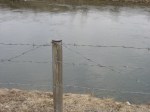
Shortly before we reached the end of our journey, we reached the spot known as Yibukua or ‘one step across’, a particularly narrow part of the river between the two countries. Perhaps the water is high at this time of year because it would have taken more than one giant step to cross it but regardless, the barbed wire fence made it impossible for anyone foolish enough to try. Signs also made it very clear that we shouldn’t attempt to cross and if that wasn’t enough deterrent, the gun-toting North Korean soldiers patrolling in the distance definitely would be.

At no point did we feel that we were in any danger though. Chinese tourists do visit North Korea and we probably could too but I doubt that we ever will. I do feel like I should have a stamp on my passport that says that I was one step away though!

Views from the Wall

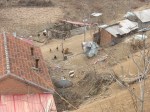
Can you imagine having the Great Wall of China in your own backyard? We were amazed to look over the edge of a lower portion of the wall and see a small farm nestled below. Chickens scratched the bare ground, small fields waited for seed and trees grew on the terraced hillside while the wall towered above. That’s some windbreak!

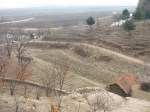
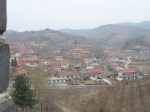
As we began to climb, we could see a small Chinese village nearby, its red roofs standing out against the brown of early spring, and when we reached the peak, a narrow branch of the Yalu River wound its way across the landscape spread out below. On the North Korean side of the river, flat agricultural land disappeared into the distant haze. The scene was deceptively peaceful considering the tension that that country is visiting on the world stage today.

Great Wall, fantastic experience!

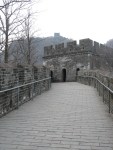
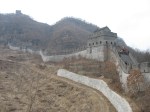
How can I possibly put the Great Wall of China, the most enormous construction project in human history, into words that truly do it justice? For most of my life I couldn’t possibly have imagined that I would one day stand on this historic structure but that’s exactly what I did on Friday morning!

Known as Tiger Mountain Great Wall, the segment of the wall located about 12 km northeast of Dandong sees far fewer tourists than the sections that are closer to Beijing. Built during the Ming Dynasty (1368-1664), it runs parallel to the North Korean border and is the easternmost section of the Great Wall. Buffeted by wind and rain for more than 500 years, the wall had fallen into ruin until a large scale restoration project was begun in 1992. Now fully restored, it snakes its way up the steep mountainside to a height of 146.3 metres. One of three watchtowers stands like a beacon at the peak and provides a panoramic view across the Yalu River and into North Korea. From the peak, the wall makes a quick descent down the back side of the mountain ending near a narrow branch of the river.

As we left our bus and walked up the road toward it, seeing the Great Wall winding its way up the hillside in the morning mist was an absolute thrill. Of course, we couldn’t help wondering how well our old knees would handle the climb but I think the sheer exhilaration of being there helped carry us up the steep incline.

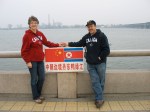
The forecast called for rain on Friday but Colleen (the redhead in one of the photos) and I are convinced that the umbrellas in my backpack and the rain cape in her bag were good luck charms as the weather was great; not too warm or too cold, no wind and not a drop of rain all day!

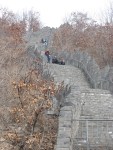
Since it was a holiday in China, we shared the wall with many other people but it wasn’t overly crowded and there was a wonderful sense of camaraderie as we shared this incredible experience with one another. We only heard a few words of English all day but plenty of delighted laughter as people huffed and puffed their way up the steep cement stairs that made up much of the climb. There were also high fives given as well as the universal thumbs up sign.

After reaching the far end of the wall, we enjoyed a fairly challenging hike back to our starting point but I’ll tell you more about that in a future post. For now though, I’m happy to say that our knees survived both the wall and the hike and we weren’t even sore afterward. Obviously, climbing the 67 stairs up to our apartment more than once a day for the past six weeks was excellent preparation!

Dandong, gateway to North Korea

Friday’s anticipated four hour bus trip to Dandong turned into more than five when it took an hour and a half for the bus to wend it’s way through congested holiday traffic and get out of Dalian! We were riding on a modern long distance bus, however, so it wasn’t too gruelling. Once outside the city, the four lane highway was in great shape all the way so it was a comfortable ride. Signs along the highway were posted in both Chinese characters and Pinyin (the system used to transcribe Chinese characters into Roman script) with occasional signs in English as well. I found it cute that the right hand lane was labelled Carriage Way and the left, Overtaking Lane but the sign that we enjoyed the most was the one warning drivers Do not drive tiredly!

Liaoning Province is largely agricultural so we rode by many orchards, fields, rice paddies and a vast number of greenhouses. Work has just begun in the fields and everything that we saw happening was being done by hand. With the exception of one donkey and two horse-drawn carts, we didn’t see any livestock.

When we arrived in Dandong, it took awhile to figure out where and how to purchase our return tickets. It’s a good thing we did that right away though as many of yesterday’s buses were already sold out and the earliest one we could get on didn’t depart until 3:15 in the afternoon. The language barrier was a hindrance, of course, but as always, people were extremely helpful, particularly the young security guard at the bus station who, when we asked for directions to our hotel, walked us all the way there, a distance of 3 or 4 blocks!

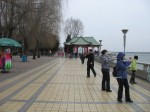
After settling in and having a late lunch in the hotel restaurant, we set off on foot for the Yalu River which separates Dandong’s lively riverfront promenade from the more desolate looking city of Sinuiju, North Korea on the other side.

China is North Korea’s only major economic supporter and Dandong, a city of about 750 000 people and the principal gateway between the two countries, thrives on trade with North Korea. We watched trucks rumble slowly across the Sino-Korean Friendship bridge which is the official border crossing.

Pedestrians are not allowed on the bridge and we actually saw Chinese soldiers escort a couple back to the Chinese side of the bridge. Perhaps they were simply on the wrong bridge. In 1950, during the Korean War, American troops bombed the older bridge between the two countries in an attempt to cut off Chinese supplies to North Korea. The North Koreans dismantled the mangled end of the bridge leaving only a row of support columns standing in the river. The Broken Bridge stands next to the Friendship Bridge and is open to the public who want a closer view of North Korea. Admission to the bridge is normally 27 yuan but when we noticed that seniors over the age of 60 with an ID card qualify for a lower price, I decided that we should show the ticket agent our resident permits to see if they would give us the reduced rate. Sure enough, we were admitted for only 10 yuan each or approximately $1.60 Canadian!

The Broken Bridge wasn’t the nearest that we got to North Korea nor was Dandong itself our main reason for heading north on our three day break from school. Rather than making this post too long, however, I’ll be breaking it into a series. Come back tomorrow to find out the biggest reason we chose Dandong as our destination. For the moment though, let’s just say that it was Great and truly unforgettable!

Tomb Sweeping Day

Tomorrow, April 4th, is Qingming Festival in China. Pronounced Chingming and known as Tomb Sweeping Day in English, this is a day to honour dead ancestors by travelling to the family tomb to sweep, clean and place flowers and offerings of food and drink on the grave.

Burning paper that is meant to resemble money in hope that the deceased is not lacking anything, is also a common practice; so common, in fact, that the authorities are urging people to take precautions and not allow fires to get out of control. Apparently, across China, a total of 520 million people visited their ancestors’ tombs during last year’s festival and 200 forest fires were reported during the three day holiday!

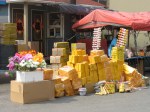
This week, we see huge stacks of the gold coloured paper everywhere. Looking something like fancy paper napkins, it’s piled in the marketplace and outside stores waiting for people to purchase it and burn it, sometimes on the graves but not always. Paper burning was also part of the Lantern Festival that took place at the end of the Chinese New Year celebrations. That night, as fireworks exploded overhead, bonfires lined the streets outside our building and we already saw a couple of people burning a pile of the paper a couple of evenings ago on the sidewalk directly across the street from where they purchased it.

In addition to remembering dead ancestors, in modern times Qingming has also been seen as a time to pay respects to those who’ve died in incidents considered sensitive in China, incidents such as the Tiananmen Square massacre that took place in Beijing on Tomb Sweeping Day in 1976.

Qingming is celebrated on the 104th day following the Winter Solstice or the 15th day after the Spring Equinox. In addition to being a time of remembrance, it’s also a time to celebrate the coming of spring and in farming communities, it marks the time to begin plowing and seeding. Outdoor pursuits including kite flying are popular Qingming activities. Though spring seems a little late this year, the past couple of days have been the warmest since we arrived in China. The grass is finally starting to turn green and I was delighted to notice tiny buds on one of the trees we passed on our walk this afternoon.

We hope that the beautiful spring weather continues for the next few days as we’re off to Dandong for our three day Tomb Sweeping holiday. Dandong, a 4 hour bus trip north of here, is located just across the Yalu River from North Korea but more about that when we get back!

A most unusual Easter!

For the second time in our lives, we’re spending Easter in a country where it isn’t celebrated; where very few people have ever heard of it. This is definitely the first and probably the only Easter Sunday that I will ever spend in a shopping mall!

Our Sundays are usually spent with students and today was no exception. We met Howard and Vicky at noon and caught a bus to Xi’an Road, Dalian’s most popular shopping area. They had chosen a Hong Kong style restaurant for our lunch and what a feast we enjoyed! Our Easter dinner included both roast duck and bullfrog! That’s right, bullfrog! Like us, Howard had never eaten it before but Vicky assured us that it was delicious and, believe it or not, she was right!

After lunch, the guys followed Vicky and I in and out of a few stores before deciding that that was boring and wandering off to a coffee shop to wait for us while we shopped. They had a great time visiting while we browsed. Can you imagine all the English that we used as we talked about colours, styles and fabrics and discussed what we liked and what we didn’t? Our afternoon was much more about spending time together and using the language than it was about shopping but Vicky did buy a pair of bright pink jeans and I bought a hat. It’s not an Easter bonnet but when I wear it, I’ll remember our most unusual Easter.

Of course, Easter wouldn’t be Easter without chocolate. I’d actually been craving chocolate lately and Easter seemed like a good excuse to check out the candy aisle the last time we were in the supermarket! In spite of the muffin top which seems to be growing around my middle thanks to the rice and noodles that make up part of almost every meal here, as well as the mochas that I drink whenever we visit a western style coffee shop, I felt justified in buying chocolate when I did my daily brain training today. As I waited for Lumosity, the internet’s most popular brain fitness website, to load one of today’s activities, I noticed the following quotation

"Chocolate can be good for your brain! Dark chocolate contains flavanols and antioxidants, which seem to be good for long-term brain health."

Of course, Easter isn’t really about what we eat or who we spend the day with. Whether we’re with family around a table laden with ham and all the trimmings or in a shopping mall in China eating bullfrog, as Christians, Easter is at the centre of who we are and what we believe.

As our day comes to an end, yours may just be beginning. I hope that, wherever you are and whoever you’re with, it will be a day of celebration and reflection.

He has risen!

Home improvements

As I’ve mentioned before, we live in a very old building. The apartment seems to be falling apart around us but each time something’s gone wrong, it’s been quickly taken care of so the place is improving all the time!

We’d only been here a few days when Richard opened the cupboard below the kitchen sink and noticed that we had a problem. There was water where there shouldn’t be water and lots of it! A call to the school resulted in the caretaker showing up that same afternoon to fix the leak. When he left, the kitchen faucet was no longer loose and we haven’t had a problem with it since.

Then there was the electricity issue. You may have read about that in my post entitled An electrician’s nightmare. In the week since the breaker was replaced, we haven’t tripped it once!

That doesn’t mean that nothing else went wrong though! Late yesterday afternoon we received a text message from the school informing us that our downstairs neighbours had called the landlord to report that there was water coming through their ceiling, presumably from our bathroom! We’d noticed a small amount of water pooling beneath the pedestal sink lately but when your entire bathroom is a shower stall, water on the floor is commonplace and we hadn’t paid a lot of attention to it or determined where it was coming from. We gave permission for the caretaker to come into the apartment while we were out teaching our evening classes and when we got home, it was easy to see that he’d narrowed the problem down to the connection leading to the washing machine. Now there’s some shiny new plumbing under the sink and no more water on the floor.

I can’t help wondering what’s next. As long as it isn’t the gas line, I guess we’ll be okay!

[Home, home improvements, plumbing, electricity]

[China]

Can I have this dance?

Richard and I came to China to teach English so what were we doing teaching a group of eager students to do the fox trot early yesterday afternoon?

Like many social media sites, WordPress is blocked in China. I’m delighted that I can continue posting to my blog via email but one thing I haven’t figured out how to do is include links to previous posts. You may, however, have read the one entitled Sunday afternoon in Zhongshan Park that I posted a couple of weeks ago; the one that talked about me dancing in the park with a Chinese gentleman. Pictures of that event quickly circulated amongst our students who were clearly delighted that we would so willingly engage in the activities of their culture. Hearing about this and learning that we love to dance led one of our fellow teachers to suggest that we should consider starting a noon hour dance club for the students. Jesse, a retired science teacher, already offers a rocket building activity twice a week.

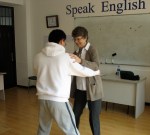
We loved the idea and so did the kids. With Bradley’s help, Richard started searching out and downloading appropriate music. Bradley, a bright 23-year-old, is one of my students that we’ve quickly developed a great friendship with. That’s him I’m dancing with in one of the photos.

Though our schedule is much lighter, our English immersion students are in school from 8:00 a.m. to 5:00 p.m. Monday to Friday. They have a two hour break at noon though which leaves plenty of time for a quick lunch followed by a dance class. Ten students showed up for our first class yesterday; five guys and five gals. Perfect, we thought, until we discovered that even though they go to school together every day, most of them were too shy to dance with a member of the opposite sex! They had no problem partnering up with someone of their own gender though and the classroom was soon ringing with laughter as they tried out the steps.

We started with the fox trot because it’s relatively easy but over the coming weeks we’ll be adding the polka and a couple of different waltzes to their repertoire. We’ll also introduce them to the jive. I can imagine already how much fun that will be!

The heart of the city

We’ve spent the last couple of Sundays with students but today we were on our own so we decided to explore the heart of downtown Dalian.

In spite of the fact that Dalian is a city of some 3.4 million people, it’s quite compact and easy to get around by bus. Since almost everyone lives in an apartment and there are virtually no single family dwellings, it’s not a sprawling metropolis like a lot of North American cities are.

We started our day by catching a bus to the train station. Long-distance buses depart from various points around the station so we scouted around and figured out where the buses to a couple of the places we’re hoping to visit in the not too distant future leave from. Once we’d found what we were looking for, we set off on foot for Zhongshan Square stopping for lunch along the way.

KFC and McDonald’s are probably the most popular western fast food restaurants in Asia. They seem to be everywhere. I think the last time we ate at KFC was in December 2008 in Hanoi, Vietnam. We don’t eat at KFC in Canada and hadn’t really planned on it here either but we’d both reached the point where we were craving a meal that didn’t involve either rice or noodles and the KFC that we passed on the way to Zhongshan Square was just too unique to pass by!

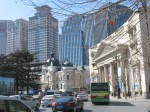
Zhongshan Square (which is actually circular) is the hub of Dalian’s business district. With ten roads radiating out from its central roundabout, it is encircled by ten buildings dating from the early 1900s that have been declared cultural heritage buildings under the protection of both the Chinese government and the Dalian municipal government. Though the central part of the square is undergoing reconstruction at the moment, I was so enthralled by the classical architecture surrounding it that I hardly noticed. We walked the entire circle admiring each of the stately buildings and remarking on the contrast with the much more modern structures that formed a backdrop for them before continuing our walk north along Shanghai Road toward Russian Customs Street.

Dalian was originally a Russian seaport. In 1898, the Russian Empire leased Liaoning Peninsula from the Chinese Qing dynasty and laid out a modern city that they named Dalny. After the Russo-Japanese war in 1905, Dalny was yielded to Japan and its name became Dairen. Prior to the unconditional surrender of Japan in August of 1945, Dairen was liberated by the Soviets who once again governed the city until it was presented to the Chinese Communist government without any compensation in 1950. Dalian’s many squares with their sculptures, lawns and western-style fountains were constructed by Russian architects who were enamoured with French culture and design.

Russian Customs Street retains some of the flavour of Dalian’s Russian days but I was disappointed by the aggressiveness of the many vendors hawking Russian stacking dolls and other cheap souvenirs. I’m not sure if any of them were genuine. I did purchase a cute scarf but it was made in Taiwan!

From Russian Customs Street it was a short walk back to the train station to catch a bus back home where we’re spending a quiet evening resting our tired feet!