9 signs that I might be 70 going on 40

Earlier this week, I played a round of golf with a group of younger women who were astounded to learn that I’m over 70. That got me thinking about a recent post by one of my favourite bloggers, Pamela Lutrell of Over 50 Feeling 40. Pam, who is the same age as I am, shared a very interesting article, 9 signs you’re 70 going on 40 — without even trying by Avery White, and then wrote a self evaluation based on the author’s 9 points. Today, I thought I’d do likewise.

I want to preface my personal evaluation by saying that I’m not interested in trying to look younger than I am. I love the introduction to White’s article… “There’s something magnetic about people who’ve crossed into their 70s but still radiate the spark, wit, and energy of someone thirty years younger. They’re not desperately clinging to youth or chasing trends — they’re just… alive. Fully, authentically alive. And they don’t even seem to be trying.” That’s definitely something I aspire to.
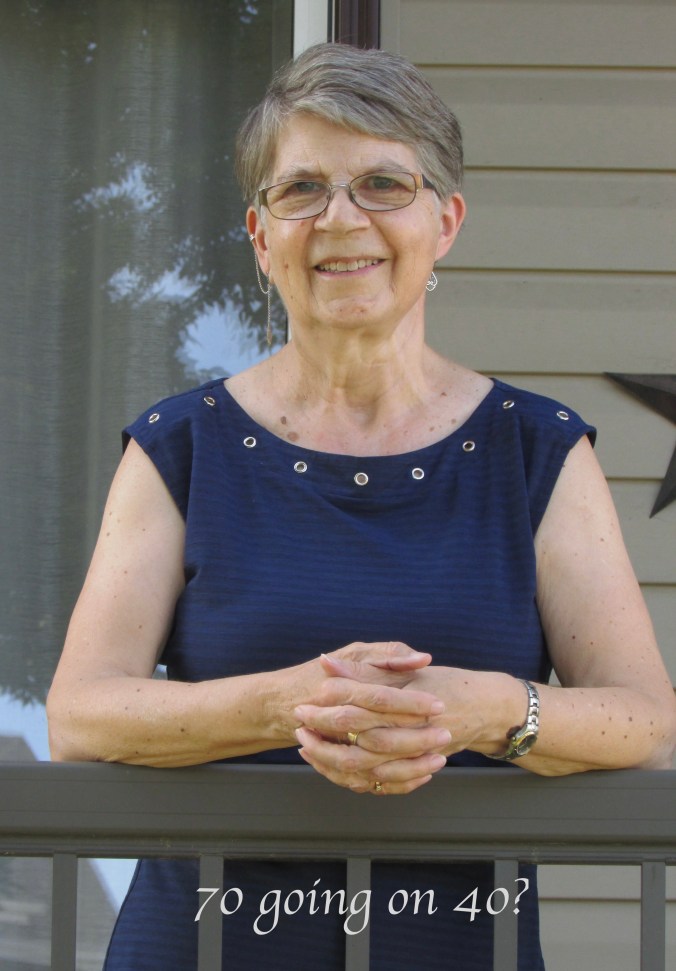
So let’s see how I’m doing.

1. You keep learning just for the thrill of it.

I think I’m doing very well in this category. I consider myself a lifelong learner with a love of reading and a passion for research. 50 years ago, I was that odd student in university who loved researching and writing papers and I haven’t really changed.

We live in an ever changing world, but even in my 70s, I try to keep up with new technology. Like Esther of the Old Testament, I believe that I was born “for such a time as this” and that it behooves me to learn to use the tools of today (although I do have to call on my more tech savvy offspring for help from time to time!)

2. You move because it feels good—not to punish yourself.

Again, I’d give myself an excellent mark in this area. I exercise for about 20 minutes before I leave the bedroom Monday to Friday mornings and I’m striving to walk at least 5 days a week, which reminds me that I’m very thankful to each one of you who has contributed to my Hoofing It fundraiser for neuroendocrine cancer research! I also enjoy bowling during the winter and hiking, kayaking, and playing golf in the summer.

I exercise, not because I’m trying to look younger or to achieve a perfect body, but simply because it feels good and because I believe in the old adage “use it or lose it”.

3. You don’t obsess over your age.

I really don’t. In fact, I’m proud of my age. When I was diagnosed with cancer 12 years ago, I had no expectation that I’d reach my 70s, so I’m just very thankful to be here. My age doesn’t define me and for the most part, it doesn’t limit me although I do get a bit frustrated when I can’t hit a golf ball as far as I used to!

4. You say yes more than no.

I’m not sure that I actually agree with this one. As I wrote in this post earlier this month, it’s okay to say no and to be able to do so without feeling guilty. I like to be spontaneous and I do say yes to lots of things, but I also know my limits and try not to overdo.

5. You have friends of all ages.

This has always been true of me, but these days most of my friends are younger than me, some as young as my own children. Sadly, some of my more elderly friends have passed away in recent years.

6. You laugh easily—especially at yourself.

I don’t know about laughter being the best medicine, but apparently it really is good for our health. According to the Mayo Clinic, one of my first go-tos for all things medical, “When it comes to relieving stress, more giggles and guffaws are just what the doctor ordered.” Knowing that, I admit that I probably don’t laugh as much as I should, but I’m definitely able to laugh at myself. Worrying less about what other people think is one of the benefits of aging for most of us and I certainly don’t embarrass as easily as I did when I was younger.

7. You still chase new goals—even small ones.

I think this fits well with #1, being a lifelong learner. I am always ready to try something new and while I don’t have a written bucket list, there are certainly a few things in the back of my mind that I haven’t done yet.

8. You don’t over-nostalgize.

I definitely do not live in the past. Parts of it are much too painful and dwelling there would rob me of joy. Instead, while trying to learn from the mistakes of the past, I try to live in the present and look forward to the future.

9. You make people feel seen.

As an introvert, this final point is one where I might give myself a failing mark, but it’s something that I’ve been consciously working on. Wherever I happen to be, I try to notice the people around me. Sometimes I simply smile as I pass by, but I’ve started to look for opportunities to offer a genuine compliment or an encouraging word. This is especially true when I’m in the cancer clinic where I know that people are often feeling stressed or overwhelmed and really need to feel seen.

Whether you’re in your 70s or not, do you recognize yourself in any of these points? One of Avery White’s final thoughts wraps up the topic perfectly. “The truest kind of agelessness comes from your mindset, your curiosity, your willingness to stay engaged — with people, with ideas, with life itself.”

No one fights cancer alone

My cancer is on the move again and so am I. It’s been 5 years since I last participated in the annual CNETS (Canadian Neuroendocrine Tumour Society) Hoofing It fundraiser and I’m late to the party this year, but I’ve decided to get involved again.

It’s been 12 years since I was diagnosed with stage 4 neuroendocrine cancer (NETs). Once the shock of learning that I had a cancer that I’d never heard of and that I’d be living with it for the rest of my life wore off, it became important to me to do what I could to help raise awareness of this little known disease and to support fundraising efforts for research, better treatments, and patient support. If it wasn’t for the research that organizations like CNETS fund, I probably wouldn’t be here today, so this is definitely something that’s very close to my heart!

I don’t think I’ve mentioned it on the blog before, but several months ago I became co-lead of the CNETS Alberta Patient Support Group that meets online once a month. Every month I hear from patients and caregivers whose lives have been turned upside down by this disease. Some are newly diagnosed and looking for answers. Others have been battling this for longer than I have and some are ready to give up hope.

After 16 months of stability following the radioembolization treatment that I had in March of last year, my cancer is growing again. Another tumour on my liver has started to increase in size and I’m waiting to find out how we’re going to treat it. At this point, my other tumours continue to remain stable and the cancer hasn’t spread to any new locations, but this is definitely beginning to feel a bit like a game of Whack-a-Mole! We haven’t exhausted all the possible treatment options yet, but this new development has reminded me how important it is that research into new treatments continues to move forward.

In past Hoofing It fundraisers, participants kept track of how many kilometres they walked, hiked, biked, or paddled, but not all patients are physically capable of doing those things. This year points are being assigned for a wider variety of physical activities. I’m not concerned about earning points though. My goal is simply to walk or hike at least 5 days a week until the end of September & to raise a minimum of $1200.

The walking part is easy. I was already doing that before we went to Europe, but since arriving home last month, I’ve been a bit lazy. Hopefully participating in this endeavour will provide the motivation I need to keep moving.

The $1200 is where you come in! As my new t-shirt says, no one fights cancer alone. I’m hoping that I can persuade you to visit my fundraising page here and make a donation. No amount is too small! Every cent received by CNETS during this campaign will go directly to neuroendocrine cancer research. We need to know what causes this disease, we need more and better treatments, and we need to find a cure!

Where was God?

Sitting down to write a blog post seems almost frivolous in light of the horrific events that have unfolded in Texas and New Mexico over the past week and a bit. We’ve seen whole buildings washed downstream like bits of flotsam. We can’t look at the news or scroll through social media (something I admit to doing way too much of) without seeing the faces of adults and children who were swept away by a raging torrent. We read agonizing reports from those who sift through the debris searching first for survivors and now for bodies to bring some sense of closure to grieving families.

How can I, who loved going to summer camp year after year when I was growing up, wrap my head around Camp Mystic? As an adult, I’ve slept in dusty old camp cabins with groups of little girls under my care. Some of those same cabins were later swept away by a flood, but thankfully no one was in them at the time. As a parent, I’ve packed up my own children and sent them off to camp trusting that they’d come home with happy stories of their time away.

I can easily imagine the whispers and giggles of little girls settling into their bunks for the night, but then came the nightmare; the rushing waters that weren’t just a bad dream. How can we even begin to process that?

Where was God in this? Couldn’t He have stopped the flood? Couldn’t He have saved every one of those lives? Why did He let this happen? Those are hard questions. Questions that might shake a person’s faith. Questions that don’t have easy answers.

I’m not here to give pat answers, to try to explain the unexplainable. I will simply tell you what I know and that is that God is still present and He is still good. This tragedy is not a sign of His anger or His judgement. He was there in the chaos and He is there for those who were left behind to grieve. Yes, He could have stopped it from happening, but for reasons that are far beyond my understanding, He chose not to.

This is not a time for speculation as to causes or for blame. It is a time for grieving, for lament, for prayer, and for reflection. It is also a time when we are reminded of the brevity and the fragility of life. Perhaps it should be a time for reevaluation. A time to ask, what am I doing with the time I’ve been given? Will my life make a difference? Am I ready for eternity?

How to say no without feeling guilty

Whether you are working and raising a family or older and possibly even retired, do you ever find yourself overwhelmed because you’ve said yes to too many things? Do you spend so much time doing for others that you don’t have time or energy for yourself, your marriage, or your family?

Establishing boundaries that protect your time, prioritize what’s important to you, and maintain healthy relationships is essential for your own well-being. Declining an invitation or saying no to a request can be surprisingly difficult, especially if you’re afraid of disappointing someone or worry that they’ll hold it against you, but sometimes it’s essential and it does get easier with practice. Learning how to say no without feeling guilty is one of the most important and most freeing lessons that I’ve learned in life. I only wish that I had learned it sooner!

One of the important things to learn is that you don’t owe anyone an explanation. You can simply say no without giving a reason. Here are some ways to do that politely, but firmly.

  1. “I’m sorry, but I won’t be able to do that.”
  2. “Sadly, I’m going to have to say no to that.”
  3. “I’m flattered to be asked, but I’ll have to say no.”

If you do want to give a reason for saying no, keep it simple.

  1. “I’m sorry, but I’m busy with other commitments.”
  2. “Thank you for thinking of me, but my calendar is full”
  3. “Thank you, but I have other plans.”
  4. “I’m really not the right person for that.”
  5. “I don’t have the necessary skills to do that.”
  6. “That’s not something I’m comfortable with.”

The following responses would be appropriate if the request is something that you might be interested in at some point in the future, but be careful that by trying to be polite you’re not to opening a door that you’d rather keep closed.

  1. “I won’t be able to help with that right now, but maybe next time.”
  2. “Unfortunately, I’m not able to go this time, but I really appreciate the invitation.”
  3. “I’ll have to say no, but please keep me in mind for the future.”
  4. “I’ll have to pass this time, but please let me know if there’s another opportunity.”

Instead of an outright no, offering an alternative might be appropriate in some situations.

  1. “I won’t be able to do that, but … might be able to help you.”
  2. “I’m not able to help this month, but I would be available next month.”
  3. “I don’t have time to bake anything, but I could bring pickles.”
  4. “I won’t be able to help set up, but I could stay afterward and help with clean up.”

One of the best strategies that I’ve adopted is not giving an immediate response to most requests. There are rare occasions when I’ll say yes or no on the spot, but I’ll usually give one of the following responses that give me time to consider the request and be sure of my answer.

  1. “I’ll have to check my calendar and get back to you.”
  2. “I’ll need to think about that. I’ll let you know by…”
  3. “I’d like to pray about that before I give you a definite answer.” I only use this one if I actually intend to pray about it!

Lastly, if you are in a relationship that is characterized by manipulative or controlling behaviour, a relationship where you are afraid to say no, you need to get help.