Tlachihualtepetl or the Great Pyramid of Cholula, the largest pyramid known to exist in the world today, isn’t in Egypt. It’s actually located in the city of Cholula, just a few kilometres west of Puebla, Mexico. Significantly shorter than Egypt’s Great Pyramid of Giza, it is much wider, covering an area measuring at least 300 by 315 metres. Partially hidden beneath what looks like a natural hill with the beautiful Iglesia de Nuestra Señora de los Remedios (Our Lady of Remedies Church) at the top, it’s actually a huge archaeological site.
After our visit, the hardest part about writing this post was deciding which and how many of the 80+ photos that I took to include!

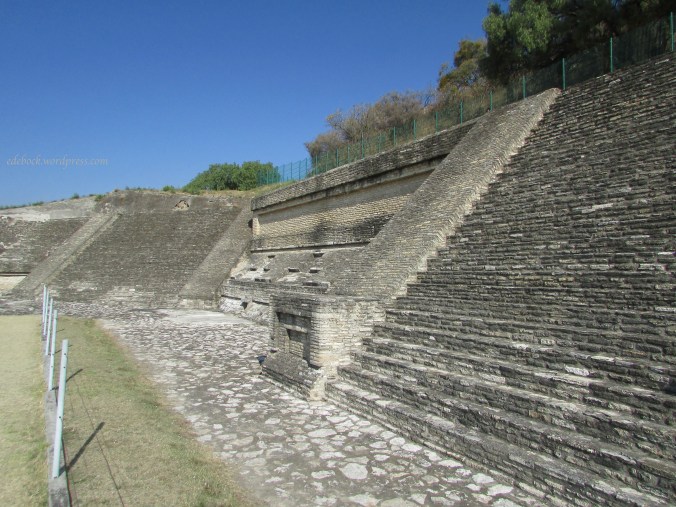
Unlike the Egyptian pyramids, the Great Pyramid of Cholula was built in stages beginning in the 3rd century BC and continuing through to the 9th century AD. As the ancient inhabitants of the area built on top of or modified previous structures the pyramid gradually took shape.

The earliest structures on the site were constructed of stones and adobe blocks made of clay, straw, and other plant material mixed with water. These were covered with a layer of stucco made of lime and sand. Over time, of course, the adobe broke down and nature took over. Legend also has it that when news of Spanish invaders arrived in the early 1500s, locals completely camouflaged the pyramid with mud and greenery to save the sacred place from being completely destroyed. What has been excavated and is visible now is just a fraction of what lies under the hill. Archaeologists have dug about 8 km of tunnels into the pyramid. Unfortunately, the 800 metres that are sometimes open to the public were not when we were there, but what we saw above ground was astounding.


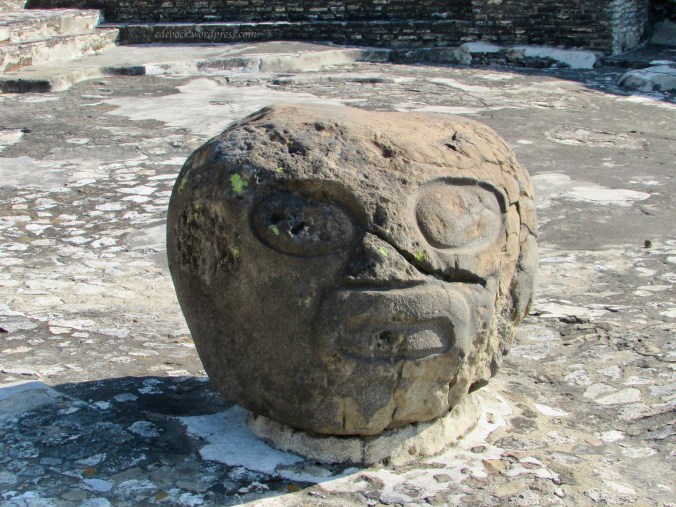
The different phases of the pyramid were built by ancient Mesoamerican civilizations including the Olmecs, Toltecs and Cholutecs. Though much smaller, this large head reminded me of the colossal Olmec heads dating back to at least 900 BC that we saw in the Museo de Antropología in Xalapa on a previous visit to Mexico in 2019.
The pyramid is thought to have had deep religious and ceremonial significance to the groups that held it at various times throughout history. Around its base and inside its walls, over 400 skeletons have been found. Disturbingly, many of these were the remains of children thought to have been sacrificed on the altar shown below during times of drought. It was believed that when they died they would carry messages to the rain god pleading for water for their people.

The interior of this altar contained the remains of two people and the remains of eight others, including children, were found under its base.

On a lighter note, how would you like to climb these stairs?

While most of the site is cordoned off and we couldn’t have attempted those stairs if we had wanted to, this flight of 50+ narrow stone steps was accessible, so of course we had to climb them!

Hanging onto the rope that’s firmly attached to the side, I made my way up. While the views from the ledge at the top were worth the climb, I soon discovered that there isn’t any other way down and wondered how I was going to manage the descent. Inching my way to the edge, I sat down and clinging to the rope, I made my way down on my butt! Thankfully, only hubby and our friends were there as witnesses!
As if that climb wasn’t enough, we also decided to take the steep walkway all the way to the top of the hill to see the church. Recognizing the religious significance of the pyramid mound, the Spanish chose to construct the Catholic church on top of it as a way of replacing the pagan cult of the past. It was constructed between May 1574 and August 1575 and consecrated on March 25, 1629.

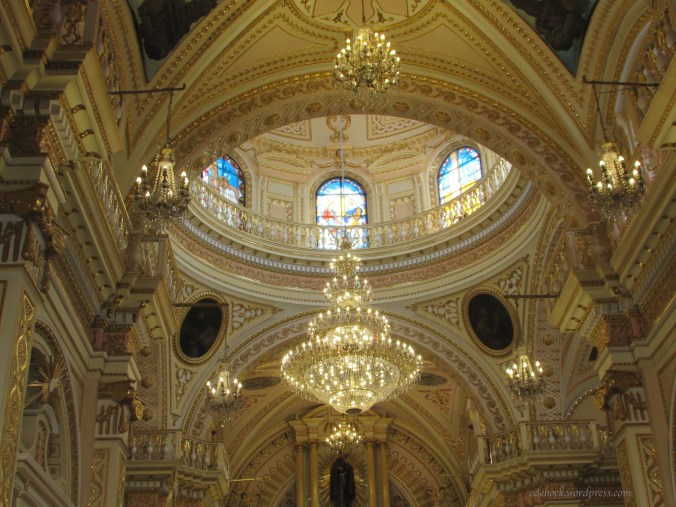
On our way up the hill, we followed a procession playing music and carrying an almost life-sized statue of a saint. Gathering just outside the sanctuary, they waited until the priest came out and blessed them with a sprinkling of holy water before they entered the already full church and a service began. At that point, we were able to stand just outside the door and see some of the church’s beautiful interior.
 Following Augustine