 Whether I like to admit it or not, fall has arrived in my part of the world. Days are cooler, nights are frosty, and leaves are changing colour. The time has come for many of us to go through our closets and decide what to keep for next summer and what we won’t wear again. Bagging up those unwanted items and dropping them off at a second-hand store might be the end of them as far as we’re concerned. It might even seem like the generous thing to do, but what actually happens to all that donated clothing?
As I mentioned in a previous post, most thrift stores are only able to sell a small fraction of what is donated. The reality is that over the years I have taken many items to our local second-hand shop. I’ve seen some of them hanging on the racks, but not once have I ever seen someone in our small town wearing one of them. Where did they go?
If your gently used garment isn’t sold within as little as three or four weeks in some shops, it might end up as carpet padding, insulation, or a rag in an auto body shop. That’s not necessarily a bad thing. Recycling textiles keeps material out of landfills and incinerators and reduces the need for virgin fibres by extending the life of existing ones.
Second-hand clothes that don’t sell in Canada, Europe and the US and that don’t end up in textile recycling facilities are often exported. The US alone sends roughly 700 000 tons of used clothing overseas annually. Again, this might sound like a benevolent thing to do, but it’s the middlemen who profit most from this practice and in many developing countries, it has had a devastating impact on local clothing industries. In Kenya, for example, where second-hand imports can be sold for a fraction of the cost of new locally produced items, the textile industry has been virtually wiped out by our “generosity”. The garment industry in that country, which employed half a million workers a few decades ago, now engages only tens of thousands. In 2016, the East African Community (EAC) agreed to a complete ban on imported clothing that was supposed to go into effect in 2019, but leaders backed down and rescinded the ban under pressure from the Trump administration.
Regardless of how much extra life our cast off clothing gets in those countries, the textiles themselves usually end their life there. Most developing countries don’t yet have even basic collection and recycling programs. Often, there isn’t even municipal waste management in place. Ultimately, what is left of our donated clothing often ends up being burned or dumped in environmentally sensitive areas that are considered wasteland.
So, what can we do to be more responsible consumers?
- Buy less. We buy too much stuff and then want our excess to somehow be good for the world. It simply doesn’t work that way!
- Shop second-hand.
- When buying new, look for garments that contain recycled content to ensure that we create demand for recycled textiles.
- Avoid fast fashion. Buy better, more durable clothing.
- Learn to extend the life of a garment by mending or upcycling.
With just one week left in my Second Hand September challenge, I will admit that I’m getting tired of limiting myself to only wearing second-hand clothes, but I’m determined to make it to the end of the month! Here are a couple of the outfits that I wore this week.


When I left for church on Sunday morning, it was too chilly to wear the sleeveless dress without something over it, so I pulled out the very versatile olive shirt that first appeared on the blog here. More than three years after finding it in our local thrift store, I still enjoy wearing it and have found it very useful this month. Even the shoes in this outfit are second-hand.
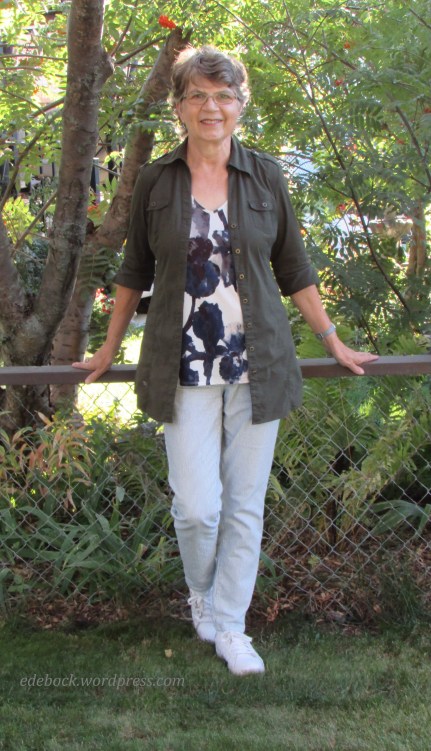
There’s that olive shirt again! The lightweight jeans that I found in one of our local second-hand stores recently look light blue or grey in the photo, but if you zoom in you can probably see that they’re actually a blue and white pinstripe. I discovered that this month’s limited wardrobe didn’t include many tops with sleeves that went well with them. When I headed off to a morning appointment, I needed a third piece over the sleeveless shell to add some warmth and finish the outfit. Thankfully, olive is a neutral colour and goes with just about everything!
 Following Augustine