Israel, land of tension

It’s impossible to visit Israel and walk the paths that Jesus walked without also confronting the current issues there. In addition to bringing scripture to life for us, our recent journey will also give me a greater interest in and hopefully, a better understanding of the news from that part of the world.

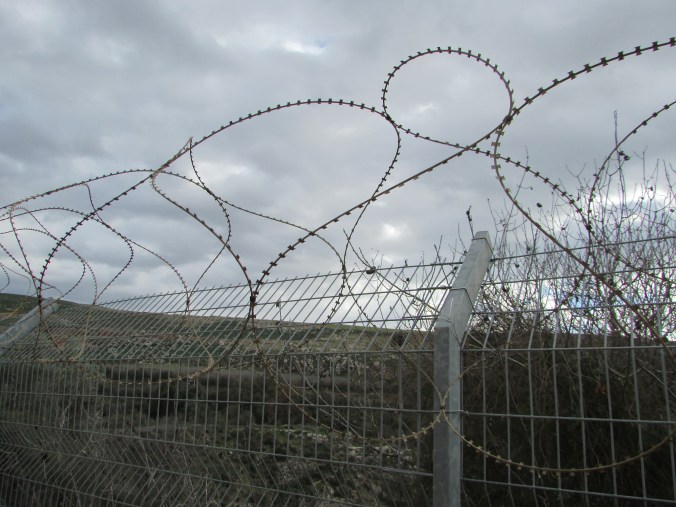
Early on the morning of Monday, January 25th, we set off for Metula, the northernmost town in Israel. This quiet agricultural community, set amongst orchards of apples, pears, peaches, nectarines, apricots, kiwifruit and lychees, sits just inside the border with Lebanon. Standing at a viewpoint on the edge of town, we peered through a razor wire fence and watched UN vehicles on patrol. Around the corner was a preschool with bullet holes in its windows from Lebanese snipers! All seems to be quiet at the moment, however, and tourism rivals agriculture as the community’s economic base.
IMG_0439

IMG_0446 - Version 2

Metula

Later in the day, after visiting two amazing Biblical sites that will be the focus of my next post, we climbed high into the Golan Heights, a rocky plateau seized from Syria in the final stages of the 1967 Six-Day War. It was here that we discovered that it does indeed snow in Israel! Apparently, it’s not unusual to see it on the upper slopes of Mount Hermon, but there was several inches on the ground in the Druze village where we stopped for lunch.

The Druze are an Arabic speaking ethnic and religious minority group found mostly in Lebanon, Syria and northern Israel.  With no country of their own, they form a close-knit, cohesive community but also integrate fully into their adopted homelands and are intensely loyal to them.

It was only when we exited the occupied territory again that we began to get a sense of what living in a land like Israel might do to one’s psyche. Though we felt no danger at all, our beloved guide, Shimon Zemer, told us that every time he crosses the border back into Israel proper, he breathes a sigh of relief and is able to relax again.

Before returning to Tiberias, we made one more stop, a visit to an Israeli Defense Forces base. Every Jew in Israel, over the age of 18, with the exception of those with a criminal record and the ultra-Orthodox Jews (as Shimon would say, “we shall talk about that later”) are required to serve in the army, males for three years and females for two.

The base that we visited is a supply centre where tanks, vehicles and supplies of all kinds are kept in readiness should war break out. We were shown one of 30 supply rooms filled with backpacks, each one already packed with clothing in the correct size for a specific soldier. The men in our group were especially fascinated with the tanks that we were shown, especially one, perhaps the most powerful in the world, that can travel 80 to 90 km/hour and while doing so, zero in on and launch a missile at a target 20 km away! We were allowed to take photographs, but only if we promised not to publish them on social media.
 

Galilee

The land of Galilee was nothing like I expected it to be. In the past, when I read accounts of Jesus teaching the multitudes and feeding the 5000, I visualized them sitting on grassy slopes. In reality, the rugged hillsides of Galilee are strewn with boulders of black volcanic basalt and I suspect that some of Jesus’ listeners chose to sit on rocks instead of on the ground.

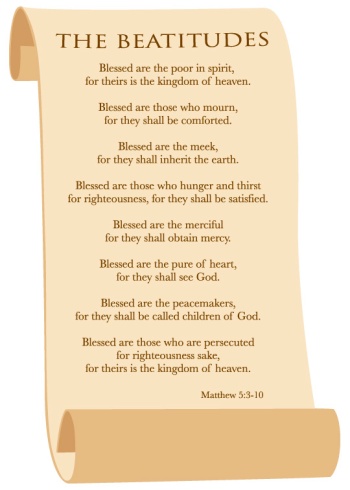
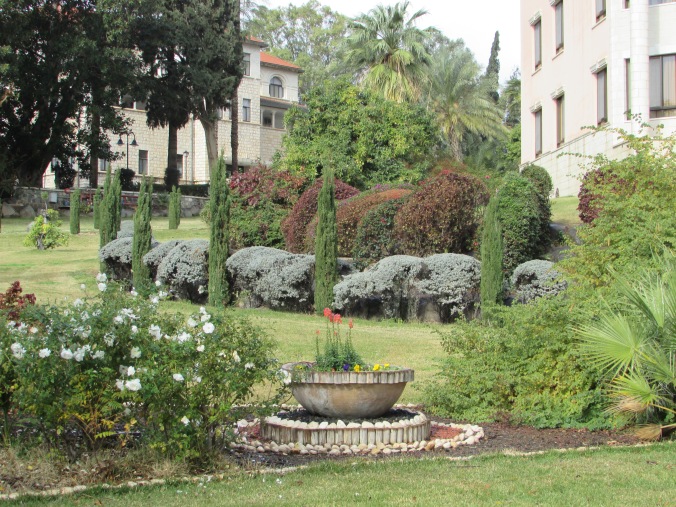
Today, a Catholic monastery surrounded by beautiful grounds is located on the Mount of Beatitudes where Christ delivered his Sermon on the Mount. After a short devotional in the gardens and singing Amazing Grace in the chapel where the acoustics were fabulous, we were sent off to read the sermon on our own. The storm that had been following us ever since our morning boat ride on the Sea of Galilee caught up to us about that time, however, and it was difficult to find a sheltered spot to do our assigned reading. The pages in that part of our travel Bible will probably be forever wrinkled, a reminder of standing in the wind and rain while we read Matthew 5:1-16!

IMG_0331

IMG_0346

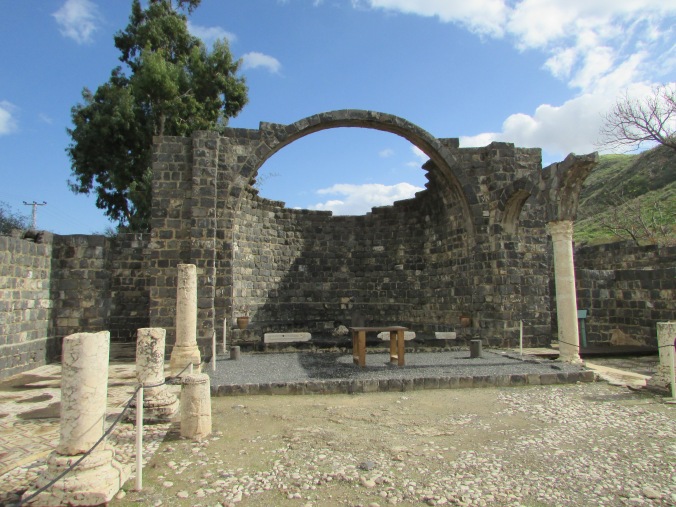
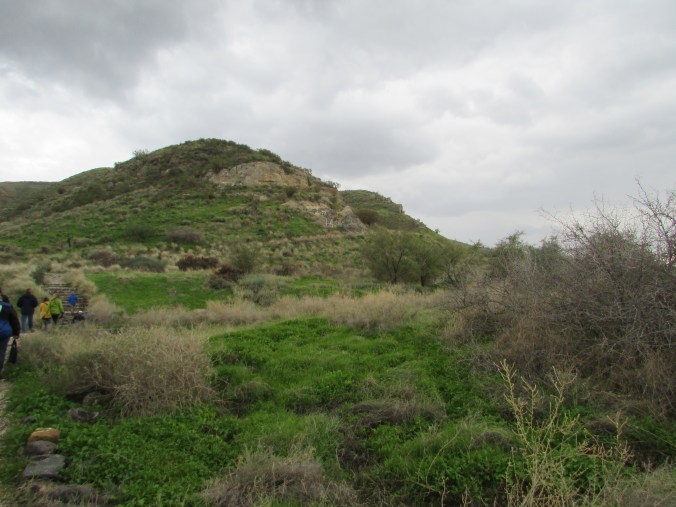
Fortunately, the rain didn’t last long and by the time we reached our next stop at Kurzi, which has been identified as the site where Jesus cast a legion of demons into a herd of swine (Mark 5:1-13), it had stopped. After investigating the remains of the oldest Byzantine church in Israel, we climbed the hillside to the probable location of the tombs mentioned in scripture. Looking down, it was hard to imagine the herd of pigs plunging into the lake and drowning because the water is actually quite a long way off. Remains of wharves have been found at the bottom of the hill, however, where bananas are now cultivated. Clearly the Sea of Galilee was significantly larger in Jesus’ day.

IMG_0355

IMG_0362

This is actually a major concern for Israel today as the Sea of Galilee is the country’s largest fresh water reservoir. Many years of below average rainfall have caused the water level to drop significantly as water is drawn from the lake for irrigation and other uses at a rate faster than it is replenished by nature.

Continuing on around the north end of the lake, we came to the recent excavation of the ancient city of Bethsaida where we walked on a stretch of cobblestone highway some 3000 years old!

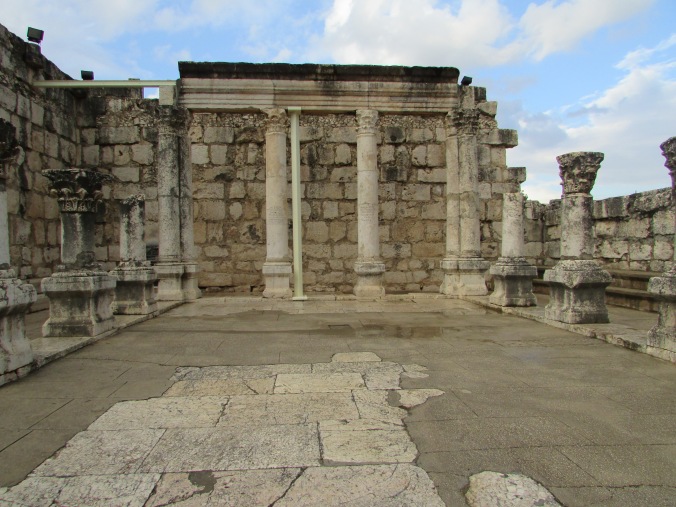
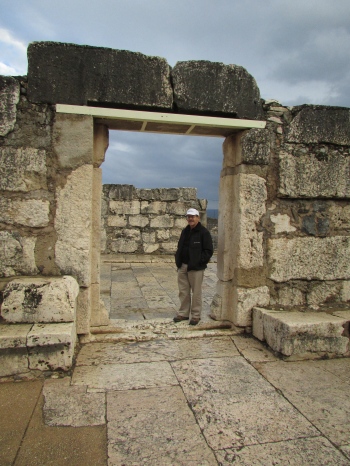
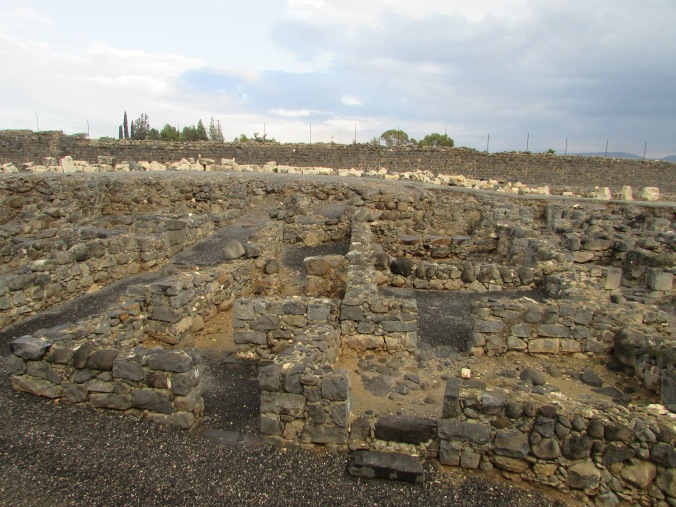
Our last stop of the day was Capernaum which was the centre of Jesus’ Galilean ministry. Here we saw the remnants of a beautiful 4th century synagogue that was built over the remains of the synagogue of Jesus’ day. Surrounding it were the remains of houses and other buildings. It is believed that the home of the apostle Peter, where Jesus is known to have spent a lot of time, lies beneath one of these.

IMG_0415

IMG_0417

IMG_0418

As we returned to our hotel in Tiberias, I felt privileged to have walked so many of the places where our Lord walked, but I also realized that Jesus was not particularly concerned about the places, but about the people who inhabited them. It was a blessing to walk where He walked physically, but how much more we need to walk as He walked spiritually, in humility and obedience, bringing salt and light to a lost and hurting world. (Matthew 5:13-16)

beatitudes

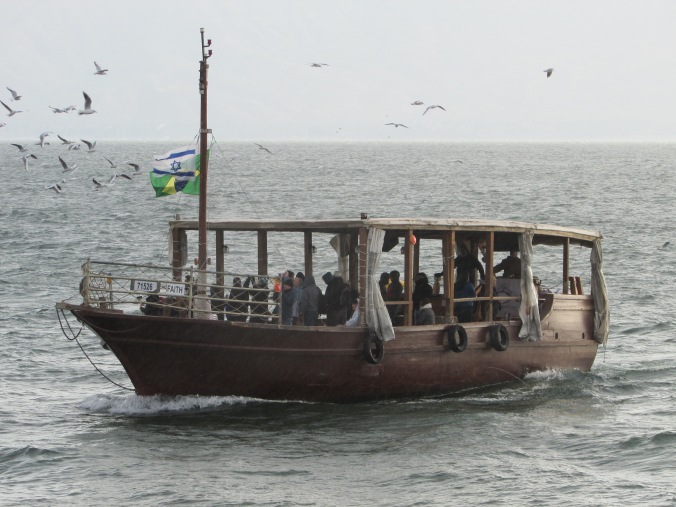
Boats on the Sea of Galilee

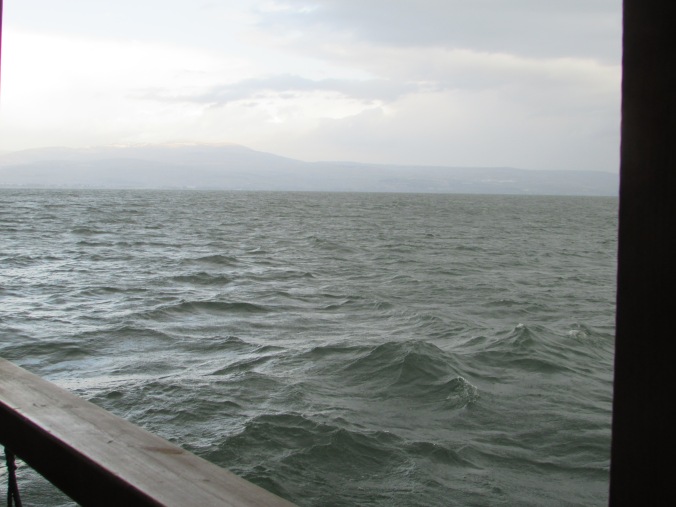
We arrived at our hotel in Tiberias overlooking the Sea of Galilee, or Lake Kinneret, shortly after dark on Saturday, January 24th. Sunday morning began with what was definitely one of the highlights of our pilgrimage to Israel; worshipping on a boat on a stormy Sea of Galilee! The original plan had been to travel by boat to another spot along the lake and have the bus pick us up there, but the water was too rough for that and since Jesus wasn’t there to calm the storm (Matthew 8:23-27), we went out and back to the same spot staying fairly close to shore. The boat was aptly named Faith and we all agreed that it was somehow very fitting that we were buffeted by wind and waves just as Jesus and his disciples had been.

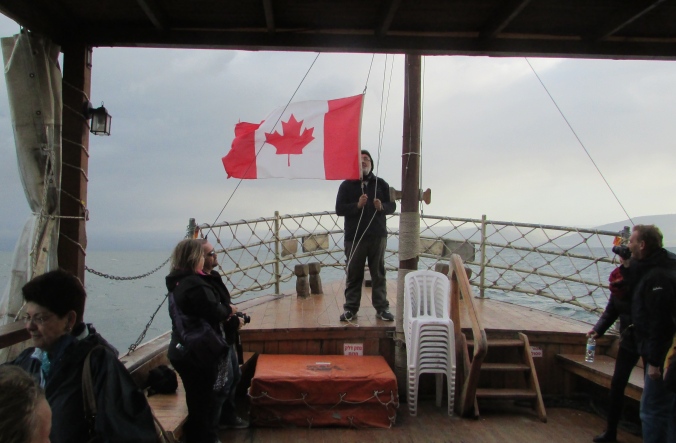
As soon as we put out from shore, the Canadian flag was raised and Captain Daniel Carmel, who is also a Christian singer and songwriter with an amazing testimony, declared the boat temporary Canadian territory and “the warmest spot in Canada today!” My heart was full as we all stood and sang O Canada. After a short devotional, we sang hymns and songs of praise and listened to Captain Daniel sing one of his own songs entitled Jerusalem. It was a very moving experience.

IMG_0299

IMG_0306 - Version 2

IMG_0310

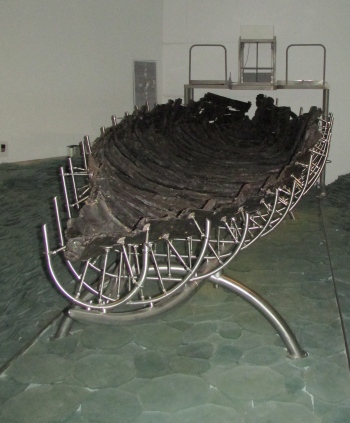
Too soon, we were back on shore and on our way to our next destination, the Jesus Boat Museum on a kibbutz at Ginosar. In 1986, at a time when the water level was particularly low, the remains of a 27 meter long fishing boat from the time of Jesus was discovered in the mud on the northwestern shore of the Sea of Galilee by brothers Moshe and Yuval Lufan. Of tremendous historical importance, it was unearthed by a team of archeologists who took particular care to keep the ancient wood wet so that it wouldn’t dry out and crumble. Encased in expanding foam, it was then floated to a spot where it could be lifted from the water by a crane and moved. It was submerged in a chemical bath for seven years to preserve the wood before it was finally put on display. Though there is no evidence to definitively connect the boat to Jesus or any of his disciples, it is an amazing relic from their day.

IMG_0322 - Version 2