
Freedom Sunday 2015

freedom_sunday2

image credit


As president of our church’s missions council, I share a short message about what the church is doing around the world during every Sunday morning service. This week’s Missions Moment required more research than most and had a profound impact on me so I’ve decided to expand on it here.

Would you believe me if I told you that there are over four and a half thousand slaves living in Canada today and approximately 60 000 in the US? If you think that slavery ended in 1865, think again! According to the 2014 Global Slavery Index, that is the number of people trapped in modern slavery in our two countries and that’s only the tip of the global iceberg. There are, in fact, more slaves in the world today than at any other time in history! Experts estimate that 30 million people are caught up in the global slave trade, an industry that generates $150 billion in profit each year.

Today is Freedom Sunday, a day that Christian churches around the world have set aside to increase awareness of the problem.

According to the Polaris Project, a national anti-human trafficking group, most of North America’s modern day slaves are foreign workers labouring in factories, farms, strip clubs, and begging and peddling rings or serving as domestic workers. They come seeking a better life, but instead, they find lives of servitude. Most are told upon arrival that they owe huge sums of money to the smugglers and traffickers who brought them here, debts that they have little hope of ever being able to pay. Many are physically abused. Employers often keep their passports and other documents “for safekeeping” making it impossible for them to escape. Threats of deportation or of harm befalling their families back home keep them from trying.

Human trafficking is defined as the illegal movement of people, typically for the purposes of forced labor or commercial sexual exploitation, a system in which both children and adults are bought and sold, held captive through force, coercion, threats, deception, or abduction. It is a global problem that affects people from many backgrounds or situations but people living in poverty are especially at risk because traffickers prey on those who are most vulnerable.

Ours is a worldwide denomination that has a presence in many countries where children and adults are vulnerable to trafficking. In those areas, it partners with local churches in anti-trafficking efforts that range from prevention and education to protection and rehabilitation. It’s strongest efforts toward ending human trafficking are through prevention and providing economic and educational opportunities to lower the risk of poverty-induced trafficking. Children living on the streets and in the slums of third world nations are particularly vulnerable to abuse and to “too good to be true” offers of a better life elsewhere. Child development centres and child sponsorship programs help children stay in school and teach them to see themselves as valuable and loved by God. Other programs focus on providing homes for orphaned and abandoned children to keep them off the streets.

Imagine the heartbreak of a parent so trapped in poverty that selling their own child seems to be the only way out; a parent who chooses to sell a son or daughter to a stranger rather than watching them starve. Church run self-help groups and skills training programs empower women to improve their household finances, thereby lessening their children’s risk of being trafficked. It’s a documented fact that money in the hands of men often goes to alcohol and prostitution but in the hands of women, it nurtures children, feeds families and promotes education.

Our denomination also partners with other ministries that help survivors of trafficking by offering rehabilitative services and skills development.

But what can we, as individuals do? What can you do?

First of all, you can do what I have done this week. You can educate yourself and then others. Take the time to be informed and to inform others. None of us can end the curse of human trafficking on our own but together, we can make a difference.

If you believe in the power of prayer, commit to praying regularly for the victims of human trafficking and for those governments that are striving to end it. James 5:16 tells us that the prayer of a righteous person is powerful and effective.

You can financially support an organization that is working to end human trafficking. Whether it be a church or a secular organization, there are many that need resources to carry on the battle. Do your homework, check the links in this post and choose an organization to support.

Combat the demand. I’m as guilty as the next person, but if we put our minds to it and took the time to do the research, most of us could do a better job of ensuring that we don’t purchase products that are produced by men, women and children trapped in slavery. Do you know how and where the clothes you’re wearing were produced? Click here for a 5 step guide to ethical fashion shopping. What about the coffee you’re sipping or your favourite chocolate? There are many resources on the internet to help you be a better global citizen through how you shop.

I know I might be treading on toes, but now that I’ve started, I’m going to get even more personal and specifically address the men who are reading. Guys, if you are in the habit of viewing pornography in any of it’s many forms, you are involved in the slave trade! You are contributing to human trafficking. I could write an entire blog post, or perhaps a series of them, on the connection between pornography and trafficking but suffice it to say that many of the girls and women who are used in its production are the victims of trafficking and are being held against their will. Think for a moment, what if that was your sister or your daughter?

Let’s all commit to doing something to help bring an end to the curse of human trafficking and modern day slavery. Let’s set the captives free!
Blogging is good for my health!

Seven years ago, when I started blogging, my husband and I were preparing to spend a year teaching English in Japan. Following Augustine was born to share that experience with friends and family back home in Canada. I’ve always enjoyed writing so it was no surprise to me that when the year came to an end, I’d fallen in love with blogging and I wasn’t ready to let it go.

Over the years that followed, my blog became an eclectic collection of posts on a wide variety of topics including faith, family, and travel with a bit of food, fashion, fitness and even history thrown in. In essence, it chronicled our life and interests as an active retired couple.

Then came cancer!

When my first cancer was diagnosed a year and a half ago, the blog became an avenue for sharing vital information about my health with concerned friends and family around the world. I soon learned that it had an added benefit. As I dealt with the diagnosis of a second unrelated cancer, surgery, radiation, multiple tests and scans, new treatments, a clinical trial, and the emotional ups and downs that accompanied them all, I found that writing about the journey helped me process what was going on. It seemed that blogging was good for my mental health.

Now I’ve discovered that there’s actually scientific evidence to support that! Studies have shown that expressive writing leads to physical and mental health benefits such as long-term improvement in mood, stress levels and depressive symptoms. People with asthma who write have been shown to have fewer attacks than those who don’t and cancer patients who write tend to have more optimistic perspectives and improved quality of life.

So what is it about writing that makes it so good for us?

Apparently, the act of expressive writing allows people to take a step back and evaluate their lives. It can help them find meaning in a stressful event, manage their emotions better, talk to other people about the situation more easily and reach out for support more willingly. Instead of brooding or obsessing over a diagnosis or a catastrophic event, they are able to focus on moving forward. By doing so, stress levels go down and health goes up.

Remarkably, researchers found that just 15 to 20 minutes of writing three to five times over the course of a four-month study was enough to make a difference. That was good news to me. Though I try to blog more often than that, I’ve never had any desire to post every day. I’ve seen too many daily bloggers burn brightly for a short period of time then flicker and burn out. I try to post at least once a week but I’ve even fallen short of that lately.

Cancer is only one of the topics that I continue to write about. Blogging will never be a cure but it’s nice to know that really is good for my health!

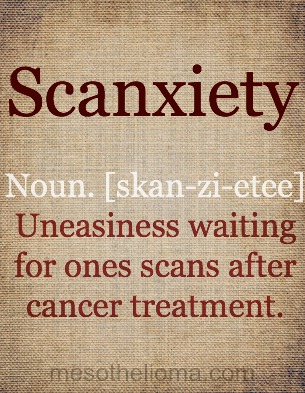
Scanxiety

Since being diagnosed with cancer almost 18 months ago, I’ve learned a lot of words that I, a self-professed word nerd, would rather not have had to know. Words like neuroendocrine tumour (I have five of them lurking inside of me) and carcinoid syndrome (a group of symptoms linked to the excess hormones released by the type of neuroendocrine tumour that I have). I could bore you with several others but the word that best describes my life the past few weeks is scanxiety.

Scanxiety

Scan + Anxiety = Scanxiety

Though my cancer is incurable, I go for a treatment about once every ten to twelve weeks that is designed to keep it from growing and spreading. I am injected with Lutetium-177, a radioactive therapy that adheres to specific receptor cells in my tumours and destroys them. The morning after each treatment, I have a full body scan that shows us exactly what has been happening with the disease since the previous treatment. Fortunately, I don’t have to wait long for the results. I meet with a doctor immediately afterward to view the pictures and talk about what they show.

For the most part, I’ve been at peace and have approached each treatment and scan without a lot of anxiety but this time was different. Since my last treatment in mid November, I’ve been experiencing intermittent stomach pains. They’re short-lived, lasting only a few minutes. It’s easy to second guess every ache or twinge and wonder if it’s related to the cancer but this was more than that. Stomach pain is one of the most common symptoms of carcinoid syndrome and one I’d experienced prior to diagnosis. I began to wonder if this was a sign that the cancer was growing or spreading.

Worry often begins as a little thing but it seems to feed on itself. Soon I was carrying a heavy burden of anxiety. It continued to grow until I was quite sure that I would hear bad news when I went for this week’s treatment and scan.

Then, on Tuesday night as I was brushing my teeth and preparing for bed, I heard the Lord say, “It’s going to be okay!” Oh, it wasn’t a booming voice thundering through the ceiling of our tiny ensuite bathroom. It wasn’t an audible voice at all but it might as well have been. I knew without a doubt that it was God speaking to my heart. He even said it several times. “It’s going to be okay!” I walked out of the bathroom feeling like the world had been lifted off my shoulders, crawled into bed and had a great sleep. Then, the next morning, I climbed out of bed, picked up the heavy load of anxiety and put it squarely back on my shoulders!

As we drove to Edmonton for my treatment and throughout the hours that followed, I tried to tell myself that everything was going to be okay, but I kept hearing the other voice, the one that said, “Are you sure it was God that you heard? It wasn’t God, it was only your own wishful thinking! You were right in the first place; the news is going to be bad!” Foolishly, I listened and my anxiety grew.

I was thankful for the visits that kept me sane that evening. First, an acquaintance from years gone by that I’ve recently reconnected with. We could have talked for hours! Then, my dear hubby who has walked every step of this cancer journey with me. I was also thankful that the treatment had made me tired enough to sleep.

The next morning, I prayed for the entire half hour or so that I was being scanned and then it was time to find out which voice I should have listened to. I walked into the consultation room where Dr. Sandy McEwan, head of the neuroendocrine tumour clinic at the Cross Cancer Institute, and Dr. Dean Ruether, leader of the provincial endocrine tumour program, sat waiting with smiles on their faces and I heard the words I’d been longing to hear, “Everything’s okay! There’s been no change.”

My cancer is stable! I can relax until mid April when we go through the whole thing again, hopefully without as much scanxiety! Oh, there are still the stomach pains to deal with but I’m even wondering if they will subside now that the burden of anxiety has been lifted. I’m going to be monitoring their frequency and intensity for the next few weeks to see if they’re actually lessening, as I think they may have been. If not, the solution might be as simple as increasing my monthly dose of Sandostatin which controls the carcinoid symptoms or as complicated as surgery to remove the primary tumour from my colon.

For now, I’m simply going to relax and give thanks to the One whose voice I should have listened to!

World Cancer Day 2015

World Cancer Day

When I first learned that today is World Cancer Day, a day in which the world comes together in unity in support of the global fight against cancer, I wasn’t sure how I felt about that. Do we really need an awareness day for everything? After all, isn’t everyone already aware of the devastation brought about by this dreadful family of diseases? Surely everybody has been touched by it in some manner. And what good does a day do anyway?

Cynical? Yes. Grouchy? Yup, that too! Perhaps my reaction has more to do with the fact that I’m resting on a heating pad because I wrenched my back yesterday than it does with whether or not we need a Cancer Day. It might also be related to the fact that I have a treatment next week followed by a scan that will tell us whether or not there has been any change in my own cancer. The days leading up to these scans are always a bit nerve wracking so I’d just as soon avoid the topic of cancer altogether today.

I’ve decided not to do that, however. The Lord has given me a voice (or in this case, a keyboard) and the least I can do is lend it to such a worthy cause. There’s really nothing that I can say about cancer that hasn’t already been said, but let’s begin with some alarming statistics:

  • Cancer is a leading cause of death worldwide and the leading cause among Canadians.
  • An estimated 191,300 Canadians were diagnosed with cancer in 2014 – 97,700 men and 93,600 women.
  • About 76,600 Canadians are estimated to have died of cancer in 2014 – 40,000 men and 36,600 women.
  • 45% of men and 41% of women will develop some form of cancer in their lifetime.
  • On average, 524 Canadians are diagnosed with cancer every day.
  • On average, 210 Canadians die of cancer every day.
  • About 30% of all cancer deaths are due to five leading behavioral and dietary risks: obesity, low fruit and vegetable intake, lack of physical activity, tobacco use, and alcohol use.
  • More than 60% of all new cases each year occur in Africa, Asia and Central and South America which account for 70% of the world’s cancer deaths.
  • Deaths from cancer worldwide are projected to continue rising, with an estimated 13.1 million deaths in 2030. I suspect that this is, in part, related to the fact that life expectancies are also rising.

Despite these gloomy numbers, cancer survival rates have doubled in the last 40 years. Awareness is making a difference!

The theme for World Cancer Day 2015 is “Not Beyond Us”. This year, the campaign is focusing on four key areas: choosing healthy lives, delivering early detection, achieving treatment for all, and maximizing quality of life. It takes a positive approach to the fight against cancer by highlighting new treatments and solutions that are within reach.

Today is World Cancer Day but the fight against cancer takes place every day. It takes place in research labs around the world but it also takes place all around you. It takes place in that home where a mother, father or child is fighting for life. It takes place in the hospitals and clinics where they receive treatment. It takes place in classrooms where good health habits are being taught and it takes place in communities, large and small, where fundraisers are held to benefit everything from individual patients to global research.

What will you do to make a difference in the fight against cancer? Will you make a donation, offer to drive an acquaintance to an appointment, or drop off a meal for the family when you know that Mom has had a treatment? Whatever you choose to do, you can make a difference!