Rose gardens and city views

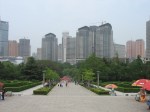
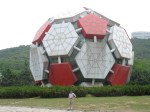
Located just a few blocks from the downtown train station in the shadow of Lushan Mountain, Labor Park is best known for its enormous red and white soccer ball that commemorates Dalian’s glory days as China’s famed football city. Like Dalian’s current football team, however, the park is a bit lacklustre in comparison to some of the more beautiful ones we’ve seen. It does have some pretty spots though as well as an amusement park and acres of space for relaxation. Though I read about “a game farm full of peacocks, deer, and cranes” we saw only a few beautiful cranes strutting around cramped and bare quarters and an empty pool that might have once housed otters or something of that nature.

What the park does have is beautiful flowers, lots of statues and some great views of the city. When we passed it on the bus earlier in the spring, it was festooned with cherry blossoms but now the roses are in full bloom. We saw several bridal couples having photos taken in and around the rose gardens.

Yesterday afternoon, after strolling the broad avenue up the centre of the park, between the statues of the twelve animals of the Chinese zodiac (I’m a dragon) to the giant soccer ball, we took a chair lift up the mountain. As we passed over treetops and even a busy highway, I was glad that I’m no longer afraid of heights. I was even happier about that when we took the glassed in elevator to the observation deck high on the communications tower at the mountain’s peak. Though the day was a bit hazy and the ever present smog hung over the city, the views from the top were definitely worth the ride up. I’m glad we waited to do this until we’d been here for awhile and seen much of the city as it was fun to pick out the various places we recognized. Sadly, the smog and the dirty windows (nothing in China stays clean very long) made it virtually impossible to get good pictures.

Today, the second day of our Dragon Boat Festival holiday, was supposed to be a beach day with one of my students but the sky is grey and it’s pouring rain so that plan has been nixed. Instead, it might just be a relax at home day.

Dragon Boat Festival

Today was the first day of China’s three day Duanwu or Dragon Boat Festival holiday. The festival itself which falls on Wednesday, commemorates ancient China’s patriotic poet, Qu Yuan, who lived from 340 to 278 BC. Though stories vary somewhat, according to legend, Qu was accused of treason and banished from the ancient state of Chu for failing to support the king’s proposed alliance with the increasingly powerful state of Qin. During his years of exile, he wrote many enduring patriotic poems. When the state of Qin later captured the capital of Chu, Qu committed suicide by drowning himself in the Milou River. HIs death occurred on the 5th day of the 5th month of the Chinese lunar calendar which this year falls on June 12. Apparently the festival takes its name from the idea that people rowed their boats out into the river in an unsuccessful attempt to either save their beloved poet or retrieve his body.

At the beginning of the semester, when I saw the Dragon Boat Festival on our school calendar, I had visions of watching colourful boats filled with rowers racing on a local waterway. Sadly, that doesn’t happen in Dalian.

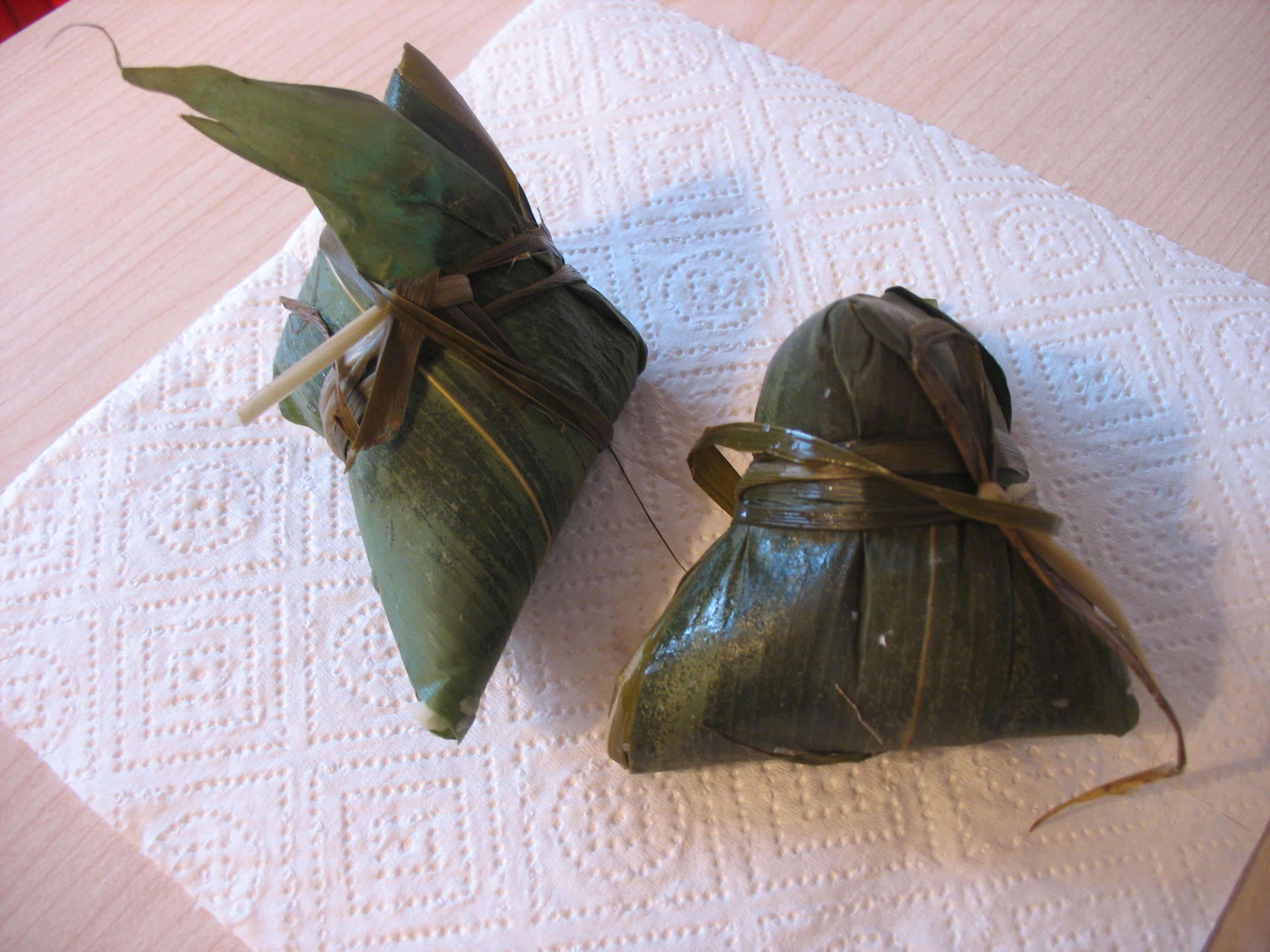
It would seem that the primary way that people here celebrate the festival is by eating zongzi, triangular packets of glutinous rice wrapped in bamboo leaves. The stores and markets have been filled with them for the past few days. It is said that this tradition originated when local people dropped sticky rice packets into the river to feed the fish and keep them from consuming Qu’s body!

We were given several homemade zongzi yesterday. Though the rice tasted okay, having taken on a mild grassy flavour from the bamboo leaves, we weren’t very impressed by its texture. For me, the word glutinous even sounds gluey and that’s exactly what it was!

A second tradition is the wearing of five-coloured silk cords around the wrists. These are being sold everywhere right now by women who have obviously been busy making them by hand. I bought mine for 1 yuan (about 17 cents) each and will wear them on Wednesday. Apparently, when the festival is over, they’re supposed to be cut off and thrown away to get rid of bad luck.

When we went down to the street market to pick up vegetables and meat this morning, we noticed lots of bundles of leaves being sold. We guessed that they too must have something to do with the festival. They didn’t look very edible and we had no idea what their purpose was until I read up on the celebration online and learned that they were mugwort leaves and calamus. Apparently, people put bundles of them over their doors to protect themselves against disease. I wonder if they have any effect on shingles? Perhaps I should have bought some! Actually, the stems and leaves of these plants are said to dispel an aroma that is thought to purify the air and discourage flies and mosquitoes so perhaps there’s something to the tradition.

Although this festival has long been part of Chinese culture, the government of the People’s Republic of China, established in 1949, refused to officially recognize it as a public holiday. It was only reinstated as a national holiday in 2008. Since it falls on a Wednesday this year, many people, including us, worked on Saturday and Sunday so that they could have today and tomorrow off and make it a three day vacation.

Since our tour of China is coming up soon, we decided not to go anywhere this holiday. Instead, we’re staying here in Dalian and being tourists in our own town but I’ll share more about that in future posts.