Spring… definitely worth waiting for!

I’ve been waiting for spring ever since we arrived on campus at the end of February. It’s been like looking at a drab cocoon and waiting for the beautiful butterfly to emerge. Though the grass was brown and the trees were bare, we could see the potential for so much beauty.

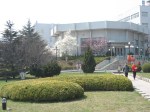
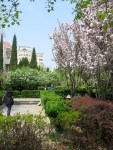
Now, suddenly, spring is upon us and it’s even more beautiful than we imagined. It began a couple of weeks ago when the grass seemed to turn green overnight. Then the magnolia trees alongside one of the lecture halls burst into magnificent bloom. Before we left on last week’s holiday, I expected to see leaves on the trees when we got back and I wasn’t disappointed.

This afternoon, as we walked across campus on our way to pick up a few groceries at the supermarket, we recognized the unmistakable smell of lilacs in bloom. We soon found ourselves wandering parts of the campus that we hadn’t bothered with before! There were blossoms everywhere; bright splashes of red, white, pink, and vibrant purple. I wasn’t the only one with my camera out!

Entertaining angels

Do not forget to entertain strangers, for by so doing some people have entertained angels without knowing it. Hebrews 13:2

We’re back in Dalian and though we’ve only been living here since late February, it really did feel like we came home today. As we settle in and get back into routine, I find myself reminiscing about the many "angels" we encountered as we travelled. They may not actually have been heavenly beings but I can’t help thinking that God brought them across our path to make our way easier and more enjoyable. I’ve mentioned some of them in previous posts.

First there was Michael who helped us find our hotel when we arrived in Jinan and later led us to a restaurant and helped us order a delicious dinner. Though he wanted to spend more time being our guide, circumstances didn’t allow it but Michael kept in touch by texting for the remainder of our trip making sure that we were fine and offering to translate or advise if we needed him to.

Then there was the gentleman who volunteered to drive us from the village of Zhujianyu to the bus station in nearby Mingshui so that we could get back to Jinan after exploring the historical site. We didn’t get his name and though we offered, he wouldn’t accept any payment for his trouble. Definitely an "angel"!

Many of the long distance buses here have someone who rides along, collecting tickets or cash from passengers as they board at various pick up stops. She often disembarks somewhere near the outskirts of the city once everyone is on board but when we rode from Jinan to Qufu, the "stewardess" stayed on board all the way. When we pulled into the Qufu bus station, 6 km outside town, she left the bus with us, found us a taxi and made sure he knew where to take us before she boarded the bus again and it continued on to its next destination. We could have managed on our own but it was much easier having an "angel" who knew the language taking care of us.

That evening, when we went out to find some supper, we encountered another one of our "angels". We were thinking about eating at the local night market where food is cooked and sold on the street. We had just started walking through the market area checking out the various things that were being prepared when Daphne, a local college student, walked up to us and asked in excellent English if she could be of any help. She advised us not to eat at the market because it might not be very healthy (exactly the same advice that our own students give us). After asking us what we enjoy eating, she suggested a restaurant, took us there, helped us order and visited with us while we ate.

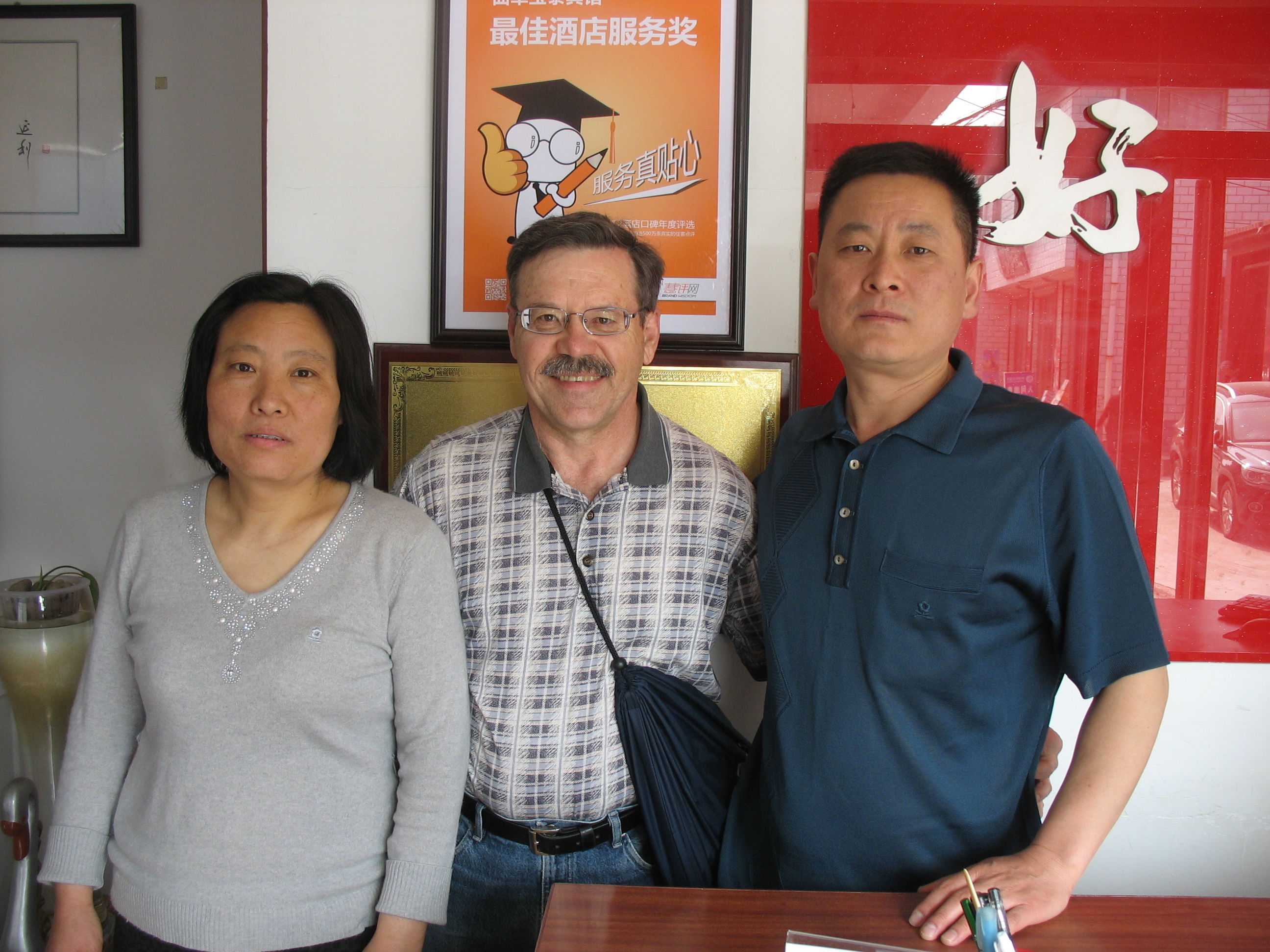
The next day Aku appeared out of nowhere to act as our guide to the Confucius Temple and Mansions but I mustn’t forget to also give credit to one more Qufu "angel", our host at the tiny Bao Tai Hotel. Our room was basic; the mattress was thin, the towels tiny and at $13 a night, we couldn’t complain about the room not being made up each day. What made our stay heavenly was our host. He didn’t speak a word of English but when we arrived, he asked us through gestures if we were hungry and when we said yes, he walked us around the corner to a little restaurant. While we ordered, he headed off on his bicycle to find a map of Qufu and brought it back to the restaurant for us. Later, he was able to communicate through the translator on his computer, that we were the first Canadian guests to ever stay in his establishment and he treated us like royalty. When we came downstairs to check out yesterday morning, he insisted on driving us to the bus station himself instead of allowing us to take a taxi! Though he isn’t smiling in the photo, I think that’s the only time I saw him without one. Yes, that’s definitely the face of an "angel"!

Second day in Qufu

If you had an entire day to do anything you wanted, what would you do? That’s the situation we found ourselves in this morning. We’d allowed ourselves two full days in Qufu thinking that one might not be enough to see all three Confucius sites that we visited yesterday.

Knowing that we had an entire day to fill, we were in no hurry to get up this morning. I haven’t been sleeping well lately largely due to the fact that I’m fighting a nasty cold so a bit of extra rest was very welcome.

Once we were up and had had a late breakfast, we went to visit another ancient temple, this one dedicated to the memory of Yan Hui, a favourite disciple of Confucius. If it were located anywhere other than almost next door to the much larger and more impressive Confucius Temple complex, it would likely draw many visitors but we were almost alone and it was very peaceful. We could actually hear the birds chirping!

The Yan Temple has been undergoing renovations over the past few years. Apparently the cost of this massive facelift prompted a hefty increase to the admission fee which, I’m assuming, resulted in even fewer visitors. We learned, however, that if we could produce our combination tickets from yesterday, we would be admitted free of charge.

In addition to enjoying the tranquility of the temple grounds, we found the renovation project quite fascinating. One of the outer buildings houses a display of photos chronicling the meticulous work that has been done. The buildings that have been completed have received much more than a new paint job. Much dismantling and rebuilding was required to replace wooden parts and roofing that had deteriorated. Many of the intricate panels were taken down, painted and put up again.

After leaving the temple, we headed over to the International Youth Hostel and rented bicycles. Leaving town, we rode out into the countryside to look at the farms where we saw corn, wheat and other crops that we couldn’t identify. Though they appear to have been seeded by machine, we saw many people, mostly women, out in the fields pulling weeds. Imagine doing that by hand on a Canadian farm! I have no idea how far we rode. I’m pretty sure my butt will be telling me about it tomorrow but it was well worth any discomfort I may have to put up with.

After an early supper, we were strolling back toward our hotel when we decided to rest for awhile on a stone bench near the main gate to the city wall, a great spot for people watching. Little did we know that we were in for an unexpected surprise. We were about to leave when someone began banging on the enormous drum atop the wall. It heralded the beginning of a gate closing ceremony complete with elaborately costumed guards, flag and lantern bearers, a herald and others we couldn’t identify. It was a perfect ending to our stay in historic Qufu!

A day with Confucius

Wheresoever you go, go with all your heart.
Confucius

We left Jinan yesterday morning and travelled south by bus to Qufu (pronounce Chu Fu). Small by Chinese standards, with a population of only about 86 000 people, Qufu is famous as the hometown of the great sage, Kong Fuzi, better known to us by the westernized version of his name, Confucius.

The old walled centre of Qufu is small and easy to get around on foot but the three principle sites; the Confucius Temple, the Kong family mansions and the Confucius Forest where the great teacher and his many descendants are buried, are absolutely enormous. We spent all day today exploring them.

When we stopped at the ticket office to purchase the combination tickets that would allow us to visit all three sites, we were also thinking about hiring an English guide but before we could, we were approached by a young college student who called himself Aku, an abbreviated version of his difficult to pronounce Chinese name, who offered to act as our guide for free if we would simply use his camera to take a few pictures of him throughout the day. We agreed and found him to be a delightful and knowledgeable companion.

We started our day at the Confucius Temple, China’s second largest imperial building complex after the Forbidden City in Beijing which we hope to visit in July. The temple started out as a simple memorial hall some 2500 years ago but over the ages, it mushroomed to today’s compound which covers 327.5 acres and is 1.3 km in length from north to south.

Though there is some debate about whether Confucianism should be considered a religion or simply a system of philosophy, the temple was once a site where sacrifices were offered to Confucius. He was a great thinker, a teacher, editor, politician and a philosopher whose teachings emphasized personal and governmental morality, correct social relationships, justice, loyalty and sincerity. He was a strong proponent of ancestor worship which is something we have a hard time getting our heads around but I can’t help wondering if he ever intended that nations of people should worship him. Whether it was his intent or not, many Asian cultures including Chinese, Korean, Japanese and Vietnamese have been strongly influenced by Confucianism.

After spending all morning touring the temple complex we stopped for lunch then moved on to the Confucius mansions, a maze of 450 halls, rooms, buildings and passages where his wealthy and powerful descendants lived like kings. Emperors were known to drop in for visits and a special ceremonial gate near the main entrance was opened only when this happened. The complex included administrative offices and meeting rooms, family residences, kitchens, guest rooms, studies, libraries and a treasury. A peaceful garden of flowers and greenery are found at the rear. Aku told us that his dream would be to build a home like this one in the Chinese countryside but I only coveted the garden and a few unique features like the round doorways! I could also imagine children having endless hours of fun playing hide-and-go-seek in the many passageways!

After relaxing over coffee, it was time for Aku to leave us as he had a bus to catch later in the day. We took a pedicab 2 km north to the Confucius Forest, the oldest and largest family cemetery in the world. There, Confucius and his descendants have been buried for more than 2000 years, a practice that continues up to the present time. The peaceful pine and cypress forest covers an area of more than 200 hectares. Burial mounds and memorial plaques are scattered haphazardly throughout the area. Confucius, himself, lies beneath a grassy mound enclosed by a low wall. Though most of the tourists crowded around the tomb were simply curious, there were those who knelt and others who made offerings of flowers.

After walking back to our tiny, family-run hotel where every room number begins and ends with 8, considered a lucky number by the Chinese, we’re spending a quiet evening resting our very weary feet. Our hosts don’t speak a word of English but they are clearly delighted to have us, their very first Canadian guests, staying with them.

To see what is right and not do it, is want of courage or of principle.
Confucius

Thank you, Dr. Bethune

Over the past few years we’ve stretched our comfort zones to such an extent that we don’t really know where the edges are anymore! I’m pretty sure we stepped outside them this morning, though, when we boarded a bus and headed out into the Chinese countryside with no definite idea how we’d get back to Jinan!

The bus dropped us off beside the highway and we walked two kilometres into the historic village of Zhujiayu. After the noise and pollution of city life in China, a walk in the country was literally a breath of fresh air! The crops on either side of the road were heading out already but it was a bit too soon to tell for sure if they were barley or bearded wheat.

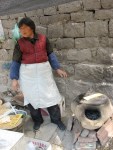
Walking the narrow stone streets of Zhujiayu is a journey back in time. Protected by hills on three sides and dating back to at least the Ming and Qing dynasties, it’s easy to see why it’s been used as a set for a number of movies and television dramas. Though the central street was crowded with vendors selling snacks and tacky tourist souvenirs, we were delighted to see that effort has been made to restore parts of the crumbling village including the wall that enclosed its northern flank and to bring history to life for those who visit. We watched a donkey grinding grain into course flour that was then sifted by hand and used to make the chive stuffed tortillas that we ate for lunch. They were cooked outdoors on a small clay oven.

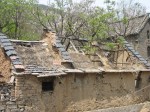
We found the construction of the now crumbling structures fascinating. Most were built of stone from the surrounding hillsides but others were made of brick covered with a layer of some kind of plaster, a building method still in use in this country today. Beneath the tiled roofs was a thick layer of thatch that would have acted as insulation.

After spending a few hours exploring almost every nook and cranny in the village, it was time to figure out how we’d get back to Jinan. According to our trusty Lonely Planet guidebook, there might be a bus that would take us to nearby Mingshui where we could catch another bus back to Jinan. If not, we could walk back to the highway and try flagging down any bus heading back toward Jinan.

As we exited the site, we stopped at the tourist services building to see if anyone there spoke enough English to advise us. Neither of the women on duty did but one of them hustled out to find someone who could. She soon returned with three smiling men. One of them spoke a few words of English but he phoned his wife who was somewhat more fluent and by passing the phone back and forth, we learned that her advice was that we walk back to the highway and flag down a bus. After the gentlemen produced their cameras and had their pictures taken with us, we headed off to do just that.

As we exited the gate, however, we were surrounded by taxi drivers offering to drive us into Mingshui or even the entire 80 km back to Jinan. Of course, they wanted an exorbitant amount in return for their services so we quickly said no and went on our way. I soon noticed that one of the men who’d crowded around us as we talked to the taxi drivers was following us on the opposite side of the road. When we got out of earshot of the others, he crossed the road and told us in broken English that if we would wait for ten minutes while he walked home and got his car, he would drive us to the bus station in Mingshui at no cost! We’ve found over and over again that the Chinese are more than willing to do things like this for us; in fact, they seem to consider it a privilege! As he drove, he explained that one of the reasons that the Chinese love Canadians is because more than fifty years ago, a Canadian doctor helped the Chinese people very much. He was, of course, speaking of Dr. Norman Bethune who died in China in 1939 while serving as a battlefield physician during the Japanese invasion of this country. He is considered a beloved hero to this day.

Though the bus from Mingshui delivered us to an unfamiliar bus station (Jinan has at least three of them) the taxi ride back to our hotel wasn’t much longer than it would have been from the main station where we caught our outgoing bus this morning. Another adventure was complete and our comfort zones, just a little bit bigger! Thank you, Dr. Bethune!