Duck soup and purple bread

A couple of Sundays ago, we went out for lunch with a colleague of ours, a self-professed foodie, and his wife. In addition to eating at a restaurant that they’d found the week before, we also visited a little takeaway kiosk across the street where we were able to buy a whole roasted duck for under $10. This wasn’t just any old duck though. It was Peking duck and came complete with the paper thin wraps and the soy based hoisin sauce that are part of this most famous of Chinese meals.
After choosing our duck, we watched in fascination as the proprietor used her razor sharp cleaver to cut it up and slice the meat into tiny thin slices. In a matter of minutes, she was done and there was hardly any meat left on the bones. We ate well that night and the next and had enough left over to freeze for a third meal at a later date! It was delicious!

The bones also came home with us and went into the freezer. I boiled them this morning and made broth that left the apartment smelling absolutely wonderful. Some of it went back into the freezer to flavour a future rice dish and I used the rest to make soup for tonight’s supper. I love making home made soups. Every one is a little bit different, depending on what ingredients I have on hand. This time, I didn’t even have to worry about adding any seasonings. There was enough of the skin in this morning’s pot to carry the delicious flavour of the seasoned glaze that the duck was coated with before it was roasted through to the soup pot.

At home in Canada, I would probably have made biscuits or corn bread to go with the soup but here I have neither the ingredients or an oven to cook it in. Bread would have to do but tonight’s wasn’t just any bread. The first time we went to the supermarket here, we were fortunate to find a whole grain bread that’s baked on site. We’ve been enjoying it ever since but when we went shopping yesterday, the store was out of it. The time had come to try something new, something that I’d been eying with curiosity for quite some time, purple bread! At first glance, I thought it had bits of nut in it but on closer inspection I realized that it was sweet red bean which would also explain the bread’s unusual colour. Though we’ll continue to buy the whole grain product most of the time, its slightly sweet flavour was a nice change and went surprisingly well with the duck soup.

Charming Chinglish

Unless the weather changes dramatically in the next little while, this may be the first day in over three months that we don’t leave our little 390 square foot apartment! It’s been pouring rain and the wind has been howling all day long. Since we don’t work on Mondays and had nothing more than a trip to the supermarket to pick up a few groceries planned, it’s been a good day to stay indoors catching up on emails, reading, and playing a few games of Carcassonne. I won three in a row! It’s also a good day to reminisce about all the places we’ve explored since coming to China and to share with you some of the great examples of Engrish that we’ve found along the way!

Engrish, or Chinglish as it’s usually called in China, is what often happens when an Asian language is translated into English. You’ve probably seen some of it when you’ve tried to make heads or tails of the instructions that came with something produced in Asia. As a lover of words, I find Engrish highly amusing. I love to visit www.engrish.com, a website that posts one example of Engrish every day but I’m even more delighted when I find my own examples like the ones pictured below.

"Rain and snow carefully slip" appears beside an escalator in downtown Dalian. Richard waited patiently while I rode up and down several times trying to get the best picture possible!

The "Subsea UFO" sign is found in the aquarium that we visited with some of our students. We had no idea what it was referring to and it made absolutely no sense to any of us! Note that it includes the word harmonious which seems to be a very popular one in China. Even the students in my beginner level university class use this word frequently. The concept of harmony is clearly at the core of Chinese thought and culture. Confucius said, " Let the states of equilibrium and harmony exist in perfection, and a happy order will prevail throughout heaven and earth, and all things will be nourished and flourish."

I don’t know how well you can read the sign that we found at the entrance to Fu Jia Zhuang Park but I especially love #3 and #10. #3 reads "Pre-school age child or psychopath should be accompanied by a guardian." I’m having a hard time typing that one without laughing! #10 is longer. It reads "The tourist who suffers from heart disease, epi lepsy, cold, neuroticism, asthma, diabetes, high (low) blood pressure, rhinopharyngitis, earache or getting drunk are not allowed to dive and swim. If the tourist conceals the above-mention situation, he or she is responsible for the consequence if the accident happens."

One of many signs at the North Korean border warned, "Forbidden to cross border in border area." Um… where else might we try to cross it?

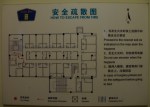
The How to Escape From Fire sign on the back of our hotel room door in Jinan also tickled my funny bone. Fortunately, we didn’t have to proceed to the nesrest exit but we did put on the safeguord before going to bed to prevent burglery from happening.

On our recent walk along the Daxishan Reservoir boardwalk there were many little wooden signs to guide our behaviour. We could figure out the intent of most of them but one was particularly entertaining. We did hold hands but it would have been pretty difficult to walk while holding our feet! The final sign was near the end of our walk. We had to look closely at the little icon to figure out what kind of nuisance people might commit. Believe it or not, though we haven’t actually seen anyone committing that kind of nuisance, we’ve definitely seen evidence of it on some of our walks!

I’m thinking about submitting a couple of these to www.engrish.com. Which ones made you chuckle?

It’s a matter of time

Though China stretches almost as far from east to west as Canada does, it’s exactly the same time in every part of the country!

Canada spans six time zones. When it’s 4:00 o’clock on the BC coast, it’s already 8:30 in Newfoundland. China used to have five time zones but the Communist Party established the country’s present time system shortly after it founded the People’s Republic of China in 1949. Apparently it was supposed to streamline operations and make the country appear more unified.

Personally, I have a problem with this! Dalian is on the east coast where the sun rises earliest. This morning, it came up at 4:36 a.m! I’m not really a morning person but when daylight arrives, I wake up. I’ve done my best to darken our bedroom by taking curtains from the computer room to double the thickness of the ones in the bedroom. It helped a little but not enough and it did nothing to shut out the noise. As soon as it’s light out, vendors begin to set up the morning market below our windows and before long the sound of cars honking and people shouting does away with any chance we might have had of getting a few more moments of sleep.

Of course, the sun also sets earliest here. As Canadians, we’re accustomed to long hours of daylight at this time of year. Back home, the sun isn’t setting until almost 10:00 p.m. but here, it went down at 7:05 this evening.

Apparently China tried Daylight Savings Time from 1986 to 1991 but it was deemed inconvenient and was dropped. Inconvenient for who, I’m not sure. Since the warm weather arrived, we see lots of people out and about enjoying their evenings. Many families from the neighbourhood gather on the plaza in front of the university administration building. Parents and grandparents sit around the perimeter relaxing and visiting while laughing children play. I’m sure that lots of them would happily give up an hour of daylight at 4:30 in the morning in exchange for longer evening light. I know I sure would!

Crossing the road Chinese style

One of the first things we learned when we came to this country was how to “cross the road Chinese style”. Coined by Chinese internet users, the term describes pedestrians who throng together to cross the street where there’s no crosswalk or at marked intersections when the pedestrian lights are against them. There’s safety in numbers was our theory as we attached ourselves to groups of locals to make our way across the busy streets.

Getting to the other side of the street often involves crossing one lane at a time, waiting on the line between lanes until the one in front of you clears. Like the locals, we often cross in the middle of a block rather than at a corner. It’s actually safer and easier than crossing at an intersection where the lights may or may not work and if they do, don’t allow nearly enough time for even an able bodied person to get across before turning red. By far the worst thing about trying to cross at an intersection, though, is the fact that you have to constantly watch for turning vehicles; not just the ones turning right but also those that are turning left! That’s right, the left turn light and the pedestrian light are often on at the same time! We joke that this must be a population control tactic. Send the pedestrians out into the street and then run over them!

Drivers share the road with conveyances of every description including modern buses, bicycles, motorcycles and three wheeled carts that are often so heavily loaded that you can barely see the driver. Some of these are pedal powered and others, fuel driven. These vehicles don’t seem to have any difficulty making room for one another but drivers NEVER give pedestrians the right of way!

Crossing the road Chinese style has been making headlines recently as cities like Beijing and Chengdu have started imposing on the spot jaywalking fines. It hasn’t happened in Dalian yet but we hear rumours that it soon will. Unfortunately, imposing fines doesn’t address the root of the problem.

Until recent years, China was a country of bicycles but automobile sales have soared at a rate of more than 20% per year since 2001 and in 2009, China overtook the United States as the world’s biggest automobile market. Infrastructure simply hasn’t kept up with the ever growing number of vehicles on the road. Here in Dalian, there are pedestrian underpasses in the downtown core
and we’re very fortunate to have a pedestrian overpass joining the north and south campuses of our university which straddles a very busy thoroughfare but many cities lack these pedestrian-friendly conveniences.

Without changes to both driving laws and infrastructure, I don’t see crossing the road Chinese style coming to an end anytime soon.

My love/hate relationship with Chinese food

Simply said, Chinese food is delicious! Absolutely delicious! In the past three months, I can only recall one dish that we didn’t enjoy. It looked tasty and there was nothing wrong with the flavour but it consisted mainly of gristle on bone. We didn’t know for sure what it was but we called it knuckles because that’s what it most resembled!

There are a myriad of tiny restaurants within a few blocks of our apartment where we can easily buy a meal for the two of us for significantly less than $10. If we weren’t as health conscious as we are, it would be easy to eat out even more often than we do, especially considering the limited cooking facilities we have here at home.

China is a huge country, of course, and cuisine varies from one region to another but in general, a Chinese diet is heavy on rice and noodles. We do our best to balance the carbs with healthy amounts of meat and vegetables but there’s not a lot we can do about the fact that almost everything seems to be cooked in oil.

I know that there are healthy and not so healthy cooking oils but then there’s Chinese cooking oil! The following is a direct quote from our trusty Lonely Planet guidebook. Be forewarned! If you have a delicate stomach, you may not want to read it!

"In 2010, diners in China were appalled to discover that one in 10 meals cooked in Chinese restaurants was prepared with cooking oil dredged up from sewers and drains. Oil is lavishly employed in Chinese cooking and generates considerable waste.

This waste oil is harvested by night soil collectors who scoop out the solidified oil from drains near restaurants and sell it. The oil is then processed, sold to restaurant owners and it re-enters the food chain…

Once used again, there is nothing to stop the waste oil from being harvested afresh for further recycling. At present, no regulations preventing the recycling of waste oil exist in China."

Yum!

Food scandals abound in China. A couple of them have made headlines in China Daily, the English language newspaper that we read regularly. Several food stores in Shanghai have been temporarily or permanently shut down for selling fake mutton made from fox, mink and rat meat! We’re a long way from Shanghai and I don’t care much for mutton so we’re not likely to be affected by that one.

We watched with great interest when a restaurant below our window underwent a complete makeover recently and we looked forward to stopping in for a meal when it opened for business. Even after one of our students told us that the sign indicated that it served "everything from a sheep" we thought we’d give it a try but they lost me with the severed goat’s head! It was on display on a table out front one morning when I visited the street market and it remained there all day! Though I was tempted to take a picture, I didn’t, so you’re spared that gruesome sight! It seems to have been effective advertising though. The restaurant has been doing such a booming business that they’ve erected some temporary shelters on the sidewalk across the street and serve their overflow customers there. When we go to bed at night, there are still patrons enjoying whatever it is that they serve!

Then there’s the tainted rice scandal that hit Guangdong province recently. An inspection campaign found that the cadmium levels in six batches of rice and two batches of rice noodles produced in two different factories exceeded national standards. Cadmium is a carcinogenic substance often used in fertilizer. Fortunately, no cadmium poisonings have been reported.

Armed with this kind of information, how can we stand to eat at all? It’s easy… as I said, the food is absolutely delicious and miraculously, my somewhat finicky stomach hasn’t bothered me a bit since we arrived in China! If we are what we eat, I guess we’re a little bit gross right now but I keep telling myself that we’re only here short term and that our bodies will clean themselves out when we get home.

Yes, I definitely have a love/hate relationship with Chinese food!

Second wind

A few days ago, I was ready to write a post called Growing Weary but it didn’t happen because I was too tired to write it! It’s probably just as well as I would likely have grumbled and complained unnecessarily.

We don’t, even for a moment, regret coming here. It’s been a fabulous experience and very good for both of us but living in a completely foreign environment where you don’t understand the language or the culture can be exhausting. China is a rapidly developing country where we see change happening all around us but the standard of living is still far below what we’re accustomed to and it’s easy to start finding fault, especially when you’re tired.

I had three goals for this month:

  • Complete and submit the annual reports that are required of me as Missions President for my church back home, a position that I’ve been filling from a distance since coming here in February.
  • Make up the final exams for my university courses.
  • Plan the trip that we want to make through China after our contract expires at the end of June and make arrangements for our return trip to Canada.

The past couple of weeks flew by as I fought with our frustratingly slow and undependable internet to send and receive emails, spent extra hours at the school photocopying, cutting and pasting (the old fashioned way with scissors and glue) and gradually crossed things off my many lists. As a result, the Missions reports have been submitted and the final exams are ready to be handed over to the office staff who will photocopy them for me.

I’m most excited about our travel plans. I usually do all our trip planning myself but this time we’ve decided on a tour. It won’t be the sort of thing where we pile off a bus and follow a flag waving tour guide through all the designated sites however. Instead, someone else is making all the travel arrangements and reservations for us and we’ll have our own driver and/or guide at each location along the way. I’ve been working closely with the travel agent to assure that the tour includes the things we most want to see and do. To date, 32 emails have passed back and forth between us! This a more expensive way to travel, of course, but in a country where there’s so little English and where we’ve discovered that doing things on your own always takes much longer than you expect, this will be a much more relaxing way to end our time here and we’ll actually be able to see and do a lot more than if we were doing it on our own. I won’t go into details at the moment but the tour begins in Beijing, includes a luxury cruise on the Yangtze River and ends in Shanghai where we’ll spend a weekend with Japanese friends who live there before we fly back to Canada. That’s definitely the icing on the cake!

I’ve discovered that even this kind of travel planning isn’t completely stress free. Most of these tours are booked by overseas travellers who pay in American dollars but we wanted to pay in Chinese currency. That meant that our money had to go into a different account than theirs but when the travel agent sent me the information that I’d need to take to our local Bank of China branch to pay our deposit, she inadvertently gave me the wrong account number. With extremely limited English, the bank clerk managed to communicate that there was a problem and that I couldn’t make the deposit. A couple of emails between the travel agent and I sorted that out and it took a second visit to the bank but the deposit has now been made and we’re waiting for final confirmation of all the travel arrangements.

Other than booking the tour, all I had to arrange were our flights from Dalian to Beijing and from Shanghai back to Canada. Even that was stressful though, especially when I discovered how much the prices have gone up since we crossed the ocean in February. Yikes! The completion bonus that we’ll receive at the end of our contract was supposed to cover the cost of our flight home but it definitely won’t. Oh well, going home isn’t optional so the tickets have been purchased anyway.

The beautiful month of May almost slipped away while I was busy with all of these concerns but now that my goals have been met, my weariness has also passed and I seem to have my second wind! Our university classes end in just over two weeks and then our not very heavy teaching schedule will be even lighter. I think the time has come to sit back, relax and coast a little as we enjoy our final weeks here!

Field trip!

Spring… the time of year when teachers often take classes on field trips.

Imagine a field trip where the pupil teacher ratio is 1:1. Now imagine that there are only 4 students, all girls and that they’re in their late teens! I’m sure my Canadian colleagues who are busy herding groups of 20 or more children through museums, historic sites and other educational venues would have seriously envied us today!

This afternoon’s Class A field trip was a "western picnic" partially planned by the girls themselves. We rode the bus to beautiful Children’s Park. I’m not sure why it’s called that. It was occupied mainly by seniors including some in wheelchairs who appeared to be on outings from a nearby care centre, and other than a small playground/amusement park area in one corner, there wasn’t anything specific to appeal to children. It was, however, a lovely spot for a picnic.

In addition to teaching them English, we’re also trying to introduce our students who plan to study abroad to western culture so our menu didn’t include any Chinese food. Instead, we ate sandwiches, potato chips, cookies and miniature chocolate bars. If we could have, we would have introduced them to s’mores but even Carrefour, the French department store that carries some import foods, didn’t have the ingredients nor did we have anywhere to roast the marshmallows.

After lunch, we had a photo scavenger hunt. Each student/teacher partnership had eleven items to find and photograph. The list was, of course, in English. Finding "something fuzzy" is a challenge if you don’t know what the word fuzzy means! I explained to my partner that it meant soft, like an animal’s fur and we set off to see if we could find the cute little puppy that had passed by while we were eating. It was nowhere to be found and I was very proud of Sheila when she spotted the poplar fuzz gathered along the edge of the sidewalk and asked, "Is that fuzzy?" We were the last to return to the starting point with our list completed but we were declared the winners because our pictures were the best! Yay!

Next came a word game. Each of us was shown a word but one person’s was different from everyone else’s. Without giving away it away, we had to take turns saying simple sentences about the word until we could guess whose was different. With word pairs like shampoo and conditioner, bread and cake, and orange and tangerine, it was tricky and the girls had to think hard to come up with good sentences. There was lots of laughter and good-natured bantering and though the senior ladies sitting near us had no idea what we were saying, they clearly enjoyed watching the girls’ enthusiasm.

Yes, this was definitely the most relaxing field trip I’ve ever been on!

The pattern of snack

Have you ever noticed how often we use the word usually? I hadn’t until I came to China to teach English and immediately noticed that the Chinese always say urally! I have no idea how the r sound crept in but apparently that’s the way all Chinese English teachers teach it. Wrong habits are hard to break and our students still need to be reminded once in a while but after lots of practice they do know how to pronounce it correctly now.

Though urally was one of the most common mistakes made by our students, who have never been taught by native English speakers before, we have encountered many other mispronunciations. Vowel sounds are particularly difficult. It isn’t any wonder considering the fact that one little letter like an a or an o can represent so many different sounds. Sometimes these mispronunciations lead to a complete lack of understanding but we also have a lot of fun with them.

Early in the term, one of my students told me that he liked eating snakes! I clearly remember being somewhat startled but this is China, after all! We’ve eaten bullfrog and catfish, restaurants serve silkworms and there’s one not far from here that specializes in donkey meat, so why not snakes? When I attempted to clarify, however, I discovered that he actually meant that he liked eating snacks! As it turns out, the snake/snack confusion is a common one and has led to lots of laughter in our classes!

Is it any wonder then that the headline "Snacks Dominate the Fashion World of This Early Spring" caught my eye when I picked up the April issue of Sichuan Airline’s in-flight magazine on our recent trip to Jinan. The magazine is published in Mandarin but some of the articles are translated into English. Clearly, they could use a more qualified translator but this particular article was hilarious! Here’s just one tidbit:

"It is the year of the snack, patterns of reptile animals have crawled back to the fashion world of women’s wear in spring and summer, among which the pattern of snack turns out to be the most popular. It seems like designers have already foreseen that the pattern of snack would be a fashion trend, this eye-catching animal pattern is now seen in all fashion fields."

The article was accompanied by photos of clothing with a snakeskin motif as well as snakeskin purses and shoes!

I haven’t been following most of my favourite fashion blogs lately because both WordPress and Blogspot are blocked in China. It’s also been several months since I’ve seen a fashion magazine so I don’t know whether or not snakeskin has caught on as a new fashion trend in North America. I haven’t actually seen it being worn here yet but for those who want to know, apparently the pattern of snack is the newest trend!

Looking for peace and quiet

Chinese people tend to be quite loud and there are a LOT of them so this is definitely not a quiet place to live! The streets below our building are usually a beehive of activity. We jokingly call the scene outside our windows our reality show as there’s always something interesting to watch. Because the building has little or no soundproofing, the show comes complete with sound and now that the weather has warmed up and we often have the windows open, the volume has been turned up. Once in awhile, I wake during the night and marvel at the silence but sometimes there are people shouting or horns honking even in the wee hours.

When I was a child, if we asked my father what he wanted for his birthday, Father’s Day or Christmas, his answer was always the same. "Peace and quiet!" I must have inherited my appreciation for quiet places from him. It’s not easy to get away from the hustle, bustle and noise that surrounds us here but we did find a couple of slightly more peaceful places this weekend.

Yesterday afternoon, we visited the Dalian Botanical Garden with one of my university students. Chinese gardens, like Japanese, tend to be landscape style gardens that include one or more ponds, rock works, trees and gazebos or pavilions connected by winding paths. Though there may be flowers, they aren’t the main focus. The Dalian garden is on the outskirts of the city and surrounds a very large pond that is obviously well stocked with fish as there were many people with lines in the water. It was a beautiful Sunday afternoon and also Mother’s Day so there were plenty of families enjoying the park but in spite of that, there was a sense of peace that isn’t easily found here.

Today, we spent a couple of hours strolling along the boardwalk that skirts the Daxishan Reservoir, not too far from here. Though we were never far from the sound of traffic and there were others also out enjoying the walk, it wasn’t crowded. Again, there was a very welcome feeling of peace.

My name is Guang

Richard and I are still somewhat uncomfortable with the fact that our students are required to use English names at school but I find the stories behind these names fascinating. Many were simply given them by their first foreign English teacher while others chose from a list of names when they first came into the school to register for classes.

Some choose a name that sounds similar to their Chinese name. Bradley’s real name is Li Borou. According to Chinese tradition, his family name comes first but reversed, it would be Borou Li which sounds a bit like Bradley. Now that he’s considering going to Canada to study, however, he’s concerned that Bradley Li (pronounced Lee) will sound odd so he has started signing his name, Brad Li.

Others are influenced by the entertainment world. Grace chose the name of a favourite character in an American television drama and was tickled to discover that I have a fondness for the name because it was also my grandmother’s.

Big Jacky, easily the tallest Chinese person I’ve ever seen, is class monitor for one of my university classes. His duties include stopping by the office when he arrives to pick up the key and unlock the classroom. He also insists on carrying my books up to the sixth floor for me every time! When I asked him how he got his English name, he explained that he’s a fan of Hong Kong actor and martial artist, Jackie Chan, who was actually born Chan Kong-sang.

Sissi (pronounced Cee Cee) was a nickname given to one of Richard’s students by her grandmother when she was just a little girl. Since it’s easy for even we foreigners to pronounce, she decided to use it instead of adopting a different English name. I think it suits her.

One of the most unusual names we’ve encountered is Dragon but his choice made perfect sense once he explained it to me. Apparently his Chinese name means little dragon.

Their English names aren’t particularly important to most our university students who are simply taking an English course because it’s a graduation requirement. When the year is over, many of them will never use the name again. When they wrote their midterm exams, I discovered that Patricia didn’t even know how to spell her English name! It’s a different story for our students who are preparing to study overseas, however. Recognizing that they will be using this name for several years, possibly the rest of their lives for those who dream of making Canada their permanent home, some of them aren’t satisfied with a name that was chosen hastily or thrust upon them by a teacher they’d only just met. Stacie is such a student. Last time I talked to her, she was considering becoming Monique!

Our school isn’t the only one that requires its students to choose an English name. Apparently this is common practice across China. When we met Michael, one of our "angels", in Jinan last week, I asked him how he got his English name and he explained that he’s a fan of both Michael Jordan and Michael Jackson.

After hearing many of these stories, I began to wonder what I would do if I had to choose a Chinese name. I’ve always been fascinated by the meaning of names so I wondered if my name, which means shining light, might have a Chinese counterpart. Over lunch one day, I asked some of our students if they knew of a Chinese girl’s name that meant light. Sure enough, Sissi told me that her mother’s name, Guang (pronounced Gwong), was the one I was looking for. Though no one actually calls me by this name, I’ve decided to adopt it as my Chinese name. I even like the look of its Chinese character. It reminds me of a burning candle or a lighthouse.

Since Chinese women take their husband’s family name when they marry, I guess I’m actually Meng Guang because Richard’s Munchkin class (his 12 year olds) recently decided that he should have a Chinese name too. They dubbed him Meng Fei, naming him after a popular TV anchorman who gained nation-wide fame as host of the popular blind date reality show "If You Are the One"!