Things are different here!

We’ve spent quite a bit of time in Asia over the past few years. As a result, we haven’t really experienced culture shock since arriving in China but there have definitely been some surprises. In no particular order, here are a few random differences that we’ve noticed so far.

  • Waking up in the middle of a densely populated city and hearing a rooster crow! We haven’t figured out where the rooster resides but we did see a chicken wandering beside the street one day. I wonder if it ended up in someone’s cooking pot?
  • Two or more girls walking arm in arm or holding hands. This is extremely common amongst women of all ages and is nothing more than a sign of friendship. I quite like it.
  • Spitting! Everywhere. All the time. That I don’t like! The spitting itself is bad enough but it’s the loud hawking up of phlegm that precedes the shot that really gets me. I have to constantly remind myself that these people (men and women) aren’t being intentionally rude or gross. This is simply an accepted practice in their culture. I must admit to giving the man who nearly hit my shoe at the street market on Sunday morning a very dirty look though!
  • Using paste to attach a stamp to an envelope. I still chuckle when I think of the expression on the face of the post office clerk when I licked the back of a stamp the first time we mailed something! He hastily pointed to the pot of paste and the worn out brush that I was supposed to use to apply it to my stamps. I’ve been careful to do it the right way ever since even though it doesn’t work half as well as licking the stamp!
  • Toilet paper without a cardboard core. You can buy it with the core but it isn’t as common and since we have nothing to hang the roll on, it isn’t needed. Also, when the roll gets small it fits easily into a coat pocket or purse which is very handy considering the fact that toilet paper isn’t provided in public bathrooms including the ones at the school.
  • People burning stuff whenever and wherever they choose. I was about to hang some towels out to dry one morning last week when I noticed a group of men burning a large pile of trash directly below our window. The fire smouldered all day while the towels dried indoors!
  • I’m not sure what the law says but in practice, pedestrians DO NOT have the right away in Dalian and since parking on the sidewalks is commonplace, one needs to be constantly vigilant while walking. We take our life in our hands each time we cross a street!
  • The city employs an army of street sweepers. Dressed in green and yellow, they use straw brooms to sweep the gutters and gather up the ever present garbage. Their efforts seem somewhat futile as people think nothing of throwing more trash on the ground.
  • In an environment where cleanliness doesn’t seem to be a priority, who would have expected to find scented kleenex? I’m not sure if all the tissues here are perfumed but the ones we bought have a lovely lavender scent! Richard doesn’t particularly care for them but I think they’re great. He may suggest that we look for unscented ones next time but since we can’t read the labels, he could be out of luck!
  • Many of the vehicles on the road are made by North American, European or Japanese manufacturers and look just like the ones we’d see at home but some are also manufactured by Chinese companies. It’s the three wheeled ones that make me giggle every time I see one! They look like Mr. Bean should be behind the wheel!


Always a teacher!

As much as Richard and I have been enjoying retirement for the past few years, we’re definitely having fun being back in the classroom this term. The job isn’t exactly what we expected but in some ways, I think its even better than what we anticipated.

We were hired to teach at the School of Continuing Education at Liaoning Normal University where all of the students are required to take one year of English. They have the option of taking it from a Chinese professor during their regular school day or they can pay extra to take it from us. We teach our university level classes during the evenings and on Saturday mornings.

I have two university classes with 27 to 30 students in each one. Teaching a foreign language to that many students at once is difficult but student motivation is probably a bigger factor in whether or not they succeed. Since attendance accounts for 50% of their final mark, working hard in class isn’t a high priority for many of them. Add to that the fact that, on most days, they come to a two hour class at 6:30 p.m. after having been in school since 8:00 a.m. I can hardly blame them for not being overly enthusiastic!

My university classes are very different from one another. One is made up entirely of students who are art, music and phys ed majors. In spite of the fact that they started learning English in third grade, their knowledge of the language is weak and prying spoken English out of them is like pulling teeth. The other class is made up of academic students who have a much higher level of English. The majority of them are somewhat fluent and they participate well in class discussions.

There are only twelve students in Richard’s university class but their level of English is more varied which presents different challenges in teaching them. Instead of a second university class, Richard spends two evenings a week teaching a class that has become fondly known as the Munchkins. This is a new course made up of 11 and 12 year olds who participated in an English camp put on by our school last summer. The camp was such a success that the parents, who are obviously very keen on having their children learn English, asked for a continuing class for them. Thus the Munchkin class came into being last fall. As a well seasoned grade 5 teacher, Richard was the obvious choice to teach them this term.

We also have two small classes of high school graduates who are spending a year in English immersion in preparation for going to college in Canada or the US. In order to qualify to do that, they must achieve a high score on the very rigourous IELTS (International English Language Testing System) test which is made up of four components; reading, writing, listening and speaking. Richard teaches Reading and a course known as Pronunciation and Idioms to the 7 students in Class B while I teach Reading and North American Geography to the 5 students who make up Class A.

Class A is without a doubt my favourite part of the job. These kids, who range in age from 17 to 23, are absolutely delightful. They are the ones who are eagerly taking advantage of every opportunity to spend time with us outside class soaking up the language and trying to learn as much as they can about our lifestyle and culture. In addition to being our students, they are quickly becoming our friends.

Though it may sound as if we’re very busy and though we do have classes at various times between 8:00 a.m. and 8:30 p.m. five days a week, our actual time in the classroom is equal to approximately a half-time teaching assignment in Canada. There’s preparation and some evaluation on top of that, of course, but all in all it’s a pretty sweet retirement project!

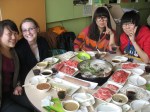
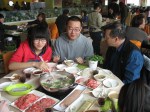
(Pictured below: our first meal with some of my A students. Known as hot pot, we cooked various meats, tofu and greens in the steaming broth in the centre of the table. It was delicious! The young Caucasian gal is Courtney, the only young teacher on our staff of six. The rest are golden oldies like us.)