Sayonara sale

I put up the first poster for our sayonara (good-bye) sale at one of our main schools today. Unlike some of our colleagues, we chose to live a very minimalist lifestyle this year so that there wouldn’t be a lot of stuff to get rid of at the end of our contract. We do have a few items to find new homes for, however.

Within minutes of the sign going up, one of our fellow teachers had spoken for my bike. She’s in no hurry to get it from me so I’ll use it for a couple more weeks before turning it over to her. I’ve often thought that if these bikes could talk they’d have interesting stories to tell. As teachers come and go, bicycles commonly pass from one to another. We have no idea how many previous owners ours have had.

In addition to the bikes, we have a very compact and sturdy computer desk to unload. We bought it at the nearby recycle store so, if we don’t find a buyer for it, it will likely end up back there. We also have a 15 inch flat screen computer monitor. I’d actually like to take that home with us but I suspect that there won’t be enough space in our luggage for it. Hopefully someone will want the computer speakers, the small oscillating fan and the folding canvas chair that we also bought second hand.

Since the sale is all about getting rid of stuff and not about making money, we’ve priced the items very reasonably. In fact, we plan to give some of them away.

There are three of us on staff who are finishing on the same day so I suspect that there will be some new teachers arriving before we depart. Hopefully they’ll be interested in having some of the things we need to get rid of. We aren’t supposed to leave anything in the apartment that wasn’t here when we moved in but I have snuck a few extra dishes and utensils into the kitchen cupboards that I know the next occupant will need. The contents of the cupboards aren’t itemized on the apartment inventory so I’m sure that leaving them there won’t be a problem.

Wow!  In some ways, the year has really flown by.  It doesn’t seem that long ago that we were setting up home and buying the items that we’re now ready to get rid of!

Beginning the long good-bye

I attended my last ladies meeting at Hope Church this morning.  We usually meet the second and fourth Wed. of each month but, since Feb. 11 is yet another national holiday in Japan, there won’t be a meeting that day.

Our contract expires on Feb. 21 and we’ll move out of our apartment and fly to Hong Kong on Feb. 25.  It had been our original intention to fly directly back to Canada from there but recent changes to airline regulations have severely restricted the amount of luggage allowed on flights within Asia.  Instead, we’ll leave the bulk of our stuff with a fellow teacher who lives a few blocks from here and return to Japan for two nights before finally heading for home.

We’ve alerted our adult students to the fact that we’ll be leaving soon.  While they’re only guaranteed the same teacher for one six month term, we’ve been teaching most of them for ten months now.  Clearly, they have enjoyed their time with us and are sad to see us go.  It will be difficult to say good-bye to them and seeing some of my littlest students for the last time is something I don’t even want to think about.

After this morning’s meeting, it was announced that I would be leaving soon and the women gathered around me for a time of prayer.  The news came as a surprise to some of them.  The year has gone so quickly!

We’re excited about going home, of course.  We miss friends and family and there’s a certain little grandson who is threatening to take his first steps before Gram and Grandpa have a chance to meet him!  On the other hand, it’s difficult to say good-bye.  When I look across the church and catch Amu-chan’s eye, he gives me a huge smile.  He’s my “adopted” Japanese grandson and I won’t get the opportunity to watch him grow up.  Being a part of Hope Church for the past ten months has been an amazing blessing to us and we will miss the people there.

On a whole, this year has been a great experience and in spite of the fact that we’ve begun the long good-bye, it isn’t over yet.  Hopefully there are still a few exciting moments out in front of us!

Staying warm

It snowed a little around noon today. It didn’t last long but it created a bit of excitement for a few minutes. With the exception of the occasional really warm day like yesterday, the daytime temperature has probably averaged around 6C lately. It’s a much damper cold than we’re used to back home in Alberta, but it’s definitely warm in comparison. I walked home from work this evening with nothing on my head and I haven’t needed more than my little knit gloves to keep my hands warm all winter.

Staying warm indoors is where the real challenge lies. Like most Japanese buildings, ours has no insulation and no central heating. Considering how concerned the Japanese people are about global warming, it surprises us that even most newer buildings are not insulated.

We have three main sources of heat. A built in unit in one corner of the kotatsu room functions as an air conditioner in the summer and a heater during winter. It provides enough heat to keep about half of that room at a comfortable temperature. An oscillating electric heater in the corner of the tatami room does a pretty good job of keeping that room warm when we’re in it. By far the best source of heat, however, is the portable kerosene heater which we keep in the corner of the kitchen by the doorway to the kotatsu room so that we can turn it toward whichever room we’re using at the time. Unfortunately, it isn’t thermostatically controlled so we have to turn it off when the room starts to get too warm and the temperature starts dropping almost immediately. As a result, it’s impossible to keep the apartment at a steady comfortable temperature.

We’ve heard of a number of foreigers who are afraid to use their kerosene heaters but we use ours all the time. We run the kitchen fan for a short while when we first turn the heater on and again when we turn it off. The rest of the time, there’s no smell of kerosene at all. We keep a 10 litre jerry can of fuel out on the deck and Richard takes the removable fuel tank out there to refill it. Every Thursday and Friday morning, the kerosene truck makes it’s way up and down the streets of our neighbourhood. We always know when it’s coming as it plays a distinctive tune that can be heard well before it gets here. Right now, we’re going through a can of fuel a week. Lately, the price has been under 70 yen/litre but it has been as high as 110. (We used to think 100 yen to a Canadian dollar but at the moment, it’s more like 72 yen/dollar.) Apparently kerosene is a little bit cheaper at the gas stations but since we don’t have a vehicle and there isn’t a station close by, we’re happy to pay a little bit extra for the convenience of home delivery.

We have two other sources of heat. The first, which is uniquely Japanese, is the kotatsu, the low table where we eat all our meals. It’s frame is covered by a quilted futon upon which the table top sits. A heating coil is built into the table frame itself and keeps our legs comfortably warm while dining.

When winter came, the school provided us with electric blankets. They enable us to stay warm and cozy all night without running any heaters. By morning, the temperature in the apartment is often around 10C so as long as one of us, usually Richard, crawls out about an hour before we actually have to get up and turns the heaters back on, we’re okay. We turn them off again when we leave for work. By the time we get home, it’s once again somewhere around 10C in here. I refuse to take my coat off until it has warmed up to 15C so I often start cooking dinner with my jacket still on! My students tell me that February 3 is considered the end of winter and beginning of spring, however, so in spite of today’s snow, we should begin to see warmer conditions soon.

Old favourites

Some of you may remember that several months ago I wondered if my shoes would last until our year in Japan was over. If I had to replace them here, my options would be very limited because my feet are huge compared to those of most Japanese women. With less than two months to go, however, it looks as if I have nothing to worry about.  One pair of dressy flats has pretty much had it but the others are all holding up well.

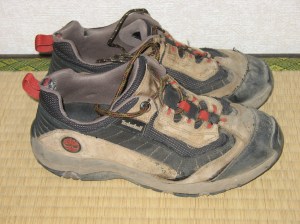
The black oxfords that Richard brought with him to wear to school disintegrated  fairly early on but he had no problem replacing them.  It’s his running shoes that have become a source of merriment.  He came to Japan with two pairs.  One pair was already well worn but the others were brand new.  Shortly after arriving, he bought a third pair, mainly because they were name brand shoes on sale for an price that was irresistible.  So why, I ask myself, is he still wearing the old worn out pair when there are two pairs in the cupboard that have never been on his feet except in the shoe stores?

As we headed out the door on our way to church this morning, I mentioned that perhaps his old favourites were a bit too shabby and he should consider wearing one of the new pairs.  He wouldn’t hear of it, however, so off we went.  As we headed down the street, I realized that with each step, I could see two gaping holes opening and closing in the side of one of his beloved shoes!  I laughed until tears rolled down my cheeks and that’s when I felt this blog coming on!

The old favourites have served him well.  They’ve  walked the streets of five countries and been to the top of Mt. Fuji.  They still have the dust of Vietnam and Cambodia on them.  I really think it’s time to retire them but now he’s threatening to take them back to Canada when we go!  I don’t think so!

the old favourites

the old favourites

Karaoke!

Shortly after arriving in Japan last year, I came across two interesting lists – the top 10 sights to see in Japan and the top 10 ways to get under the skin of the country and the people. Between our first visit to Japan in 2005 and having now lived here for the past ten and a half months, we’ve managed to take in 7 of the top 10 sights. Distance will probably prevent us from getting to the remaining three.

Last night I also reached number 7 on the second list when I went to karaoke with four of my adult students! Though I’ve never been to karaoke in North America, I understand that it’s usually very different from Japan. Here you don’t perform in front of the general public. Instead, a karaoke establishment looks much like a hotel with individual rooms for private groups.

It was a fun and relaxing evening – just five women letting their hair down and having a good time together. There were two huge catalogues of songs to choose from – one English and one Japanese. I sang English songs, they sang Japanese songs and we all sang English ones together. We sang solos, duets and group numbers. I sang everything from Puff the Magic Dragon (a childhood favourite) to Leaving on a Jet Plane and Bridge Over Troubled Water (songs from my youth) to Amazing Grace! I was also the lead singer for a rousing rendition of Jambalaya.

The room was cozy and comfortable with couches surrounding a table that was soon laden with food. We ordered the meal when we arrived and it was delivered to the room. Whenever we needed anything, all we had to do was pick up the phone and ask.

I understand that Edmonton now has a few karaoke establishments that offer private rooms. Hmm… maybe we’ll have to investigate. I can definitely visualize my girlfriends and I whiling away an evening in such a place on our annual Christmas shopping weekend in the city. What do you think, girls?

Seijin no hi

Today is Seijin no hi, Coming of Age Day, in Japan. Until recent years this national holiday fell on January 15 but it’s now celebrated on the second Monday of the month. Twenty is the age of majority in Japan; the age at which a young person can begin smoking, drinking and voting. Though they legally come of age on their birthday, local governments hold special ceremonies on Seijin no hi to honour all those who have turned or will turn twenty during the current school year which runs from April to March. During the ceremony, local officials give speeches and those who are being honoured receive small gifts. This is a very formal occasion. Young men usually wear suits and women often dress in kimono. Parties with friends often follow the ceremony.

We went into Tokyo after church yesterday to have lunch with Matt and Robin’s friend, Kumiko, who is visiting from Kyoto. Though it’s not unusual to see a few women out and about in kimono, we saw many more than usual yesterday. Kumiko told us that families were probably celebrating the coming of age of their children.

For us, today is just another work day. We often work on national holidays and receive other days off in lieu.

Cambodia

We’ve been home for almost a week already so it’s time to try to wrap up this travelogue. We flew from Saigon to Siem Reap, Cambodia on Jan. 3. After purchasing our visas and making our way through immigration, we took a taxi into town. The guest house where we had hoped to stay was full so our taxi driver suggested another one that was nearby. It wasn’t much more than a roof over our heads but it had a warm shower, the staff was friendly and for $12 US/night, we couldn’t complain.

The guest house hooked us up with Tiger, a young tuktuk driver who pretty much became our personal chauffeur. A tuktuk, a small trailer pulled behind a motorcycle, is a fun and inexpensive way to travel and see the sights. For $20 US, Tiger would tour us around to all the Temples of Angkor, waiting at each spot for as long as we wanted to explore. Since one day tickets go on sale at about 5:00 p.m. the day before and can be used that evening, he took us out to the ticket booth on the way to the temples in time for us to be the first in line and then to Phnom Bakkheng, the first of Angkor’s several temples and a popular hilltop location from which to watch the sunset. It was too cloudy for that but we did catch our first glimpse of Angkor Wat in the dying light and also enjoyed looking out over the dense jungle.

On the way back to the hotel, Tiger recommended a nearby restaurant so we went there for dinner. The food was delicious but the service very slow, something we quickly came to expect. We returned to the hotel for a drink in the rooftop lounge then went to bed early so that we could get up at 4:30 a.m. and be out at Angkor Wat in time to see the sunrise over its towers. Again,img_3476 there was just enough cloud that we didn’t actually see the sun break over the temple but we did enjoy watching it emerge from the early morning darkness. After breakfast at a nearby restaurant, we began exploring.

What impressed us most was the sheer immensity of the ruins. Between the 9th and 13th centuries each Cambodian god-king strove to build a temple that would better those of his ancestors in size, scale and symmetry. Angkor Wat, the world’s largest religious building, was the culmination and is a source of inspiration and national pride for a country that is trying to rebuild after years of terror and trauma.

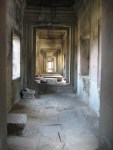
img_3486 img_3514 img_35171

img_3521 img_3523

After exploring Angkor Wat itself, we moved on to the ancient city of Angkor Thom. Within it’s more than 12 km of walls that are 6 metres high and 8 metres thick, are found several interesting structures including it’s temple, Bayon. There, 216 gigantic faces of the god, Avalokiteshvara, watch over visitors and bas-reliefs incorporating some 11 000 carved figures depict vivid scenes of life in 12th century Cambodia.

img_3564

After exploring a number of the structures within the walls of Angkor Thom, we took a quick look at Ta Keo, a massive temple that was never finished possibly due to the death of the king. It’s lack of carvings was a stark contrast to the elaborate detail of the others.
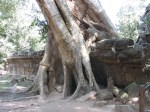
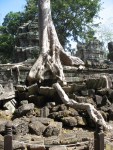
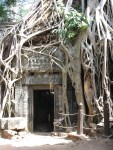
img_3615Another fascinating temple with a difference was Ta Prohm. While the other monuments of Angkor have been carefully preserved with a massive ongoing program to clear away the ever encroaching jungle, Ta Prohm has been left untouched. Gigantic tree roots twist their way through its stonework as the surrounding jungle strives to reclaim it. In recent years, it has been used as a set for movies such as Tomb Raider.
img_3628 img_3635 img_3642

That evening, again on Tiger’s recommendation, we had dinner at a large restaurant with a huge buffet where we also had the opportunity to enjoy traditional Cambodian music and dancing.

We weren’t in Cambodia long enough to get much of a feel for the country but, if anything, it appeared that there was even greater poverty there than in Vietnam. The infant mortality rate throughout most of the country is close to 10% and there are a number of orphanages just within the Siem Reap area. Outside every temple, visitors are bombarded by women and children selling all manner of things including books, postcards, silk scarves and tablecloths, and bead bracelets. Though some are so persistent that they are downright annoying, it’s difficult to ignore their pleas when we have so much and they have so little. Though we did purchase one book, we chose other ways to try to make a small difference.

After going out for a hearty breakfast the next morning, we checked out of the guest house, stowed our luggage in their office for safekeeping and took a tuktuk across town to the Kantha Bopha Pediatric Hospital to donate blood. Please don’t panic! Conditions were sterile and everything was done in much the same way as it would be done at home. One of three such hospitals in Cambodia founded by a European doctor and funded entirely by donations, this hospital has successfully reduced the infant mortality rate in the Siem Reap area to approximately 2%. Here are a few other fascinating statistics concerning the three hospitals: 600 000 visits by sick children, 55 000 hospital admissions, 9000 surgical operations, 100 000 vaccinations and 5500 births each year. All of these services are provided free of charge.

Early January in Cambodia feels much like early July in Canada. The day was hot and sunny so we decided to walk all the way back to the guest house. At one point, we became hopelessly lost in a maze of narrow streets on the outer edge of town. They were really nothing more than dirt paths and the locals looked at us with some curiosity. I’m sure not many tourists pass their way! Fortunately, before wandering for too long, we spotted the red roof of the guest house in the distance and found our way back.

Massage parlours abound throughout southeast Asia and, in many cases, these shops provide employment for the blind so we decided to indulge ourselves once again with full body massages in one of these establishments for a cost of just $5 US each. They weren’t the best massages we’ve ever had but it was a relaxing way to end our visit.

After a quick lunch, it was time to meet Tiger back at the guest house for our final tuktuk ride out to the airport. We flew back to Saigon where we had a four and a half hour layover at the airport and then from there, back to Japan arriving very early the next morning. We managed to get some sleep on the plane and had a full day to rest before going back to work the following day.

Saigon for New Years

img_3382The night bus from Hoi An to Saigon was a little more comfortable and spacious than the one from Hanoi to Hoi An had been. The front half of the bus had seats like any other tour bus and the back half was double wide berths for sleeping. Since we expected to be on board for 24 hours with only two one hour breaks, we were pleased to see this. We were delayed by a flat tire sometime during the night, however, and 24 hours stretched into 26 with only a few quick bathroom stops and one half hour break for a hot meal.

We finally arrived in Saigon, or Ho Chi Minh City as it’s officially known, at about 8:00 p.m. on New Years Eve. We hadn’t been concerned with reserving a room because we knew that there were many small hotels in the downtown area where the bus would drop us off and we’d been assured that since Vietnam celebrates the lunar New Year later in January or February, there wouldn’t be a problem. Arriving as late as we did, however, it soon became apparent that this was not the case. As we wandered from hotel to hotel hearing “Sorry, we’re full” time and again, we began to wonder what we’d do if we didn’t find a room! Fortunately, we came across a very helpful desk clerk at one of the hotels. Though his establishment was full, he called another hotel and confirmed that they had a room available. At $45 US/night, it was significantly more expensive than what we’d become accustomed to paying but we reminded ourselves that this was still pretty cheap for a hotel room and it was nicer than most we stayed in. It was also located within easy walking distance of the all things we wanted to see. I think perhaps the real reason we ended up there, though, was the fact that it came with a large fan. As we settled in, we discovered that water had soaked through one of our bags that had been in the luggage compartment of the bus and all of it’s contents were wet. The fan was an absolute blessing as we were able to hang things up and blow them dry!

Once we’d hung everything up to dry, we headed out to find some dinner and to take in some of the New Years festivities that we’d noticed happening in an open area nearby. After watching several performances, we decided to head back to our hotel but we had a little trouble finding it. The new year actually came in as we wandered around looking for it!

After seeing nothing but gray skies since arriving in Vietnam, we were delighted when January 1 broke hot and sunny! Since we were flying to Siem Reap in Cambodia the following day, we had only one day in Saigon but that was all we needed to see the things we most wanted to see. We started with a visit to the War Remnant’s Museum, a largely pictorial display of the atrocities of the Vietnam war. We found it to be very one-sided and anti-American. Though I don’t for one moment excuse the dreadful things that the Americans did in Vietnam, I found this disappointing. We couldn’t help but compare it with the Peace Memorial Museum in Hiroshima that we visited on our first trip to Japan four years ago. It’s exhibits are just as graphic and disturbing but rather than laying blame, it focuses on the need to prevent future tragedies of this nature and is much more balanced.

img_3394After leaving the museum, we wandered through crowded Ben Thanh Market where one could buy almost anything. Though it was interesting to see, I was glad we’d already done all the shopping we wanted to do in Hanoi and Hoi An.
We ate lunch in a little bakery/cafe where we met and chatted with the proprietor, a very interesting man who escaped Vietnam as a young boy. Immediately after the war, when his father who had been a leading politician was imprisoned, his mother put her seven children on boats and sent them off hoping they’d find a better future. He grew up and was educated in Australia eventually becoming very wealthy there. He now divides his time between Australia and Vietnam where he and his associates have set up their business to provide jobs and training for disadvantaged people. They even provide meals and on site accommodation for some of their employees and hope to be able to expand this venture into a chain of similar shops.

After lunch, we enjoyed a very interesting tour of Independence Palace which was built in 1966 to serve as South Vietnam’s presidential palace. It was toward this building that communist tanks rolled on the morning of April 30, 1975, the day that Saigon surrendered and it has been left exactly as it looked on that day.

img_3402

With over five million people, Saigon is bigger than Hanoi but it seemed to be a little cleaner and the traffic was definitely more manageable. Streets were wider and there were more traffic lights and for the most part, people actually paid attention to them. Saigon is also more westernized with many North American and Australian chain stores to choose from. For example, there was a La Senza just down the street from our hotel and the first McDonald’s is due to open soon.

Night bus to Hoi An

Dec. 27 was a drizzly wet day in Hanoi. After checking out of our hotel and leaving our luggage there for safekeeping, we set out with umbrellas in hand to do some more exploring. After lots of walking, we treated ourselves to one hour full body massages for $15 US each!

Late in the afternoon, we headed back to the hotel to pick up our luggage and meet the van that would take us to catch the overnight sleeping bus to Hoi An which is located about half way down the coast of Vietnam. What an adventure that was! Three rows of narrow bunks filled the bus from front to back and the narrow aisles in between were crowded with luggage. We claimed two top bunks toward the back of the bus and settled in. The passengers were an interesting mix and camaraderie soon developed. It reminded me of being in an overcrowded summer camp cabin on wheels! We drove through the night making several bathroom stops along the way. The facilities were very primitive and way beyond dirty but when you gotta go, you gotta go! Everyone would pile out of the bus, climbing over the luggage in the aisles and line up. Then back on the bus and on we’d go. It didn’t help that it rained most of the night.

Travel in Vietnam is incredibly slow. I think the bus averaged about 50 km/hour. At times, however, it barely crawled over roads that were almost impassable due to road repairs and bridge construction or in some places, washouts. In spite of the bone jarring ride, we did manage to get some sleep. Early in the morning, the bus pulled in to Hue and those of us who were going on to Hoi An were shepherded onto other buses for the remainder of the trip. We were part of a group who had to carry our luggage a couple of blocks down the street to the place where our second bus would pick us up. It seemed like mass confusion but we were soon on our way again and arrived in Hoi An around one o’clock.

We quickly found a very nice hotel with an indoor swimming pool where we were able to get a room for $14 US/night including breakfast and free internet. Prices in Vietnam continued to amaze us. Dinner for two including wine could be easily had for around $10 US.

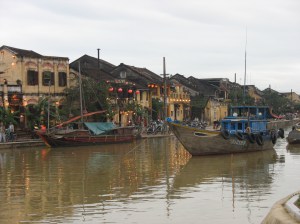
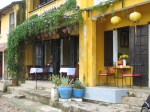
img_3287Hoi An, a town of about 76 000 people, is like a living museum and it’s Old Town area has been designated a UNESCO World Heritage site. After having showers and settling in, we set off to explore this fascinating place. There are over 200 tailoring shops in Hoi An. By this time, I had fallen in love with the traditional Vietnamese ao dai, a two piece silk outfit comprised of pants and long tunic, that is still in common use. When I discovered that I could have one made to measure in the fabric of my choice for $35 US, I couldn’t resist even though I’m not sure where I’ll wear it! Of course, we think of silk as a luxury item but in Vietnam, it’s commonplace. It’s nothing to see women dressed in silk sitting on the ground selling vegetables. It took the seamstress only a matter of minutes to take my measurements and I was told to come back the next afternoon for a fitting. What fun!
img_3304 img_3317 img_3380

After strolling the riverfront area and enjoying a delicious seafood dinner, we were caught up in an amazing street scene on the way back to our hotel. Vietnam had just won the Suzuki Cup, an Asian soccer championship, claiming victory over Thailand, the expected winner. Impromptu parades of flag waving, cheering people filled the intersection. We simply had to stand back and take it in as there was absolutely no way to cross the street and head back to our hotel. The police were visible but there was no sign of violence or vandalism, just a great overflowing of national pride and rejoicing. It was a privilege to be a part of it. As the crowd dispersed enough for us to move on, I returned to the hotel wearing a bright red “Vietnam Vo Dich” (Veitnam wins) ribbon around my neck. Many of the locals who saw it were delighted and called out to us as we passed. The ribbon, purchased from a child in the crowd for just a few cents, is as meaningful to me as any souvenir I’ve ever bought.

We spent much of the following day wandering the Old Town visiting a variety of attractions including a Chinese assembly hall, the Museum of History and Culture, a couple of handicraft workshops and a historic house that has been in the same family for seven generations. The family lives upstairs and opens the main floor to tourists most of the year. The house is located on the river’s edge. During the three month rainy season, the main floor floods and all the heavy wood furniture has to be moved upstairs!

Late in the afternoon, we returned to the Dung tailor shop (how’s that for a name?) for my fitting. The ao dai fit to perfection so I was able to take it with me.

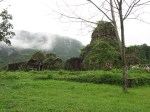
img_3354Early the following morning, we were picked up at the hotel for a tour of the Cham ruins at My Son, 35 km southwest of Hoi An. Another UNESCO World Heritage site, the ruins were a religious centre built and occupied between the 4th and 13th centuries. Though they pale in comparison to Angkor Wat, which we would see later in our trip, the ruins were fascinating and their location, nestled in a lush valley, gave us opportunity to see the dense jungle growth up close. Part way back to Hoi An, we transferred to a boat and finished the trip by river. Once back in town, we had a mid afternoon meal and picked up food for the next long bus trip to Saigon.
img_3326 img_3335 img_33491

Hoi An was once a major Vietnamese seaport but with the advent of larger ships that couldn’t enter the silt filled harbour, that role was taken over by Danang and the once thriving community faltered. In very recent years, tourism has been a boon to Hoi An and I suspect that it will contribute to future restoration and development. Hopefully, the town will continue to become the jewel that it could someday be without losing any of it’s charm or quaint character.

Halong Bay

We awoke very early Christmas morning to the sound of roosters crowing. This might not have been unusual had we not been in the middle of Hanoi, a city of approximately 3.5 million people but we were quickly learning not to be surprised by anything!

After eating breakfast at our hotel, we were picked up by a 14 passenger van for our trip to beautiful Halong Bay. The trip took longer than we expected but it gave us an opportunity to see more of the countryside as well as many small img_3116towns along the way. We also stopped at a very large souvenir shop that sold local pottery and a wide variety of other handicrafts. At one end of the building, a workshop had been set up where embroidery pictures were being handmade. This was a work project for disadvantaged people, many of them quite young.
img_3125We arrived at the busy Halong Bay tourist wharf and boarded our junk around noon. As this was our Christmas gift to each other, we had booked the deluxe tour. After a welcome drink, we settled into our small but comfortable cabin then made our way to the dining room for the first of the four fabulous meals that we’d be served aboard. Though the food was incredible, some of us jumped up several times to rush out on deck and take photographs of the amazing sights that surrounded us.

img_3130 img_3141 img_3147

img_3151 img_3201

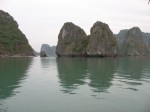
More than 3000 rocky islands rise from the waters of Halong Bay which is both a UNESCO world heritage site and one of Vietnam’s natural marvels. At about 3 o’clock, we docked at one of these unusually shaped limestone formations and climbed up well over 100 steps to the mouth of a massive and fascinating cave which is made up of three enormous caverns complete with stalagmites and stalactites. The cave has been well developed in recent years with lights and a pathway so that it can be safely enjoyed by the many tourists that pass through it. Apparently there are countless other caves throughout the bay area but entrance to most of them is forbidden in order to protect them from damage.

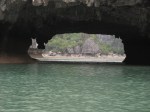
Sea kayaking was one of the options that was available to us when we booked our tour but Richard and I were the only passengers on board our junk who chose to take advantage of this. After exploring the cave, the other passengers boarded the junk again while we and our guide set off by kayak. We met up img_3159with them just outside a fabulous lagoon with just one entrance, a tunnel through the rock. As we kayaked through the tunnel, we sang Silent Night and listened to our voices echoing off the rock walls around us. We enjoyed a peaceful paddle around the lagoon while our fellow passengers boarded a small boat and came in for a quick look around then we all returned to the junk which was now anchored for the night. As the sun set over the bay, we relaxed on board until supper, another wonderful feast, was served by candlelight. The water was dead calm and the lights of several other junks reflected off it beautifully.

We shared the junk with fifteen other passengers, mainly French, including two families with children. Our Vietnamese guide, however, spoke fairly good English. He seemed to take quite a liking to us and as we visited that evening, he willingly shared his concerns about the corruption of the Vietnamese government and the plight of his people. We learned that in his youth he tried to escape Vietnam as one of the boat people but after reaching Hong Kong, was sent back and endured many years of regular interrogation by the police. He talked of how difficult it was to decide to bring children into such a world. He now has two, aged 8 and 10. What impressed us most was the fact that this young man constantly had a smile on his face and whistled and sang as he paddled his kayak. We saw this repeatedly throughout our trip; people who have so little and who truly don’t know what their future holds living for the moment and doing it joyfully.

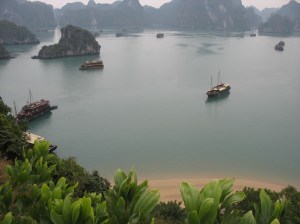
Following a good sleep and an early breakfast, we set off again by kayak rendezvousing with the junk and our fellow passengers at a sandy beach on one of the islands for a climb to the top where we were able to enjoy spectacular views of the bay. North Vietnam is a bit too chilly for swimming at this time of year but I did go wading before climbing back aboard the junk!

img_3171 img_3187_1

After an early lunch, we arrived back at the wharf, transferred to another van and headed back to Hanoi. That evening we attended a performance at the Water Puppetry Theatre. This unique art form originated in the rice paddies of North Vietnam more than 1000 years ago. The large wooden puppets are manipulated by puppeteers who are themselves standing in water but hidden from view behind a curtain. The performances are accompanied by music played on traditional instruments. After the performance, we stopped at a nearby KFC (the only North American fast food chain that we saw in Vietnam) for a snack then took a cyclo, a bicyle powered rickshaw, back to our hotel.