I really like the traditional Japanese floor covering known as tatami. There are three parts to each tatami mat; the tightly woven rush cover, a soft core that was traditionally made of rice straw but is often made of synthetic material today, and a decorative cloth edging that is most often a green brocade. Each mat is a standard size, approximately 90 x 180 cm. Except during a period of mourning, tatami mats are never laid in a simple grid pattern. Since it’s considered bad luck to allow three or more mat corners to meet, they’re always laid in interesting patterns.
Tatami provides at least as much cushioning as carpet, making it a comfortable floor to sit on and providing extra padding under the futon mats that we sleep on. I also exercise on the tatami every morning and find that it provides all the padding I need. Tatami is also thought to have a number of health benefits. Apparently, it absorbs both heat and humidity, a definite plus in this climate. The natural smell is said to relax the body and soothe the mind. This smell, which is really quite pleasant, is most noticeable when the tatami is new.
Tatami is amazingly easy to keep clean. It just needs to be vacuumed regularly and if anything does spill on it, it beads up and can be wiped away without leaving a mark.
Given all of the above, what’s not to like about tatami? My only complaint is that it harbours insects! Last spring, when my friend, Seiko, and I went shopping for the various products needed to prevent or do battle with moths, mold and cockroaches, she warned me about this problem and showed me what to buy if we found we needed it. If you start to notice insect bites that you can’t explain, she told me, they’re likely living in your tatami! We’ve managed to live through the rainy season and most of the hot, humid summer without encountering a cockroach but I did begin to notice itchy bites awhile back. We purchased the spray which comes in a can with a pin-like nozzle that is pushed down into the tatami mat to deliver the poison to the inner portion of the mat. We treated the entire tatami room and hoped for the best.
Shortly after our return from Korea, however, I began to notice new bites appearing. Once again, Richard gave the tatami room a thorough spraying. Imagine my disgust a little while later when I noticed that the centre mat was littered with dead and dying insects that had crawled out of the matting to escape the poison! I had heard these insects referred to as fleas or ticks so I had visualized tiny flea-like critters but these were winged insects about the size of a mosquito. Some were considerably bigger and they’d been biting me during the night! How gross! Richard vacuumed them up and decided to treat the centre of the room a second time just in case we hadn’t massacred the entire population yet. That was several days ago. This morning, he’s just finished treating the room once again and we intend to keep this up on a regular basis for a little while just in case there are more nasties hatching out below the surface.
While we’re on the topic of insects, there are plenty of unusual ones here in Japan. Some time back, I blogged about the tiny moths that had taken up residence in our bathroom. Once Richard figured out how to remove the panel in front of the bathtub and cleaned out the buildup of hair and slime under there, we were rid of those. The sink and tub both drain into that area and the moths must have been breeding in the dampness. (Have I mentioned how blessed I am to have a husband who does housework?)
We’ve also been entertained all summer by the loud high-pitched sound of the cicadas, gigantic locust-like insects that inhabit the trees all around us. Not all the insects here are as obnoxious, however. We also have butterflies that are literally the size of small birds! How beautiful!
 Reconstruction has been ongoing since 1990 but the structures that are standing today are impressive and palace guards in period costumes added to the atmosphere.
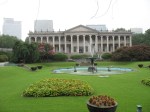 within the walls of a Korean palace. This huge stone structure with it’s European style rose garden and beautiful fountain looks quite startling surrounded by traditional Asian buildings.
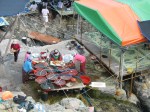
 also visited the Shinsaegae department store, the city’s oldest and definitely one of it’s finest. What a contrast! From the noisy, crowded market where much of the activity takes place in the street to the opulent department store where name brand items are tastefully displayed in spacious surroundings. Of course, the prices are just as different and so are the food venues – from street vendors selling both raw and ready to eat foods to an entire floor of classy restaurants.
 Our visit to Seoul also included a subway ride to Samneung Park to see some uniquely Korean royal burial mounds, a couple of hours at the National Folk Museum and a visit to Namsan Park, the upper portion of a small mountain in the centre of the city. We rode a cable car up into the park then ascended the Seoul Tower by elevator. From the observation floors, we enjoyed views of the enormous city spread out below us.


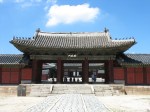 Our first full day in Seoul was especially memorable. After breakfast, we caught a bus to Changgyeong-gung, one of the three palace complexes that we visited. Though many of these historical buildings were destroyed by the Japanese at various times throughout history and have since been rebuilt, the throne hall at Changgyeong-gung escaped destruction and is said to be the oldest building of its kind in Korea. Much work has been done in recent years to restore the rest of the palace complex to its original state. The buildings were very similar in design to many that we have seen in Japan.
 Royal Ancestral Shrine where two long buildings house memorial tablets for many former kings, queens and other royal family members. Jongmyo is considered the most important shrine in Korea and one of its two main buildings is the longest traditional wooden building in the country. Once a year, in early May, a ritual Confucian ceremony is held here. During this six hour rite, special food and wine are offered to the spirits of each of the departed kings, ceremonial recitations are spoken and traditional musicians and dancers perform. A video presentation gave us a glimpse of that.
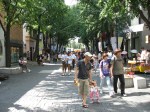 handmade lamp that we both fell in love with. We enjoyed lunch in a tiny, authentic Korean shop in Insa-dong. It was here that we first tried a popular Korean dish called bibimbap. Though we found much of the Korean food to be too hot for our liking, this dish was very tasty.
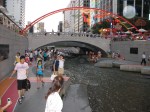 fountains, stepping stones and historical bridges it is clearly an asset to the city and drew many people on this hot summer afternoon! We decided to walk along it as it led in the general direction that we needed to go. What an amazing experience that turned out to be. At one point, we heard drumming
  in the distance and soon came across a colourful group of street artists
 performing traditional music. We sat and listened for awhile before continuing on to the end of the waterway where we discovered that the Korean Olympic committee had set up a huge TV screen, a stage where a live band was performing and even a huge electronic Olympic flame! As darkness fell, we joined the large crowd that had gathered there and watched the Korean women’s archery team win the gold medal! What a moment that was, complete with fireworks! The square rocked with loud music and cheering. It was a wonderful privilege to share that moment of national pride with the local people gathered there. Eventually, we moved on, stopping for a quick supper along the way. A little later, we once again heard music in the distance and were drawn to Seoul Plaza, an open grassy space in front of city hall. There we caught the finale of an open air symphony concert complete with vocalists and dancers!


 Following Augustine