Month: July 2008
Obligation gifts
The giving of gifts is a big part of Japanese culture. For example, whenever a person goes somewhere, even for a few days, it is expected that they will return with gifts for friends and coworkers. These gifts are usually sweets of some kind. Consequently, wherever you go, stores are filled with boxes of individually wrapped sweets sold specifically for this purpose. As teachers, we are often the recipients of these gifts when our adult students have been somewhere. As a result, we’ve had the opportunity to sample a wide variety of Japanese sweets!
Gifts are also a way of showing appreciation. For example, at church yesterday we were given two fresh mangoes by Mrs. Sunaga. This was her way of saying thank you for our prayers and concern on behalf of her husband who is in hospital recovering from a heart attack. We’ve also enjoyed a jar of her homemade jam given to us as a welcome gift shortly after we started attending the church.
At church yesterday, we learned about another aspect of gift giving. When our friend, Seiko, gave birth to her wee son, Ayumu, we bought a baby gift. Knowing that baby showers are not held in Japan, we took the gift to church and gave it to her husband, Atsuo. We noticed that many other people did the same thing. Yesterday, Atsuo and Seiko arrived at church with a huge box of gifts to give to all those who had given gifts to Ayumu! We were presented with a nicely wrapped tin box of very tasty sweets. The box itself is lovely and will be a treasured keepsake. More important to me, however, was the handwritten note that accompanied it thanking us for the gift as well as for our prayers and encouragement during Seiko’s pregnancy.
Since we don’t know any engaged couples, it isn’t likely that we’ll have the opportunity to attend a wedding while we’re in Japan but it’s my understanding that they are very costly affairs because the bride and groom are expected to give gifts to all their guests! They also receive gifts, usually money, but my impression is that the gifts that they give are often quite elaborate. Adult students have told me about giving not only food, but also dinnerware and other household items.
Summer festival
Several weeks ago I noticed that colourful posters had appeared on fences around our neighbourhood but, of course, they were in Japanese so I had no idea what they were advertising. They were all the same and the drawings included strings of lanterns and little characters in traditional dress who appeared to be dancing. I was able to determine that something was happening on July 26 and 27 and when I considered where the posters were located, I wondered if whatever they were advertising might be occurring at the nearby elementary school.
A little while after the posters appeared, we received a photocopied flier in our mailbox with the same drawings on it. I took it to one of the ladies meetings at the church and asked my friend, Yoko, to translate it for me. She told me that there would be a summer festival in our neighbourhood this weekend and confirmed that it would be happening on the school grounds. The flier included a coupon for a free gift and also promised the first 300 people a free insect, a popular pet amongst Japanese children! It also explained that anyone who wanted an insect would be required to bring an appropriate container to take it home in. The flier also included the information that traditional dancers were needed for the festival and gave a deadline for registering. We immediately decided that the event was something we’d want to check out when the time came and marked it on the calendar.
As I walked home from work early yesterday evening, it was clear that the festival was underway. I could hear the music and when I looked down the street that leads to the school, I could see brightly lit lanterns strung above the entrance to the school ground. We decided to head over there before making supper to see what was going on.
It was definitely a happening place. Crowds of people were milling around, many dressed in yukata (summer kimono). The grounds were brightly lit by strings of lanterns and a stage had been set up in the centre. On the stage and in a circle in front of it, dancers moved to the rhythmic music and the throb of the drums which were located both on a platform high above the stage and on the ground in front of it. Groups of dancers in matching costumes clearly knew the precise steps of the dances while young children joined those on the ground and did their best to imitate them.
Around the perimeter of the school ground, booths had been set up to sell various snacks as well as glow in the dark toys to appeal to the children. We enjoyed some tasty pork pieces grilled on wooden skewers. The people who sold them to us were clearly delighted by the presence of Eigo (English) customers and called out “good bye” and “good night” as we moved on.
After we returned from church this afternoon, we decided to head down to the school ground again to see it in daylight. Though the recorded music was playing, the drumming and dancing hadn’t started yet. There were lots of people, however, and we milled around amongst them enjoying a few more snacks. It was oppressively hot and humid and we weren’t surprised when thunder began to roll and lightning flashed. Suddenly the skies opened! Rain began to pour down and everyone ran for shelter. Our first summer storm in Japan! We took cover with many other people near the entrance to the school and waited for the rain to subside a bit before heading for home. Though we only had a few blocks to go, the skies opened again and we were drenched to the skin before we arrived!
Fortunately, the storm blew on by and awhile ago I could hear the drums throbbing in the distance so the festival was clearly underway again. I’m glad as people had obviously gone to a lot of work to set it up and it would have been such a disappointment if the weather had shut it down early.
Just in case you’re wondering… no, we didn’t come home with an insect. We did turn in our coupon though and our prize was a package of garbage bags!
The earth moved again!
There’s been a lot of earthquake activity this week. In fact, we’ve felt the ground move beneath us three times since Saturday!
At about 11:40 a.m. on Saturday, I was in teaching a playgroup when the building began to sway. The children, amongst our youngest students, were in the midst of an action song and didn’t notice anything amiss but the parents who attend class with them were clearly aware of what was going on. I later learned that an earthquake with a magnitude of 7.0 had occurred off the east coast of the island of Honshu about 300 km northeast of Tokyo.
On Monday evening, I was at home and Richard was still at school when things began to rock again. It was another earthquake off the east coast, this time about 270 km northeast of Tokyo. It had a magnitude of 6.0.
Shortly after midnight last night, as we were falling asleep, we felt some fairly significant movement. We wondered if we ought to get out of bed and open the apartment door as we’ve been told that this is a precaution that we should take in the case of a serious quake. Apparently, when a building shifts due to an earthquake it’s sometimes impossible to open the doors and escape afterward. Last night’s shaking didn’t last long enough for us to feel that that was necessary, however, but we did learn this morning that a quake with a magnitude of 6.8 had hit causing numerous injuries and some damage to buildings in and around the city of Hachinohe which is located near the north end of Honshu. Again, the epicenter was beneath the ocean floor off the coast. I’m not sure why this one felt so much bumpier to us as it was actually further away than the other two but it certainly was enough to cause us to sit up and take notice.
Umi No Hi
Today is a national holiday in Japan. Known as Ocean’s Day or Day of the Sea, the holiday was established in 1995 and first celebrated in 1996 because, until that time, there were no public holidays between May and August and the government felt that workers needed a break. Because Japan is an island nation, it was decided that this would be a day of gratitude for the blessings of the sea and a day to hope for the continued prosperity of the country. It always falls on the third Monday of July.
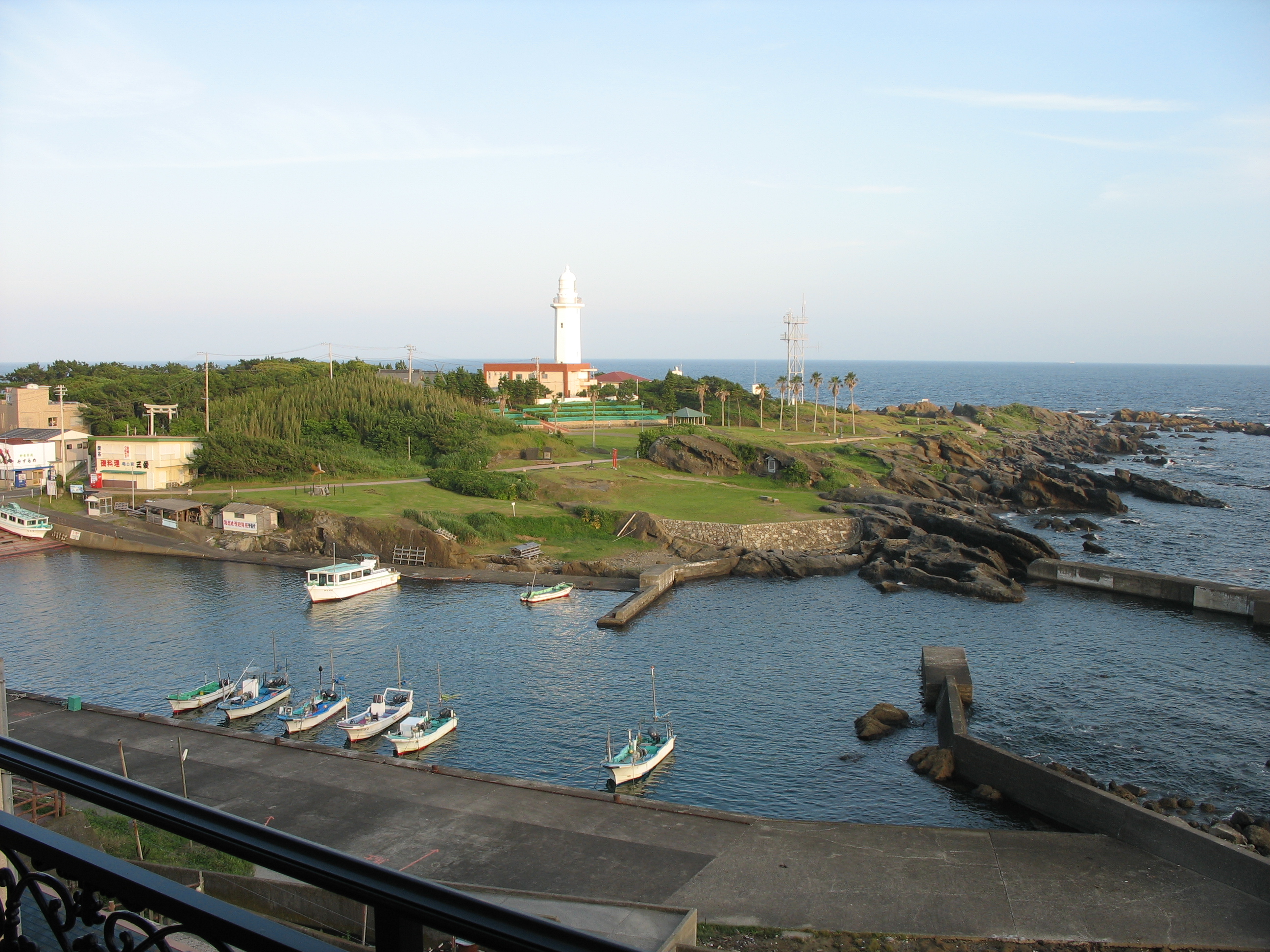
Though many have already taken advantage of the beaches by this time, today is also the day that they officially open for the summer season and many people will spend the day at the beach. Unfortunately, though I would love to be one of them, our schools are open today and I’ll be in the classroom instead. For me, it will have to be a day of remembering the beauty of the ocean and reminiscing about my recent coastal experience at Nojimazaki.
Fuji-san follow up
I can’t believe that I blogged about climbing Mt. Fuji and forgot to include the Japanese proverb that says he who climbs Mt. Fuji once is a wise man but he who climbs it twice is a fool! Fuji has been considered a sacred mountain since ancient times and women were actually forbidden to climb it until the Meiji Era, hence the proverb’s somewhat chauvinistic wording.
Two days after the fact, we’re looking back on the experience with a deep sense of satisfaction but we both agree that we wouldn’t be foolish enough to tackle the mountain a second time! We’re also quite proud of the fact that, though we’re still feeling the effects of the climb and a night without sleep, our bodies are recovering remarkably well. I really expected to be much stiffer!
In answer to tokyo5’s question about walking sticks, we decided not to purchase them and I’m actually glad that we didn’t as I much preferred having my hands free for the rocky part of the climb. The octagonal wooden sticks sell for about 1200 yen at the 5th station gift shops. They come adorned with bells and Japanese flags. Most climbers remove the flags to keep them from becoming torn and dirty and the bells because they’re annoying. I do have one of the bells because I found it on the trail on our way down.
At each station along the ascending trail, climbers can pay an additional 200 or 300 yen to have a brand burned into their stick marking their progress toward the top. They make a nice souvenir but we didn’t want to deal with the difficulty of figuring out how to transport them back to Canada. Instead, Richard bought a souvenir T-shirt and I bought a leather and metal keychain/luggage tag to hang on my backpack. Both have pictures of the mountain as well as it’s name and height. There’s space on the back of my tag to put my name and telephone number but I’m also going to record the date of our climb on it.
We climbed Mt. Fuji!
Our schools were closed yesterday and Richard took a yukyu (personal leave day) on Wednesday, which was already my regular day off. That gave us another two day break together which we used to climb Japan’s highest and most famous mountain. Most of the pictures that you see of Mt. Fuji are taken during the winter when it’s covered with snow and truly majestic looking. During the official climbing season, which lasts from July 1 to August 31, there are only small patches of snow. Even so, it’s a challenging climb.
From base to summit, the mountain is divided into 10 stations. These days all but the most die hard climbers start their ascent at one of the four 5th stations which can be reached by road. We arrived at the Kawaguchiko 5th station on the north side of Fuji by bus from Tokyo early Wednesday evening. Traditionally, Fuji is climbed at night. The climber’s goal is to reach the summit at dawn both to see the sunrise from the top and because the views are best early in the morning when the mountain is less likely to be shrouded in clouds. Climbing a mountain in the dark may seem a very strange thing to do but for me, it was perfect. Because all I could see was the part of the mountain that was illuminated by my flashlight, my fear of heights didn’t kick in and dampen my enthusiasm. Had I been able to look down and see what was below me, I’m not sure I could have done it! Instead, I was able to enjoy the stars overhead and when the full moon peaked over the edge of the mountain, I was thrilled.
Mt. Fuji rises 3776 meters (12 388 feet) above sea level. Kawaguchiko 5th station is located just below the tree line at an elevation of 2305 meters. From there, the climb seemed to be made up of three sections. The first was much like a steep but wide gravel driveway switchbacking up the hillside. Next came the serious climbing looking for the best footholds as we made our way up the rock. The route was very clearly marked. In fact, most of the way, it was chained off on both sides so that it would have been very difficult to stray too far in the wrong direction. The last part of the climb was mostly a loose gravel pathway again switchbacking back and forth. Lots of slipping back made upward progress slow.
Timing is important because you don’t want to reach the mountaintop much before sunrise as it’s usually very cold and windy. Even at this time of year, the temperature hovers around the freezing point at night. As on any mountain, the weather can be very changeable so it’s important to be well prepared. Though we had rain capes with us, we were fortunate not to need them. We took plenty of layers of clothing though and were happy to have them when we reached the top. The latter half of the climb was done in a pretty stiff wind. It didn’t bother us too much while we were climbing but we got chilly very quickly when we stopped to rest. The mountain is also high enough for altitude sickness to be a problem. We knew that cans of oxygen were available at the various huts scattered up the mountainside so we didn’t take any with us. Though we did see several people sucking back on oxygen, we decided that the best way to combat the effects of altitude was probably to give ourselves lots of time and to rest often along the way. That seemed to work well. We definitely noticed the shortness of breath as our elevation increased and at one point near the top, I had to stop for a few minutes when I noticed that my heart was racing.
We actually left the 5th station and began our climb earlier than we had originally planned. My research told me that there are several restaurants at the 5th station so we had planned on having a good supper before beginning our ascent. Unfortunately, when we arrived, we discovered that the restaurants were all closed! We were carrying food but didn’t want to break into it just yet so we set off right away and climbed to the first hut where we were able to purchase noodles, chocolate bars and pop. Perhaps not the most nutritious supper but we rationalized that the sugar would give us the energy we needed for climbing!
The climb was definitely more strenuous than we had anticipated after reading in our Lonely Planet guidebook that children and grandparents regularly reach the summit. We would probably have found it considerably easier 25 or 30 years ago! It was fortunate that we started climbing earlier than we had originally planned as Richard’s right hip began to hurt early in the climb and he had to take it pretty slow. With dogged determination, he just kept on going though. He wore his knee brace, of course, and his bad knee didn’t bother him at all. I must admit that about three quarters of the way into the climb, I could feel myself wearing out and I did begin to wonder if we’d make it but on we went.
When you’ve gone without hours of sleep and expended a great deal more energy than usual, your mind starts doing strange things. About 2 o’clock in the morning, as I stopped to wait for Richard as he plodded up the path behind me, I began to wonder what would happen if he had a heart attack on the mountainside! It was shortly after that that my own heart started racing so I guess it wasn’t him I should have been worrying about!
Climbing midweek early in the season, the mountain wasn’t overly crowded but we were never alone. Many languages and nationalities were represented amongst the climbers and regardless of whether or not we could understand one another, a sense of camaraderie quickly developed as we passed and greeted one another along the way. We did much of the climb with Blue who is stationed in Okinawa with the American military. We met him on the bus from Tokyo.
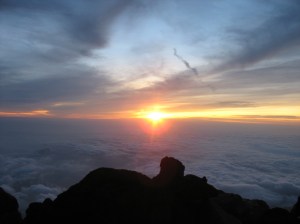
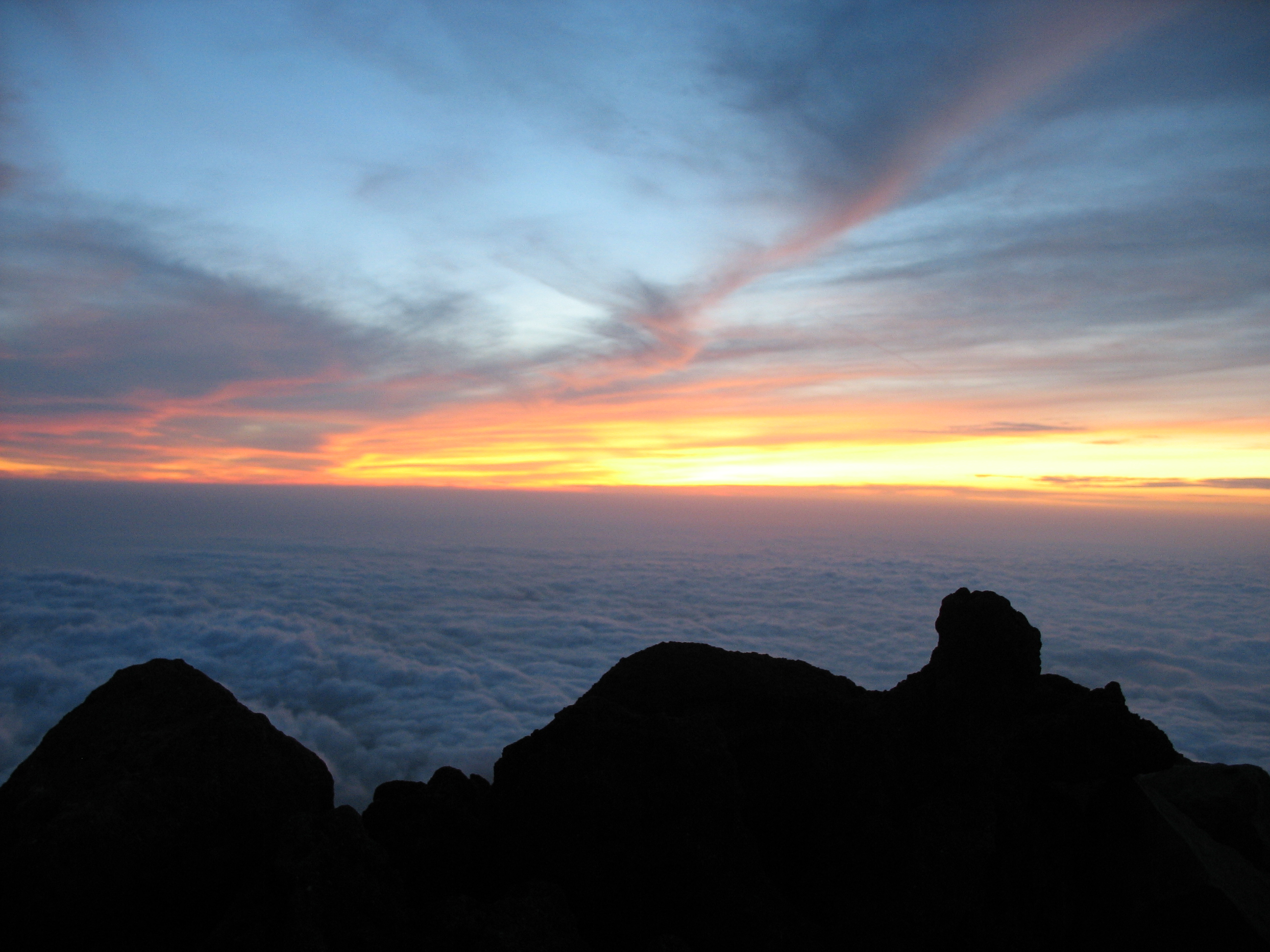
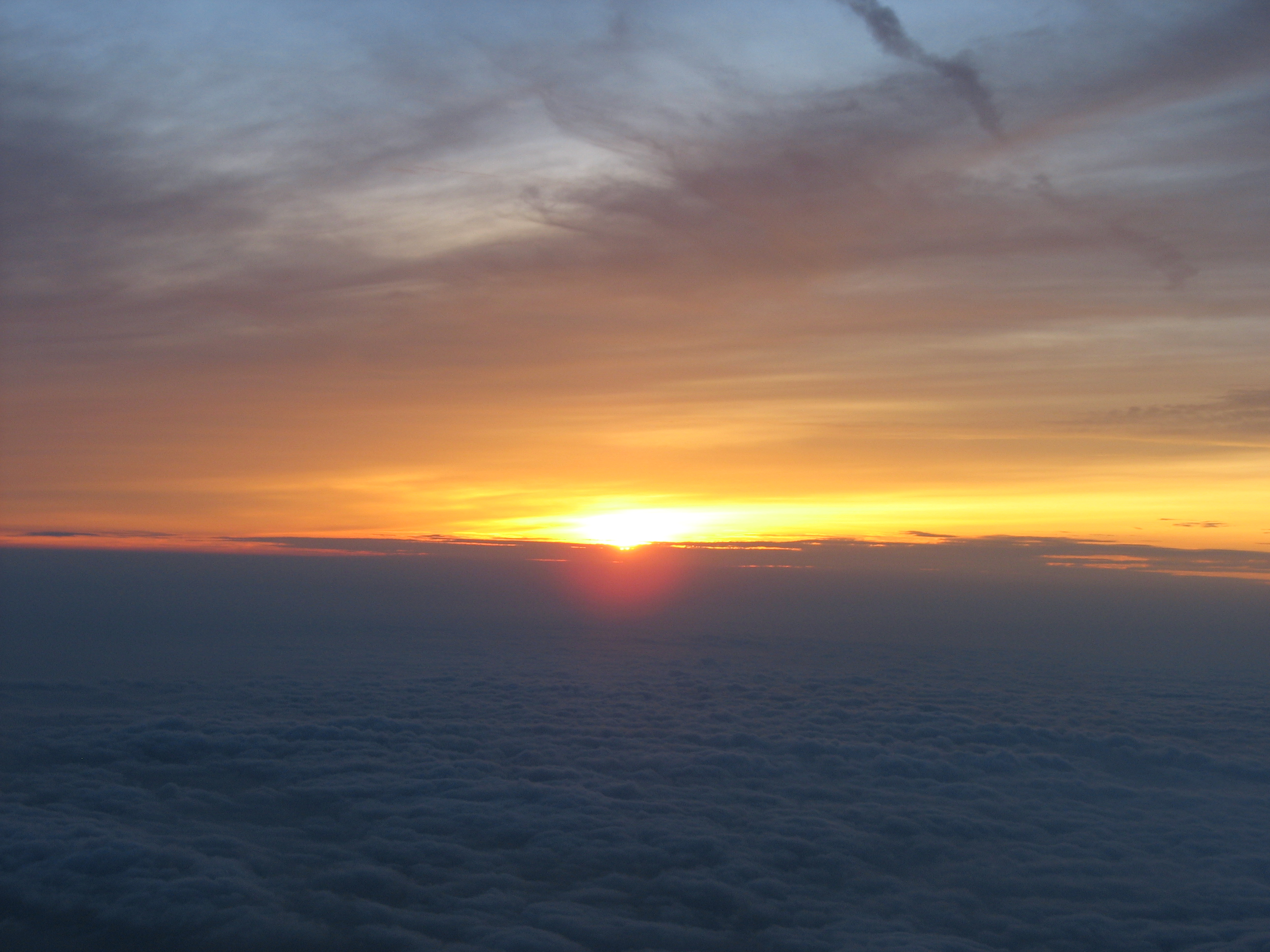
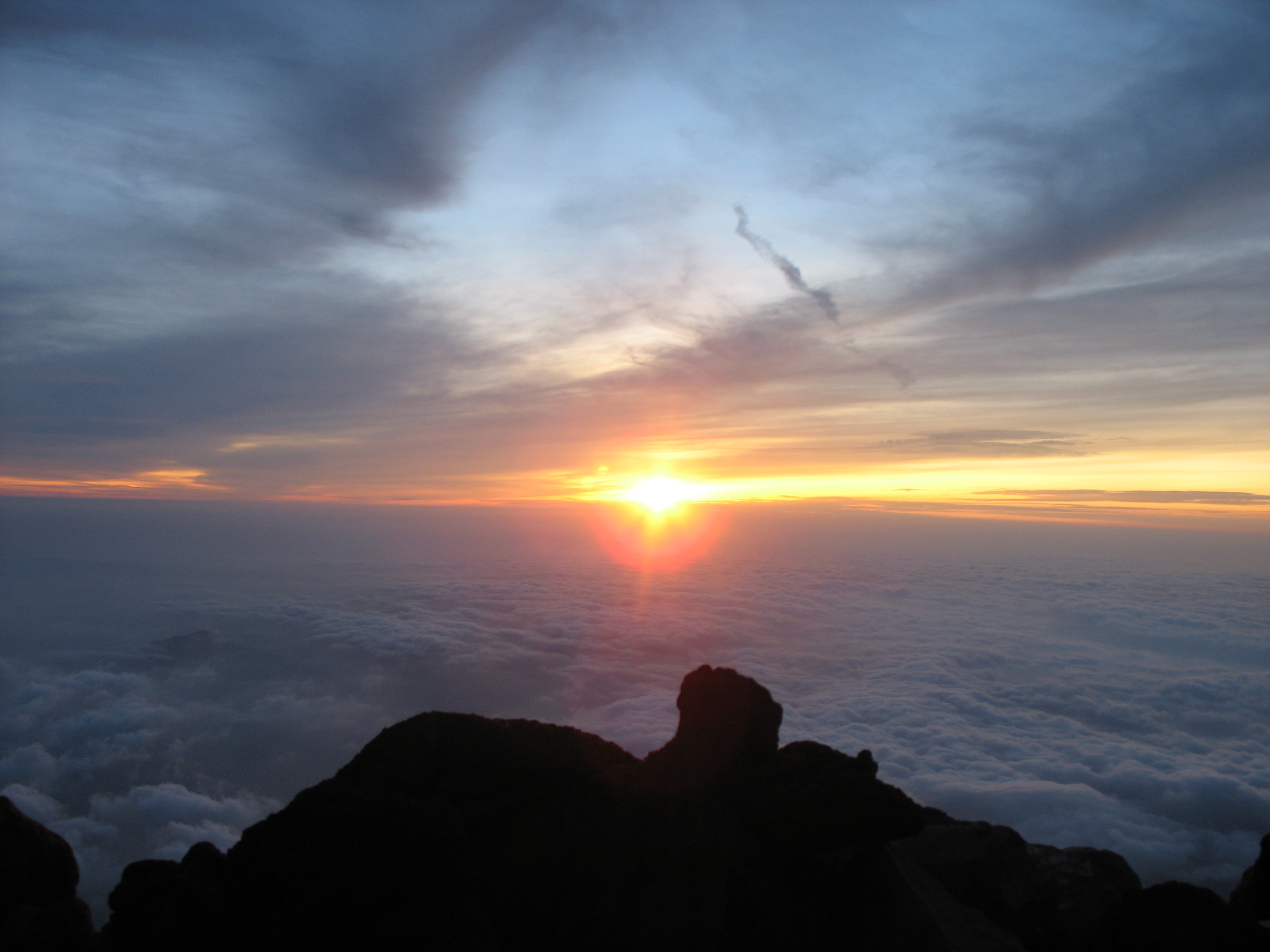
We reached the edge of the mountaintop crater just a while before the sky began to lighten and watched the lights of those on the path below us snaking toward the top. Sitting with so many others who had just made the same trek and watching the sun rise above the clouds far below us was absolutely amazing! As soon as the sun was fully up, someone came out of one of the huts and made a loud announcement, in Japanese, of course. I’m assuming that he was greeting the sun. I only recognized subarashi (wonderful, beautiful) and Ohayo gozaimasu (Good morning) which became a cheer rising from all of us, Japanese and non Japanese alike. It is a beautiful memory that will stay with me for a long time.
The actual summit or highest point of the mountain was located on the far side of the crater. Reaching it would have involved another hour of hiking before beginning our descent. We knew that our bodies didn’t have that in them, so like most others, we chose not to take that final step. It was only a few meters higher than the spot where we were standing and we had seen what we came to see.
When you’ve climbed to the top of a mountain, you’ve made a very serious commitment. Regardless of how tired and sore you are, you have to climb down again! For most of the way, there is a separate trail for descending Fuji. While it looks much easier, I’m not sure that it is. For me, the first challenge was overcoming my fear of heights. For most of the way, we descended on a wide gravel pathway. In my head, I knew that there was no way that I could fall off the mountainside from such a trail but the fear riding on my shoulder didn’t listen to reason and for the first while I was unable to enjoy the splendor laid out before us as the morning cloud cover burned off. After awhile though, I was able to shake it off and enjoy the sight. The descending trail was made up of a loose red gravel that reminded me of popcorn. It was very slippery and steep enough that keeping your footing and not landing on your behind was at times difficult. We found descending hard on the knees and I also began to experience cramping in my thigh muscles. It was also very dusty. Our eyes were pretty sore last night both from the lack of sleep and the grime. In spite of these difficulties, the descent still took less than half the time that the climb had taken.
When we got home, we cleaned up and walked over to our local hospital just a few blocks away. Fortunately, our visit had nothing to do with the climb nor was either one of us sick or injured. Before leaving Canada, we decided to have the immunizations that are recommended before traveling to some of the Asian countries that we hope to visit while we’re on this side of the globe. In Canada, the hepatitis A and B vaccine is given in three doses. We were able to have the first two before leaving the country but the third is given several months later so we planned to have it here. We’ve learned, however, that Japan only gives two doses. The doctor here decided to check our blood for the antibodies then decide whether or not we need more of the vaccine so we went to the hospital yesterday for the blood tests.
After supper at a nearby restaurant that we’ve been wanting to try, we fell into bed earlier than usual last night and both enjoyed a long, deep sleep. In spite of somewhat stiff and achy leg muscles and joints, we’re upright and walking fairly normally today and are definitely enjoying the fact that we’ve accomplished yet another long term goal!
We survived parents’ week!
The past week has been a tiring one because our children’s classes had parents’ day. Since each class meets only once a week, this went on for the entire week.
Parents’ week stress actually started several weeks ago because we were required to hand in parents’ day lesson plans to our school administrators ahead of time for their approval. The due date for these plans was originally set for June 27th but at our weekly staff meeting during the second week of June, we were told that this date had been bumped up to the 18th and we had no choice but to scramble and get them done in a rush. The reason that we were given for the sudden change was that this would give administration time to help those new teachers whose plans weren’t adequate. As I expressed at staff meeting, suddenly giving me six days to complete a job that I thought I had fifteen days to do wasn’t likely to be helpful at all!
In addition to the stress of having to hand in our plans early, we were also expected to spend plenty of time in recent weeks prepping the kids for parents’ day instead of moving forward with our teaching but at the same time, we have a certain amount of work that has to be completed by the end of term! Is it any wonder that we get frustrated with our employer? On the other hand, I keep reminding myself that MIL is my ticket to being here in Japan. This is definitely where I wanted to be and that hasn’t changed so I try to remain as positive as possible.
I feel that most of my parents’ day classes went well, though it was usually very difficult to judge the parents’ reactions as they sat very quietly and showed very little reaction to anything that happened. I did have one class today where the parents responded with laughter and obvious appreciation. Perhaps that’s because it was Saturday and there were fathers in attendance. They seemed more relaxed than the moms and it didn’t hurt that the kids in that class are very young and very cute.
On the other hand, one of my littlest and cutest students is Mahiro. I call him my little boyfriend because every Monday he meets me in the reception room at Katsutadai school, takes me by the hand and leads me upstairs to our classroom. He’s absolutely adorable. There are only two children in that particular class. The second child is Hana, a little girl who is just as sweet, but she didn’t show up for parents’ day. Poor little Mahiro was on his own with an audience made up of his mother, grandmother and older sister. Though he left his shyness with me behind many weeks ago, that was too much for him and he never said a word out loud the entire class! He did everything I asked of him but would only whisper!
There are CDs that go along with each of our children’s textbooks. Often the kids are asked to listen to the CD and repeat what is said. In one of my classes this week, the CD stuck. I didn’t even know a CD could do that but it just kept repeating “their…their…their” over and over again! The kids dissolved in fits of giggles, the tension in the classroom was broken and things went smoothly from then on! There are also silly songs on the CDs that use familiar tunes to reinforce the vocabulary that we’re teaching. After practicing for weeks on end, I know, without a doubt, that some New Year’s Eve, I’m going to hear Auld Lang Syne and what will be going through my head is “Whose keys are these? Whose keys are these? Whose keys are these? They’re mine!”
Anyway, we’re glad it’s over and are happy that parents’ week happens only once a year. As we sip our wine and relax this evening, we look forward to tomorrow. Sunday, our favourite day of the week!
Lights down, awareness up
With climate control and carbon dioxide emissions as one of the major topics on the agenda for the annual G8 summit meetings which are taking place in northern Japan this week, the Education, Science and Technology Ministry has been calling on Japanese households to join in a new “Tanabata Light Down” event this evening. The message has been spread primarily through primary, middle and high schools throughout the nation. For this country to achieve the emission reduction targets set out under the Kyoto Protocol, household emissions, which have been rising dramatically, have to be cut. Some estimates suggest that if every home in the country turned off their lights for two hours, greenhouse gas emissions could be reduced by 15 000 tons, equivalent to the amount of emissions from one million households in a 24 hour period.
The idea is not an entirely new one. In 2003 the Environment Ministry began calling on people to turn off their lights for two hours from 8 p.m. to 10 p.m. on the summer solstice each year. As the Japanese people are very aware of and concerned about the issues of climate control and emissions reduction, many have already been taking part in that event. This year the decision was made to introduce the July 7 event as well to coincide with the G8 summit.
With the exception of the bathroom lights, we have fluorescent lighting throughout the apartment. The kitchen is lit by an overhead light fixture as well as one over the sink. The other two rooms have overhead fixtures that each have three settings. On the brightest setting, two circular tubes are lit. On the lower setting only one of them is lit and on the lowest, a tiny night light bulb provides just enough light to prevent one from stumbling in the dark. It’s now just a few minutes past 8 p.m. and as I look out the windows, I still see plenty of light coming from homes around the neighbourhood and I’m not one to get overly excited about this issue but I’m going to do my part by keeping the lights on the lower setting and using only the light over the sink to cook by this evening. Trying to cook in complete darkness would be foolhardy. If I can figure out a way to light the candles that we were given as promotional gifts by a shoe store where Richard bought a pair of sneakers, perhaps we’ll also eat by candlelight tonight. We don’t have any matches though so that could be tricky!
Tanabata
July 7 is Tanabata in Japan, a day for making wishes and hanging them on bamboo trees.
Tanabata is based on a legend that goes something like this. A long time ago, Ten-kou, the god of the sky had a daughter called Orihime who spent her time weaving cloth for the gods. Ten-kou was worried because his daughter did nothing but work every day so he introduced her to Hikoboshi Kengyu, who spent all his time taking care of cows. When they met, they fell in love and soon spent all their time together. As a result, all the cows became sick and when the gods’ clothing wore out, there was no new cloth to make more. This made Ten-kou very angry so he took Orihime away to the other side of the river Amanogawa (the Milky Way) and wouldn’t allow the lovers to meet anymore. This made them so sad that they were unable to work. Eventually, Ten-kou felt so sorry for them that he decided to allow them to meet once a year on July 7 as long as they worked hard the rest of the year. Traditionally people hoped that the sky would be clear on that day so that the lovers could meet over the Milky Way. If it rained, the water level of the river Amanogawa would rise and they would be unable to cross. Originally people made this wish by writing it on a piece of paper and hanging it on a bamboo tree. Nowadays, people write their own wishes instead. Though adults sometimes participate, these days it is largely an activity for children.
When the Tanabata tradition came up for discussion in some of Richard’s adult classes this week, he was told that this weekend there would be a Tanabata festival on the street where our closest MIL school is located but we didn’t know when or where. We worked yesterday and went to church today. As usual, we stayed for lunch and visited for quite awhile after church then did a bit of shopping before heading for home. We didn’t really consider trying to take in the street festival because we thought it was likely a midday activity and that we had probably missed it. Since we’d had a big lunch after church and it was such a warm day, we decided to forgo cooking dinner at home, pick up a few goodies at the bakery and go to the park for a picnic supper. Before we headed out, I felt prompted to take the camera with us. At first, I ignored the thought but as we were leaving, I once again felt that I was being told to take it. I’ve learned to listen to these promptings and so it went into the bag.
After picking up our dinner at the bakery, we headed for the park but as we got close, we could see bright lights and crowds of people a little further up the street. We decided to investigate and soon found ourselves in the middle of the Tanabata street festival! For several blocks, booths were set up along the sidewalk. Games of chance and booths selling all sorts of ready to eat foods were the main attractions. The sidewalk was a slow moving river of humanity. Many of the young girls were decked out in yukata (summer kimono) and everyone was in a festive mood. We quickly decided that our bakery goods would last until tomorrow and filled up on okinomiyaki, which might best be described as a Japanese omelet, and takoyaki, balls of batter covered octopus.
One of the side streets was blocked off and in the intersection, a musical group featuring a young female singer with a beautiful voice was entertaining the crowd. Though her pronunciation was somewhat difficult to understand, she was singing English songs. When she started into the Tennessee Waltz, we couldn’t resist the urge. Spotting an open space behind the group, we slipped into it, dropped our bags and enjoyed a dance before sliding back into the crowd and continuing on our way!